Table of Contents >> Show >> Hide
- Start Here: What’s SaggingThe Cushion or the Couch?
- Fast Fixes First: Cheap, Easy, and Shockingly Effective
- Add Couch Cushion Support from Below: The “Make It Feel New” Moves
- Fix the Cushion Itself: Rebuild, Reinforce, or Replace the Foam Insert
- If the Cushions Are Fine: Repair Springs, Webbing, or the Support Deck
- Supplies & Tools Checklist (Pick What Matches Your Fix)
- Common Mistakes (So You Don’t Fix It… and Then Un-Fix It)
- Keep It Comfy: How to Prevent Couch Sagging
- When to Stop DIY and Call a Pro
- Real-World Experiences: What People Usually Learn After Fixing a Sagging Couch (500+ Words)
- Conclusion
A sagging couch is basically a slow-motion betrayal. One day it’s “movie night,” the next day you’re sitting in a trench like you’re reenacting a historical battle called
The War of the Worn-Out Foam.
The good news: most saggy sofa situations can be fixed without buying a whole new couch (or learning to love floor-sitting). The trick is diagnosing what’s actually failing
the cushions, the support underneath, or the frame/springsthen using the right fix for that specific problem.
Start Here: What’s SaggingThe Cushion or the Couch?
Before you buy anything, do one simple test. Pull the seat cushions off and place them on a flat surface (the floor works). If they look lopsided or “pancaked” on their own,
the cushions are the issue. If the cushions look fine on the floor but the couch still dips when you put them back, your support system underneath is the likely culprit.
Quick diagnosis checklist
- One seat is worse than the others: Usually a single cushion insert or a stretched spring in your favorite spot.
- All seats sag evenly: Often a worn support base (webbing, springs) or a platform that’s lost tension.
- You feel a bar, ridge, or frame edge: Support layer may be failing, springs may be loose, or foam is too thin/soft.
- Cushions slide forward: Not always “sagging,” but it can make the couch feel unsupported.
Fast Fixes First: Cheap, Easy, and Shockingly Effective
If you’re trying to add couch cushion support quicklylike “people are coming over in two hours” quicklystart with these. They won’t solve every couch problem, but they can
dramatically improve comfort and shape while you decide whether a bigger repair is worth it.
1) Flip, rotate, and re-fluff (the free fix)
Rotating cushions spreads wear around so one side doesn’t do all the emotional labor. If your cushions are reversible, flip them. If they aren’t reversible, rotate left to right
so the “favorite seat” gets a break.
For cushions filled with fibers (common in back cushions), pull the fill apart with your hands and redistribute it to the corners and top. Think of it like detangling hair
gentle, patient, and slightly judgmental about how it got this way.
2) Add filling to back cushions (especially if they look deflated)
Back cushions often sag because polyester fiberfill compacts over time. If your couch has zippered back cushions, you can add more fiberfill to restore loft. Don’t underfill:
you want it full enough to hold shape without turning into a rock.
Pro tip: add fill in small batches, then “karate chop” the top edge (yes, really) to help the cushion sit upright and look crisp.
3) Stop cushions from sliding (so you stop re-sitting every 12 minutes)
Sliding cushions make a couch feel saggy even when it isn’t. A simple non-slip layer under the cushion (rug pad, shelf liner, or a cut-to-size grippy mat) increases friction and
helps keep everything in place.
Add Couch Cushion Support from Below: The “Make It Feel New” Moves
If your cushion foam is still okay but you’re sinking because the base underneath has weakened, supporting the cushions from below can be the fastest path to a firmer seat.
This is also the best category for “I need results today.”
Option A: The plywood (or hardboard) support panel
This is the classic fix: place a panel under the cushions so the weight is distributed evenly instead of dropping into a sagging center. Measure the seating area, cut plywood to fit
(no overhang), and set it directly on the couch frame under the cushions.
How to make plywood feel better: If you’re worried it’ll feel too firm, add a thin layer of felt, old blanket, or a low-profile foam sheet between the plywood and
the cushion. This keeps the support but reduces the “plank” vibe.
Option B: Cushion support boards (foldable or rigid inserts)
If you don’t want to cut wood, you can use a purpose-made cushion support insert designed to sit under couch cushions. They’re typically sized for sofas/loveseats and meant to
level the seat. The upside is convenience; the downside is they may not fit unusual couch dimensions as perfectly as a custom-cut panel.
Option C: A dense foam “base layer” under the cushion
Another approach is placing a high-density foam sheet beneath the seat cushions (on the couch deck). This can add comfort while still providing support, especially if the couch base
has softened but you don’t want a hard panel.
If you go this route, choose foam meant for seating support (not squishy packaging foam). A thin, firm layer can be surprisingly effective.
Fix the Cushion Itself: Rebuild, Reinforce, or Replace the Foam Insert
If the cushion fails the “flat surface test,” the best long-term fix is usually inside the cushion cover. Most seat cushions are foam-based (sometimes wrapped in batting), and foam
is not immortal. It’s more like a banana: good for a while, then suddenly… not.
Foam 101: Density vs. firmness (the thing that confuses almost everyone)
Density (often shown as pounds per cubic foot) is about durability and longevityhow well foam holds up over time. Firmness (often measured as ILD/IFD)
is how hard or soft it feels when you sit on it. You can absolutely have high-density foam that feels soft, and low-density foam that feels firm. They’re related, but not the same.
How to pick a replacement foam insert for seat cushions
- For everyday couches: Look for higher-density upholstery foam designed for seating support. It will resist bottoming out and keep its shape longer.
- For guest room/occasional seating: You can use a lower-density option if cost matters more than lifespan.
- For people who want a softer “sink-in” feel: Use a supportive core plus a softer top layer (more on layering below).
- For heavier use or heavier bodies: Consider a firmer feel and thicker foam (within what your cushion cover can fit) to prevent bottoming out.
Measure like you mean it
Your cushion cover is basically a tailored suit for foam. If your foam is too big, it won’t fit. Too small, and it’ll look sloppy. Measure:
- Width and depth of the cushion cover interior (not just the outside).
- Thickness of the existing foam (and note if it’s badly compressed).
- Corner shape (some cushions are square, some have rounded edges, some have a slight wedge).
Wrap it like a burrito: batting (Dacron/polyester wrap) matters
Many high-quality cushions aren’t just foamthey’re foam wrapped in a layer of polyester batting (often called Dacron wrap). This wrap:
- Softens edges so the cushion feels less “blocky.”
- Helps the cushion fill out the cover so it looks plumper and more finished.
- Reduces friction, making it easier to slide the foam into the cover.
If your cushion feels firm but looks wrinkly or underfilled, adding a wrap can be the difference between “still sad” and “wow, this is actually nice.”
Layering foam for comfort (support underneath, softness on top)
If you want a supportive couch that doesn’t feel like an airport bench, consider foam layering:
- Base layer: Supportive, higher-density foam that does the heavy lifting.
- Comfort layer: A thinner, softer foam on top for pressure relief.
- Wrap: Batting/Dacron around the whole insert for a smooth finish.
Layering lets you customize the feel without sacrificing structure. It’s the furniture version of wearing supportive shoes… with a nice insole.
If the Cushions Are Fine: Repair Springs, Webbing, or the Support Deck
Sometimes the cushion is innocent. The real villain is underneath: loose serpentine springs, stretched webbing, or a sagging platform that’s lost tension over time.
If your couch dips even with good cushions, this is where to look.
Serpentine (zig-zag) springs: what to check
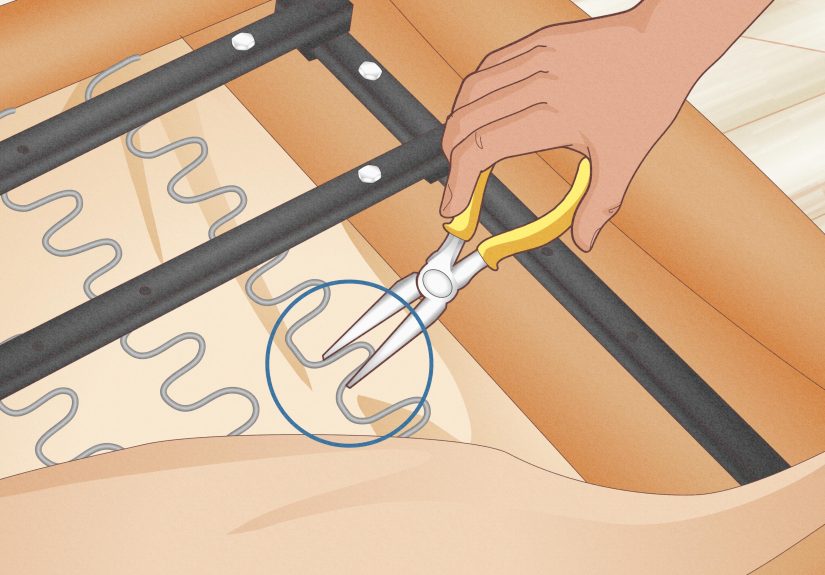
Many couches use serpentine (also called zig-zag) springs that run front-to-back inside the frame. Common issues include:
- Springs popping loose from clips attached to the frame.
- Stretched springs that have lost their “springiness.”
- Broken springs or broken attachments at the frame.
If you’re comfortable turning the couch over and removing the dust cover fabric (usually stapled on), you can inspect whether springs are detached or visibly damaged.
Reattaching or replacing springs can restore support, but it’s a bigger job than adding a plywood panelso it’s worth weighing time and cost.
Webbing (elastic or jute straps) that’s stretched out
Some couches use webbing straps instead of (or alongside) springs. Over time, webbing can stretch and create a hammock effect. Re-webbing can bring a couch back to life, but it
requires tools (often a staple gun) and careful tensioning.
If your couch is otherwise solid and you want the best long-term repair, new webbing plus refreshed cushions can feel like a full upgrade.
Don’t ignore loose screws and wobbly joints
Sometimes “sagging” is partly a frame issue: loosened fasteners, weakened corner blocks, or joints that shift under weight. Tightening hardware can reduce wobble and improve
how the couch supports you. If the wood is cracked or split, you may need reinforcementor a professional repair.
Supplies & Tools Checklist (Pick What Matches Your Fix)
- For quick support: non-slip pad, rug pad, shelf liner, cushion support insert, or plywood/hardboard.
- For cushion rebuild: replacement upholstery foam, batting/Dacron wrap, spray adhesive (optional), scissors or a serrated knife for clean cuts.
- For under-couch repairs: staple remover, staple gun, screwdriver/drill, pliers, replacement webbing or springs (as needed), work gloves, safety glasses.
Common Mistakes (So You Don’t Fix It… and Then Un-Fix It)
- Buying foam that’s too soft: It feels great for 10 minutes, then you bottom out and start blaming gravity.
- Ignoring the base problem: New foam won’t save a couch with detached springs or a collapsed support deck.
- Skipping cushion rotation: Even great cushions wear unevenly when one seat gets all the attention.
- Overstuffing back cushions: Yes, you want supportbut you still want the zipper to close without a wrestling match.
- Using bare plywood with no padding: It can work, but a thin buffer layer often improves comfort dramatically.
Keep It Comfy: How to Prevent Couch Sagging
Once you’ve added couch cushion support and fixed sagging, keep your hard work from disappearing with a little maintenance:
- Rotate and flip seat cushions monthly (or at least seasonally).
- Fluff back cushions weekly if they’re fiber-filled.
- Switch seats sometimes (yes, your couch has a “favorite spot,” and it’s getting tired).
- Vacuum crumbs and grit from seamsgrit speeds up fabric wear and makes cushions shift.
- Address small issues early (loose clips, sliding cushions) before they become big sagging problems.
When to Stop DIY and Call a Pro
DIY is greatuntil the couch frame is cracked, the springs are mangled, or the repair requires specialized tools you’ll use exactly once and then store forever “just in case.”
Consider professional upholstery or furniture repair if:
- The frame is broken or cracked.
- Multiple springs are detached/broken and the couch is valuable or sentimental.
- You want a full rebuild (new webbing, springs, foam) for long-term use.
Real-World Experiences: What People Usually Learn After Fixing a Sagging Couch (500+ Words)
If you’ve never tried to fix sagging sofa cushions before, you’re probably imagining a simple, heroic moment: you slide something underneath, angels sing, and your couch becomes a
cloud throne again. Real life is still very fixablebut it’s a little more “trial and error” and a little less “instant movie montage.”
One of the most common first experiences is discovering that sagging doesn’t always mean “bad couch.” It often means “one worn-out layer.” People pull the cushions off, set them
on the floor, and realize the cushions look finethen they sit back down and still sink. That’s the moment you learn the support deck underneath matters just as much as the cushion.
A simple support panel (like a cut-to-fit board) can feel almost unfairly effective, because it changes the physics of the seat immediately.
Another frequent lesson: plywood can be both a miracle and a menace. If you put a hard board directly under the cushions, you may love the renewed supportbut you may
also think, “Why does my couch suddenly feel like a stage platform?” That’s why so many DIYers end up adding a thin buffer layer (felt, a folded blanket, or a slim foam sheet)
between the board and the cushion. The support stays, but the comfort comes back. It’s the difference between “firm and supportive” and “did I accidentally sit on a cutting board?”
Foam replacement is another experience that surprises peoplemostly because of expectations. A lot of folks assume foam is foam. Then they replace a seat cushion with something too
soft (because it felt nice in the store or online listing), and two weeks later they’re right back in the sag. The “aha” moment is learning that durability is tied to foam density,
while feel is tied to firmness. Once people choose a more durable foam core and then soften it with batting or a comfort layer, the couch starts feeling “expensive” again
instead of “temporary.”
There’s also the surprisingly emotional part: the couch has history. People fix sagging cushions because they like the sofa’s size, style, or memorieseven if it’s a little outdated or
has a mysterious stain that may or may not be from salsa. Repairs become less about perfection and more about getting that “this feels like home” comfort back.
Practical lessons show up fast, too. Measuring is everything. Many first-timers learn the hard way that cushion covers are not forgiving. If your replacement foam is even slightly too big,
it fights you like it’s trying to avoid responsibility. If it’s too small, the cover looks baggy and the cushion shifts. People who get the best results usually measure carefully, cut cleanly,
and add wrap so the cushion fills the cover smoothly.
Finally, there’s a very common experience that feels almost funny in hindsight: after you fix the sag, you suddenly notice other “little couch problems” you ignored for yearslike cushions
sliding, squeaky frame joints, or uneven wear. The upside is that once you’ve already started tinkering, those smaller upgrades feel easy. Add a non-slip layer to stop sliding. Tighten a screw.
Rotate cushions monthly. Small habits help the repair last, so you’re not repeating this whole saga next season.
In other words: fixing sagging couch cushions isn’t just one repairit’s a set of small, smart improvements that add up. And once you sit down on a couch that finally supports you again,
you’ll wonder why you waited so long (right before you fall asleep during your show because you’re finally comfortable).
Conclusion
To add couch cushion support and fix sagging, start by identifying whether the problem is the cushion insert or the couch base underneath. If it’s the cushion, replacing or reinforcing
the foam (plus batting wrap) is usually the most durable solution. If it’s the base, a support panel or cushion insert can give immediate results, while spring/webbing repairs offer the
strongest long-term fix. Pick the repair level that matches your couch’s value, your budget, and your willingness to turn furniture upside down like you’re solving a mystery.