Table of Contents >> Show >> Hide
- What Is a Cyanotype Comic?
- Why Cyanotype Was the Right Medium for a Story About My Dad
- A Brief History of Cyanotype Art
- How I Planned the Comic
- The Cyanotype Process: From Sketch to Sunlight
- Turning Family Memory Into Sequential Art
- Why Handmade Comics Feel Different
- Specific Pages That Changed the Project
- What I Learned About My Dad While Making It
- Tips for Making Your Own Cyanotype Comic
- Experience Section: Making a Cyanotype Comic About My Dad
- Conclusion
I made a cyanotype comic about my dad because regular ink felt too obedient. Black lines on white paper can tell a story, sure, but my father was never a black-and-white person. He was a man of half-finished jokes, sun-faded work shirts, garage-radio wisdom, and advice that arrived three days late but somehow still worked. So when I started thinking about making a handmade comic about him, I wanted a process that could hold memory the way memory actually behaves: blurry at the edges, bright in the middle, and impossible to rush.
That is how I ended up with cyanotype: a deep-blue photographic printing process that uses light, chemistry, water, and patience. It is sometimes called the blueprint process, which felt almost too perfect. A comic about a father is, in many ways, a blueprint. Not the kind that tells you exactly how to build a lifebecause dads are famous for assembling emotional furniture without reading the manualbut the kind that leaves marks, measurements, shadows, and clues.
This article is part art-process essay, part family memoir, and part practical guide for anyone curious about cyanotype comics, handmade graphic storytelling, and turning personal history into something you can hold in your hands without immediately crying into the paper. Although, to be fair, cyanotype paper can handle water. Feelings are another matter.
What Is a Cyanotype Comic?
A cyanotype comic combines sequential art with the cyanotype printing process. Instead of simply drawing panels, scanning them, and printing them digitally, the artist prepares light-sensitive paper, places drawings, negatives, objects, or text over it, exposes the composition to sunlight or ultraviolet light, and then rinses the paper in water. The exposed areas turn that unmistakable Prussian blue, while blocked areas remain pale or white.
In traditional comics, timing comes from panels, gutters, speech balloons, page turns, and pacing. In cyanotype art, timing also comes from exposure. Too little light and the image whispers. Too much and the shadows disappear. That tension made the medium ideal for a family memoir comic because memory works the same way. Some moments are underexposed. Some are burned into you. Some need to be washed before they reveal what they really are.
For my project, I treated each page as both a comic page and a photographic print. The comic used simple hand-drawn line art, handwritten captions, old family objects, and photo negatives. I wanted the final pages to feel like they had been discovered in a shoebox under a bed, right next to a broken tape measure, a receipt from 1997, and a mysterious cable nobody in the family is allowed to throw away.
Why Cyanotype Was the Right Medium for a Story About My Dad
My dad was practical, not sentimentalat least not in public. He showed affection by tightening loose screws, checking tire pressure, cutting fruit badly but confidently, and asking if I had enough gas in the car. A glossy digital comic would have looked too smooth for him. He was not smooth. He was textured. He was a man who could fix a sink while muttering at it like the sink owed him money.
Cyanotype has that same hands-on honesty. It is physical. It stains your fingers if you are careless. It depends on the weather. It makes you wait. It asks you to work with what the light gives you, not what you demanded from it. That felt like the emotional language of my father: quiet, stubborn, useful, and blue in a way that was not sad exactly, but deep.
The color mattered too. Blue can feel like distance, grief, loyalty, work clothes, old denim, evening light, and the sky over a driveway where your dad is teaching you something you are too young to appreciate. In a cyanotype comic about my dad, the blue was not decoration. It was atmosphere. It turned every page into a small weather system.
A Brief History of Cyanotype Art
Cyanotype has a long history in photography, science, architecture, and contemporary art. The process was invented in the 1840s by Sir John Herschel, a scientist whose experiments with iron salts led to the rich blue image-forming chemistry associated with cyanotypes. Unlike many early photographic methods, cyanotype did not require silver. It relied on iron-based compounds and light, which made it comparatively accessible, durable, and visually distinctive.
One of the most famous early users was Anna Atkins, a botanist who created cyanotype images of algae by placing specimens directly onto sensitized paper and exposing them to light. Her book, Photographs of British Algae: Cyanotype Impressions, is widely recognized as a landmark in photographic publishing. Atkins used the process not only to document nature, but also to make compositions that still look startlingly modern. Science did the paperwork; art slipped in through the side door wearing a beautiful blue coat.
Cyanotype later became associated with blueprints because engineers and architects used related processes to copy technical drawings. That connection gave my project another layer of meaning. My dad built, repaired, measured, guessed, remeasured, and occasionally declared something “good enough” with the confidence of a Roman engineer. Making a cyanotype comic about him felt like creating an emotional blueprint: not a perfect record, but a plan of influence.
How I Planned the Comic
Before touching the chemistry, I wrote a list of scenes. I did not begin with a grand thesis like “What fatherhood means in modern America.” That sounded exhausting, and my dad would have asked if it came with a warranty. Instead, I began with objects and moments: his coffee mug, the garage light, the way he held a pencil behind his ear, his habit of falling asleep during movies he had personally chosen, his hands carrying grocery bags in one heroic trip because two trips were apparently a moral failure.
From that list, I built a loose narrative arc. The comic would not tell my dad’s entire life. A life is too large for one handmade comic, and frankly, I did not have enough coated paper. Instead, I focused on the relationship between ordinary care and memory. The story moved through small scenes: childhood observation, teenage embarrassment, adult understanding, and the quiet realization that love often arrives disguised as maintenance.
The Structure
I divided the comic into short sections. Each section had three to six panels. Some pages used traditional comic layouts with borders and captions. Others were more open, with objects casting shadows across the page. For example, one page showed a drawn version of my dad fixing a bicycle chain. Across the panel, I placed an actual wrench during exposure so its silhouette became part of the image. The result looked like a tool had wandered into the memory and decided to stay.
The Visual Language
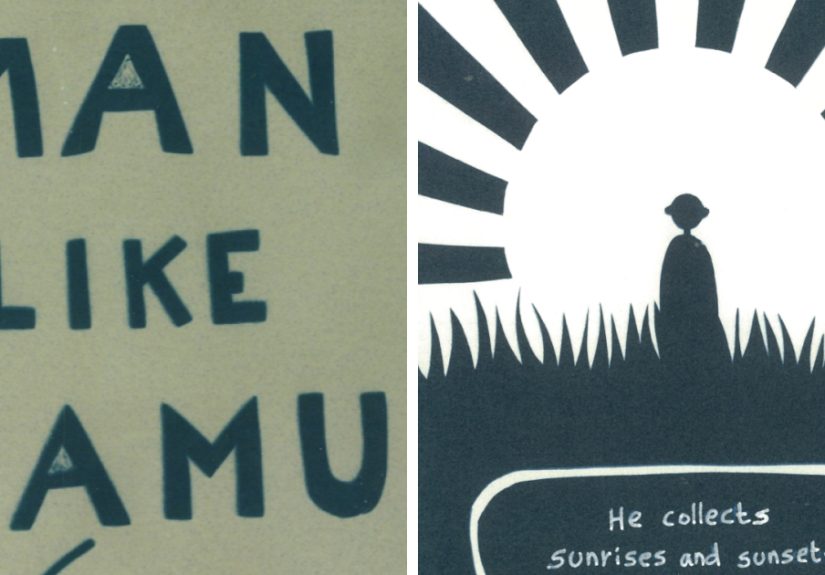
I kept the drawings simple. Cyanotype can handle delicate detail, but the process rewards strong shapes and clear contrast. Thin lines may fade if the negative is weak or the exposure is off. I used bold silhouettes, handwritten captions, and repeated motifs: hands, tools, sunlight, doors, and rectangles that echoed windows, panels, and old photographs.
The comic did not need superhero anatomy, dramatic speed lines, or a villain monologue. The central conflict was subtler: how do you tell someone you finally understand their love after years of pretending not to notice it?
The Cyanotype Process: From Sketch to Sunlight
Creating the cyanotype comic required several steps. First, I drew the panels in black ink on transparent film and prepared some digital negatives from old family photos. Then I coated watercolor paper with cyanotype solution in dim light and let it dry in a dark place. Once the paper was ready, I arranged the negatives, drawings, and objects on top under a sheet of glass.
Exposure time depended on sunlight. On a bright day, a page could expose in several minutes. On a cloudy day, the process became a philosophical exercise in patience and weather-related bargaining. After exposure, I rinsed the paper in water until the yellow-green chemicals washed away and the blue deepened. Watching the image appear felt like developing a memory in real time.
Every page had surprises. A caption came out softer than expected. A leaf shadow looked like smoke. A panel border shifted slightly because the wind had nudged the glass. At first, I treated these as mistakes. Later, I realized they were part of the comic’s personality. A family story should not look machine-perfect. Families are registration errors with snacks.
Turning Family Memory Into Sequential Art
The hardest part was not the chemistry. It was deciding what to include. When making a family memoir comic, especially one about a parent, every detail feels loaded. A lunchbox is not just a lunchbox. It is economics, routine, care, fatigue, and peanut butter. A garage is not just a garage. It is a cathedral of extension cords.
Comics helped me manage that emotional clutter because panels force selection. Each panel asks, “What matters in this moment?” A close-up of my dad’s hand on a steering wheel said more than a full portrait. A speech balloon containing only “Hold the flashlight steady” instantly summoned an entire childhood apprenticeship in being blamed for shadows.
Graphic storytelling is powerful because it lets words and images share the emotional labor. A caption can admit what the drawing avoids. A drawing can reveal what the narrator does not yet understand. In one page, I wrote, “He never said he was worried.” The drawing showed him standing in the doorway at midnight, waiting for the porch light to catch my car. The image did not need a speech balloon. Silence was the dialogue.
Why Handmade Comics Feel Different
A handmade comic carries evidence of time. You can see the brush marks, the exposure variations, the paper texture, the places where the artist hesitated. In a cyanotype comic, the sun becomes a collaborator. So does water. So does chance. The finished work feels less like a file and more like an artifact.
That mattered for a story about my dad because he belonged to the world of physical things. He trusted objects more than abstractions. A hammer made sense. A cloud backup did not. If I had told him I was making a “multimedia autobiographical graphic narrative,” he would have nodded slowly and asked whether it paid. If I told him I was making pictures with sunlight and water, he would have inspected the paper, asked about drying time, and probably recommended a better place to put the table.
There is also intimacy in limitation. Cyanotype does not give you every color. It gives you blue, white, and whatever subtle tonal magic you can coax from them. That restriction made the storytelling stronger. I stopped worrying about realistic skin tones, furniture colors, or whether the family car was technically beige or “old sandwich.” The limited palette focused attention on gesture, rhythm, and feeling.
Specific Pages That Changed the Project
The Flashlight Page
One of the first pages I printed showed me as a child holding a flashlight while my dad repaired something under the kitchen sink. The joke was simple: I was doing a terrible job, and he was pretending this was a professional worksite. In the final cyanotype print, the flashlight beam became an almost white diagonal across the blue page. It looked theatrical, like a spotlight in a tiny domestic drama. That accident taught me that the comic could be funny and tender at the same time.
The Hands Page
Another page used traced outlines of my father’s hands from an old photograph. I layered them with drawings of tools, receipts, and a handwritten grocery list. When printed, the hands looked ghostly but strong. They were not sentimental hands. They were working hands. The page became one of the emotional anchors of the comic because it showed how much of my dad’s love was manual: lifting, fixing, carrying, opening jars, and pointing at the thermostat like it had betrayed the family.
The Empty Chair Page
The quietest page showed an empty chair at the kitchen table. No dramatic caption. No heavy symbolism wearing a neon sign. Just the chair, the table edge, and a coffee ring made by placing an actual mug on the paper during exposure. The circle appeared pale against the blue, like a small moon. It said more than I could have written.
What I Learned About My Dad While Making It
I started the project thinking I was making art about my dad. By the end, I realized I was also making art about how I had learned to see him. As a child, I noticed rules. As a teenager, I noticed limits. As an adult, I noticed labor. That shift changed the comic. The pages became less about explaining him and more about listening to the evidence he left behind.
One surprising lesson was that humor protected the tenderness. Every time a page became too solemn, I added a small human detail: the crooked shelf, the bad pun, the way he called every video game “Nintendo,” the heroic confidence with which he mispronounced new restaurant names. Those details made the love believable. Real affection is rarely polished. It usually has sawdust on it.
Tips for Making Your Own Cyanotype Comic
If you want to make a cyanotype comic, start small. A one-page comic is enough. Choose one memory, one object, or one relationship. Strong concepts beat complicated layouts. Use bold black drawings or high-contrast digital negatives. Test your exposure times before committing your favorite page to the sun. Most importantly, embrace imperfection. Cyanotype is not a printer you can scold. It is a conversation with light.
Think about materials as storytelling tools. A key, a leaf, a piece of lace, a handwritten note, or a tool can become part of the page. Objects cast shadows differently than drawings, which gives the comic a layered, tactile quality. For family stories, this can be especially powerful because objects often carry emotional charge. Your grandfather’s ruler, your mother’s recipe card, your dad’s socket wrenchthese are not props. They are witnesses.
Also, protect your finished prints. Handle them by the edges, keep them clean and dry, and avoid unnecessary adhesives or rough storage. Handmade art deserves care, especially when it contains family memory and several hours of squinting at the sun like a confused sunflower.
Experience Section: Making a Cyanotype Comic About My Dad
Making a cyanotype comic about my dad became a stranger, slower, and more emotional experience than I expected. I thought I was beginning an art project. I was actually beginning a negotiation with memory. The first day, I spread drawings across the table and tried to organize them into a clean storyline. Childhood here. Teenage years there. Adult reflection at the end. Very tidy. Very professional. Completely false.
Memory did not cooperate. The scenes that mattered were not the big ones. They were tiny. My dad standing in the driveway with one hand on his hip. My dad pretending not to watch when I backed the car out for the first time. My dad saving screws in jars because “you never know,” which is both a practical philosophy and possibly the family motto. These small details kept pushing their way into the comic until I stopped resisting.
The cyanotype process made me physically slow down. I had to coat the paper, wait for it to dry, arrange the negative, check the sun, expose the page, rinse it, and wait again. There was no instant undo button. That changed the way I thought about the story. Instead of rushing toward a finished product, I spent time with each page. I noticed whether a drawing felt honest. I noticed when a caption sounded too clever. I noticed when I was hiding behind jokes because the real sentence underneath was harder to say.
One afternoon, I printed a page about my dad teaching me to ride a bike. The first exposure failed. The lines were too faint, and the wheel looked like a sad potato. I almost threw it away. Then I realized the failed print captured the memory better than the clean drawing did. Learning to ride a bike was not crisp. It was panic, wobbling, scraped knees, and my dad jogging behind me with the doomed optimism of a man who believed balance could be shouted into existence.
Another time, I used one of his old shop pencils as an object on the page. When I lifted the glass after exposure, the pencil had left a pale shape across the panel like a missing tool. It hit me harder than expected. The absence was the point. Cyanotype is very good at showing what was there by preserving the space it blocked. That became the emotional logic of the whole comic. A father shapes your life not only through what he says, but through the outline he leaves.
By the final pages, I stopped trying to make the comic perfect. I let the brush marks show. I let the edges stay uneven. I let some panels remain quiet. The finished cyanotype comic looked handmade because it was handmade, and it felt honest because it did not pretend grief, gratitude, humor, and love could be separated into neat boxes. My dad would probably have said, “That’s a lot of blue.” He would have been right. It was a lot of blue. It was also a lot of him.
Conclusion
Making a cyanotype comic about my dad taught me that some stories need more than words and drawings. They need light. They need water. They need time. Cyanotype gave me a way to build a handmade comic that felt like memory itself: imperfect, emotional, physical, and beautifully unpredictable. The process connected the history of early photography with the intimacy of family storytelling, turning ordinary objects into visual evidence of love.
A cyanotype comic is not the fastest way to make a graphic memoir, but speed was never the point. The point was to create pages that felt touched by the same forces that shape family memory: exposure, shadow, accident, repetition, and care. In the end, the comic became less of a portrait and more of a conversation. Not everything was said out loud. Some things appeared slowly in the rinse water, turning blue.