Table of Contents >> Show >> Hide
- The Moment That Started It All
- From Hurtful Words to Helpful Action
- Why the Story Resonated With So Many People
- The Difference Between Charity and Respect
- What This Story Teaches About Teenagers, Shame, and Second Chances
- How Neighbors Can Help Without Overstepping
- Why Home Pride Matters at Any Age
- The Viral Power of One Good Decision
- Experiences Related to This Story: What We Can Learn From Everyday Neighborly Kindness
- Conclusion
Sometimes a neighborhood changes because of a city plan, a new business, or one of those road-construction projects that appears overnight and then somehow lasts until the next presidential administration. But sometimes, a neighborhood changes because one person hears something unkind and decides not to let it be the final word.
That is what happened in Pendleton, Oregon, when a railroad worker named Josh Cyganik overheard teenagers mocking the home of 75-year-old Leonard Bullock. The comments were casual, cruel, and aimed at a house that had clearly seen better days. Leonard was sitting nearby on his porch, close enough to hear the insult. Josh saw the look on the older man’s face, and instead of shrugging it off as “kids being kids,” he let the moment bother him in the best possible way.
What followed was not a lecture, a social media rant, or a dramatic confrontation. Josh did something far more useful: he gathered people, secured supplies, asked permission, and helped turn Leonard’s worn-down house into a home that made him proud again. The story became a viral example of community kindness, but its real power is quieter than that. It shows how respect, when acted on, can become paint, porch furniture, food, friendship, and dignity.
The Moment That Started It All
Josh Cyganik worked as a track inspector for Union Pacific Railroad. For years, his daily routine took him past Leonard Bullock’s house. Like many familiar neighborhood relationships, theirs began without much conversation. Josh would wave. Leonard would sit on his porch. The two men were not close friends at first, but they were part of each other’s everyday scenerythe kind of ordinary connection that quietly builds a community.
Then one day, Josh overheard two teenagers making fun of Leonard’s house. According to public reports, the teens mocked the condition of the home and suggested it should be burned or torn down. The words were not just about peeling paint or an old exterior. They landed on a person. Leonard was there. He heard them. Josh noticed him lower his head, and that small movement said plenty.
Anyone who has ever been embarrassed in public knows the feeling. The ears get hot. The heart sinks. You suddenly wish you could become wallpaper, which is inconvenient when the wallpaper is also probably overdue for replacement. For an older homeowner, especially someone who spends much of the day on the porch, a house is more than curb appeal. It is memory, safety, independence, and identity nailed together under a roof.
Josh later said he stewed over the comments for a couple of days. That detail matters. Many good deeds begin as irritation. He was bothered not only by the insult, but by the lack of respect behind it. Instead of letting that irritation turn into bitterness, he turned it into a plan.
From Hurtful Words to Helpful Action
The easiest reaction would have been to complain about rude teenagers. The more effective reaction was to help Leonard. Josh contacted a friend connected to a local lumber and paint store and asked whether materials could be donated. Once the supplies were lined up, he approached Leonard and asked if he would be comfortable with volunteers painting his house.
That step is worth noticing. Josh did not assume he had the right to “fix” someone else’s home just because he had good intentions. He asked. Kindness without consent can quickly become a bulldozer wearing a smiley-face sticker. Leonard welcomed the help, and the project began to grow.
Josh expected a small crew. He posted on Facebook asking friends and family to lend a hand. The post spread quickly, and what started as a modest paint job became a community event. Volunteers showed up ready to scrape, prime, paint, carry supplies, and do the sort of work that looks charming in a before-and-after photo but feels very real when your arm starts wondering why you are still holding a roller.
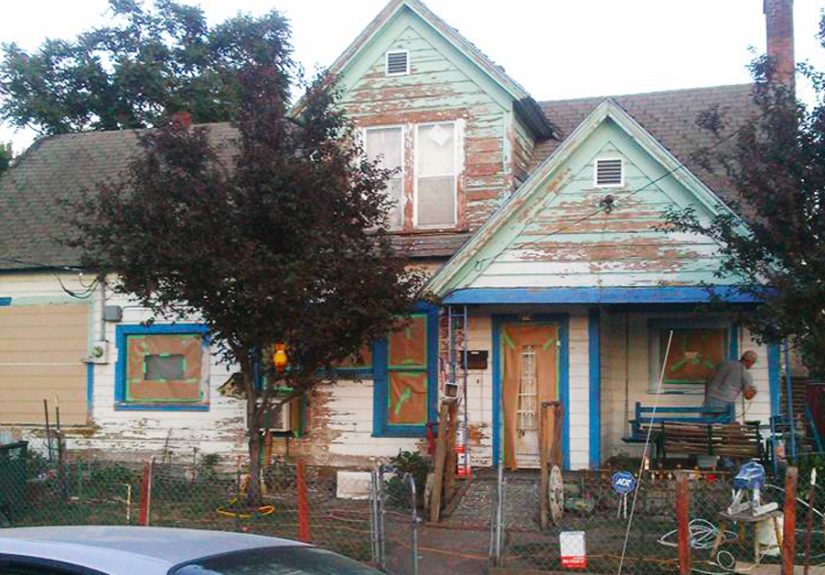
By the end of the day, more than 100 people had stopped by to help. Some painted. Some brought food and drinks. Others donated supplies. The house received a fresh coat of paint, the porch was improved, and outdoor furniture was added so Leonard could continue enjoying his favorite spot with more comfort and pride.
Why the Story Resonated With So Many People
The story spread because it was heartwarming, but it also touched a nerve. Many Americans know an older neighbor whose home needs attention. They may notice the loose railing, the faded paint, the overgrown yard, or the porch steps that look like they are negotiating with gravity. What they may not see is the complicated reality behind those repairs.
Older adults often want to stay in their homes as long as possible. Aging in place is not just a housing preference; it is tied to independence, routine, memories, and community. Yet maintaining a home can become difficult as physical ability, income, transportation, and social support change. A project that looks simple to one personpaint the siding, repair the porch, replace a light fixturecan feel overwhelming to someone living on a fixed income or dealing with health limitations.
That is why organizations such as Habitat for Humanity, Rebuilding Together, AARP-supported local initiatives, HUD home modification programs, and community volunteer groups focus on helping older adults remain safely in their homes. Minor repairs can make a major difference. Better lighting, safer steps, grab bars, repaired flooring, fresh paint, and accessible entrances are not glamorous upgrades, but they can protect health, confidence, and dignity.
In Leonard’s case, the makeover was highly visible. A fresh exterior changed the way the house looked from the street. But the deeper repair was emotional. The same house that had been mocked became the reason strangers gathered to show respect.
The Difference Between Charity and Respect
One of the strongest lessons from Josh Cyganik’s response is that he did not frame the project as pity. He framed it as respect. Leonard was not a prop in a feel-good story. He was a neighbor who deserved to sit on his porch without humiliation.
That distinction matters. Charity can sometimes create distance: one person gives, the other receives, and everyone poses awkwardly with oversized scissors or a ceremonial paintbrush. Respect creates connection. It says, “You matter here. Your comfort matters. Your home matters. We see you as part of us.”
Respect also changes how communities respond to need. Instead of asking, “Why has that house gotten so run down?” it asks, “What would make life easier for the person living there?” Instead of turning a neighbor’s struggle into gossip, it turns attention into action.
Small Actions Can Carry Big Meaning
Josh did not build a new house. He did not launch a national nonprofit overnight. He did not write a 37-page strategic kindness framework with laminated tabs, though someone in a committee somewhere probably would. He simply noticed a hurtful moment and looked for a practical way to answer it.
That is why the story feels possible. Most people cannot solve every housing problem in America. But many people can check on a neighbor after a storm, carry groceries, help with a yard, connect someone to a local repair program, or organize a few friends for a Saturday project. The scale does not have to be massive to be meaningful.
What This Story Teaches About Teenagers, Shame, and Second Chances
The title of the story naturally focuses on the teenagers because their comments triggered the action. But the lesson should not be reduced to “teens are terrible.” Teenagers, like adults, sometimes say careless things to impress friends, test boundaries, or make themselves feel bigger by making someone else feel smaller. The real issue is not age. It is empathy.
One important takeaway is that public mockery can cause private pain. A joke tossed into the air may land heavily on someone who is already carrying stress. For an older adult, embarrassment about home repairs can be especially painful because it may touch on finances, health, grief, or the fear of losing independence.
There is also a hopeful angle. The community’s response gave everyone, including younger people watching the story spread, a better model. It showed that when you see something wrong, you can do more than criticize it. You can repair, include, and encourage. If the teens ever heard what happened afterward, they were handed a lesson stronger than any scolding: their cruelty was answered by kindness, and kindness won by a landslide.
How Neighbors Can Help Without Overstepping
Many people feel inspired by stories like Leonard’s, but they may hesitate because helping a neighbor can feel delicate. Nobody wants to accidentally insult someone by implying their home needs work. Nobody wants to become the neighborhood busybody with a ladder and a savior complex.
The safest approach is to begin with relationship, not repair. Say hello. Learn the person’s name. Ask how they are doing. Offer help in specific, low-pressure ways. “I’m trimming my bushes this weekendwould you like me to take care of that branch near your walkway?” usually lands better than “Wow, your yard has become a botanical crime scene.”
Permission is essential. So is privacy. Some older adults may not want public attention, photos, or a crowd at their home. Others may welcome a group project if they trust the people involved. The goal is not to create viral content. The goal is to make life better for the person being helped.
Practical Ways to Turn Concern Into Help
A neighbor who wants to help can start small. Offer to replace a porch bulb, move trash bins, clear leaves from steps, or share information about local aging-in-place programs. If a bigger project is needed, ask whether the homeowner would like help contacting a nonprofit, church group, veterans organization, city office, or county aging services department.
For safety-related repairs, it is best to involve qualified people. Painting a fence is one thing. Electrical work, roofing, structural repairs, plumbing, and accessibility modifications may require professionals. Good intentions are lovely; a badly installed handrail is just slapstick with medical bills.
Community projects work best when someone coordinates supplies, volunteers, food, timing, and cleanup. Josh’s success came partly from a clear mission: paint Leonard’s house and make the porch more comfortable. Simple goals help volunteers show up ready to work instead of standing around asking where the extension cords are.
Why Home Pride Matters at Any Age
It is easy to dismiss exterior paint as cosmetic. But home pride affects how people feel when they wake up, step outside, and greet the world. A house in disrepair can become a source of shame, even when the owner loves it deeply. A repaired house can restore confidence.
Leonard’s response after the makeover was simple and powerful: the house looked nice, and it made him feel good. That is the emotional center of the story. The volunteers did not just improve siding. They improved the view Leonard had of his own life from his front porch.
There is also a community benefit. When neighbors work together, they become less like strangers sharing a ZIP code and more like people with a common stake in the block. A paint day can introduce people who have lived near each other for years but never talked. It can remind younger residents that older adults are not background characters. It can remind older residents that they are not forgotten.
The Viral Power of One Good Decision
The internet loves dramatic transformations, and Leonard’s home had the ingredients: a hurtful comment, an unlikely helper, a crowd of volunteers, and a before-and-after reveal. But the reason the story continues to be shared years later is not simply because the house looked better. It is because people want proof that decency still has muscle.
Every day, people see rude behavior and wonder whether kindness is too small to matter. Josh’s story says no. Kindness is not small when it is organized. It is not weak when it comes with ladders, paint cans, lumber, and neighbors willing to give up a Saturday. It is not sentimental when it repairs something real.
The best part is that Josh did not wait to become an expert in community development. He used what he had: a daily connection, a sense of respect, a friend who could help with supplies, and a social network that turned out to be bigger-hearted than expected. That is often how meaningful change beginsnot with perfect conditions, but with one person saying, “I can do something.”
Experiences Related to This Story: What We Can Learn From Everyday Neighborly Kindness
Stories like the one about Josh and Leonard feel memorable because many people have seen a smaller version happen in their own neighborhoods. Maybe it was the elderly woman whose mailbox leaned farther and farther toward retirement until someone finally replaced the post. Maybe it was the widower whose leaves piled up after his wife died, until three neighbors arrived with rakes, bags, and the kind of cheerful determination usually reserved for holiday baking competitions. Maybe it was the older veteran whose porch steps became unsafe, and a local handyman quietly fixed them before winter.
These experiences teach us that people often notice need long before they act. We drive past the same house. We see the peeling paint, the broken fence, the lawn that has gotten too high. We may feel concern, but we also feel uncertainty. Is it our business? Will the person be offended? Do we have enough time? Are we about to accidentally volunteer ourselves into a twelve-week renovation saga involving permits, termites, and someone named Gary who “knows a guy”?
The answer is not to invade someone’s privacy or assume every older homeowner needs rescuing. The answer is to build enough trust that help can be offered naturally. A wave can become a conversation. A conversation can become an offer. An offer can become a project. That is exactly what makes Josh’s story powerful. For years, he and Leonard shared a simple daily greeting. When the painful moment came, Josh was not helping a total abstraction called “an elderly man.” He was helping Leonard, a real neighbor whose dignity had been wounded.
Another experience many communities share is the surprising speed at which kindness spreads once someone takes responsibility for organizing it. People are often more willing to help than we assume; they just need a clear invitation. “Can someone help this man?” is vague. “We’re painting Leonard’s house Saturday at 8 a.m.; bring gloves, rollers, or drinks” is actionable. Clear plans turn good feelings into good results.
There is also a personal lesson for anyone who has ever felt embarrassed by the condition of a home, car, yard, or clothing. Life leaves marks. Paint fades. Money gets tight. Health changes. Grief interrupts maintenance. A neglected porch does not mean a neglected life, and an old house does not mean a person has stopped caring. Sometimes it means the work got bigger than the resources available.
The most meaningful community experiences happen when people respond to those realities with humility. They do not show up to judge. They show up to stand beside someone. They bring practical help, but they also bring a message: “You still belong. You are still worth our time.” That message can be more lasting than the paint itself.
In the end, the story of the guy who heard teens making fun of a 75-year-old man’s house is not really about rude teenagers or even a beautiful repainting project. It is about the choice between being a witness and being a neighbor. Josh Cyganik chose to be a neighbor. Because of that choice, Leonard Bullock’s house became more than a target for mockery. It became a landmark of respect, proof that one overheard insult can spark a hundred helping hands.
Conclusion
The story of Josh Cyganik and Leonard Bullock remains powerful because it turns a painful moment into a practical lesson. A cruel comment could have faded into another sad example of public disrespect. Instead, one man listened, cared, and acted. With donated supplies, volunteer labor, and community energy, Leonard’s home was refreshed, his porch became a place of pride again, and a neighborhood was reminded that dignity is something people can protect together.
For readers, the takeaway is simple but challenging: notice the people around you. A neighbor’s worn-down house may tell a story of age, limited resources, illness, or years of doing the best they can. Before judging, ask. Before mocking, imagine. Before scrolling past another feel-good story, consider whether there is a Leonard on your own streetand whether you might be the Josh who helps.
Note: This article is based on publicly reported information about Josh Cyganik, Leonard Bullock, and the Pendleton, Oregon, volunteer house-painting effort, combined with broader real-world context about aging in place, home repair, and community support.