Table of Contents >> Show >> Hide
- What “Best” Really Means for Nail Guns
- Types of Nail Guns (And When Each One Shines)
- Cordless vs. Pneumatic vs. Fuel-Powered: The Real-World Tradeoffs
- Best Nail Guns by Category: Standout Picks That Make Sense in 2026
- Best cordless framing nailer for all-around performance: Metabo HPT 18V 30° Paper Strip Framing Nailer (NR1890DCS)
- Best “zero ramp-up” cordless framing nailer with fast response: Milwaukee M18 FUEL 30° Framing Nailer (2745-20)
- Best fuel-powered framing nailer when weight and portability matter: Paslode Cordless Framing Nailer (CF325 series)
- Best value framing nailer (workshop or compressor setup): BOSTITCH 21° Pneumatic Framing Nailer (F21PL)
- Best cordless finish nailer for trim work: DEWALT 16-Gauge / 18V–20V class Cordless Finish Nailer family (popular angled finish platforms)
- Best cordless brad nailer for homeowners who want simple and capable: DEWALT 20V MAX XR 18-Gauge Brad Nailer (DCN680-style platform)
- Best compact cordless brad nailer for tight work: Milwaukee M12 FUEL 18-Gauge Brad Nailer
- Best budget-friendly cordless brad nailer if you’re already on the platform: Ryobi ONE+ AirStrike 18-Gauge Brad Nailer
- Best roofing nailer for serious shingle work: Metabo HPT Roofing Nailer (coil roofing category)
- How to Choose the Right Nail Gun (Without Overthinking It)
- Safety: The Part Everyone Skips Until They Don’t
- Maintenance Tips That Keep Your Nailer From Turning Into a Paperweight
- of Real-World Experience With the “Best Nail Guns”
- Conclusion
If you’ve ever tried to nail baseboard trim with a hammer while balancing a coffee on the windowsill, you already know the truth:
sometimes “old school” is just “unnecessarily stressful.” A good nail gun turns projects that feel like a wrestling match into something
closer to… well, a mildly competitive video game where the final boss is “finding the studs.”
But here’s the catch: there isn’t one single “best nail gun.” There are best nail gunspluralbecause nailing down roof shingles,
framing a wall, and pinning delicate trim are three different sports. This guide breaks down the types, explains what actually matters,
and highlights standout options that consistently test well across major U.S. tool publications and manufacturer specs.
What “Best” Really Means for Nail Guns
When people search for the best nail guns, they usually mean one (or more) of these:
a nailer that drives nails reliably, doesn’t jam every five minutes, feels balanced in your hand, and won’t make you regret your life choices
halfway through a Saturday project.
Three things decide whether you’ll love a nail gun
- Application fit: The right nail type and gauge for the job (framing vs. finish vs. brad vs. roofing).
- Power source: Pneumatic (air), cordless battery, or fuel-powered (gas + battery).
- Daily-living features: Tool-free depth adjustment, easy jam clearing, good visibility at the nose, and smart safety options.
Translation: the best nail gun is the one that matches your work, your tolerance for hoses/compressors, and your existing battery ecosystem
(because nobody wants to adopt a whole new battery family for one toolunless that tool also does your taxes).
Types of Nail Guns (And When Each One Shines)
Framing nailers
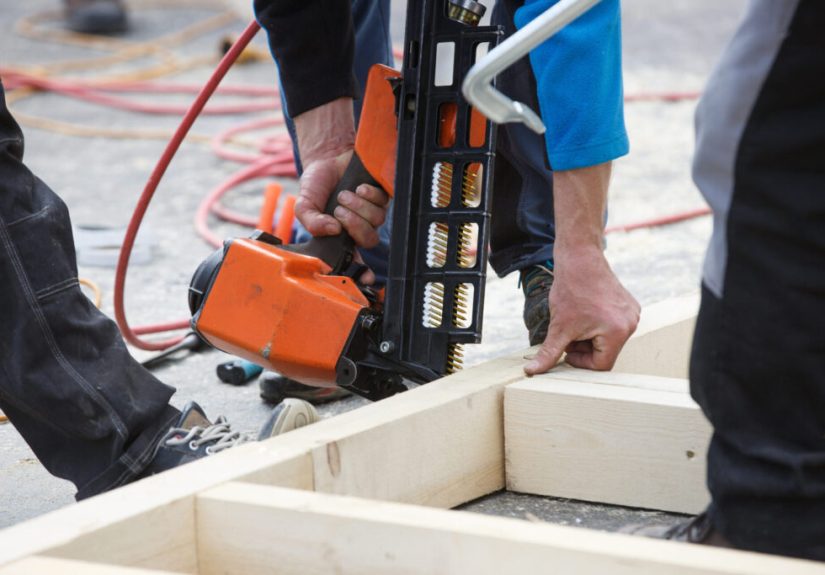
Framing nailers are the heavy hittersused for studs, joists, subfloors, sheathing, decks, fences, and anything where the wood is thick
and the nails are long (typically 2″ to 3-1/2″). If you’re building structures, this is your main character.
Finish nailers (15-gauge and 16-gauge)
Finish nailers live in the sweet spot between strength and finesse. They’re commonly used for thick trim, door casing, baseboards,
crown molding, and other places where you need real holding power but still want a clean result.
If you’re remodeling interiors, this tool gets a lot of screen time.
Brad nailers (18-gauge)
Brad nailers are a go-to for thin trim, decorative molding, cabinetry, and light woodworking. They leave smaller holes than finish nails,
which means less filling and sanding (and fewer “why does my trim look like it got peppered?” moments).
Pin nailers (23-gauge)
Pin nailers are for delicate worktiny headless pins that basically whisper the wood into place. Great for small trim returns, fine
woodworking, and glue-ups where you want a clamp substitute that doesn’t leave a noticeable hole.
Roofing nailers
Roofing nailers typically use coil nails and are built for speed and repetition. If you’re installing shingles or doing large-scale
exterior work, a roofing nailer is a big time-saver.
Cordless vs. Pneumatic vs. Fuel-Powered: The Real-World Tradeoffs
Pneumatic nail guns (air-powered)
Pneumatic nailers are often lighter than cordless equivalents, and they can fire all day as long as you’ve got a compressor and air hose.
They’re also generally cost-effective. The downside is the “tail”: hoses get snagged, compressors need space, and portability takes a hit.
In a workshop, pneumatics feel effortless. On a ladder across the yard? Less so.
Cordless battery nail guns
Cordless nailers are the convenience champions. No hose. No compressor. No “where did I put the extension cord?” They’re especially
popular for punch-list work, remodeling, and anywhere you’re moving a lot. Tradeoffs: they’re often heavier, and they can feel bulkier
in tight spots. But modern cordless framing nailers have gotten dramatically better in speed and consistency.
Fuel-powered cordless nail guns (gas + battery)
Fuel-powered nailers (often associated with framing) are famously portable and strong. You get excellent power-to-weight, but you’ll
buy fuel cells, maintain the combustion system, and occasionally enjoy the aroma of “jobsite cologne.”
In cold climates, some fuel systems are designed to keep working when pneumatics get cranky.
Best Nail Guns by Category: Standout Picks That Make Sense in 2026
Below are nail guns that repeatedly show up as top performers across trusted U.S. tool reviews and are backed by solid manufacturer specs.
Think of these as “safe bets” rather than a single universal winner.
Best cordless framing nailer for all-around performance: Metabo HPT 18V 30° Paper Strip Framing Nailer (NR1890DCS)
If you want a cordless framing nailer that feels well-balanced and jobsite-friendly, this one is frequently praised for ergonomics and
usable features like a robust rafter hook and reliable depth-of-drive adjustment. It accepts 30° paper-collated nails and is designed
for common framing ranges (2″ to 3-1/2″). It’s a strong option for framing, sheathing, and decking when you want cordless freedom without
feeling like you’re swinging a cinder block.
Best “zero ramp-up” cordless framing nailer with fast response: Milwaukee M18 FUEL 30° Framing Nailer (2745-20)
One of the big selling points here is immediacy: pull the trigger, get a nailno waiting. It’s built around a nitrogen spring mechanism
and is marketed to deliver pneumatic-style performance while staying fully cordless. If you’re doing lots of repetitive framing shots and
you hate lag, this is the vibe.
Best fuel-powered framing nailer when weight and portability matter: Paslode Cordless Framing Nailer (CF325 series)
Paslode framing nailers have long been popular for their portability and power-to-weight feel. They use fuel cells (plus a battery) and
are often chosen by crews who don’t want hoses but also want a lighter tool than many all-battery framers. If you’re moving fast,
climbing, and hopping between tasks, fuel-powered can be a practical middle pathjust budget for fuel and routine upkeep.
Best value framing nailer (workshop or compressor setup): BOSTITCH 21° Pneumatic Framing Nailer (F21PL)
Pneumatic framing nailers remain a favorite for long days and steady production, and this BOSTITCH model is widely seen as a durable,
cost-effective workhorse. If you already own a compressoror plan topneumatic framing can be the lowest cost per shot and the
easiest to keep firing nonstop.
Best cordless finish nailer for trim work: DEWALT 16-Gauge / 18V–20V class Cordless Finish Nailer family (popular angled finish platforms)
For thicker trim and casing, cordless finish nailers from major platforms are a smart move when you’re bouncing room-to-room.
DEWALT’s cordless finish options consistently show up in mainstream “best nail gun” roundups for their practicality and availability.
If you’re already on a compatible battery system, staying in the same ecosystem can be the simplest win.
Best cordless brad nailer for homeowners who want simple and capable: DEWALT 20V MAX XR 18-Gauge Brad Nailer (DCN680-style platform)
Brad nailers are often the “first nail gun” people buy for a reason: they handle a lot of trim and DIY woodworking without leaving
giant craters. DEWALT’s cordless brad nailer platform is frequently described as reliable and practicalideal for baseboards, shoe molding,
light casing, and DIY builds where you don’t want to drag an air hose through the living room.
Best compact cordless brad nailer for tight work: Milwaukee M12 FUEL 18-Gauge Brad Nailer
If you value maneuverability, compact 12V brad nailers can be a delightespecially in cabinets, closets, or awkward corners.
This category has earned praise for being easy to handle and surprisingly capable for trim-level fastening, even if it won’t replace a
heavier finish nailer when you need maximum holding power.
Best budget-friendly cordless brad nailer if you’re already on the platform: Ryobi ONE+ AirStrike 18-Gauge Brad Nailer
Ryobi’s AirStrike line is often recommended as a value play for DIYers. If you’re already invested in the ONE+ battery system,
this can be a practical way to get cordless convenience without paying pro-tier prices. Great for weekend trim projects and hobby builds.
Best roofing nailer for serious shingle work: Metabo HPT Roofing Nailer (coil roofing category)
Roofing is where coil nailers earn their keep. Look for consistent depth control, comfortable handling, and a magazine that loads smoothly.
A dedicated roofing nailer is built for high-volume fastening, and Metabo HPT roofing options are commonly recommended by home improvement
review sites for this niche.
How to Choose the Right Nail Gun (Without Overthinking It)
1) Start with nail gauge and nail length
Gauge is about thickness: lower number = thicker nail = more holding power. In plain English:
15-gauge and 16-gauge are common for thicker trim, while 18-gauge brads are better for detail work and thinner trim.
If you want one trim nailer that covers a lot, 16-gauge is often considered a versatile middle ground.
2) Decide how much “cordless freedom” is worth to you
If you mostly work in a garage or shop: pneumatic nailers can be lighter and cheaper, and the compressor is a shared resource.
If you remodel inside finished spaces, do punch-list work, or hate hoses with a passion: cordless is worth the premium.
If you frame often and want lighter weight than many battery framers: fuel-powered framing is still a contender.
3) Look for features you’ll actually use
- Tool-free depth adjustment: lets you fine-tune countersink depth across different woods.
- Dry-fire lockout: prevents blank firing when you run out of nails.
- Easy jam clearing: because jams always happen when you’re in a hurry.
- Selectable fire modes: sequential (one nail per pull) vs. contact/bump firing (fast, but needs discipline).
- Rafter hook / belt hook: sounds minor until you’re on a ladder and need a third hand.
4) Match the tool to the environment
Installing trim in a finished bedroom? A compact cordless brad nailer is quiet-ish, clean, and easy.
Building a deck? A framing nailer (cordless or pneumatic) is the right tool.
Roofing? Don’t improviseuse a roofing nailer with the right coil nails for consistent shingle fastening.
Safety: The Part Everyone Skips Until They Don’t
Nail guns are fantasticright up until the moment they aren’t. The most important safety “upgrade” you can make is choosing the right
trigger mode and actually using it properly. Sequential firing is slower, but it’s also more controlled. Contact/bump firing is fast,
but it’s easier to double-fire or discharge unintentionally if your technique gets sloppy.
Smart habits that prevent dumb injuries
- Wear eye protection every time. Nails can ricochet and wood chips love drama.
- Keep your free hand well away from the back side of the workpiece (nails can blow through knots or thin stock).
- Don’t “ride the trigger” when repositioning. Finger off until you’re ready to fire.
- In tight spaces or awkward angles, slow down. Toe-nailing and ladder work are where mistakes multiply.
- If your nailer offers a trigger swap/setting, choose the mode that matches your experience and task.
Maintenance Tips That Keep Your Nailer From Turning Into a Paperweight
Pneumatic nailer maintenance
Keep air dry and clean. Use an inline oiler if recommended, and add a few drops of pneumatic tool oil as needed.
Drain your compressor tank regularly to avoid moisture issues that can shorten tool life.
Cordless nailer maintenance
Keep the nose clean, check fasteners for proper collation, and store batteries at reasonable temperatures.
If the tool starts misfiring, it’s often a combination of low battery, debris buildup, or mismatched nails.
Fuel-powered nailer maintenance
Keep the combustion area clean and follow the manufacturer schedule. Fuel cells are consumablesstore them properly, and don’t be shocked
when “out of fuel” becomes your tool’s favorite surprise ending.
of Real-World Experience With the “Best Nail Guns”
Here’s what the glossy product photos don’t show you: the best nail gun isn’t the one with the most aggressive spec sheetit’s the one
that behaves like a reasonable adult when you’re tired, your wood is imperfect, and your project involves crawling behind a toilet to
install quarter-round.
The first time you use a cordless brad nailer for baseboards, you’ll feel unstoppable. You’ll tack trim in place, step back, and wonder
why you ever tried to do this with a hammer and finishing nails that bend if you look at them wrong. Then reality shows up: you hit a
knot, and one brad decides it’s a gymnast and exits the side of the trim. That’s when you learn the quiet art of adjusting depth-of-drive
and angling shots just slightly to avoid trouble spots. The “best” brad nailer is the one that lets you dial in depth quickly and recover
gracefully from imperfect lumber.
Pneumatic nailers feel like cheating in a shop environment. When the compressor is already humming, an 18-gauge air brad nailer can feel
feather-light compared to cordless. You can fire all day, and the tool barely gets warm. But the hose has a personality. It snags on table
legs, drags dust across fresh paint, and occasionally tries to yank the nailer out of your hand like it’s auditioning for a prank show.
If you’re trimming out a whole house, you’ll forgive the hose. If you’re doing a quick repair in a finished room, the hose becomes your
sworn enemy.
Cordless framing nailers are a different kind of experience. The power is legit, and the convenience is addictiveespecially for deck
repairs, blocking, or quick wall changes where setting up a compressor feels like overkill. But you’ll notice the weight after an hour,
particularly overhead or on ladders. That’s where balance matters more than you expect. A nailer that “feels” lighter because it’s
well-balanced can outperform a technically lighter tool that fights your wrist all day.
Fuel-powered framers (the gas + battery type) have their own charm: they often feel nimble, and they’re famously portable. But they also
teach you planning. You don’t just grab the toolyou grab the right nails, the right fuel, and a battery that isn’t pretending it charged
overnight. On cold mornings, you learn that storage habits matter. On busy days, you learn that nothing ruins momentum like discovering
your fuel cell is empty after you’ve already climbed back up the ladder.
After thousands of nails, the biggest “pro tip” is this: buy the nailer that matches the work you actually do most. If 80% of your life is
trim, get a finish nailer (and maybe a brad nailer). If you frame occasionally, rent or borrow a framing naileror choose a cordless framing
model that fits your battery platform. The best nail guns are the ones you’ll confidently reach for, not the ones that live in the corner
because they’re annoying to set up.
Conclusion
The best nail guns aren’t about hypethey’re about fit. For framing, prioritize power, speed, and ergonomics. For trim, focus on gauge,
precision, and depth control. If you want maximum mobility, cordless is hard to beat; if you want lightweight all-day firing, pneumatic
still rules many workshops. Pick the category that matches your work, then choose a tool that fits your platform, your budget, and your
patience level for hoses or fuel cells. Your future self (and your wrists) will thank you.