Table of Contents >> Show >> Hide
- Why WandaVision Felt WeirdAnd Why the Comics Are Even Weirder
- 1. Wanda’s Origin Once Involved a Talking Cow Midwife
- 2. Wanda and Vision’s Twins Had a Mephisto Problem
- 3. A Time Villain Treated Wanda Like a Cosmic Battery
- 4. Avengers Disassembled Turned Family Trauma into a Super-Team Meltdown
- 5. Wanda Accidentally Made Zombie Mutants Fight Plant Aliens
- What These Bananas Plots Reveal About WandaVision
- Fan Experience: Watching WandaVision After Learning the Comics Are Even Stranger
- Conclusion: The Bananas Were Real, But WandaVision Chose the Heart
- SEO Tags
WandaVision already asked viewers to accept a lot: a powerful witch, a synthezoid husband, suspiciously cheerful neighbors, decade-hopping sitcom aesthetics, and a suburban town where the laugh track seemed to know more than the FBI. For a normal TV show, that would be plenty. For Marvel Comics, that is basically a quiet Tuesday with snacks.
The Disney+ series turned Wanda Maximoff and Vision’s strange romance into something surprisingly emotional. Beneath the retro wallpaper and magic babies, the show was really about grief, denial, love, identity, and what happens when a superhero with reality-bending powers needs therapy more urgently than another boss fight. Smart choice. Because if Marvel Studios had adapted the comics too literally, WandaVision might have needed a warning label reading: “May contain talking cows, time tyrants, demon math, and plant-zombie warfare.”
So, let’s open the dusty long boxes and explore five real Marvel Comics plots that are too bananas for WandaVision. These storylines are not internet rumors. They are actual pieces of Scarlet Witch and Vision history. Some are funny. Some are tragic. Some sound like a writer lost a bet during lunch. All of them prove that the MCU actually showed restraint, which is not something we usually say about a franchise where a raccoon uses heavy artillery.
Why WandaVision Felt WeirdAnd Why the Comics Are Even Weirder
WandaVision worked because it did not simply throw comic book chaos at the screen. It used sitcom language to make Wanda’s pain easier to understand. Each era of television became a protective blanket: black-and-white domestic comedy, colorful suburban fantasy, family sitcom warmth, mockumentary awkwardness, and finally the cold reality waiting outside the Hex.
That structure gave the show rules. The weirdness had a purpose. A toaster commercial could be unsettling. A neighbor could feel funny and threatening at the same time. Vision could question reality while wearing a cardigan, which is honestly one of the most Marvel things ever filmed.
The comics, however, were never built with that kind of tidy nine-episode architecture. Wanda and Vision’s printed history spans decades, creative teams, retcons, reinventions, cancellations, revivals, and the occasional “let’s make this much stranger” editorial meeting. That is why the comic book versions of these characters have lived through storylines the MCU wisely sanded down, avoided, or transformed into something more emotionally digestible.
1. Wanda’s Origin Once Involved a Talking Cow Midwife
Before Wanda Maximoff became the Scarlet Witch of MCU fame, her comic book origin went through enough revisions to make a family tree look like a conspiracy board. At different points, Wanda and her twin brother Pietro, also known as Quicksilver, were tied to Magneto, the High Evolutionary, Mount Wundagore, mysterious parentage, mutant history, and magical destiny.
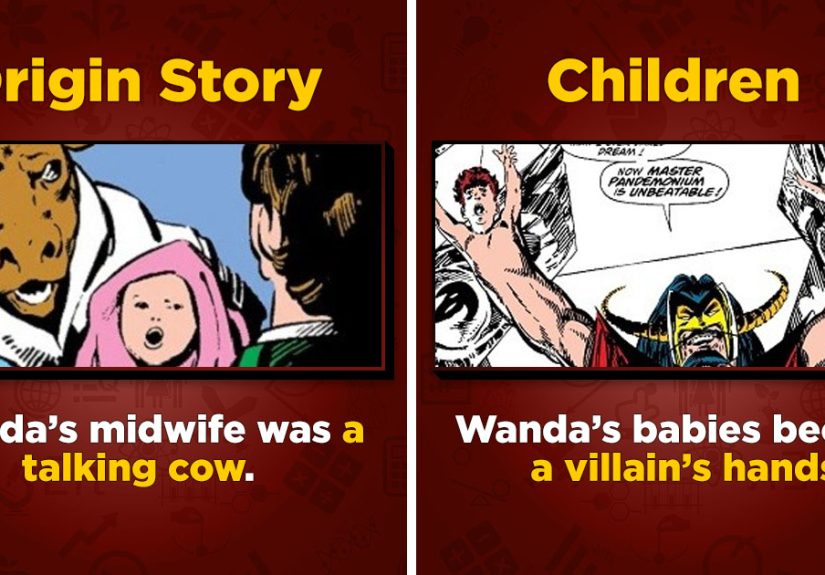
And yes, one important version of the story involves Bova, a cow evolved into a humanoid caretaker by the High Evolutionary. Bova helped care for the newborn twins after their mother sought refuge near Wundagore. In comic book language, this is treated with surprising seriousness. In regular human language, Wanda’s early life includes a scientifically altered cow nurse living near a mountain full of experimental beings. Try pitching that in a corporate meeting without someone slowly closing the laptop.
Why WandaVision skipped it
WandaVision was already asking mainstream viewers to follow S.W.O.R.D., the Hex, Agatha Harkness, fake commercials, magically created children, Vision’s restored body, and the emotional aftermath of Avengers: Infinity War and Endgame. Adding Bova would have turned the show from prestige superhero television into “Old MacDonald Had a Multiverse.”
Still, Bova matters because she shows how flexible Wanda’s mythology has always been. Wanda is not a character with one clean origin. She is a character shaped by mystery, rewritten history, and other people trying to define her. WandaVision understood that part perfectly, even without inviting a talking cow to Westview.
2. Wanda and Vision’s Twins Had a Mephisto Problem
WandaVision gave us Billy and Tommy as sweet, fast-growing sitcom children. They were adorable, chaotic, and suspiciously convenient, which is how most sitcom children behave even without chaos magic. In the show, the boys were tied to Wanda’s created reality. In the comics, the explanation became much wilder.
Wanda wanted children with Vision, but Vision is a synthezoid, which makes traditional family planning complicated. Comics solved this the way comics solve many things: magic, emotional longing, and a demonic loophole. Wanda’s twin sons were eventually revealed to be connected to fragments of Mephisto’s essence. Mephisto, for anyone not fluent in Marvel weirdness, is one of the publisher’s major demonic villains.
Then the story added Master Pandemonium, a villain whose name sounds like a rejected energy drink but who became central to the twins’ disappearance. The children were absorbed back into Mephisto’s larger supernatural mess, leaving Wanda devastated. Later stories would reveal that Billy and Tommy were effectively reincarnated as Wiccan and Speed, two important Young Avengers.
Why this plot is too much for WandaVision
Fans spent most of WandaVision guessing whether Mephisto would appear. Every fly, rabbit, stained-glass window, and suspicious line delivery got treated like a demonic breadcrumb. But the show never went all-in on Mephisto, and that was probably wise. Once you introduce a demon as the explanation for Wanda’s children, the emotional center risks getting swallowed by lore.
The MCU version kept the focus on Wanda’s grief and desire for family. The comics version turns that desire into a supernatural custody nightmare. Great for a wild comic arc. Less great for a show trying to make audiences cry over a farewell inside a collapsing magical town.
3. A Time Villain Treated Wanda Like a Cosmic Battery
Wanda’s powers are famously difficult to define. Probability manipulation? Hex magic? Chaos magic? Reality rewriting? The answer often depends on the decade, the writer, and how much trouble the plot needs by page seven. One of the strangest attempts to explain her importance came through the idea of Wanda as a Nexus Being.
In Marvel Comics, a Nexus Being is a rare figure connected deeply to the flow of reality. Wanda’s status made her important not just as an Avenger, but as a cosmic-level factor in the timeline. That attracted Immortus, a time-manipulating villain connected to Kang’s complicated timeline family tree. Immortus meddled in Wanda’s life and tried to use her growing power for his own reality-controlling agenda.
Think of it this way: in WandaVision, Wanda’s grief accidentally rewrites a town. In this comics plot, a time lord looks at Wanda and thinks, “Excellent, a human-shaped reality engine.” That is not romance, therapy, or heroism. That is cosmic appliance shopping.
Why the MCU left Immortus out
Immortus would have dragged WandaVision into heavy time-travel mythology before the show had finished explaining why everyone in Westview kept smiling like they were trapped in a cereal commercial. The series did include the word “Nexus” in one of its fake ads, which made comics fans immediately point at the screen like detective owls. But it never paused the story to explain Nexus Beings, Immortus, or Wanda’s role in multiversal architecture.
That restraint helped the show. WandaVision was strongest when its mystery served character. Immortus would have made Wanda’s suffering feel less personal and more like a cosmic paperwork issue.
4. Avengers Disassembled Turned Family Trauma into a Super-Team Meltdown
Avengers Disassembled is one of the most important Scarlet Witch storylines, and also one of the reasons longtime readers react nervously whenever Wanda remembers something painful. In that event, suppressed memories of her lost children resurfaced, and Wanda’s unstable powers contributed to a catastrophic collapse of the Avengers.
The storyline included attacks on the team, the apparent deaths of major members, and the destruction of the Avengers as fans knew them. It was dramatic, messy, controversial, and hugely influential. It also helped pave the road to House of M, where Wanda reshaped reality on a massive scale and eventually uttered the infamous phrase “No more mutants.” That moment changed mutant history for years, stripping many mutants of their powers and reshaping the X-Men side of Marvel Comics.
WandaVision borrowed the emotional skeleton of these ideas: grief, lost children, reality manipulation, and Wanda’s terrifying potential. But it avoided turning Wanda into a simple disaster machine. The show asked viewers to understand her without pretending her actions were harmless. That balance is why WandaVision remains one of Marvel’s most interesting character studies.
Why this would be too dark for the show’s structure
If WandaVision had fully adapted Avengers Disassembled, it would have stopped being a mystery-sitcom tragedy and become an Avengers demolition derby. The series would need more heroes, more casualties, more exposition, and far less time for Wanda and Vision quietly arguing over dinner-party etiquette.
Instead, Marvel Studios turned inward. Westview became a smaller, more intimate version of Wanda’s comic book reality crises. The damage still mattered, especially to the townspeople trapped inside her fantasy, but the story stayed focused on one woman’s refusal to let go.
5. Wanda Accidentally Made Zombie Mutants Fight Plant Aliens
Just when you think Scarlet Witch comics cannot get any stranger, along comes Empyre: X-Men. In that storyline, Wanda tried to make amends for the harm connected to her past actions against mutants. Her plan involved resurrecting millions of mutants who had died on Genosha, the island once central to mutant history.
That sounds noble. Unfortunately, the spell did not go as planned. Instead of a peaceful restoration, the result was an army of undead mutants. At the same time, Marvel’s larger Empyre event involved the Cotati, plant-like alien forces. So the story became, in practical terms, mutant zombies versus alien plants.
This is the sort of plot that makes comic fans say, “Actually, it makes sense in context,” which is usually the first sign that it absolutely does not make sense outside context. And yet, there is something fascinating about it. Wanda’s intention was redemption. Her result was disaster. That contrast captures a recurring Scarlet Witch theme: even when Wanda means well, her power can turn a heartfelt gesture into a global incident before anyone has finished the first cup of coffee.
Why this plot belongs nowhere near WandaVision
WandaVision had a controlled visual identity. It moved through sitcom decades with precision. Empyre: X-Men would have required the show to suddenly become a supernatural disaster comedy involving resurrection ethics, mutant politics, alien botany, and probably a very confused Jimmy Woo. Delightful? Maybe. Coherent? Not for this series.
The zombie-plant chaos works in comics because comics can pivot from heartbreak to absurdity at super-speed. Television needs a steadier emotional rhythm. WandaVision’s rhythm was grief first, weirdness second. Empyre: X-Men is weirdness driving a monster truck through grief’s front yard.
What These Bananas Plots Reveal About WandaVision
The funniest thing about these five plots is that none of them are completely random once you understand Wanda’s comic history. They all orbit the same core ideas: unstable identity, manipulated memory, impossible love, motherhood, guilt, reality breaking under emotional pressure, and other people trying to use Wanda’s power.
That is why WandaVision did not need to adapt every bizarre detail. It only needed to understand the pattern. Wanda’s story is not strange merely because she can change reality. It is strange because reality keeps changing her back. Her family history shifts. Her powers get redefined. Her children vanish and return in new forms. Her romance with Vision is tender one decade and tragic the next. Even her place in Marvel’s universe moves between hero, threat, victim, and mythic force.
The series translated that instability into television language. A changing sitcom world became the perfect metaphor for a woman trying to edit her pain into something livable. The show did not need Bova, Master Pandemonium, Immortus, or plant aliens to make that point. It only needed a house, a laugh track, a husband who should not be alive, and a town quietly begging to be released.
Fan Experience: Watching WandaVision After Learning the Comics Are Even Stranger
The experience of watching WandaVision changes once you learn how wild the comics can get. At first, the show feels like Marvel’s bold experimental cousinthe one who shows up to Thanksgiving wearing vintage clothes and whispering, “Something is wrong with the cranberry sauce.” But after reading the Scarlet Witch comics, WandaVision starts to look almost elegant. It is weird, yes, but it is curated weird. It is weird with matching curtains.
For many viewers, the first episode was confusing in the best way. There were no giant portals, no sky beams, and no immediate villain explaining the plot like a tour guide at the Museum of Exposition. Instead, we got Wanda and Vision trying to survive a dinner with Vision’s boss. The scene was funny, stiff, charming, and then suddenly uncomfortable. That slow shift from sitcom comfort to psychological unease became the show’s secret weapon.
Learning about the comics makes those early episodes even more rewarding. The cheerful suburban setup is not just a gimmick. It is a cleaner version of decades of Wanda stories about wanting a normal life and never being allowed to keep one. In the comics, normalcy is always interrupted by demons, time villains, memory manipulation, team collapses, and cosmic consequences. In WandaVision, normalcy is interrupted by a radio voice, a beekeeper, a red helicopter, and Vision gradually realizing his home is built on someone else’s suffering. The scale is smaller, but the emotional punch is sharper.
There is also a special kind of comedy in being a WandaVision fan during theory season. Every tiny detail became evidence. A rabbit was not just a rabbit. A commercial was not just a commercial. A line of dialogue could launch three thousand posts before breakfast. Some theories were thoughtful. Others were built on the kind of logic usually reserved for finding shapes in clouds. Still, that was part of the fun. WandaVision made audiences feel like they were solving a puzzle, even when the real answer was less about secret villains and more about grief refusing to stay buried.
The comics also make you appreciate the MCU’s restraint. It would have been easy to toss in Mephisto, Immortus, mutant politics, and a dozen cameos for applause. Instead, the series mostly kept its attention on Wanda and Vision. That choice may have disappointed fans hoping for a multiverse fireworks show, but it gave the story lasting emotional weight. The most memorable moments are not explosions. They are Wanda standing in an empty lot, Vision asking difficult questions, Monica showing compassion, and the family saying goodbye as the Hex closes.
That is the real viewer experience: you come for the weird sitcom superhero mystery, then stay because the show understands that grief can make people build entire worlds in their heads. The comics provide the bananas. WandaVision provides the bruised heart underneath the peel.
Conclusion: The Bananas Were Real, But WandaVision Chose the Heart
Scarlet Witch comics are a glorious storm of strange ideas. A talking cow midwife? Real. Demon-connected children? Real. Time villains trying to control Wanda’s cosmic importance? Real. Avengers collapsing because buried trauma came roaring back? Very real. Zombie mutants fighting plant aliens? Somehow, also real.
But WandaVision succeeded because it did not confuse “more complicated” with “more powerful.” The show borrowed the emotional DNA of these stories and left the most chaotic plot machinery on the comic book shelf. That was the right move. Wanda Maximoff did not need every wild panel adapted literally. She needed room to be funny, frightening, loving, selfish, broken, and human.
In the end, WandaVision gave viewers something rarer than a perfect comics adaptation: a version of Wanda’s story that understood why the comics got so strange in the first place. Her world keeps breaking because her heart keeps breaking. The bananas plots are entertaining, but the pain beneath them is what made the series unforgettable.
SEO Tags
Note: This article is based on real Marvel Comics and MCU information, rewritten in original language for web publishing without copied source text or unnecessary citation markers.