Table of Contents >> Show >> Hide
- Who Is The Artist Behind These Funny Minimalist Comics?
- Why Minimalist Comics Hit So Hard
- Here Are 35 Of The Best Ones, Or At Least The 35 Best Kinds Of Laughs This Artist Delivers
- What Makes These Best Minimalist Comics So Shareable?
- Why This Comic Artist Stands Out In A Crowded Internet
- Reader Experience: Why Funny Minimalist Comics Feel Weirdly Personal
- Final Thoughts
- SEO Tags
Some comics arrive dressed like a marching band. Others show up wearing one clean line, a blank face, and the confidence of a comedian who knows the punchline will land anyway. Andrew, the creator behind Crustacean Singles, belongs very much to the second group. His work proves a beautiful and slightly annoying truth: you do not need a thousand details to make people laugh. Sometimes you just need a deadpan character, one strange thought, and a sharp left turn into absurdity.
That is exactly why funny minimalist comics work so well online. They are quick to read, easy to recognize, and somehow able to feel both silly and weirdly profound. You can glance at one while waiting for coffee, laugh, send it to a friend, then think about it again three hours later while pretending to answer emails. That is not just a joke format. That is efficiency. Frankly, office productivity never had a chance.
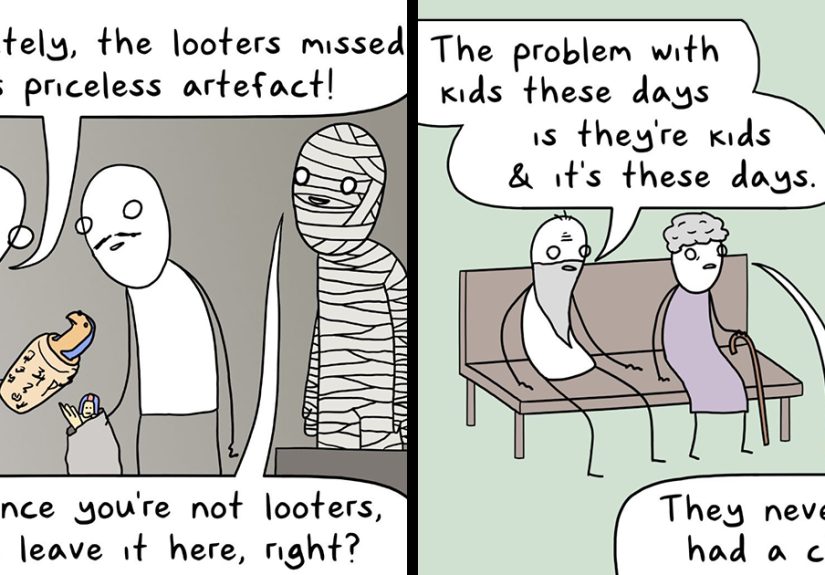
Andrew’s style feels simple on the surface, but the comedy is carefully built. The stripped-down visuals make room for timing. The sparse backgrounds make the expressions hit harder. The short dialogue keeps the joke moving. And because the drawings are so minimal, your brain does part of the work, which makes the final laugh feel a little more satisfying. It is the comic version of a magician using one card instead of a smoke machine.
Who Is The Artist Behind These Funny Minimalist Comics?
The artist at the center of this title is Andrew, the creator of Crustacean Singles, a long-running comic project known for absurd, often single-panel humor. His work has been described as simple in style but rich in ideas, which is exactly the kind of compliment cartoonists secretly frame and hang on the wall. He has also cited The Far Side as an influence, especially for showing that a whole story can live inside a single panel. That makes perfect sense when you look at his work: the jokes are compact, the premises are odd, and the laughs often arrive in one clean strike.
What separates Andrew from a lot of internet humor creators is that his comics do not feel like content machine jokes built from templates. They feel authored. They have a point of view. The humor leans absurd, but it rarely feels random. Even when a comic is about a bizarre creature, a nonsense phrase, or a conversation that clearly escaped from a sleep-deprived brain, the structure is controlled. That control is what makes the weirdness land.
There is also range in the work. Crustacean Singles has roots in one-panel humor, but it wanders freely into recurring characters, call-backs, tiny mini-stories, visual gags, and strange little philosophical detours. In other words, the comic does not stay in one lane. It steals several lanes, makes eye contact, and keeps driving.
Why Minimalist Comics Hit So Hard
Minimalism makes the joke faster
When a comic is visually simple, the reader does not have to fight through clutter. Your eye knows where to go, your brain processes the setup quickly, and the punchline gets more room to breathe. That is one reason minimalist cartooning has such staying power. In comics, timing is everything, and clean design is often timing’s best friend.
Simple drawings can carry complex feelings
Minimalist comics are not only good at humor. They are also surprisingly good at awkwardness, anxiety, confusion, loneliness, and that specific human emotion best described as “well, this escalated strangely.” When a face is reduced to just a few marks, readers project more of themselves onto it. That is why a basic little character can somehow feel more relatable than a hyper-detailed illustration with seventeen eyelashes and a dramatic sunset.
Absurdity works better when the art stays calm
Andrew’s best jokes often come from the contrast between an unbothered visual style and a ridiculous premise. The drawing stays cool while the idea goes rogue. That mismatch is part of the comedy. The comic never begs you to laugh. It just places something delightfully wrong in front of you and lets your brain trip over it.
One-panel traditions still matter
There is a long tradition behind this approach. American cartooning has celebrated compact visual humor for more than a century, from newspaper comics to magazine cartoons to modern webcomics. Minimalist humor may feel internet-native, but it is really a clever descendant of older single-panel storytelling. Andrew’s comics feel fresh because they understand that tradition without getting stuck inside it.
Here Are 35 Of The Best Ones, Or At Least The 35 Best Kinds Of Laughs This Artist Delivers
- The one where a normal sentence becomes a tiny disaster. Andrew is excellent at starting with everyday language and then nudging it one inch sideways until the whole scene collapses into nonsense.
- The one built on deadpan confidence. A ridiculous statement gets delivered with the calm certainty of someone explaining how to sort laundry. That contrast is comedy gold.
- The delayed-laugh comic. You do not always laugh instantly. Sometimes the joke blooms two seconds later, which somehow makes it funnier.
- The visual reversal. Something you assume works one way suddenly flips, and the entire comic changes direction without adding extra clutter.
- The object with feelings. Giving emotion or attitude to an inanimate thing is one of the oldest tricks in cartooning, and Andrew still makes it feel fresh.
- The oddly polite absurdity. Characters speak with a weird courtesy even when the premise is completely deranged, and that restraint makes the joke sharper.
- The social awkwardness special. Few things are funnier than a conversation that starts wrong and somehow keeps getting wronger.
- The comic that sounds philosophical but is actually nonsense. This is a premium internet-humor move, and Andrew uses it beautifully.
- The creature joke. Strange beings, simplified animals, or shape-shifty little figures show up with just enough design to be memorable.
- The comic powered by one facial expression. A tiny mouth line and two dots for eyes can carry more emotional damage than a prestige drama.
- The one where logic is technically present but spiritually absent. The steps all connect, yet the conclusion is still wonderfully absurd.
- The surprise tenderness comic. Just when you expect pure silliness, the joke turns soft, human, and unexpectedly sweet.
- The callback to a recurring character. Minimalist comics get even better when familiar little weirdos return and bring their baggage with them.
- The language joke. Word choice, phrasing, and literal interpretations do heavy lifting in these comics, which makes them fun for readers who love verbal humor.
- The comic that treats a dumb idea with total seriousness. This is one of Andrew’s strongest habits, and thankfully he uses it often.
- The anti-climax. Instead of exploding toward a huge ending, the joke fizzles in the funniest possible way.
- The existential mini-panic. A character realizes something deeply strange about reality, and we laugh because, honestly, same.
- The tiny fantasy detour. A comic may look everyday for one beat, then suddenly wander into surreal or speculative territory.
- The “I should not relate to this, yet here we are” entry. Great minimalist comics turn bizarre situations into emotional mirrors.
- The comic with no wasted motion. Every line exists for a reason. Every word earns its rent. Nothing is there just to decorate the room.
- The awkward honesty joke. Some comics are funniest because a character says the quiet part so loudly that the whole panel flinches.
- The mild apocalypse with a calm tone. Catastrophic implications are delivered as if discussing a parking issue, which is always a strong choice.
- The visual understatement. The art refuses to overreact, which lets the absurd premise do all the shouting.
- The comic that feels like a dream you almost remember. It has dream logic, dream confidence, and the same suspicious ability to make sense for half a second.
- The “what if this tiny thing had rules?” joke. Andrew has a gift for inventing systems around nonsense and making them feel weirdly official.
- The painfully relatable self-drag. When the humor pokes at insecurity, avoidance, or modern life, it lands because it is honest under the silliness.
- The comic that weaponizes politeness. Civil dialogue can be much funnier than yelling when the underlying premise is unhinged.
- The one-panel world-building trick. In just one image, you get a full reality, a conflict, and a punchline. That is not minimal effort. That is compact craftsmanship.
- The joke that looks easy to make but absolutely is not. Minimalist comics often hide the hardest part: choosing what to leave out.
- The quiet insult. Andrew’s humor can be gently savage, the kind that stings a little before it makes you laugh.
- The comic that is 60% wordplay and 40% emotional damage. A very respectable ratio, honestly.
- The character who misunderstands everything. Literal thinking, skewed assumptions, and warped interpretations are comic fuel forever.
- The comic that turns mood into the joke. Sometimes the funniest part is not the punchline but the emotional weather of the panel.
- The minimal background, maximum consequence comic. Bare space can make a tiny exchange feel huge, which is part of the charm.
- The one that makes you want to send it immediately. The best minimalist comics have shareability baked in. They are quick, quotable, and dangerously easy to message to five people before breakfast.
What Makes These Best Minimalist Comics So Shareable?
Three things: speed, clarity, and replay value. First, the comics read quickly. That matters in an online environment where readers are moving at the speed of thumb-scroll. Second, they are clear. Even when the joke is weird, the panel composition is not confusing. Third, they reward rereading. Some comics are funny once. The best ones get funnier because your brain keeps discovering how efficiently the joke was built.
That is also why minimalist webcomics travel so well across platforms. They fit modern attention spans without feeling disposable. You can save them, revisit them, and quote them to friends like a tiny absurd scripture. In a world where many jokes are loud and instantly forgettable, Andrew’s comics often feel quiet and sticky. They stay with you.
Why This Comic Artist Stands Out In A Crowded Internet
The web is not exactly suffering from a shortage of humor. Every platform is full of memes, punchlines, reaction images, and people announcing that they are “just going to keep this one short” before posting a twelve-slide thread. So why does a comic artist like Andrew still cut through the noise? Because restraint is rare. Minimalism, when done well, feels confident. It trusts the reader. It does not explain too much. It does not decorate every inch. It simply arrives, makes the joke, and leaves the room before anyone can ask unnecessary follow-up questions.
That artistic confidence matters. Plenty of creators can draw more. Not all of them know how to subtract more. Andrew’s comics show the value of reduction: fewer lines, fewer words, fewer moving parts, stronger impact. It is the same reason a good one-liner beats a rambling story, or a tiny raised eyebrow can outperform a speech. Precision is funny.
Reader Experience: Why Funny Minimalist Comics Feel Weirdly Personal
There is a very specific experience that comes with finding a minimalist comic artist you love. It rarely begins with a grand literary revelation. It usually starts with you being tired, slightly over-caffeinated, and one mild inconvenience away from becoming a Victorian ghost. Then you see a tiny comic. Two characters, almost no background, maybe six words total. You think, “Fine, impress me.” And then it does.
That is the strange power of this format. It sneaks up on you. A big, flashy joke announces itself from a mile away. A minimalist comic does not. It just sits there, looking harmless, like a grilled cheese sandwich that secretly knows your tax situation. You glance at it, and before you know it, you are laughing at something that is half absurdity and half uncomfortable truth.
For many readers, the best part of comics like Andrew’s is not just that they are funny. It is that they understand the shape of modern thought. Life now is full of unfinished tabs, weird messages, accidental self-awareness, and conversations that feel one typo away from collapse. Minimalist humor mirrors that beautifully. A single panel can capture social awkwardness, emotional exhaustion, overthinking, or random joy faster than a five-paragraph essay ever could. It is basically emotional shorthand for people whose brains have twelve browser windows open at all times.
These comics also fit naturally into daily routines. You read one while eating lunch. You send another to a friend with no explanation except “you.” You save one because it describes your entire personality better than your resume does. Then, hours later, you remember a line from it and laugh again for no respectable reason. That repeat value is important. The best humor does not vanish after the first reaction. It lingers. It becomes part of your internal joke library.
There is also something comforting about the visual simplicity. Detailed art can be impressive, but minimalist comics can feel more welcoming. They leave space for the reader. You are not overwhelmed by design choices or buried in visual information. Instead, you meet the comic halfway. Your imagination fills in the tone, the pacing, the emotional weight. In that sense, reading minimalist comics is a little collaborative. The artist sets the trap. Your brain steps into it willingly.
And then there is the social part. Funny minimalist comics are perfect for sharing because they do not demand a giant setup. You do not need to explain lore. You do not need to send a six-message preface. You just forward the comic, and if your friend laughs, congratulations, you have had a tiny successful cultural exchange. If they do not laugh, that is fine too. You now know something useful about the friendship.
Most of all, comics like these feel personal because they are built from observation. Beneath the silliness is recognition: human beings are odd, language is slippery, modern life is exhausting, and sometimes the only reasonable response is a tiny, slightly cursed joke. Andrew’s work understands that. It offers humor that is light without being empty, simple without being lazy, and strange without losing emotional truth. That is why readers keep coming back. Not just for a laugh, but for the peculiar comfort of being understood by a drawing with almost no face.
Final Thoughts
Andrew’s Crustacean Singles proves that funny minimalist comics are not “small” art. They are concentrated art. They take the long tradition of compact cartooning and give it a modern, web-friendly pulse. The best ones are fast, weird, sharp, memorable, and just self-aware enough to make you laugh at the joke and at yourself. That is a pretty great deal for a panel with almost no furniture in it.
So yes, this comic artist really does have the ability to create funny and minimalist comics, and the best of them succeed for the same reason all great jokes do: they get in, hit cleanly, and leave behind something extra. A laugh, a thought, a wince of recognition, or the sudden need to send a comic to a friend at 11:43 p.m. with the caption, “This is unfortunately us.”