Table of Contents >> Show >> Hide
- Why This Headline Still Matters
- What Made Arecibo So Special?
- Why Did It Face the Axe in the First Place?
- From Budget Threat to Structural Disaster
- What Astronomy Lost When the Dish Went Silent
- FAST Changed the Global Conversation
- Could a Telescope Like Arecibo Be Worth Rebuilding?
- The Real Lesson Behind the Shuttering Threat
- Experiences Related to “The Largest Radio Telescope in the World Could Be Shuttered”
- Conclusion
Some headlines age like milk. This one aged like prophecy.
When people first worried that the world’s largest radio telescope could be shuttered, the fear sounded dramatic, maybe even a little theatrical. After all, giant scientific instruments are supposed to feel permanent. They sit in the landscape like mountains with grant funding. Surely something that massive, that historic, that useful would always find a way to survive. Right?
Well, not exactly. The story of the Arecibo Observatory in Puerto Rico proved that even legendary tools of discovery can be squeezed by budgets, battered by infrastructure problems, and lost faster than anyone wants to admit. And because science loves an uncomfortable sequel, Arecibo’s fall also forced the world to look harder at what happens when irreplaceable research machines disappear. The result is bigger than one telescope, one country, or one dramatic photo of twisted metal in a tropical valley. It is a story about how modern astronomy decides what is worth saving, what gets replaced, and what vanishes forever.
If you came here expecting a simple tale of one old dish going dark, buckle up. This is really about the changing priorities of radio astronomy, the scientific power of giant single-dish telescopes, the rise of China’s FAST telescope, and the painful reality that “important” does not always mean “protected.” Science, sadly, does not come with plot armor.
Why This Headline Still Matters
The title The Largest Radio Telescope in the World Could Be Shuttered originally fit Arecibo during a moment of funding anxiety. For decades, the 305-meter telescope was one of the most famous scientific instruments on Earth. It helped scientists study pulsars, map asteroids, probe planets, search for extraterrestrial signals, and test ideas tied to gravity itself. In plain English: Arecibo was not just a big metal bowl in the forest. It was an intellectual Swiss Army knife.
But that 2016 warning now reads differently because history kept going. Arecibo later suffered catastrophic cable failures, was slated for decommissioning on safety grounds, and then collapsed in 2020 before a controlled dismantling could happen. By 2022, the decision was made not to rebuild the signature 305-meter instrument. The observatory site would continue in educational and limited scientific roles, but the iconic giant dish was gone for good.
That makes this topic more than click-worthy nostalgia. It turns the article into a case study in how world-class infrastructure can slide from “vital” to “vulnerable” with alarming speed.
What Made Arecibo So Special?
It was huge, yes, but size was only the beginning
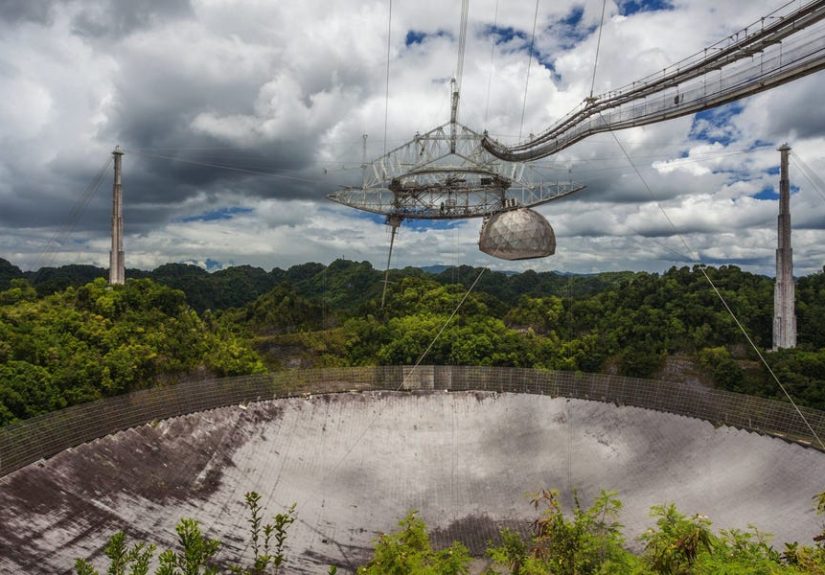
Arecibo was built into a natural sinkhole and completed in the early 1960s. Its fixed dish, with a suspended platform hanging far above it, looked like a Bond villain’s daydream because, frankly, it kind of was. Hollywood loved it. Scientists loved it more.
The telescope was originally designed for ionospheric research, but it quickly became a powerhouse for radio astronomy and radar astronomy. That mix mattered. Many observatories do one thing brilliantly. Arecibo did several things brilliantly, which is one reason its potential closure felt so dangerous even before the final collapse.
It was especially strong at detecting faint radio signals, timing pulsars with extraordinary sensitivity, and using radar to characterize near-Earth asteroids. That last point is not glamorous until you remember that “near-Earth asteroid” is just a more professional way of saying “space rock that could become everyone’s problem.”
A machine with a résumé most telescopes would envy
Arecibo’s scientific legacy is absurdly impressive. Work at the observatory contributed to the discovery of the first known planets beyond our solar system, found around a pulsar in 1992. It played a central role in the study of the binary pulsar that provided early, indirect evidence for gravitational waves. It contributed to pulsar science, fast radio burst research, atmospheric studies, galaxy surveys, and planetary defense. It also transmitted the famous 1974 Arecibo Message, making it one of the very few telescopes that can say, with a straight face, “I literally called outer space first.”
That combination of scientific seriousness and cultural symbolism is rare. Arecibo was both a research instrument and a scientific landmark. People who never read a journal article still knew what it was. That matters when we talk about public trust in science, STEM inspiration, and the emotional weight of shutting a place like this down.
Why Did It Face the Axe in the First Place?
The uncomfortable answer is simple: science budgets are not infinite, and older facilities often find themselves competing with newer ones. In the mid-2010s, Arecibo became part of a larger conversation inside the U.S. research ecosystem about divesting from aging observatories so money could be redirected toward more modern projects.
That logic was not invented to be cruel. New facilities can open new windows on the universe, and agencies like the National Science Foundation constantly face choices between maintaining legacy infrastructure and funding next-generation instruments. But the Arecibo debate exposed the downside of that approach. A telescope can still be scientifically productive, globally unique in certain capabilities, and beloved by entire communities, yet still land on the chopping block because it no longer fits the preferred funding model.
In other words, the question was never just “Is Arecibo valuable?” It was “Is Arecibo valuable enough compared with everything else the science system wants?” That is a much harsher question, and older observatories rarely enjoy hearing the answer.
From Budget Threat to Structural Disaster
Budget fears were only one chapter. The story became far more devastating in 2020, when cable failures severely damaged the observatory. Engineering assessments concluded that repairs could not be carried out safely. Before a controlled decommissioning could happen, the suspended platform collapsed into the dish. It was the kind of event that left astronomers stunned, students heartbroken, and science fans staring at video footage like they had just watched a library burn in slow motion.
The collapse changed the entire tone of the conversation. The debate was no longer about whether the telescope might be shuttered. It was about how the world had already lost one of its most capable radio astronomy tools and what, if anything, should replace it.
The National Science Foundation later opted not to rebuild the 305-meter telescope. Instead, the Arecibo site moved toward education, outreach, workforce development, and use of remaining infrastructure. That path preserved part of the observatory’s public mission, especially for Puerto Rico, but it did not restore the scientific capabilities that made Arecibo singular.
What Astronomy Lost When the Dish Went Silent
Planetary defense took a hit
Arecibo’s radar system was one of the most powerful tools available for studying near-Earth objects. Radar observations can reveal an asteroid’s size, shape, rotation, surface features, and orbital path with far more precision than many optical methods alone. That is not a niche benefit. It is a practical one. If humanity ever needs fast, reliable information about a potentially hazardous asteroid, losing powerful radar capacity is a serious problem.
Scientists did not lose all planetary defense tools when Arecibo fell, but they did lose a uniquely capable asset. In this field, redundancy is comforting. The universe has a long history of throwing rocks around with very little regard for our scheduling preferences.
Pulsars and gravitational-wave astronomy lost a major ally
Arecibo was also a favorite for pulsar timing. Because of its sensitivity, it helped researchers monitor millisecond pulsars that can function like extraordinarily stable cosmic clocks. Those observations feed efforts to detect nanohertz gravitational waves using pulsar timing arrays.
That means the loss of Arecibo was not just about one telescope disappearing. It affected a broader network of science tied to black hole mergers, galaxy evolution, and tests of fundamental physics. Legacy Arecibo data still matter enormously, but legacy data are not the same thing as continued observations.
SETI and symbolic science lost a giant stage
Like it or not, some scientific places become mythic. Arecibo was one of them. It inspired students, appeared in movies, anchored educational programs, and gave the public a concrete image of what astronomy looks like when it gets really ambitious. The search for extraterrestrial intelligence, in particular, benefited from Arecibo’s iconic status. It was a telescope that made the question “Are we alone?” feel less like philosophy and more like an engineering problem with a schedule.
That symbolic power is easy to dismiss until it disappears. Then suddenly everyone remembers that science is not only about data. It is also about imagination, public visibility, and the kinds of places that make young people think, “I want to do that.”
FAST Changed the Global Conversation
As Arecibo’s story darkened, another giant dish reshaped the field: the Five-hundred-meter Aperture Spherical Telescope, or FAST, in China. Completed in 2016 and later opened to broader scientific use, FAST surpassed Arecibo as the world’s largest single-dish radio telescope. It has already contributed major results, including sensitive pulsar work and headline-grabbing fast radio burst observations.
FAST is not a perfect substitute for Arecibo in every respect. No telescope is a drop-in replacement for another because the technical details, observing modes, national access rules, and research ecosystems all differ. Still, FAST has become proof that giant single-dish radio telescopes are not outdated museum pieces. When properly supported, they remain scientifically potent.
That matters because one argument often made during debates over legacy observatories is that the future belongs only to arrays and newer distributed systems. Arrays are indeed powerful and flexible. But FAST demonstrates that there is still real value in enormous collecting area, extreme sensitivity, and specialized capabilities. In astronomy, newer is not always better. Sometimes newer is just newer.
Could a Telescope Like Arecibo Be Worth Rebuilding?
This is where the story gets thorny. Emotionally, the answer is easy: yes. Scientifically, there is also a strong case that replacing some of Arecibo’s capabilities would benefit radio astronomy, planetary radar, education, and Puerto Rico’s scientific ecosystem. But institutionally and politically, rebuilding something on that scale is much harder than admiring the idea.
Modern science funding tends to favor projects that promise transformative new capabilities rather than heroic restoration of a beloved predecessor. That bias is understandable, but it can leave unique facilities stranded in a gap between reverence and investment. Everyone says they were important. Fewer people sign the checks.
The lesson is uncomfortable but useful: if a society truly values flagship scientific infrastructure, it cannot wait until cables snap, headlines explode, and memorial essays start circulating. By then, the best options are usually gone.
The Real Lesson Behind the Shuttering Threat
The biggest takeaway from this story is not just that Arecibo was special. It is that scientific importance does not automatically guarantee survival. Infrastructure ages. Budgets shift. Governance changes. Maintenance gets deferred. New priorities arrive wearing shiny brochures. Then one day a facility everyone assumed would always exist becomes a case study in preventable loss.
That is why this story still resonates. It asks a bigger question than whether one radio telescope could be shuttered. It asks what kind of scientific civilization we want to be. One that builds breathtaking tools and sustains them thoughtfully? Or one that applauds discovery while quietly letting the machinery of discovery fall apart?
Arecibo’s story does not offer a comforting answer. But it does offer a clear warning.
Experiences Related to “The Largest Radio Telescope in the World Could Be Shuttered”
The human side of this topic is easy to underestimate if you only look at budgets, engineering reports, and telescope specs. But ask people who worked at, studied at, visited, or simply grew up knowing Arecibo existed, and a different kind of story appears. It is not just about a scientific instrument. It is about experience.
Imagine approaching a giant radio telescope for the first time. Before you understand the physics, you feel the scale. The dish does not merely sit in the landscape; it seems to reorganize it. Trees, roads, railings, and people all start looking like props built to remind you how small you are. Then you look up at the platform hanging overhead and your brain does a brief, unhelpful calculation: that thing is enormous, it is above me, and trusting it requires more optimism than I packed this morning.
For students, especially, that kind of place can be life-altering. A classroom can explain radio waves. A giant observatory makes them feel real. Suddenly science is not just diagrams and vocabulary quizzes. It is a living machine designed to catch whispers from pulsars, galaxies, and asteroids. That shift matters. Many scientists have stories that begin not with a textbook but with a visit to a place that made the universe feel tangible.
For working researchers, the experience was different but just as intense. Arecibo was not decorative. It was useful. Scientists depended on its sensitivity, its radar power, its long-running data sets, and its odd, wonderful engineering personality. Observing time there was not a sentimental pilgrimage. It was serious work. Yet serious work often grows affection. People do not spend years with an instrument like that without developing a bond. Telescopes may be machinery, but in research culture they also become companions, landmarks, and chapters of a career.
For Puerto Rico, the experience was wider than science alone. Arecibo was part of the local identity, a point of pride, an educational magnet, and a visible reminder that world-class research did not belong only to distant campuses on the mainland. When the telescope failed and then collapsed, the loss was technical, yes, but also emotional and civic. It felt like losing a symbol that had told generations, “Important things happen here.”
Even for people who only knew Arecibo through documentaries, magazine photos, or a cameo in a movie, the shutdown landed hard. That is because giant observatories occupy a strange place in public imagination. They are practical machines doing difficult math, but they also feel like cathedrals for curiosity. When one goes silent, the grief is not irrational. It reflects a basic fear that we are becoming too willing to abandon big, beautiful tools for understanding the universe.
And maybe that is the most lasting experience of all: the uneasy realization that scientific wonder is not self-sustaining. It needs maintenance, money, political will, and people who care before the obituary is written. Otherwise, the next time a headline warns that a great telescope could be shuttered, we may again discover that “could” was just the universe clearing its throat.
Conclusion
The phrase the largest radio telescope in the world could be shuttered once sounded like a warning about future risk. Now it reads like a compact history of how fragile even legendary science can be. Arecibo’s story includes funding stress, extraordinary discoveries, engineering tragedy, and a painful reckoning over what the scientific community preserves versus what it allows to fade.
At the same time, the rise of FAST shows that giant radio telescopes still matter. The science is alive. The appetite for discovery is alive. What remains uncertain is whether institutions will consistently support the kind of ambitious, long-term infrastructure that discovery requires.
If there is any hopeful note here, it is this: people still care deeply about places like Arecibo because they represent something larger than themselves. They remind us that science is not only about answers. It is also about building instruments worthy of the questions.