Table of Contents >> Show >> Hide
- What Exactly Is a Ken Den?
- Why the Ken Den Arrived at the Perfect Time
- The Difference Between a Man Cave and a Ken Den
- The Core Ingredients of a Great Ken Den
- Five Ken Den Styles That Actually Work
- How to Build a Ken Den Without Blowing the Budget
- Why the Ken Den Has Staying Power
- Experience-Driven Add-On: What Living With a Ken Den Actually Feels Like
- Conclusion
- SEO Tags
For years, the man cave had one job: be a room where taste went to take a long nap. It was often dark, overstuffed, and decorated like a sports bar had a clearance sale with a warehouse full of leather recliners. Then something changed. Homeowners started wanting rooms that still felt personal and relaxed, but also looked like an adult with opinions lived there. Enter the Ken Den: the polished, personality-driven, slightly more self-aware evolution of the traditional man cave.
The Ken Den is not about making a space less masculine. It is about making masculinity less lazy. Instead of relying on clichés, it turns a spare room, den, basement, nook, or lounge into a stylish retreat that actually reflects the person using it. Think tailored seating, better lighting, art with a pulse, a drink station that feels curated instead of chaotic, and enough intention to make the room feel like a destination rather than a furniture storage zone with a television in it.
In other words, the Ken Den asks a radical question: what if a guy’s room had both a record player and decent lamp placement?
What Exactly Is a Ken Den?
The Ken Den is best understood as a modern den with style. It borrows the privacy and comfort of the classic den but upgrades the visual language. It is part lounge, part hobby room, part entertaining zone, and part personal headquarters. It can include a bar area, a reading corner, a listening station, a gaming setup, a home office nook, or a display wall for books, guitars, cameras, collectibles, or whatever else makes the owner feel delightfully specific.
That specificity is the whole point. The old-school man cave often assumed all men wanted the same room: a giant TV, a mini fridge, a heavy chair, and a shrine to either football or whiskey. The Ken Den says no two people are built the same, so why should their private spaces be? One Ken Den might feel like a boutique hotel lounge. Another might read like a moody library with a hidden coffee bar. A third might split the difference between a listening room, a chess club, and a beautifully lit Zoom cave.
And yes, the name has a wink in it. Part of its charm is that it does not take itself too seriously. The room may be upscale, but it is not uptight. It can be playful, glamorous, nostalgic, or quietly weird. Frankly, a room should be allowed to own a velvet chair and a vintage stereo without apologizing to a mounted fish.
Why the Ken Den Arrived at the Perfect Time
1. Homes have to work harder now
American homes are under more pressure than ever to multitask. One room may need to host remote work in the afternoon, friends at night, and solo recovery on Sunday morning. That is why the Ken Den makes sense now. It is not just a hideaway. It is a flexible, elevated space that can support hobbies, focus, hosting, and downtime without feeling like a random mash-up of furniture categories.
Designers and editors across home publications have been circling this same idea from different angles: elevated game rooms, analog rooms, stylish basement bars, cozy libraries, and more thoughtful home offices. Put them together and you get a bigger cultural shift. People do not just want a room with a function. They want a room with an identity.
2. Personal taste beats stereotypes
The Ken Den also reflects a broader move away from one-note interiors. Cookie-cutter spaces are out. Rooms that look like they were assembled by an algorithm are losing their charm. The most interesting interiors right now feel collected, layered, and personal. That means meaningful objects, quirky art, books that are actually read, and materials that age with character.
In practical terms, this gives the Ken Den much more range than the old man cave ever had. It can be sleek and urban, rustic and warm, mid-century and playful, or dark and moody in a way that feels cinematic rather than cave-like. The room becomes a portrait, not a stereotype.
3. Entertaining at home got an upgrade
Another reason the Ken Den is thriving is that at-home entertaining has become more stylish. Today’s home bars are not always giant built-ins with neon signs screaming about domestic lager. They might be bookcase bars, coffee-and-cocktail stations, or compact shelving moments with vintage glassware, great lighting, and a little swagger. That shift matters because it transforms the room from a private escape into a hospitable one.
The Ken Den is not anti-social. It is just more selective. It says, “Welcome in, but please respect the records.”
The Difference Between a Man Cave and a Ken Den
The man cave is theme-first
A traditional man cave often starts with a theme and stops there. Sports. Cars. Beer. Dark leather. Done. The result can feel more like a commercial set than a lived-in room.
The Ken Den is person-first
A Ken Den starts with how someone wants to feel in the space. Relaxed? Inspired? Focused? Social? Slightly mysterious, like a handsome professor who knows how to make a perfect old fashioned? Once the feeling is clear, the design follows.
The man cave isolates
Many old man caves were intentionally shut off from the rest of the home, almost as if the goal was emotional witness protection. The Ken Den can still be tucked away, but it usually feels connected to the home’s overall design story. It belongs there. It does not look like it was dropped in by a different species.
The Ken Den edits better
This may be the biggest difference of all. The Ken Den knows when to stop. It is curated, not crammed. There is room for collections, but they are displayed with purpose. There is tech, but it is integrated. There is comfort, but not furniture bloat. It has taste, which is just another way of saying it understands restraint.
The Core Ingredients of a Great Ken Den
Layered seating
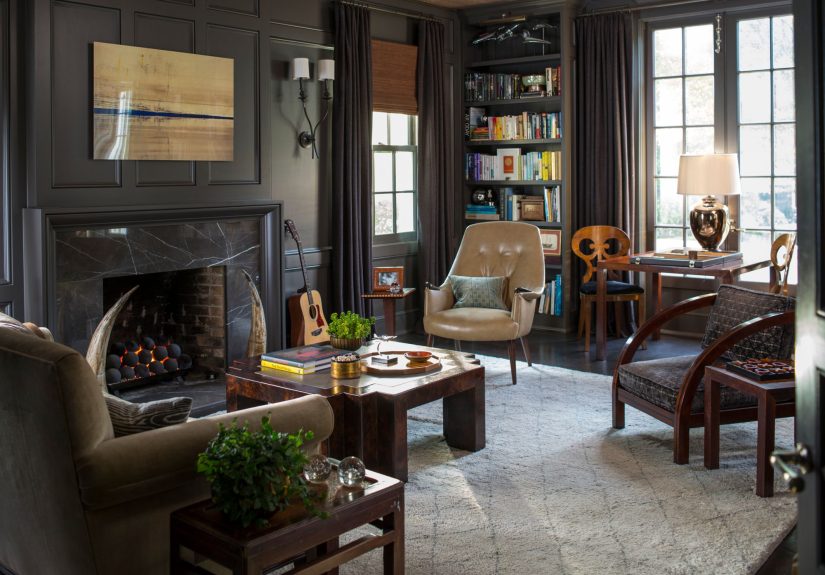
Start with seating that looks good from every angle. A handsome lounge chair, a compact sofa, a leather club chair, or even a curved accent chair can set the tone. The best Ken Den seating invites lingering. It says, “Sit down, stay awhile,” not “Brace your lower back and stare at this television for six hours.”
Warm lighting
Overhead lighting alone is the fastest route to interrogation-room energy. A Ken Den needs layers: a floor lamp near the chair, a table lamp by the books, accent lighting for shelves, maybe even dimmable sconces if you are feeling ambitious. Good lighting is what makes the space feel expensive, even when the budget is not.
Display-worthy storage
Open shelving, built-ins, cabinets with character, or a beautifully styled bookcase can all do the heavy lifting here. The goal is not to hide everything. The goal is to turn storage into storytelling. Books, framed photos, travel finds, ceramics, board games, barware, cameras, sneakers, vinyl, and yes, even the fancy chess set you bought after one dramatic weekend of self-reinvention can all live here.
A beverage ritual
Every Ken Den gets better with a ritual station. That could be a cocktail corner, a coffee setup, an espresso bar, a tea tray, or a nonalcoholic drinks shelf with serious glassware. The idea is less “party bunker” and more “civilized pause button.”
Texture, texture, texture
The upscale feel comes from mixing materials. Wood, boucle, velvet, metal, stone, linen, leather, cane, wool, and glass all help a room feel richer and more dimensional. Even a simple room looks more expensive when it has contrast under control.
Something with soul
This is where the room either comes alive or dies trying. Add the thing that makes it yours: a framed concert poster, inherited barware, travel books, oddball art, a sculptural lamp, a restored stereo cabinet, a vintage map, or the boxing gloves you no longer use but still want to romanticize. A Ken Den needs one or two elements that feel impossible to duplicate exactly.
Five Ken Den Styles That Actually Work
1. The Boutique Hotel Lounge
Think moody paint, tailored upholstery, brass details, low lighting, and a compact bar setup. This is the version for the host who wants every guest to ask, “Wait, why is this nicer than most restaurants?”
2. The Modern Library Retreat
Wall-to-wall shelves, a reading chair, layered rugs, a side table, and art that makes the room feel studied but not stuffy. This style works especially well in smaller dens because books immediately make a room feel intentional.
3. The Analog Escape
No doomscrolling sanctuary here. A turntable, records, card table, chessboard, notebooks, and maybe a hidden door or curtain if you want the room to feel removed from the daily buzz. It is less productivity cave, more nervous-system reset.
4. The Entertainer’s Game Room
Not the sticky-felt basement of your childhood friend. The new version is polished: card table, beautiful shelving, integrated TV, lounge seating, and a proper lighting plan. It is playful, but grown.
5. The Creative Studio Den
For the person with hobbies, this is where the Ken Den gets truly useful. Photography gear, guitars, drawing tools, sewing supplies, journals, or model kits can all live in a room that still looks attractive. Creative energy likes a room that feels both functional and flattering.
How to Build a Ken Den Without Blowing the Budget
You do not need a sprawling basement or custom millwork to pull this off. In fact, some of the best Ken Dens start small because constraints force better decisions.
Use one anchor piece
Pick the item that sets the tone: a great chair, a vintage cabinet, a sculptural lamp, or a fantastic rug. Let that be the room’s handshake.
Upgrade what the eye notices first
Lighting, art, paint color, and shelving matter more than buying fifteen accessories that all look vaguely expensive and collectively say nothing.
Borrow from other categories
A bar cart can become a coffee station. A bookcase can become a bar. A desk can hide in a library corner. A bench can become a listening perch. The Ken Den loves multifunctional furniture because it likes beauty with a side of competence.
Edit aggressively
If you are displaying everything, you are highlighting nothing. Group objects, vary heights, and leave breathing room. Luxury often looks like confidence, and confidence is not shouting from every shelf.
Why the Ken Den Has Staying Power
Unlike some trend names that sound clever for six weeks and embarrassing forever, the Ken Den points to a real shift in how people want to live. It is not just a new label for a spare room. It is a better design philosophy. It values comfort, identity, hospitality, and polish all at once.
That balance gives it staying power. Even if the phrase itself evolves, the idea will remain: private rooms should not be design dead zones. They should feel as considered as kitchens and living rooms. They should support the life you actually live. They should look good in daylight, at night, on your own, and when friends come over.
Ultimately, the Ken Den is not about replacing masculinity with softness or style with irony. It is about proving that personal space can be handsome, welcoming, useful, and fun at the same time. The man cave walked so the Ken Den could moisturize, buy better lighting, and become the best room in the house.
Experience-Driven Add-On: What Living With a Ken Den Actually Feels Like
On paper, the Ken Den sounds like a design trend. In real life, it feels more like a quality-of-life upgrade that sneaks up on you. The biggest difference is not what the room looks like in a photo. It is how the room changes your habits.
Picture someone who used to collapse on the couch at the end of the day and scroll until bedtime. After creating a Ken Den, he starts ending the evening in a chair that actually supports conversation with himself. The lamp is warm. The shelf behind him holds a few favorite books, a camera from college, and a glass set he once thought was “too nice to use.” Suddenly the room asks for better rituals. One drink gets poured carefully. One record gets played all the way through. One idea for tomorrow gets written down. Same person, different room, better ending to the day.
Or imagine the weekend host who used to invite people over and then apologize for the basement before anyone even sat down. After the upgrade, the space becomes the destination. Friends drift toward the bookcase bar, comment on the lighting, fight over the best chair, and linger longer than expected. Nobody says, “Cool man cave.” They say, “This room has great energy.” That is a meaningful shift. The room no longer performs a stereotype. It creates an experience.
There is also the creative version of the Ken Den, which may be the most satisfying of all. A spare bedroom gets turned into a hybrid studio-lounge with a worktable, framed prints, storage that does not look like punishment, and enough style that you want to spend time there. The room stops being where hobbies go to become clutter and starts becoming where hobbies look legitimate. You sit down to practice guitar, sketch, edit photos, or build something with your hands, and the room quietly tells you that this part of your life matters.
Even for people who are not natural decorators, the experience can be surprisingly emotional. A lot of homeowners discover that the Ken Den is the first room in the house they designed almost entirely for themselves. Not for resale. Not for guests. Not because a trend report demanded boucle and fluting. For themselves. That can feel indulgent at first, but it usually turns into relief. The room becomes a permission slip to care about your surroundings in a more intentional way.
And maybe that is the real reason the Ken Den resonates. It is not just prettier than a man cave. It is more honest. It makes room for work, rest, hobbies, hosting, memory, mood, and style without forcing all of that into one tired template. It feels grown-up without being boring, polished without being precious, and personal without looking messy. Once people experience that mix, it is hard to go back. After all, when you have had a den with good lighting, thoughtful shelves, and a drink station that does not involve sad mini-fridge energy, the old cave life starts to look a little… prehistoric.
Conclusion
The Ken Den is the upscale evolution of the man cave because it replaces cliché with character. It keeps the privacy, comfort, and fun people always wanted from a personal retreat, but upgrades the execution with better design, more flexibility, and a sharper sense of identity. Whether your version is a moody lounge, a reading room, a game night hub, or a creative studio, the idea is the same: build a room that reflects who you are now, not a stereotype from fifteen years ago. That is not just good decorating. That is good living.