Table of Contents >> Show >> Hide
- Why sledding safety matters more than people think
- Choose the hill like a safety expert, not a thrill-seeker
- Wear the right gear for safe sledding
- Pick the right sled, not just the fastest one
- How to ride a sled the safer way
- Supervision matters more than parents think
- Do not ignore the cold just because everyone is having fun
- What to do after a crash
- A quick sledding safety checklist before you go
- Conclusion: Keep the thrill, lose the risk
- Real-World Experiences With Sledding Safety Tips
- SEO Tags
Note: This article is for general safety education and practical winter planning. If someone has a possible head, neck, back, or cold-related emergency, seek medical care right away.
Sledding looks innocent enough. It is, after all, one of the few sports where your main equipment can fit in a trunk, a garage corner, or the “we’ll deal with this later” pile near the front door. But that simplicity is exactly why people underestimate it. A snowy hill can feel like pure childhood magic one minute and a very bad idea with momentum the next.
That does not mean families should avoid sledding. It means they should treat it with a little more respect. The best sledding safety tips are not complicated, expensive, or joy-killing. They are mostly about choosing the right hill, wearing the right gear, riding the right way, and knowing when the weather is trying to pick a fight. Get those basics right, and sledding stays in the “best winter memory” category instead of the “why are we at urgent care in snow pants?” category.
Why sledding safety matters more than people think
Sledding is fast, low to the ground, and surprisingly hard to control. That combination is fun, yes, but it also means small mistakes can turn into big impacts. Most serious sledding injuries happen because someone collides with something, falls into a bad position, goes down a dangerous hill, or stays out in the cold too long. In other words, the danger usually is not the snow. It is the setup.
Think of a sled like a very cheerful projectile. It does not care whether the hill ends at a soft patch of snow or a fence post. It does not care whether the rider is sitting upright or launching themselves head-first like a winter penguin with questionable judgment. Safe sledding starts before the first run, not halfway down the hill.
Choose the hill like a safety expert, not a thrill-seeker
Look for a gentle slope with a long, flat run-out
The safest hill is not the tallest one in town or the one your cousin calls “awesome because you hit crazy speed.” It is a hill that is not too steep, has a clear path, and ends in a long flat area where riders can slow down naturally. That flat run-out matters. Without it, a sled may keep going until it meets something solid, and the solid thing always wins.
A good sledding hill should be free of trees, rocks, fences, poles, benches, ditches, parked cars, drop-offs, ponds, streams, or roads at the bottom. If the hill ends near a street, parking lot, or body of water, skip it. No “it should be fine.” No “we’ll just be careful.” No hill is worth testing with your body.
Avoid icy, crowded, or poorly lit spots
Hard-packed ice can turn a normal ride into a high-speed slide with very little control. Overcrowded hills raise the chance of crashes with other riders, especially when kids walk back up through the same path people are racing down. Night sledding can be fun in theory, but if the hill is not clearly lit, hazards become much harder to spot. Daylight is better. If you go at dusk or after dark, visibility needs to be excellent.
Use designated sledding hills when possible
If your community has an official sledding area, that is usually your best bet. Designated hills are often chosen because they have safer terrain, fewer hidden obstacles, and more room to stop. They are not magical bubbles of invincibility, but they are usually safer than the random neighborhood hill that ends near a mailbox and someone’s decorative boulder.
Wear the right gear for safe sledding
Yes, wear a helmet
If there is one piece of advice that shows up over and over in sledding safety guidance, it is this: wear a properly fitted helmet. Head injuries are one of the biggest concerns in sledding accidents, and a helmet adds a meaningful layer of protection. A winter sports helmet is ideal. If that is not available, many safety sources note that a bike helmet is still better than no helmet at all.
This is not just for kids, either. Adults crash too. Adults just do it with more confidence and worse backs. If you are going down the hill, your head deserves the same protection as everyone else’s.
Dress warmly, but avoid anything that can snag
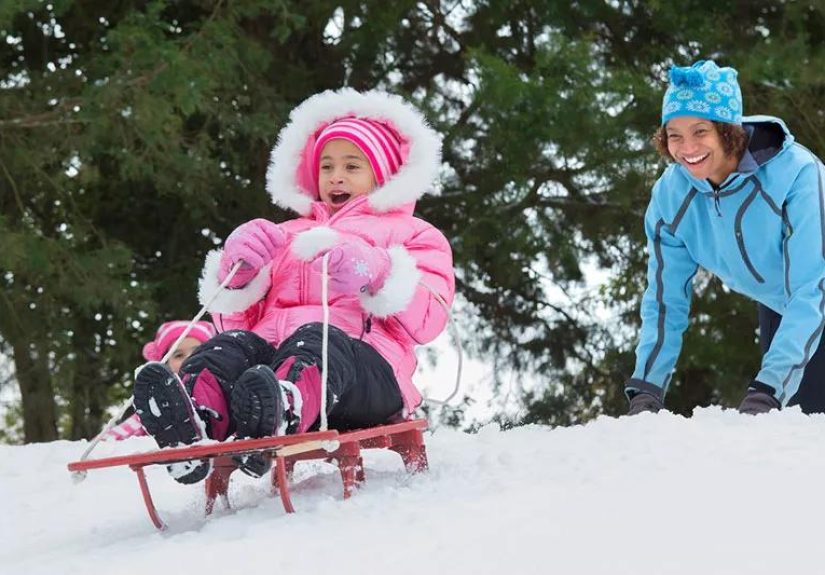
Cold-weather clothing should keep you warm, dry, and able to move. Think hat, gloves or mittens, winter coat, snow pants, and insulated boots with good traction for walking up the hill. Dress in layers so you can adjust if kids get sweaty from climbing back up over and over again. Wet clothing chills the body fast, which is one reason cold-related problems can sneak up on families during a long snow day.
Skip loose scarves or anything long and dangling that could catch on the sled. Tuck in drawstrings, tighten loose gear, and check clothing before the first run. Bright colors also help with visibility, which is useful when you are trying to keep track of three children, two sleds, and one mitten that has apparently chosen freedom.
Inspect the sled before you use it
Check for cracks, broken handles, sharp edges, weak ropes, or anything that looks like it already had a rough season. A sturdy, steerable sled is generally a smarter choice than something flimsy, improvised, or impossible to control. If your sled looks like it lost a fight with the garage wall, let it retire with dignity.
Pick the right sled, not just the fastest one
Not all sleds behave the same way. Steerable sleds with good handholds generally offer more control than discs, tubes, saucers, or improvised options like plastic bins, cardboard, or lunch trays. Those improvised rides may sound hilarious until they launch sideways toward a tree.
Many pediatric and injury-prevention sources caution that tubes and discs can be harder to steer and stop. That does not mean every run on one is guaranteed disaster. It means they can be less forgiving, especially on crowded or fast hills. If you are choosing equipment for children, lean toward control over chaos. Winter fun should not depend on “just vibe and hope.”
How to ride a sled the safer way
Feet first, seated, and facing forward
This is the golden rule of sledding posture. Riders should sit upright, face forward, and go down the hill feet first. Going head-first increases the risk of serious head, face, and neck injuries. Standing on a sled is also a terrible idea unless your long-term goal is to become a cautionary tale at family gatherings.
Feet-first riding gives better control and helps protect the head in a crash. Keep arms and legs inside the sled rather than dragging them like emergency brakes. That habit can lead to twisted limbs, fingers caught in the snow, or awkward spills.
One rider at a time is usually the safer call
Each sled should follow the manufacturer’s guidance for rider limits. In general, overloading a sled makes it harder to control. Many safety resources recommend one rider per sled, especially on regular hills, because extra weight can mean more speed and a harder impact. If a child is very young, use a tiny beginner slope and close adult assistance rather than piling onto a steep hill together and hoping physics becomes sentimental.
Wait for a clear path
Do not start downhill if someone is still in the landing area. That sounds obvious, but a lot of collisions happen because excited riders launch before the path is clear. Make “look first, then go” a house rule. On busy hills, that one habit may be the difference between an ordinary snow day and a dramatic group text.
Walk back up the side of the hill
Never climb back up through the center of the sledding lane. Riders coming downhill may not be able to stop or swerve in time. Use the side of the hill for walking, keep the main lane clear, and teach children to check for incoming sledders before crossing any run-out area.
No jumps, ramps, or vehicle towing
If you want airtime, choose a different hobby. Homemade jumps and ramps increase the risk of hard falls and unpredictable crashes. And towing a sled behind a car, ATV, snowmobile, bike, or anything motorized is an absolute no. That is not advanced sledding. That is preventable danger wearing a winter hat.
Supervision matters more than parents think
Adult supervision is one of the simplest ways to reduce risk. Children should not be left to figure out hill safety, spacing, weather limits, equipment checks, and collision prevention on their own. A supervising adult can choose safer terrain, enforce turn-taking, spot fatigue, and step in before the “fun idea” becomes a bad one.
Younger children need especially close supervision. They may not judge speed or distance well, and they are more likely to wander into a run path or forget basic rules when the snow gets exciting. Separate younger kids from bigger, faster riders when possible. A hill full of teenagers trying to break land-speed records is not the ideal classroom for a preschooler learning how to sit still on a sled.
Do not ignore the cold just because everyone is having fun
Cold stress is part of sledding safety
Sledding injuries are not always crash-related. Frostbite and hypothermia are real concerns during long winter outings, especially when clothing gets wet or the temperature drops quickly. Kids are famous for ignoring their own discomfort until they are suddenly freezing, tearful, and somehow missing one glove.
Bring children inside for regular warming breaks. Change wet socks, mittens, and pants right away. Offer water and a snack. Being outdoors in winter is physical work, and tired, cold kids make poorer decisions on the hill.
Know the warning signs
Watch exposed areas like fingers, toes, ears, cheeks, and noses. If skin becomes numb, painful, pale, waxy, or white-gray, it may be an early sign of frostbite. Hypothermia is more serious and can show up as intense shivering, confusion, unusual sleepiness, poor coordination, or slurred speech. If someone seems “off,” stop sledding and warm them up immediately. If symptoms are severe or persistent, get medical care.
What to do after a crash
Not every spill is dramatic, but every hard fall deserves a quick check. Stop and assess the rider before encouraging them to “shake it off.” If there is head pain, vomiting, dizziness, confusion, loss of consciousness, neck pain, back pain, or trouble moving a limb, that is not business as usual. Get help.
Even when injuries seem minor, it is smart to be cautious. Children sometimes minimize pain because they want one more run. Adults do the same thing, except they add phrases like, “I’m fine,” while moving exactly like someone who is not fine.
A quick sledding safety checklist before you go
- Choose a hill with a clear path and a long, flat stopping area.
- Avoid roads, parking lots, trees, poles, rocks, water, and drop-offs.
- Use a sturdy sled with better control whenever possible.
- Wear a properly fitted helmet.
- Dress in warm layers, waterproof outerwear, gloves, and boots.
- Skip scarves and anything loose that could snag.
- Ride seated, facing forward, and feet first.
- Send one sled only when the path is clear.
- Walk up the side of the hill, not the middle.
- Do not build jumps or tow sleds with vehicles.
- Take warming breaks and change wet clothes quickly.
- Supervise children closely, especially younger riders.
Conclusion: Keep the thrill, lose the risk
The best sledding safety tips are not about making winter boring. They are about making winter repeatable. Families should be able to go sledding, come home rosy-cheeked and tired, drink something warm, and laugh about the wipeouts that were funny instead of frightening. That outcome is much more likely when you plan ahead.
So pick the safe hill. Wear the helmet. Sit down, point your feet downhill, and leave the daredevil nonsense to cartoon characters. Sledding is supposed to give you a rush, not a discharge summary. When you respect the hill, the weather, and the rules, you get the best part of winter without paying for it the hard way.
Real-World Experiences With Sledding Safety Tips
Anyone who has spent time on a sledding hill knows safety advice feels very theoretical until you see it play out in real life. The family who arrives first with matching helmets and a thermos of hot chocolate may look a little overprepared at first glance. Two hours later, they usually look like the smartest people there. Their kids are still warm, still taking turns, and still having fun while everybody else is negotiating wet socks, lost hats, and increasingly questionable decisions.
One of the most common real-world lessons is how quickly a “pretty good hill” reveals itself to be a bad one. Maybe it looked fine from the sidewalk, but once kids start picking up speed, the fence at the bottom suddenly feels much closer. Or the hill seems gentle until a sled hits an icy patch and starts turning sideways. Parents often say the same thing afterward: the danger was not obvious until the sled was already moving. That is why checking the full path before anyone rides matters so much.
Another experience families talk about is the difference a helmet makes in peace of mind. Even when there is no crash, a helmet changes the whole tone of the outing. Parents relax a little. Kids get a visible reminder that sledding is fun but not reckless. And when someone does tip over or bump into another rider, everyone is grateful that at least one major risk was taken seriously from the start.
There is also a practical lesson in supervision that most adults learn quickly: children do not get more cautious as they get colder and tireder. They get sillier. The last half hour of a sledding trip is often when the odd choices start. Someone wants to go backward. Someone wants to ride with three people on one sled. Someone is convinced a homemade jump is a brilliant innovation worthy of winter history books. This is usually the moment when a warm-up break, a snack, or calling it a day becomes the true expert move.
Experienced winter parents also know that the walk back up the hill can be as important as the ride down. On busy slopes, many near-misses happen because excited kids charge uphill through the center lane without looking. Once families start using the side of the hill consistently, the whole area feels calmer and more organized. It is not glamorous advice, but it works.
And then there is the weather itself. Plenty of families have stories about the child who insisted they were “not cold at all” while wearing one soaked mitten and snow packed into both boots. Cold stress rarely announces itself dramatically at first. It creeps in through wet clothes, red cheeks, numb fingers, and slowing energy. Parents who build in regular breaks often say the day lasts longer and goes better because they stopped problems before anyone reached the miserable stage.
In the end, real sledding experience tends to prove the same thing safety experts have said all along: the fun does not come from pushing every limit. It comes from setting up the day well enough that everyone gets to enjoy the speed, the laughter, and the winter magic without turning the outing into a cautionary legend. The safest families are not the least adventurous. They are just the ones who know that good memories usually start with good decisions.