Table of Contents >> Show >> Hide
- What Is The Line, Exactly?
- Why Saudi Arabia Wants a Straight-Line City
- Why The Idea Is So Fascinating
- The Problem With a City That Looks Great in a Rendering
- Cost, Delays, and the Great Reality Check
- Human Rights and Environmental Concerns
- What The Line Means Now
- What Experiencing The Line Might Actually Feel Like
- Conclusion
Some countries build a new neighborhood. Saudi Arabia looked at the desert, looked at the future, and said, “What if we built a city that was basically a giant ruler?” That, in a very shiny nutshell, is THE LINE, the headline-grabbing project inside NEOM and one of Crown Prince Mohammed bin Salman’s boldest bets on the future. It is part urban experiment, part branding exercise, part engineering moonshot, and part debate magnet.
At first glance, the concept sounds like something dreamed up during a late-night brainstorming session fueled by espresso and science-fiction movies: a linear city stretching across the landscape, free of cars and streets, with high-speed transit, walkable communities, mirrored facades, and a promise that people can live closer to nature while surrounded by advanced technology. In theory, it is the anti-sprawl city. In practice, it has become one of the most controversial urban projects on Earth.
This is why MBS’s Line City keeps pulling global attention. It is not just a construction project. It is a statement about what Saudi Arabia wants to be after oil dominates less of the conversation. It is also a test of whether grand visions can survive basic things like budgets, physics, politics, logistics, and the timeless human preference for cities that do not feel like someone turned a skyscraper sideways and kept going.
What Is The Line, Exactly?
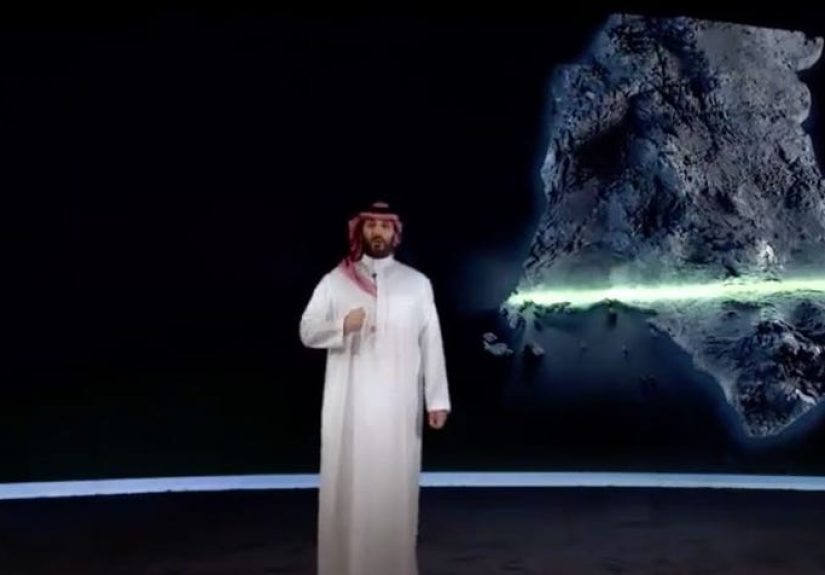
THE LINE is the flagship urban concept within NEOM, the giant development zone in northwestern Saudi Arabia. The official pitch has long described it as a 170-kilometer linear city with a narrow footprint, no cars, no traditional streets, and daily essentials reachable within a five-minute walk. The design is meant to stack urban functions vertically, with pedestrian layers, infrastructure layers, and a high-speed transit system built into the concept from the beginning.
The scale is where the project stops being merely ambitious and starts sounding like architecture after too much caffeine. Saudi Arabia’s original public vision for THE LINE described mirrored walls rising roughly 500 meters high and enclosing a city about 200 meters wide. The long-term population target was framed in the millions. That immediately set it apart from normal urban development. This was not a new district or a fresh capital. It was presented as a full reset button for city design.
The sales pitch is easy to understand. Urban sprawl wastes land, forces car dependency, stretches infrastructure, and often turns daily life into a commute sandwich. THE LINE proposes the opposite: compact living, instant access to services, clean mobility, and a futuristic urban form that says, “What if convenience and density actually dated each other instead of just texting?”
Why Saudi Arabia Wants a Straight-Line City
To understand why Saudi Arabia wants to build a city in a straight line, you have to zoom out to Vision 2030, the kingdom’s larger effort to diversify its economy, attract investment, create jobs, and reduce dependence on oil revenue. In that framework, NEOM is not just real estate. It is a symbol. It is meant to tell the world that Saudi Arabia wants to be seen as a laboratory for technology, tourism, design, logistics, renewable energy, and big-ticket innovation.
In branding terms, THE LINE is a masterpiece. Plenty of countries can announce a mixed-use development. Fewer can unveil a mirrored megastructure across the desert and instantly dominate headlines. The project turns urban planning into geopolitical theater. It says the kingdom is not content with incremental change. It wants a visual icon large enough to be visible from space, or at least from a PowerPoint deck so dramatic it deserves its own soundtrack.
There is also a practical argument buried beneath the spectacle. Saudi Arabia, like many countries, faces questions about housing, infrastructure efficiency, sustainability, and economic competitiveness. A dense, transit-first city sounds attractive on paper because it promises to reduce travel times, lower per-capita infrastructure costs, and create a cluster for new industries. For policymakers, that is not just sexy marketing. It is strategic storytelling tied to national transformation.
Why The Idea Is So Fascinating
The fascination with THE LINE comes from the fact that it borrows from real urban anxieties. People are tired of traffic. They are tired of endless suburbs, isolated towers, bad transit, and cities that feel like they were designed by committee and then value-engineered into disappointment. So when a project arrives promising walkability, integrated transit, renewable energy, and a city built around human access instead of car storage, ears perk up.
There is also the appeal of total design control. Most major cities evolve through centuries of compromise, conflict, layering, and accidental weirdness. That is part of their charm, but it also means they are hard to fix. THE LINE skips that slow process and asks a very modern question: what if we designed a city all at once, using data, engineering, and infrastructure logic from day one?
That question is why even skeptical observers keep watching. The project is outrageous, yes, but it also forces a useful conversation about the future of urban life. Can density be beautiful? Can transit shape cities better than highways? Can daily needs be clustered so tightly that errands stop feeling like military campaigns? Even people rolling their eyes at the renderings often admit the underlying questions are worth asking.
The Problem With a City That Looks Great in a Rendering
This is the part where the glossy brochure meets the grumpy calculator.
Critics of MBS’s Line City argue that the very form that makes it famous may also make it deeply impractical. A city in a straight line is elegant as an image, but real cities thrive on overlapping networks, multiple centers, messy interactions, and flexible circulation. Urban life is not just about moving from point A to point B. It is about creating countless point Cs, Ds, and Es in between. That is hard to do in a hyper-rigid linear format.
Architects and planners have also questioned whether a city this tall, narrow, and long would feel genuinely livable. What would light be like at lower levels? How would evacuation, maintenance, and emergency services work at full scale? Would neighborhoods feel organic, or would they feel like premium corridors inside a climate-controlled megastructure? The problem is not only engineering. It is psychology. Human beings like cities that surprise them. They do not always dream of living inside a very expensive geometry lesson.
Another criticism involves scale and timeline. Grand projects often become more difficult, more expensive, and more politically sensitive as they leave the rendering stage and collide with material reality. Steel, glass, labor, infrastructure, water, cooling, transit systems, digital systems, and supply chains all cost money. Then they cost more money. Then someone discovers the original estimate belonged in the fantasy section.
Cost, Delays, and the Great Reality Check
Outside reporting over the last two years has repeatedly suggested that THE LINE has faced serious reassessment. Analysts and major outlets have described rising costs, shifting priorities, and scaled-back near-term ambitions compared with the original presentation. That does not necessarily mean the project disappears. It does mean the version that gets built may be much smaller, slower, and more modular than the dazzling first reveal.
And honestly, that is often how mega-projects work. Vision arrives in a cape. Construction shows up in a hard hat and asks for revised numbers.
Saudi officials have publicly defended NEOM and rejected some claims that the project’s scale has fundamentally changed. Even so, the broader public conversation has clearly moved. The question is no longer just, “Can Saudi Arabia build a city in a straight line?” It is now, “How much of it can be built, by when, at what cost, and for whom?” Those are much less cinematic questions, but they are the ones that matter.
The project has also drawn attention because its economics are connected to broader Saudi priorities. Vision 2030 includes many large investments across tourism, sports, infrastructure, and industry. That creates competition for capital and political focus. When conditions change, states do what companies do: they reprioritize. A futuristic megacity may still matter, but it might matter differently than it did when the marketing video first dropped and the internet collectively said, “Well, that escalated quickly.”
Human Rights and Environmental Concerns
THE LINE is not controversial only because of design or cost. It has also faced major criticism tied to human rights and environmental concerns. Reports and commentary from prominent outlets and advocacy voices have raised alarm about displacement connected to the project area, particularly involving members of the Huwaitat tribe. That means the story of THE LINE is not just about technology and sustainability language. It is also about who bears the cost when states pursue monumental development.
Then there is the environmental contradiction that hangs over the whole idea like a beautifully mirrored cloud. The project markets itself around clean energy, reduced car dependency, and a lighter urban footprint. Yet constructing a gigantic steel-and-glass megastructure in a harsh desert environment demands enormous material inputs, energy, logistics, and ecological disturbance. Critics have also pointed to the risks such a vast mirrored form could pose to wildlife, including migratory birds.
So while the branding language emphasizes sustainability, many observers argue that the embodied carbon and environmental disruption of actually building THE LINE could undermine much of the green narrative. That tension is now central to how the world reads the project. Is it a climate-conscious urban prototype, or a massive resource-intensive monument wearing a sustainability nametag?
What The Line Means Now
As of today, THE LINE still matters because it captures a larger global mood. Around the world, governments, developers, and tech evangelists are searching for the next city model. They want density without dysfunction, innovation without disorder, and growth without the mess that usually comes with real life. Saudi Arabia’s straight-line city is the boldest version of that dream ever publicly sold.
But it is also a warning. Cities are not just objects. They are ecosystems of behavior, history, culture, economics, and improvisation. The more a project tries to master every variable from the top down, the more it risks misunderstanding what makes cities work in the first place. People do not only need efficiency. They need character, friction, surprise, memory, and room for unplanned life.
That is why MBS’s Line City remains so compelling. It sits at the intersection of ambition and absurdity, innovation and image-making, sustainability language and material reality. It may yet produce useful infrastructure, new districts, or successful parts. It may also become one of the great cautionary tales of 21st-century development. Either way, the world is watching because THE LINE is bigger than a building plan. It is a referendum on whether the future can be master-planned into existence.
What Experiencing The Line Might Actually Feel Like
Imagine arriving at THE LINE for the first time. From a distance, it would not look like a city in the traditional sense. It would look like a decision. A sharp, reflective stroke across the landscape, so clean and controlled that it might feel less like urban fabric and more like an edit made to the desert itself. You would not roll into a skyline with random towers and patchwork neighborhoods. You would approach a singular object, a city that behaves more like infrastructure than settlement.
The first emotional reaction would probably be awe. Not because every city resident secretly wants to live inside a giant mirror, but because scale like this has a way of short-circuiting ordinary judgment. Human beings are wired to react to things that are too large, too strange, or too deliberate to ignore. THE LINE, if experienced in person, would almost certainly produce that sensation. It would feel engineered to overwhelm you before it ever tried to charm you.
Once inside, the experience might shift quickly from spectacle to curiosity. If the project delivered on its promises, daily life could feel unusually frictionless. Groceries, schools, clinics, parks, and transit could be astonishingly close. A resident might step out for coffee, pick up a prescription, meet a friend, and return home without touching a car, crossing a giant parking lot, or budgeting half a day for “simple errands.” For people used to traffic-heavy cities, that could feel almost magical.
At the same time, there might be a strange uniformity to the place. Traditional cities reveal themselves through detours, old corners, accidental storefronts, local smells, and neighborhoods with totally different personalities. A linear megacity could struggle to create that same feeling of organic discovery. Even if each district were designed with its own character, visitors might still sense the master plan everywhere. The city could be efficient, dramatic, and comfortable while still feeling unusually curated, like life was happening inside a premium simulation with excellent transit and suspiciously tidy edges.
There is also the emotional experience of living in a place built around constant systems management. In theory, advanced technology could make the city more responsive and convenient. In practice, some residents might love that intelligence-driven convenience, while others might find it slightly unnerving. A hyper-connected city can feel smart; it can also feel like the building knows more about your habits than your best friend does. Some people call that innovation. Others call it a reason to suddenly miss dumb sidewalks.
Then there is the landscape itself. One of the most interesting promises behind THE LINE is that it tries to compress urban life so tightly that the surrounding environment remains more accessible. If that worked, residents might enjoy a rare contrast: intense urban density inside, dramatic natural scenery outside. That rhythm could be powerful. You could spend the morning in a dense vertical neighborhood and the evening looking out at desert, mountains, or sea. In the best-case version, that contrast would feel refreshing rather than disorienting.
But experience is never just about architecture. It is also about social texture. Would THE LINE feel like a real city with spontaneous culture, conflicting identities, subcultures, favorite corners, annoying shortcuts, and beloved imperfections? Or would it feel more like a managed environment where the hardware arrived before the soul did? That may be the biggest question of all. Great cities are not remembered only for how they move people. They are remembered for how they make people feel while getting gloriously, inconveniently, human things wrong and right.
So the real experience of THE LINE, if it comes close to its ambition, would probably be a blend of wonder, convenience, unease, admiration, and debate. You might walk through it thinking, “This is the future.” Then ten minutes later think, “This is the strangest mall, train station, sci-fi set, and urban experiment I have ever seen.” And honestly, that mixed reaction may be the most believable part of the whole project.
Conclusion
Saudi Arabia’s plan to build a city in a straight line remains one of the most astonishing development stories of the modern era. THE LINE is futuristic, provocative, visually unforgettable, and full of ideas that tap into real urban frustrations. It is also burdened by profound questions about practicality, cost, environmental trade-offs, governance, and human consequences. That tension is exactly why the project still dominates discussion.
If it succeeds, even partially, it could reshape how planners think about density, transit, and urban form. If it stumbles, it will still matter as a lesson in the limits of top-down futurism. Either way, MBS’s Line City has already achieved one thing beyond doubt: it made the whole world argue about what a city should be. And for a project built in a straight line, it has generated a very tangled conversation.