Table of Contents >> Show >> Hide
- Does Pilates Work for Weight Loss? The Short Answer
- How Weight Loss Actually Happens (and Where Pilates Fits)
- What the Research Says About Pilates and Weight Loss
- How Many Calories Does Pilates Burn?
- Why Pilates Can Be Great for Weight Loss (Even If It’s Not “Best” for Calorie Burn)
- When Pilates May Not Be Enough for Weight Loss by Itself
- How to Use Pilates for Weight Loss (Without Wasting Your Time)
- Mat Pilates vs. Reformer Pilates for Weight Loss
- A Beginner-Friendly Weekly Plan (Example)
- Common Mistakes to Avoid
- Safety Tips Before You Start
- Real-World Experiences with Pilates for Weight Loss (500+ Words)
- Conclusion
If you’ve ever finished a Pilates class feeling taller, stronger, and suspiciously aware of muscles you didn’t know existed, you’re not alone. Pilates has a way of making you feel like a graceful athlete and a shaky baby deer at the same time. But the big question remains: Can Pilates actually help with weight loss?
The honest answer is: yes, Pilates can support weight loss but it usually works best as part of a bigger plan, not as a magical one-workout solution. Pilates can help you build strength, improve consistency, increase daily movement, and support better body composition. It may also improve posture and body awareness, which can make other workouts (and everyday life) feel easier. However, if your main goal is to lose weight, Pilates tends to work best when paired with nutrition habits, enough weekly activity, and sometimes additional cardio.
In other words, Pilates is not a scam, not a miracle, and definitely not just “stretching on a fancy bed.” It’s a smart tool and tools work best when you use the whole toolbox.
Does Pilates Work for Weight Loss? The Short Answer
Yes, Pilates can help with weight loss, especially if you’re new to exercise, returning after a break, or looking for a low-impact routine you can stick with consistently.
That said, Pilates is usually not the fastest way to burn calories compared with higher-intensity cardio workouts like running, cycling, or interval training. Where Pilates shines is in the “long game”:
- It helps you build strength and muscle endurance.
- It improves movement quality and core stability.
- It can make exercise feel more accessible (which improves consistency).
- It may reduce discomfort that keeps people from moving more.
- It complements walking, strength training, and cardio very well.
If weight loss is your goal, think of Pilates as a powerful support player sometimes the MVP for consistency rather than the only player on the field.
How Weight Loss Actually Happens (and Where Pilates Fits)
Weight loss generally happens when your body uses more energy than you consume over time (a calorie deficit). That doesn’t mean you have to count every almond or fear pasta forever. It does mean that exercise alone often isn’t enough unless your eating habits also support your goal.
Pilates fits into this process in several useful ways:
1) It burns calories (just not usually as many as hard cardio)
Pilates does increase energy expenditure. The exact amount depends on the class style (mat vs. reformer), your body size, experience level, and how hard you work. A gentle beginner class will burn less than a faster-paced, strength-focused reformer session.
2) It helps build and maintain muscle
Muscle tissue is metabolically active, and resistance-style exercise supports body composition during weight loss. Pilates is not the same as heavy lifting, but it can still challenge muscles, especially the core, glutes, hips, and postural muscles. This matters because many people want to lose fat while keeping strength and function.
3) It improves consistency (the underrated superpower)
Low-impact workouts are often easier to recover from and easier to repeat. And repetition is where results happen. The “best” workout for weight loss is usually the one you can do regularly without dreading your life choices.
4) It can improve movement, posture, and confidence
When your back feels better, your balance improves, and you feel stronger in your body, you’re more likely to walk more, train more, and stay active throughout the day. That indirect effect can be huge for weight management.
What the Research Says About Pilates and Weight Loss
The research on Pilates and weight loss is encouraging but not perfectly clean or uniform. That’s important. If someone tells you “Pilates always melts fat,” they are overselling it.
Some studies and meta-analyses suggest Pilates can reduce body weight, BMI, and body fat percentage in adults with overweight or obesity, especially over longer programs. But other reviews (particularly on mat Pilates in healthy adults) found Pilates was not necessarily superior to other exercise types or control conditions for body composition changes.
That doesn’t mean Pilates “doesn’t work.” It means:
- Results vary by population (beginner vs. trained, healthy vs. obesity).
- Program design matters (duration, frequency, intensity, supervision).
- Mat and reformer Pilates are not the same training stimulus.
- Diet and total activity levels strongly affect outcomes.
A practical takeaway: Pilates can absolutely be part of an effective weight-loss plan, but it doesn’t appear to be uniquely superior to all other exercise methods for fat loss. It’s one good option and for many people, it’s a great one.
How Many Calories Does Pilates Burn?
This is the question everyone asks, often right after class while lying on the mat and questioning their life. The short answer: it depends.
Calorie burn in Pilates varies based on:
- Mat vs. reformer
- Class intensity and pacing
- Your weight and body composition
- Fitness level and movement efficiency
- Rest periods
- Instructor programming
General estimates often place mat Pilates in a moderate calorie-burn range compared with higher-intensity cardio. Reformer classes may burn more, especially if they are more dynamic and resistance-focused. But no number is universal, and wearable trackers can be wildly dramatic (sometimes optimistic, like your friend who “burned 900 calories” in a 45-minute class and definitely did not).
The important point: calorie burn is only one part of the story. Pilates may support weight loss even when the calorie burn per session is modest, because it improves strength, adherence, recovery, and the ability to stay active overall.
Why Pilates Can Be Great for Weight Loss (Even If It’s Not “Best” for Calorie Burn)
It’s low impact and joint-friendly for many people
Pilates is often easier on the joints than high-impact workouts. That makes it a helpful option for beginners, older adults, or people easing back into exercise. If jumping workouts flare up your knees or back, Pilates may help you build a foundation so you can move more comfortably.
It trains the core and not just the “six-pack” muscles
Pilates emphasizes deep core control, trunk stability, breathing, and alignment. Stronger core muscles can improve posture, movement efficiency, and confidence in daily activities and other workouts.
It supports balance, flexibility, and body awareness
These improvements may not show up directly on the scale, but they absolutely matter. Better balance and flexibility can make you more capable and less injury-prone. Body awareness can also help you notice fatigue, stress eating patterns, and movement habits.
It complements cardio and strength training
If your weekly plan includes walking, cycling, or strength training, Pilates can fill in the gaps by improving mobility, control, and stability. A smarter body tends to move more and move better.
When Pilates May Not Be Enough for Weight Loss by Itself
Pilates alone may not produce the results you want if:
- You do only one short class per week.
- Your classes are very gentle and not progressively challenging.
- Your nutrition habits consistently exceed your energy needs.
- You are mostly sedentary outside of class.
- You expect spot reduction (for example, “I’m doing core work, so my belly fat should disappear first”).
Also, weight loss is not always linear. Some people lose inches before pounds. Some gain a little muscle while losing fat, so the scale barely moves while their clothes fit better. Pilates is especially likely to create those “I look different before the scale says so” moments.
How to Use Pilates for Weight Loss (Without Wasting Your Time)
If you want results, here’s a realistic strategy that combines Pilates with evidence-based habits.
1) Do Pilates 2–4 times per week
Consistency matters more than perfection. Two sessions weekly can help you build skill and strength. Three to four sessions may produce more noticeable changes in conditioning and body composition, especially when paired with other activity.
2) Add cardio on most weeks
Walking, cycling, swimming, dancing, or intervals can help increase total weekly energy expenditure. Even brisk walking is effective when done consistently. If you love Pilates but not running, great walk more. Your body does not care whether your cardio looks cool on social media.
3) Include progressive challenge
If every class feels exactly the same forever, your body adapts. Progress can come from:
- More control and range of motion
- Harder variations
- Longer sessions
- Shorter rest periods
- Reformer resistance changes
- Better form under fatigue
4) Keep nutrition simple and sustainable
You do not need a punishment diet. You do need habits you can repeat:
- Prioritize protein and fiber
- Build most meals around minimally processed foods
- Watch liquid calories and “healthy” snack creep
- Use portion awareness, not food guilt
- Aim for a moderate calorie deficit, not a crash diet
5) Increase non-exercise movement (NEAT)
NEAT (non-exercise activity thermogenesis) includes walking, chores, errands, standing, and generally not becoming one with the couch. Pilates can make daily movement feel better, which may naturally raise your activity levels.
6) Sleep and stress still matter
Poor sleep and chronic stress can make weight loss harder by affecting appetite, energy, and recovery. Pilates may help some people unwind, especially with breathing-focused classes another indirect win.
Mat Pilates vs. Reformer Pilates for Weight Loss
Mat Pilates
- Usually more affordable and accessible
- Easy to do at home
- Excellent for core control, mobility, and technique
- Can be challenging, but intensity varies a lot
Reformer Pilates
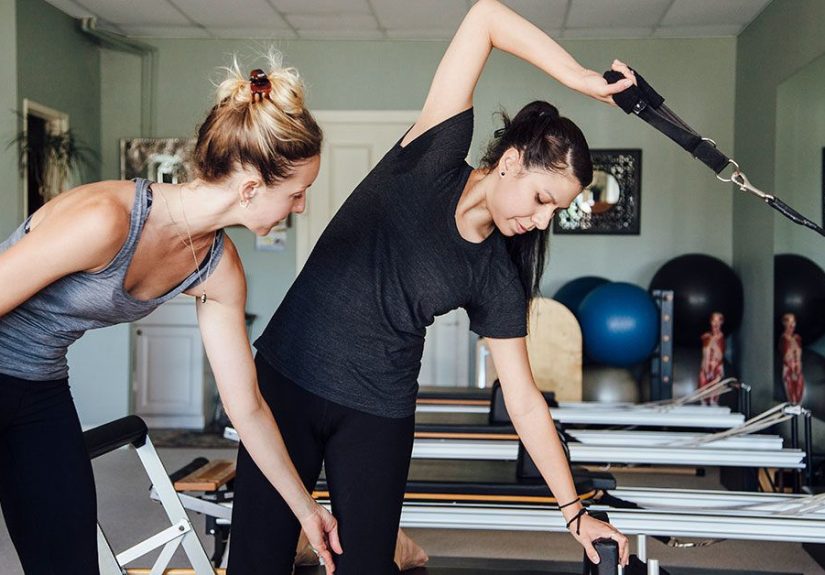
- Uses spring resistance and a moving carriage
- May feel more strength-focused or dynamic depending on class style
- Often easier to scale up or down with instructor guidance
- Usually more expensive, but can improve adherence if you love the format
For weight loss, neither is automatically “best.” The better choice is the one you can do safely, consistently, and progressively.
A Beginner-Friendly Weekly Plan (Example)
Here’s a simple plan if your goal is fat loss with better strength and mobility:
- Monday: Pilates (45–60 min)
- Tuesday: Brisk walk (30–45 min)
- Wednesday: Pilates (45 min) + short walk
- Thursday: Rest or gentle mobility
- Friday: Cardio (30–40 min) or strength training
- Saturday: Pilates (45–60 min)
- Sunday: Easy walk, stretching, or full rest
This kind of schedule blends core work, resistance-style training, and aerobic movement a much stronger formula for weight loss than relying on one type of exercise alone.
Common Mistakes to Avoid
- Only tracking the scale. Take waist measurements, progress photos, and note how your clothes fit.
- Doing Pilates but staying sedentary all day. One class cannot fully cancel 12 hours of sitting.
- Eating back all “exercise calories.” Tracker estimates are often inaccurate.
- Ignoring intensity. A gentle recovery session and a challenging reformer session are not the same stimulus.
- Comparing your results to influencers. Lighting, genetics, and camera angles are undefeated.
- Progressing too fast. Form matters in Pilates. Rushing can lead to frustration or injury.
Safety Tips Before You Start
Pilates is generally a low-impact option, but it still counts as exercise. If you are pregnant, recovering from surgery, dealing with chronic pain, or managing a medical condition, check with a healthcare professional before starting. A qualified instructor can also help modify movements for your needs.
If you’re new, start slow. Pilates can look graceful, but the muscle fatigue is very real. It’s normal to feel challenged. It is not normal to push through sharp pain just because the playlist is motivating.
Real-World Experiences with Pilates for Weight Loss (500+ Words)
One reason Pilates gets strong reviews from real people is that the experience often changes before the scale does. That can be frustrating at first especially if you started because you wanted a visible transformation yesterday but it’s also why many people stick with it longer than other workouts.
A very common experience is this: during the first few weeks, people notice posture, energy, and muscle awareness changes before weight loss. Someone who works at a desk all day may say, “I’m not lighter yet, but I’m sitting up straighter and my lower back doesn’t bark at me by 3 p.m.” That matters more than it sounds. When you feel better in your body, you usually move more outside of class, and that extra movement adds up.
Another common experience is the “hidden intensity” surprise. Pilates doesn’t always look dramatic from the outside. There may be no jumping, no slamming weights, no heroic grunting (unless you count controlled breathing and quiet regret). Then class ends, and your core, glutes, and legs are humming. People often realize Pilates can be much more demanding than they expected, especially in slower, controlled sequences where form is strict and muscles stay under tension.
People trying to lose weight also frequently report better consistency with Pilates than with high-impact programs. For example, someone might quit boot camp after two weeks because their knees hurt, but they can handle Pilates three times a week and actually look forward to it. From a weight-loss perspective, that’s a big win. A “less intense” plan done consistently often beats an “optimal” plan abandoned by week three.
There’s also the body-composition effect. Many people describe looking leaner or more toned even when the scale changes slowly. That may happen because they’re improving muscle tone and posture while reducing some body fat over time. Clothes can fit differently, waistlines can shrink, and posture can make the entire frame look stronger. This is why progress photos and measurements are often more helpful than daily weigh-ins.
Some people do hit a plateau with Pilates-only routines, especially if their sessions are gentle and their eating habits haven’t changed. A typical story sounds like this: “I loved Pilates, felt stronger, but my weight stopped moving after the first month.” When they add brisk walking, improve sleep, or tighten up portions and protein intake, progress often resumes. The lesson is not that Pilates failed it’s that Pilates was one piece of the puzzle.
Reformer Pilates users often describe a different experience from mat beginners. They may feel more challenged by the resistance and the variety of movement patterns, which can make workouts feel more engaging. Some say the reformer helps them understand alignment and muscle activation better because the equipment gives more feedback. On the other hand, mat Pilates can be incredibly effective once technique improves, and it’s easier to continue at home without paying studio prices. So the “best experience” often depends on budget, access, and personal preference.
Another overlooked experience: improved confidence. Many people start Pilates thinking they are “not flexible enough” or “not fit enough.” A good instructor proves otherwise quickly with modifications. As people build competence, they become more willing to try other activities walking farther, strength training, joining a gym, hiking, or simply moving more in everyday life. That confidence can become a quiet but powerful driver of long-term weight management.
In short, the most realistic Pilates weight-loss experience is not usually a dramatic one-week transformation. It’s a steady progression: better movement, better consistency, better strength, better habits and then, with the right overall plan, better weight-loss results. Not flashy, but very effective. And honestly, sustainable progress is a lot less stressful than trying to “sweat off” your goals in a single heroic workout.
Conclusion
Pilates can work for weight loss especially when it helps you stay consistent, build strength, and move better. It may not burn as many calories as intense cardio, but it offers real benefits for body composition, posture, core strength, flexibility, and long-term exercise adherence. For the best results, combine Pilates with regular aerobic activity, smart nutrition habits, and a routine you can actually maintain.
If you enjoy Pilates, that’s not a minor detail it’s the whole game. The workout you can stick with is the one most likely to help you reach your goals.