Table of Contents >> Show >> Hide
- Why Some Last Names Sound “Offensive” (And Usually Aren’t)
- The Greatest Hits of Awkward Moments
- When It’s Not Just Jokes: Real-World Downsides
- How People Cope (Without Changing Who They Are)
- Considering a Legal Name Change?
- A Note for Everyone Else: Be the Person Who Doesn’t Make It Weird
- Extra : More Real-Life “Offensive Surname” Experiences
- Conclusion
Every family has a story. Some families also have a last name that makes that story
way harder to tell without someone giggling, blushing, or “helpfully” suggesting a nickname.
If your surname looks like a swear word, sounds like a body part, or accidentally resembles a phrase your
middle-school classmates were way too excited to learn, congratulations:
you’ve been drafted into a lifelong comedy routine you did not audition for.
This isn’t just about crude jokes (thoughyesthere will be crude jokes). It’s about the weird little
frictions that pop up in modern life when a perfectly normal family name collides with autocorrect,
customer service scripts, classroom roll call, and forms that treat your identity like a rejected password.
And somehow, the people living with these “offensive” last names manage to be both the punchline
and the hero of their own story.
Why Some Last Names Sound “Offensive” (And Usually Aren’t)
Surnames are ancientand English is nosy
A lot of surnames are old snapshots of jobs, places, or traits: a baker, a miller, a person from a certain
town, someone with a physical characteristic, and so on. Over centuries, pronunciation shifts. Meanings
drift. Words that used to be neutral pick up slang meanings. And suddenly your great-great-great
ancestor’s respectable label becomes today’s awkward punchline.
Language collisions create accidental comedy
Many “offensive-looking” surnames are totally innocent in their original languageuntil they’re read
through the lens of modern American English. A German surname might look like an English curse word.
A Slavic name might resemble a crude phrase once it’s squeezed into an English spelling system.
The name didn’t changeEnglish just decided to be dramatic about it.
Sometimes the real villain is the keyboard
Even if your surname is pronounced in a perfectly normal way, the spelling may contain letter strings that
trigger profanity filters. Computers often don’t “read” words the way humans do; they scan for forbidden
substrings and hit the panic button. The result: you, a real human being with a real last name, get treated
like an internet troll trying to register “Mr. [REDACTED]420.”
The Greatest Hits of Awkward Moments
1) Roll call: the pause heard ’round the classroom
People with offensive-sounding surnames can identify the moment a substitute teacher meets their name on
the attendance sheet. There’s the confident startthen the pause. Then the “Uh… did I say that right?”
Then the whisper-laughter from the back row.
Some kids learn early to jump in with the correct pronunciation to save everyone time (and spare the teacher).
Others freeze and hope the teacher quietly replaces their last name with a first initial. Either way, the name
becomes a recurring “event,” not just an identifier.
2) Introductions that turn into improv
In adulthood, the script changes, but the vibe stays familiar:
“Hi, I’m Alex… Lastname.”
Then the other person smiles a little too hard, like they’re trying to be polite while their brain is juggling
three jokes and a moral dilemma. It’s like watching someone decide, in real time, whether they’re a good person.
3) Email addresses and corporate badges: now with extra regret
Many companies default to firstname.lastname for email. If your surname is “spicy,” your email can look like:
(a) a prank account, (b) a message that HR should probably intercept, or (c) a password that violates policy.
Some people dodge this with middle initials, a shortened surname, or a carefully negotiated alias
that keeps things professional without feeling like they’re hiding.
4) Customer service calls that go off the rails
Customer support agents are trained to confirm identities. That means reading names out loud.
And if your name is the kind that makes adults revert to middle school, you may hear:
“Can you confirm your last name is… that?”
followed by a nervous laugh and a quick “Sorry, sorry, I justokaythank you.”
5) The wedding invitation dilemma
Getting married can become a full-on strategy session:
Do we keep the name because it’s our history?
Hyphenate and create a new combo that sounds like a cartoon villain?
Take a partner’s name and stop explaining ourselves at Starbucks forever?
For many couples, it’s not about “escaping” the surnameit’s about choosing how much daily friction
they want to live with.
When It’s Not Just Jokes: Real-World Downsides
Bullying can stickand names are easy targets
Kids can be creative in the way hurricanes are creative: lots of energy, not much empathy.
A last name that sounds rude can become a low-effort, high-reward target for teasing. And repetitive teasing
isn’t just “kids being kids.” It can affect confidence, school engagement, and mental health.
People who grew up with an offensive surname often describe a very specific emotional math:
laugh along to survive + pretend it doesn’t bother you + carry that reflex into adulthood.
That coping style can be useful… until it’s exhausting.
Workplace bias: the “unprofessional” trap
Most people like to believe hiring decisions are purely rational. But research on how names shape perception
suggests otherwise: names can cue assumptions about background, class, and “fit.”
With offensive-sounding surnames, the bias may not be about ethnicityit may be about perceived seriousness.
The fear is subtle: “Will they assume I’m joking? Will the recruiter think my resume is fake?
Will my email get flagged?” Even if nothing bad happens, the anticipation itself becomes a tax.
Name pronunciation and “othering”
Not all “offensive” name problems are dirty-word problems. Sometimes the issue is a surname that is simply
unfamiliar in English and gets butchered repeatedly. Over time, constant mispronunciation can feel like
being treated as optionallike people can’t be bothered to learn the basic label attached to your identity.
The funny part? People with truly awkward surnames often become name-pronunciation professionals.
They develop a short, friendly script, sometimes with a rhyme or a “like ____” reference, and they deliver it
with the confidence of someone who has trained for this moment since third grade.
The algorithmic comedy of errors
Modern life requires entering your name into dozens of systems: rideshare apps, airline accounts, pharmacy portals,
school forms, banking profiles. Profanity filters and automated moderation can produce absurd outcomes:
your real surname gets rejected, redacted, or auto-corrected into something even weirder.
People describe being asked to “choose a different name” as if they were naming a pet hamster, not presenting
their legal identity. And the worst part is that it’s often impossible to explain to a chatbot that your name
isn’t profanityit’s your family.
How People Cope (Without Changing Who They Are)
Own the jokeon your terms
Many people adopt a simple boundary: they can joke about their name, but strangers can’t.
It’s the difference between self-deprecating humor and being treated like public entertainment.
Some use a light opener (“Yes, I’ve heard them allgo ahead, pick your favorite”) and then pivot back to
the conversation. Others keep it firm: “It’s pronounced ____.” No smile. No apology. Just truth.
Professional hacks that actually work
- Use an initial: Alex B. instead of Alex Badword-Adjacent.
- Add a middle initial in email: [email protected].
- Set a display name: keep the legal email, but display “Alex Lastname (pronounced: ____).”
- Get ahead of it: in client-facing roles, introduce yourself confidently and move on.
Teach pronunciation like a pro
If your surname is frequently misread, a short pronunciation guide can reduce daily hassle.
Some people use a simple phonetic hint; others use a comparison (“It’s like ‘CO-burn,’ not ‘cock-burn’”),
turning an awkward moment into a quick correction that saves everyone future discomfort.
Considering a Legal Name Change?
Not everyone wants to change their surnameand no one should feel pressured to.
But for some, changing an offensive or frequently misinterpreted last name feels like reducing needless friction.
In the U.S., legal name change rules vary by state, but common steps include filing a petition, paying a fee,
and sometimes appearing before a judge.
Publication requirements: the old-school step that still surprises people
In many places, a name change historically involved public notice (often newspaper publication) to help prevent fraud
and give interested parties a chance to object. Today, this requirement can feel outdatedespecially for people who
may face safety risks if their name change becomes public record.
The practical takeaway: if you’re thinking about a name change, check your state’s current rules.
Some states offer waivers or alternatives in certain situations. Others have been debating reforms that reduce or remove
publication requirements. You don’t have to become a legal scholarjust be prepared that the process can include steps
that feel like they were designed in the era of newspapers and quills.
Alternatives that keep family ties intact
- Use a preferred “professional” name informally while keeping your legal surname.
- Hyphenate thoughtfully (test the full name out loud firsttrust me).
- Shift to a middle name in certain settings without legally changing everything.
A Note for Everyone Else: Be the Person Who Doesn’t Make It Weird
If you meet someone with an offensive-sounding surname, you have two choices:
(1) be the reason they sigh internally, or (2) be the reason they relax.
A good rule: if you wouldn’t make a joke about someone’s accent, body, or identity, don’t make it about their name.
Treat it like any other surnamebecause for them, it’s Tuesday.
- If you’re unsure how to say it, ask once, listen, repeat, move on.
- Don’t insist on a nickname unless they offer it.
- If an app rejects their name, believe them. It’s not “just a typo.”
Extra : More Real-Life “Offensive Surname” Experiences
The everyday stories from people with offensive-sounding surnames tend to fall into a few lovable categories:
the accidental roast, the technology fail, and the “I can’t believe this is still happening” moment.
And what makes them funny is rarely the name itselfit’s the way the world reacts like it has never seen a
slightly awkward arrangement of letters before.
Take the airport experience. One person described watching their boarding pass print with their last name
partially truncated, as if the kiosk itself got embarrassed and decided to protect the other passengers.
Another joked that the TSA agent’s face did a whole emotional journey: professional neutrality, a flicker of amusement,
a brief moment of “Don’t laugh,” and then a perfectly calm “Have a good flight.” The traveler didn’t even feel offended.
They felt oddly proudlike their surname had just completed a side quest.
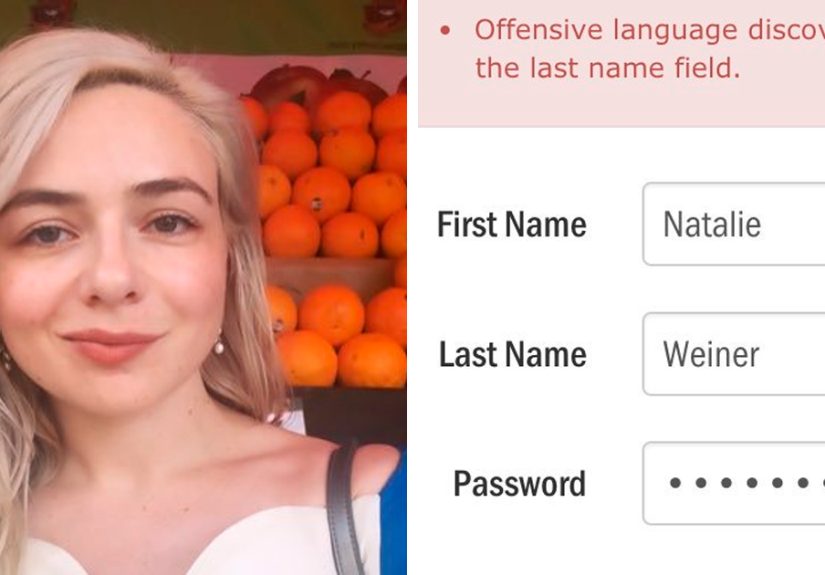
Then there’s online account creation, where profanity filters turn real people into suspicious content.
Imagine entering your legal last name and being told it violates community guidelines. People have reported being prompted
to “try again,” as if they could simply brainstorm a new family history on the spot. Some learned to keep a backup plan:
add a middle initial, shorten the surname by one letter, or use a different capitalization patternbecause apparently the
algorithm is fine with the same “bad” letters as long as they wear a trench coat.
School and sports rosters create their own mini sitcom. Parents have described hearing coaches call out a surname
during practice and watching a whole line of kids collapse into laughter like dominoes. The funniest part? The child with the
“offensive” surname is often the most emotionally prepared person on the field. They’ve already lived through years of roll call.
They know the drill: correct it, shrug, score a goal, move on. The other kids are the ones acting like they’ve just discovered
humor for the first time.
Work life adds a fresh layer of awkwardness, because adults are expected to behavebut not all adults got the memo.
People with spicy surnames sometimes notice a pattern in meetings: their name is avoided. Colleagues will refer to them by first name only,
or use vague gestures (“Can you ask… um… him…?”), as if the surname might summon a demon.
Others experience the opposite: the colleague who repeats the surname too many times, like they’re stress-testing it,
hoping it becomes less funny by exposure. (Spoiler: it does not.)
And finally, there’s the family anglethe part that makes it more than a joke. Even when the surname causes hassles,
many people keep it because it connects them to parents, grandparents, and stories that matter. Some say the name toughened them up.
Others say it forced them to get good at setting boundaries early. The best summary might be this:
the name isn’t the problem; the world’s inability to act normal is the problem. And once you accept that,
you can laughwithout letting the laughter erase your dignity.
Conclusion
People with “offensive” last names live at the intersection of history, language, and modern technologywhere one innocent surname
can trigger giggles, bias, and a pop-up warning from a website that thinks your identity is inappropriate content.
The good news is that these problems are manageable. Whether you choose to keep your surname proudly, tweak how you present it,
or pursue a legal change, the best outcome is the same: you get to be known for who you are, not for the letters on your ID.