Table of Contents >> Show >> Hide
- What Are Nature-Focused Lessons?
- Why Nature-Based Learning Matters for Young Students
- How to Design Effective Nature-Focused Lessons
- Nature Lesson Ideas by Subject
- Best Nature-Focused Activities for Young Students
- How to Make Nature Lessons Inclusive
- Safety Tips for Outdoor Learning
- Assessment Ideas for Nature-Focused Lessons
- Experience-Based Reflections: What Nature-Focused Lessons Feel Like in Real Classrooms
- Conclusion
- SEO Tags
Nature-focused lessons for young students are not just a charming excuse to let kids hold leaves, name bugs, and ask whether clouds are “sky sheep.” They are a powerful way to teach science, language, math, art, problem-solving, emotional awareness, and environmental responsibility through real-world experiences. For early learners and elementary students, nature is basically the world’s biggest interactive classroomno batteries required, no login password needed, and no mysterious “update later” button.
At its best, nature-based learning gives students permission to observe closely, wonder loudly, test ideas, move their bodies, and connect classroom concepts to the living world around them. A simple walk around the schoolyard can become a lesson in patterns, habitats, weather, counting, descriptive writing, teamwork, and patience. A puddle can become a science lab. A tree can become a history book, a math model, a poetry prompt, and a shady meeting place for very serious discussions about squirrels.
This guide explores how teachers, parents, and program leaders can design meaningful nature-focused lessons for young students. It includes practical strategies, examples, classroom connections, and experience-based ideas that make outdoor learning safe, inclusive, memorable, and academically useful.
What Are Nature-Focused Lessons?
Nature-focused lessons are educational activities that use the natural world as the subject, setting, or teaching tool. These lessons may happen outdoors in a school garden, playground, park, forest trail, beach, or neighborhood sidewalk. They can also happen indoors through natural materials such as leaves, seeds, rocks, shells, soil samples, feathers, flowers, weather charts, or classroom plants.
The goal is not simply to “go outside.” The goal is to help students learn through direct observation, hands-on exploration, guided questions, creativity, and reflection. For young children, this approach is especially effective because they learn best when they can touch, move, compare, sort, build, draw, listen, and ask questions.
Examples of Nature-Focused Lessons
A kindergarten class might collect leaves and sort them by size, color, shape, and texture. A first-grade class might observe clouds and write weather words. A second-grade class might plant bean seeds and measure their growth each week. Third graders might study pollinators by watching bees and butterflies near flowers. Fourth or fifth graders might explore ecosystems by mapping food chains, comparing habitats, or collecting simple data about birds, insects, or temperature.
The same outdoor space can support many subjects. A schoolyard tree can teach life cycles, seasonal change, symmetry, measurement, descriptive writing, and even social-emotional learning. After all, trees are very patient teachers. They never interrupt, and they have excellent posture.
Why Nature-Based Learning Matters for Young Students
Young students are naturally curious. They want to know why worms come out after rain, why leaves change color, why birds hop instead of walk, and whether ants have meetings. Nature-focused lessons use that curiosity as fuel for academic learning.
Outdoor learning also supports whole-child development. It encourages movement, conversation, cooperation, sensory awareness, and problem-solving. When students explore a natural setting, they are not passively receiving information. They are noticing, predicting, testing, adjusting, and explaining. That is real learningnot worksheet survival.
Nature Supports Science Thinking
Science begins with observation. Nature gives young students endless things to observe: shadows moving across the pavement, seeds sprouting, birds calling, puddles shrinking, insects traveling, and clouds changing shape. Students can practice asking questions such as, “What do I notice?” “What changed?” “What do I think will happen next?” and “How can I find out?”
These questions build early scientific habits. Students learn to gather evidence instead of guessing wildlyalthough wild guesses can be entertaining. A child who says, “The leaf turned brown because it got tired,” is not wrong in spirit. They are noticing change and trying to explain it. A good nature lesson gently turns that curiosity into investigation.
Nature Builds Language and Vocabulary
Outdoor learning naturally expands vocabulary. Students describe rough bark, smooth stones, damp soil, tiny sprouts, fluttering wings, curved stems, and slippery mud. They learn words like habitat, observe, compare, predict, decompose, pollinate, migrate, and adapt.
Nature also gives students something meaningful to write and talk about. Instead of asking children to describe a random picture, teachers can ask them to describe the actual spiderweb sparkling on the fence. Real experiences make writing more vivid because students have sensory details to use.
Nature Encourages Social and Emotional Growth
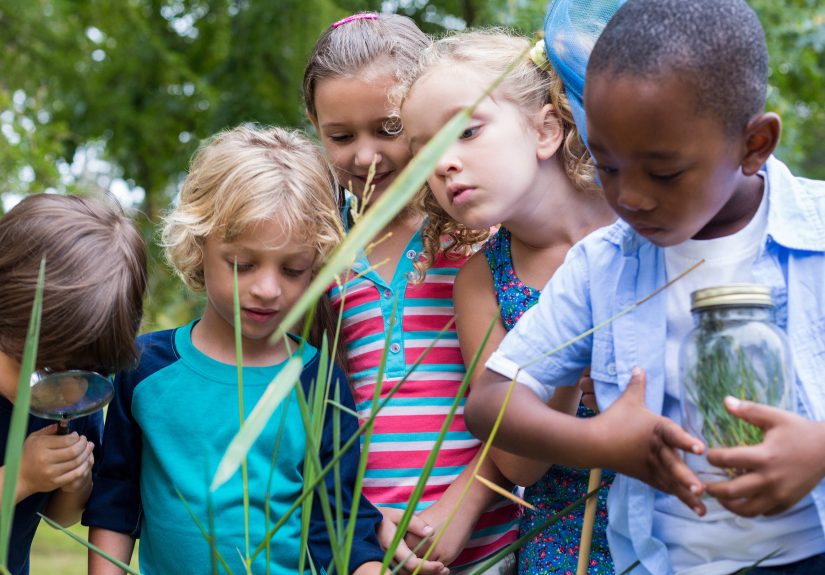
Nature-focused lessons often involve teamwork. Students share magnifying glasses, compare discoveries, build small shelters for toy animals, take turns watering plants, or work together to create a nature journal page. These activities build cooperation, patience, communication, and responsibility.
Nature also gives students calming rhythms. Listening to birds, watching leaves move, touching soil, or sitting quietly near a garden bed can help children slow down. In a world where even cereal boxes seem to shout for attention, a quiet moment with a leaf can be surprisingly powerful.
How to Design Effective Nature-Focused Lessons
A strong nature-focused lesson does not need to be complicated. Teachers do not need a forest, a fancy outdoor classroom, or a background in wilderness survival. A patch of grass, a sidewalk crack with a determined weed, or a classroom windowsill plant can become a learning opportunity.
Start With a Clear Learning Goal
Before heading outside, decide what students should learn. The goal might be academic, social, sensory, or creative. For example:
- Students will identify three signs of seasonal change.
- Students will compare living and nonliving things.
- Students will measure plant growth using a ruler.
- Students will write three descriptive sentences about a natural object.
- Students will work with a partner to observe and record bird behavior.
A clear goal keeps the lesson focused. Otherwise, the class may accidentally become a 40-minute investigation into one unusually dramatic beetle. That can still be valuable, but it helps to know where the lesson is headed.
Use the “Notice, Wonder, Connect” Method
One simple structure for nature-based learning is: notice, wonder, connect.
Notice: Students quietly observe what they see, hear, smell, and feel. They might say, “I notice the soil is darker under the leaves.”
Wonder: Students ask questions. “I wonder why there are more ants near the tree.”
Connect: Students link the observation to a concept. “Maybe ants are finding food, and that connects to habitats and animal needs.”
This method works across grade levels because it gives students a thinking routine. It also makes outdoor lessons less chaotic and more purposeful.
Keep Activities Hands-On and Age-Appropriate
Young students need lessons that match their developmental stage. Preschool and kindergarten students may focus on sensory exploration, sorting, naming, and storytelling. Early elementary students can begin recording observations, measuring, drawing diagrams, and comparing patterns. Older elementary students can collect data, create simple graphs, study ecosystems, and design small conservation projects.
Nature Lesson Ideas by Subject
Nature-focused lessons are flexible because the natural world connects to almost everything students learn. Here are practical ways to connect outdoor learning to core subjects.
Science: Mini Habitat Study
Ask students to choose a small area, such as a garden bed, tree base, patch of grass, or planter box. Have them observe what lives or grows there. Students can draw the area, label plants and animals, and discuss what each living thing needs to survive.
For younger students, keep it simple: “What do you see?” “Where is it living?” “What might it need?” For older students, introduce vocabulary such as habitat, shelter, food source, predator, decomposer, and ecosystem.
Math: Nature Sorting and Graphing
Students can collect fallen leaves, small sticks, seed pods, or rocks and sort them by attributes. They might group leaves by color, size, edge shape, or texture. Then they can count each group and create a class graph.
This activity teaches classification, counting, comparison, data collection, and visual representation. It also proves that math is more exciting when it involves leaves and fewer suspiciously cheerful workbook frogs.
Reading and Writing: Nature Journals
Nature journals help students combine observation, drawing, vocabulary, and reflection. Each entry can include the date, weather, location, sketch, labels, and a few sentences. Prompts might include:
- Today I noticed…
- I wonder why…
- This reminds me of…
- One small change I saw was…
- If I were this plant or animal, I would…
Nature journals are especially helpful because they show growth over time. Students can revisit the same tree, plant, or garden space weekly and record changes.
Art: Texture Rubbings and Natural Patterns
Students can place paper over bark, leaves, or flat stones and gently rub with crayons to reveal textures. They can compare patterns, create collages, or design symmetrical artwork inspired by butterfly wings, flowers, shells, or leaves.
This lesson connects art with geometry, science, and close observation. Students begin to see that nature is full of design: spirals, lines, dots, rings, veins, and repeating shapes.
Social Studies: Community Nature Map
Students can create a map of natural features around the school or neighborhood. They might include trees, gardens, puddle zones, sunny spots, shaded areas, bird areas, and places where people gather. This helps students understand place, community, and how humans interact with the environment.
Older students can discuss questions such as: Who has access to green space? How do parks help communities? What could make our schoolyard more welcoming for people and wildlife?
Best Nature-Focused Activities for Young Students
1. The Five-Senses Nature Walk
Take students on a slow walk and ask them to record one thing they see, hear, smell, and feel. Taste should only be included with safe, teacher-approved foods, not random berries, leaves, or mystery objects. Nature is wonderful, but it is not an all-you-can-eat buffet.
After the walk, students can share observations and create a class chart. This activity builds sensory vocabulary, attention, and descriptive language.
2. Adopt-a-Tree Project
Choose one tree near the school and visit it throughout the year. Students can draw it in different seasons, measure its trunk, observe its leaves, look for animals nearby, and write short reflections.
This long-term project teaches seasonal change, plant structure, habitats, measurement, and responsibility. It also helps students build a personal connection with a living part of their environment.
3. Weather Watchers
Create a daily or weekly weather observation routine. Students can record temperature, cloud cover, wind, precipitation, and how the weather feels. Younger students can use picture symbols; older students can use charts and graphs.
Weather lessons connect science, math, and daily life. Students learn that weather is not just something adults complain about while holding coffee. It is a system they can observe, measure, and understand.
4. Schoolyard Bird Observation
Bird watching is an excellent nature-focused lesson because birds are found almost everywhere. Students can observe bird size, color, movement, sounds, and behavior. They can compare birds that hop, glide, perch, or search for food.
For a simple activity, ask students to watch quietly for ten minutes and tally how many birds they see. They can later discuss patterns: Did birds prefer trees, grass, rooftops, or fences? Were they alone or in groups?
5. Seed-to-Plant Investigation
Plant fast-growing seeds such as beans, peas, or sunflowers. Students can predict what will happen, observe changes, measure growth, and draw plant parts. This activity teaches life cycles, needs of living things, measurement, patience, and responsibility.
It also teaches a valuable life lesson: some things grow slowly, even when you stare at them intensely every morning.
6. Decomposition Discovery
Place natural materials such as leaves, fruit peels, and small sticks in a compost observation container or outdoor compost area. Students can compare what changes over time. Keep the activity clean, safe, and well-managed.
This lesson introduces decomposition, soil health, recycling in nature, and the role of worms, fungi, and microorganisms. It helps students understand that “old” natural materials do not simply disappearthey become part of a new cycle.
How to Make Nature Lessons Inclusive
Nature-focused learning should be accessible to every student. Not all children have the same physical abilities, sensory preferences, outdoor experiences, cultural backgrounds, or comfort levels with insects, dirt, weather, or open spaces.
Offer Multiple Ways to Participate
Some students may love touching soil; others may prefer drawing, photographing, pointing, describing, or using tools. Provide options such as gloves, magnifiers, clipboards, seated observation spots, partner roles, and indoor nature stations.
A student does not have to climb, dig, or hold a worm to learn from nature. Observation is participation. Asking questions is participation. Drawing a careful sketch is participation. Politely declining to touch a beetle the size of a small spaceship is also participation.
Use Nearby Nature
Teachers do not need a perfect outdoor space. Urban schools can study sidewalk plants, street trees, pigeons, clouds, shadows, rainwater flow, rooftop gardens, or classroom seeds. Rural schools can explore fields, forests, farm edges, streams, and wide-open weather patterns.
The key is helping students see that nature is not only “somewhere else.” It is around them, even in small corners.
Safety Tips for Outdoor Learning
Outdoor learning works best when students understand expectations. Before going outside, review boundaries, walking rules, tool use, respect for living things, and what students should not touch. Teachers should check weather conditions, avoid unsafe areas, and be aware of allergies, heat, cold, insects, and local hazards.
A helpful rule is: “Look closely, touch gently, and leave living things where they belong.” Students can observe insects, plants, and habitats without damaging them. Nature lessons should build care, not chaos.
Assessment Ideas for Nature-Focused Lessons
Assessment does not need to be a formal test. Teachers can evaluate learning through student journals, drawings, oral explanations, class charts, exit tickets, group discussions, and simple projects.
For example, after a habitat walk, students might draw one living thing and label what it needs. After a weather unit, students might explain how today’s weather affected what they wore. After a seed investigation, students might sequence plant growth stages with pictures and words.
The best assessments show what students can notice, explain, connect, and apply. Bonus points if their drawings of birds do not all look like flying potatoes.
Experience-Based Reflections: What Nature-Focused Lessons Feel Like in Real Classrooms
In real classrooms, nature-focused lessons often begin with a plan and quickly become something richer. A teacher may step outside intending to teach leaf shapes, only to have students discover a line of ants carrying crumbs near the sidewalk. Suddenly, the lesson expands into animal behavior, teamwork, food sources, and respectful observation. This is one of the great strengths of nature-based learning: it leaves room for surprise.
One common experience is that quieter students often become more expressive outdoors. A child who rarely raises a hand inside may become the first to notice a bird call, a tiny mushroom, or a pattern in bark. Nature gives different students different ways to shine. The best observer is not always the fastest reader or the loudest speaker. Sometimes it is the student who slows down enough to see what everyone else stepped over.
Teachers also find that nature lessons make abstract ideas concrete. “Interdependence” is a big word for young students, but it becomes easier to understand when they watch bees visiting flowers or birds searching for seeds. “Change over time” becomes real when students revisit the same plant each week. “Data collection” feels less intimidating when students are counting clouds, measuring shadows, or tallying birds instead of staring at a blank chart.
Another powerful classroom experience is the way outdoor learning improves student questions. Indoors, students may ask, “Is this on the test?” Outdoors, they ask, “Why is this leaf full of holes?” “Where did the water go?” “Why are there more worms after rain?” These questions are academic gold. They show curiosity, reasoning, and a desire to understand cause and effect. A good teacher can turn those questions into research, experiments, writing prompts, or group investigations.
Nature-focused lessons also create memorable emotional connections. Students often remember the day they planted seeds, released a ladybug, watched a butterfly, found animal tracks, or built a tiny shelter from sticks. These moments matter because memory and emotion work together. A student who feels wonder is more likely to care, and a student who cares is more likely to keep learning.
Of course, outdoor lessons are not always perfectly peaceful. Clipboards fall. Someone may be deeply offended by mud. A gust of wind may steal three worksheets and one teacher’s dignity. But even these moments can become part of the learning experience. Students learn flexibility, humor, problem-solving, and how to adapt when the environment does not behave like a quiet classroom poster.
Many educators discover that the most successful nature-focused lessons are short, repeated, and routine. A ten-minute observation every Friday can be more effective than one huge outdoor event each semester. Students build familiarity over time. They begin to notice patterns: the tree has fewer leaves, the soil is drier, the birds are louder, the shadows are longer. Repeated exposure turns nature from a novelty into a trusted learning partner.
Families can extend these experiences at home without needing special equipment. A parent and child can watch clouds, compare leaves, listen for birds, grow herbs in a cup, or notice how the moon changes. These simple activities support school learning and help children see nature as part of everyday life, not just a field trip destination.
The lasting value of nature-focused lessons is that they teach students how to pay attention. In a fast, screen-filled world, attention is a superpower. When young students learn to observe a seedling, listen to wind, compare rocks, protect a worm, or wonder about rain, they are learning more than science. They are learning curiosity, care, patience, and respect for the world they share.
Conclusion
Nature-focused lessons for young students bring learning to life in ways that textbooks alone cannot. They help children build science skills, language, math understanding, creativity, cooperation, and environmental awareness through direct experience. Whether students are observing birds, planting seeds, mapping the schoolyard, journaling under a tree, or investigating weather, they are learning with their whole selves.
The beauty of nature-based education is that it does not require perfection. It requires curiosity, structure, safety, and a willingness to let the natural world become part of the lesson. A small patch of grass can become a science station. A leaf can become a writing prompt. A puddle can become a weather investigation. And a young student with a magnifying glass can become, at least for the afternoon, the most serious scientist on Earth.