Table of Contents >> Show >> Hide
- What “Onboard Tool Storage” Actually Means
- Why This Hack Matters More Than People Think
- Safety Rules Before You Start Hacking Your Ladder
- The Simplest DIY Version: A Plywood Ladder Caddy
- Best Onboard Storage Ideas by Ladder Type
- Features Worth Copying From Pro Accessories
- Smart Tool Groupings for Common Jobs
- Mistakes That Ruin a Good Ladder Storage Setup
- How to Build a Better Workflow Around the Ladder
- Is a DIY Hack Better Than a Store-Bought Accessory?
- Experience: What Ladder Storage Actually Feels Like in Real Life
- Conclusion
- SEO Tags
If you have ever climbed a ladder, reached your working height, and then realized your screwdriver was on the floor next to your tape measure, your pencil, and your dignity, welcome. You are among friends. Ladder work has a funny way of turning simple jobs into cardio sessions. One minute you are patching drywall, swapping out a light fixture, or trimming paint around the ceiling. The next minute you are playing a sweaty game of up-down-up-down because the one tool you need is always exactly one floor below you.
That is why onboard tool storage is such a smart ladder hack. Instead of balancing a drill on the top cap like you enjoy living dangerously, you create a safe, organized way to keep essential gear within reach. Done right, onboard tool storage saves time, reduces fatigue, and helps you work more safely because you are not constantly climbing with tools in your hands or making extra trips just to grab a screw, brush, or pair of pliers.
And no, this does not mean turning your ladder into a flying toolbox. It means being strategic. The goal is not to carry everything you own up the ladder. The goal is to keep the right tools accessible, secure, and easy to reach without cluttering your working position. Think of it as giving your ladder a tiny, hardworking kitchen island. Not glamorous, perhaps, but deeply useful.
What “Onboard Tool Storage” Actually Means
Onboard tool storage is any setup that lets a ladder carry your essential tools and materials safely while you work. That can be a factory-built tray, a bucket attachment, a top-cap organizer, magnetic storage, a pouch system, or a simple homemade caddy that fits over the top of a stepladder.
The concept works because most ladder jobs are repetitive. You are not usually carrying a hundred different tools. You are cycling through a small group of essentials: a drill, driver bits, fasteners, tape measure, utility knife, pencil, small level, putty knife, paint cup, rag, and maybe a snack you forgot was in your pocket. If those items have designated homes on the ladder, you spend less time climbing and less time improvising bad storage decisions.
Professional ladder accessories have leaned into this idea for years. Tool trays with slots for drills, magnetic dishes for screws, pouches for hand tools, hooks for cords or paint cans, and utility buckets are popular because they solve one very annoying problem: ladders are good at lifting people, but terrible at holding all the things people need once they get there.
Why This Hack Matters More Than People Think
There is a productivity angle here, but there is also a safety angle, and that matters even more. Ladder injuries are common in both jobsite and home settings, and a surprising number of problems start with simple bad habits: climbing while carrying tools, overreaching because a tool is out of place, rushing because the task feels small, or balancing objects where they can slide off and fall.
Onboard storage helps prevent the “I’ll just hold this in one hand” mistake. It also helps reduce overreaching because your most-used items stay close to your body. In practical terms, that means fewer awkward twists, fewer unnecessary climbs, and fewer moments where you realize you have somehow become a circus act with a paint brush and cordless drill.
That is the real genius of this ladder hack. It is not flashy. It is efficient. It turns a ladder from a temporary perch into a better-organized workstation.
Safety Rules Before You Start Hacking Your Ladder
Before we talk storage ideas, let’s talk rules. A clever accessory is only clever if it does not make the ladder less safe.
Keep both hands free while climbing
You should not climb with a drill in one hand and a fistful of screws in the other. Use a tool belt, ladder-mounted organizer, or hand line for heavier items. Your ladder is not the place to test your grip strength.
Maintain three points of contact
That old phrase exists for a reason. Two feet and one hand, or two hands and one foot, should stay connected while climbing. Any storage solution that forces you to stretch, twist, or juggle tools defeats the entire point.
Use accessories for their designed purpose
Storage add-ons should fit your ladder type and be compatible with the model whenever possible. A tray that works beautifully on a fiberglass stepladder may be completely wrong for a multi-position ladder or extension ladder.
Do not overload the ladder
The ladder’s duty rating includes you, your clothing, your tools, and whatever else you insist on bringing to the party. Onboard storage should hold essentials, not a full hardware aisle.
Avoid top-heavy chaos
If your setup makes the ladder feel unbalanced, crowded, or awkward to climb around, scale it back. Good storage should feel invisible in use. Bad storage announces itself every time you bump your knee.
The Simplest DIY Version: A Plywood Ladder Caddy
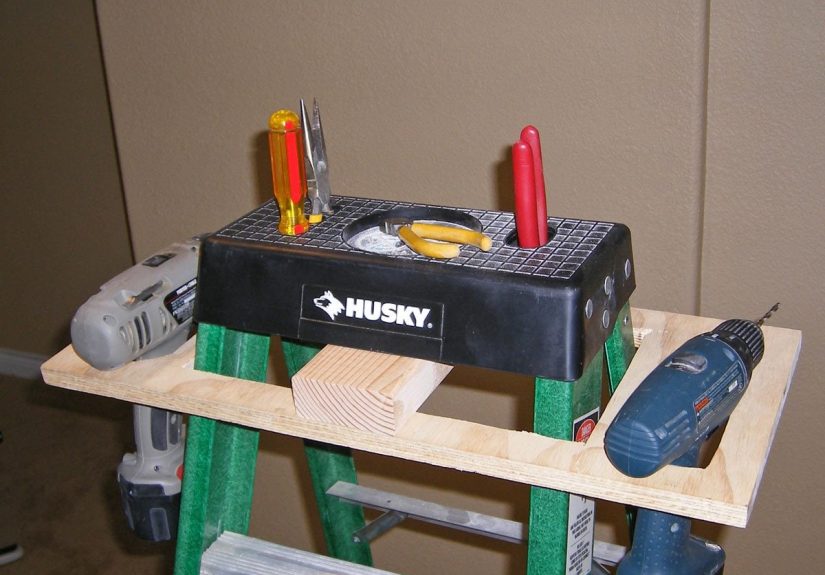
One of the smartest homemade versions of onboard tool storage is also one of the simplest: a plywood caddy that fits over the top of a stepladder. The classic idea is to cut a flat board so it drops over the ladder top, then add shaped cutouts or slots for the tools you use most.
This works especially well for repetitive overhead tasks like installing trim, drilling pilot holes, hanging grid ceiling components, replacing fixtures, or patching and painting. A basic design can hold a drill, driver, screws, pencil, and a small parts cup. A better design can also include a magnet strip, shallow tray area, and a hook underneath for a rag or cord.
The reason this hack is so effective is because it is custom. You are not buying a generic organizer and hoping it suits your workflow. You are building a mini workstation around the exact tools you reach for every two minutes.
If you make one, keep the design light, balanced, and compact. Smooth the edges, avoid sharp corners, and make sure the caddy seats securely without wobbling. If the board shifts when a tool is removed, the design needs work. Storage should feel stable whether the tray is full, half-full, or nearly empty.
Best Onboard Storage Ideas by Ladder Type
Stepladders
Stepladders are the easiest platform for onboard storage. Many already have molded tops, slots, paint can hooks, or accessory-ready hardware. They pair well with caddies, pail shelves, lock-in buckets, and top-cap organizers. This is the sweet spot for painters, electricians, drywall patchers, and general DIYers doing indoor work.
Extension ladders
Extension ladders are less forgiving. You are climbing vertically, often outdoors, and space is tighter. For these, the best storage options are tool belts, lightweight pouches, ladder hooks, or lifted tool bags using a hand line. Keep it minimal. The ladder is for access first and storage second.
Multi-position ladders
These ladders work well with model-specific trays and platforms. Some accessory systems include grooves for drills, magnetic trays for fasteners, and paint-can areas. They can be very convenient, but compatibility matters. Universal solutions are nice in theory; secure solutions are better in practice.
Features Worth Copying From Pro Accessories
If you are choosing a ready-made organizer or building your own, look for these features:
Dedicated drill and driver slots
Power tools are bulky, heavy, and annoying when they slide around. A shaped slot or cradle keeps them upright and easy to grab.
Magnetic storage for screws and bits
This is one of those small features that feels silly until you use it once. Then suddenly you never want to hunt for one escaped screw again.
Hooks for cords, rags, or paint tools
A slidable or fixed hook can keep clutter off your steps and out of your pockets. That alone makes a ladder feel more civilized.
Separate wet and dry storage
If you paint, caulk, or patch, it helps to keep messy items away from clean tools. A bucket or cup for wet materials is smarter than letting a brush nap across your screwdriver handle.
Compatibility and secure fit
Some accessories are universal-ish. Others are very specific. Check ladder type, material, and size before buying. A product that fits only certain fiberglass step ladders is not being difficult. It is being honest.
Weight discipline
A good tray holds what you need, not what you might need if the afternoon takes a weird turn. Keep the load light and focused. A handful of fasteners, not a brick of them. One drill, not the whole charging station.
Smart Tool Groupings for Common Jobs
For painting
Keep a mini paint cup, angled brush, painter’s tape, rag, 5-in-1 tool, and small screwdriver onboard. Skip the giant can if you can decant into a lighter container. Your forearms will send a thank-you note.
For electrical work
A compact organizer for wire nuts, driver, tester, stripper, tape, and screws makes sense. A fiberglass ladder is usually the smarter choice around electrical tasks because metal ladders and live power are a terrible romance.
For trim and finish work
Think tape measure, pencil, pin nails or screws, drill, driver bits, small level, and filler knife. This is where a top tray with a magnetic section shines.
For patch and repair jobs
A putty knife, sanding sponge, small mud cup, utility knife, rag, and touch-up tools are usually enough. Keep the setup tidy so dust and debris do not coat everything you touch.
Mistakes That Ruin a Good Ladder Storage Setup
The first mistake is treating storage like decoration. If it looks cool but gets in the way of climbing, it is not a feature. It is a liability.
The second mistake is storing tools on random rungs, steps, or the ladder top without restraint. That is how things fall. And tools never fall in a dignified way. They either clang loudly enough to wake the neighborhood or land exactly where your foot planned to go next.
The third mistake is overloading the setup with “just in case” items. Onboard storage works best when it is edited. Choose the five to eight items you use constantly and leave the backup gear on the ground in a bin or bag.
The fourth mistake is ignoring the ladder environment. If you are near doors, foot traffic, uneven flooring, slick ground, or exterior wind, the storage system should get simpler, not more elaborate.
How to Build a Better Workflow Around the Ladder
The best ladder hack is not only about what goes on the ladder. It is also about what stays near it. Pair onboard storage with a small ground-level tote or bucket. That gives you a two-zone system: daily essentials up top, refills and backups below. When you do need to come down, you are restocking once instead of taking five separate trips.
Another smart move is to preset your tray before you climb. Load fasteners into a dish, place bits where they belong, hook the rag, and test the balance. Good ladder work feels calm because the thinking happened on the floor.
That may sound dramatic, but anyone who has climbed down three times for the same missing pencil understands that chaos starts before the first step.
Is a DIY Hack Better Than a Store-Bought Accessory?
Sometimes yes, sometimes absolutely not. A DIY caddy is excellent when you use a specific ladder for a repetitive task and want custom slots for your exact tools. It is inexpensive, adaptable, and satisfying in that “I built a useful thing from scrap wood” kind of way.
A store-bought accessory wins when you want tested fit, molded compartments, quick installation, or ladder-brand compatibility. Many professional add-ons now include magnetic sections, tool pouches, tether points, and shaped storage that would be annoying to recreate by hand.
The best answer is simple: buy when compatibility and safety matter most, build when the job is specific and the design is easy to keep stable. Either way, the goal stays the same. Fewer trips. Better organization. Safer climbing.
Experience: What Ladder Storage Actually Feels Like in Real Life
Here is the part that does not always show up in product descriptions: onboard ladder storage changes the mood of the job. Seriously. The first time I worked off a well-organized ladder tray, the project felt less like a series of interruptions and more like actual progress. Instead of climbing up, realizing I forgot a bit, climbing down, finding the bit, climbing back up, then dropping a screw and muttering at the ceiling, I stayed in position and just kept moving.
The biggest difference was mental. A cluttered ladder makes you feel rushed because every movement is a tiny recovery operation. Where did I put that? Can I balance this here? Will that fall if I turn around? Good onboard storage removes those little questions. Your drill goes in one slot. Your screws go in one tray. Your knife goes in one pouch. It sounds boring, but boring is exactly what you want when you are six feet in the air trying to line up a bracket.
I also learned very quickly that less is more. My first instinct was to bring everything with me, as if I were moving into a studio apartment on top of the ladder. Bad idea. A loaded tray gets crowded fast. The smarter approach was to bring only the tools used every minute or two. Everything else stayed in a tote on the floor. Once I started doing that, the ladder felt stable, the top area stayed clear, and I stopped knocking into my own gear.
Another surprise was how much difference a magnetic dish made. Tiny hardware has a supernatural talent for disappearing at the exact moment you need it. Put those same screws in a magnetic section and suddenly the job becomes much less theatrical. The same goes for hooks. One small hook for a rag or cord can keep the entire workspace from becoming a tangled little mess.
For painting, the onboard setup made the job cleaner. For electrical work, it made the job more organized. For trim work, it made the job faster. And in every case, it made me less tempted to do something dumb, like tuck a screwdriver into the ladder hinge or balance a fastener box on the top cap like it had signed a waiver.
That is probably the best argument for this hack. It supports better habits. When the ladder has a place for the right tools, you are more likely to work the safe way because the safe way is also the convenient way. That is a rare and beautiful thing in home improvement.
So if you want one upgrade that feels small but pays off almost immediately, onboard tool storage is it. Not because it is trendy. Not because it looks impressive. Because it turns ladder work from a stop-and-go frustration machine into something smoother, safer, and a whole lot less annoying. And honestly, any hack that saves your knees, your time, and your temper deserves a spot in the toolbox.
Conclusion
Ladder hack: onboard tool storage is one of those ideas that feels obvious the second you use it. Whether you build a simple plywood caddy, add a brand-specific tray, clip on a bucket, or rely on a slim belt-and-hook system, the principle stays the same: keep essentials close, keep your hands free, and keep your setup light and organized. That means fewer wasted trips, less fatigue, and better ladder habits overall.
In other words, this is not just about storing tools. It is about storing them where your future self will stop yelling, “Why is the screwdriver all the way down there again?”