Table of Contents >> Show >> Hide
- Why the Modern Farmhouse Belongs in Wine Country (and Not Just on Instagram)
- The Case Study: A Brit and a Texan Trade the City for Sonoma
- Architecture That Feels Like a Farmhouse (Without Feeling Like a Costume)
- The Kitchen: Where Wine Country Houses Earn Their Keep
- Concrete Floors + Radiant Heat: The Quiet Luxury Nobody Brags About (But Everyone Loves)
- Indoor-Outdoor Living: The Real “Amenity” of California Wine Country
- Finishes That Feel Elevated (But Still Livable)
- Designing in Wine Country Means Designing for Wildfire Reality
- How to Steal the Look (Even If You’re Not Building in Sonoma)
- Wine Country Living: of Real-World Experience (The Part No One Puts in the Floor Plan)
- Conclusion
California wine country has a way of making even the most committed city-dweller start romanticizing mud on boots, herbs on windowsills, and the idea of “just popping outside” to pick lemons like it’s a casual Tuesday. (It is never a casual Tuesday. The lemons have opinions.)
And that’s exactly why the modern farmhouse keeps winning hearts from Sonoma to Napa: it promises the warmth of an old agrarian outbuilding, the clarity of contemporary design, and the kind of indoor-outdoor living that makes you forget your phone existsuntil you need a photo of the light hitting the stucco at 5:12 p.m. sharp.
This story follows a very wine-country-flavored equation: a Brit + a Texan, a long stretch of San Francisco city life, and a floor plan discovered far from Northern Californiathen reimagined into a modern farmhouse that feels calm, practical, and quietly luxurious. Along the way, we’ll pull design lessons you can borrow whether you’re building new in Sonoma County or just trying to make your kitchen feel less “weekday panic” and more “weekend in Healdsburg.”
Why the Modern Farmhouse Belongs in Wine Country (and Not Just on Instagram)
“Farmhouse” gets tossed around like confetti, but in California wine country it has a specific job to do: fit the landscape. Vineyards, oaks, gravel drives, barn silhouettes, and long views demand architecture that doesn’t shout over the scenery. The modern farmhouse answers with familiar formsgables, simple rooflines, restrained materialsthen upgrades the experience with bigger openings, smarter layouts, and finishes that can handle real life (including dogs, guests, and that one friend who always arrives “just for a taste” and leaves after dessert).
California wine country design is often defined as much by lifestyle as by looks: a strong connection between inside and outside, spaces that support cooking and gathering, and materials that feel honest and tactilewood, stone, plaster, concrete. The goal is a house that’s not precious. It’s “considered,” but it can survive a red wine splash and a muddy labrador victory lap. [2][8][9]
A quick style translation: rustic, but edited
The best wine country modern farmhouse doesn’t cosplay as a 1900s dairy shed. It borrows the simple bones of agricultural buildingsrectangular volumes, straightforward detailingthen refines everything. Think fewer frills, more proportion. Less “shiplap everywhere,” more “let the light do the decorating.”
The Case Study: A Brit and a Texan Trade the City for Sonoma
In one standout example, a coupleone partner from England, the other from Texasmade a permanent move from San Francisco to Sonoma County and built a modern farmhouse designed for both full-time living and generous entertaining. Their inspiration didn’t come from a Pinterest board or a trend report. It came from a vacation: a farm-to-table cottage community in Cabo San Lucas where the floor plan felt so livable they essentially said, “We’ll take this… but make it Sonoma.” [1]
That floor plan became a blueprint for a house built around cooking, hosting, and the rhythm of indoor-outdoor days. It also proves a useful point: great design isn’t always about inventing something new. Sometimes it’s about finding a layout that genuinely worksand then customizing it for how you actually live. (In this case: add a mudroom for dogs, expand the kitchen, and make every gathering feel effortless.) [1]
What makes it “wine country modern farmhouse” instead of “suburban farmhouse”
- Entertaining-first flow: kitchen, dining, and outdoor space act like one big social zone. [1]
- Materials that match the setting: concrete floors, oak details, plaster, and a restrained palette that lets the landscape lead. [1]
- Indoor-outdoor openings: large doors that fully open to patios and pool areasbecause wine country practically requires it. [1][8]
Architecture That Feels Like a Farmhouse (Without Feeling Like a Costume)
Modern farmhouse architecture works best when it’s disciplined. The silhouette is typically simple, but the details are intentional: clean eaves, thoughtfully sized windows, and a front entry that’s welcoming without being fussy. In this Sonoma example, the exterior uses a troweled stucco finishan interesting twist that still reads as earthy and agricultural, just more streamlined. [1]
Here’s the not-so-secret secret: wine country houses are often at their best when they borrow from working buildings, then elevate comfort. That might mean generous overhangs for shade, deep thresholds that blur inside/outside, and spaces that feel airy even when it’s warm out.
Make the “modern” do real work
Modern moves aren’t just aesthetic flexes; they improve daily life. Think: an accordion door that opens an entire wall of a bedroom to the outdoors, or a Dutch door that lets fresh air in while keeping dogs from launching themselves into the vineyard like furry missiles. [1][6]
The Kitchen: Where Wine Country Houses Earn Their Keep
In wine country, kitchens aren’t background scenerythey’re headquarters. The best ones are designed for “real cooking” and real crowds, which is why this modern farmhouse kitchen leans into function: a roomy layout, durable surfaces, and a look that’s calm enough to handle the chaos of dinner prep.
Blue cabinets, white tile, and the magic of restraint
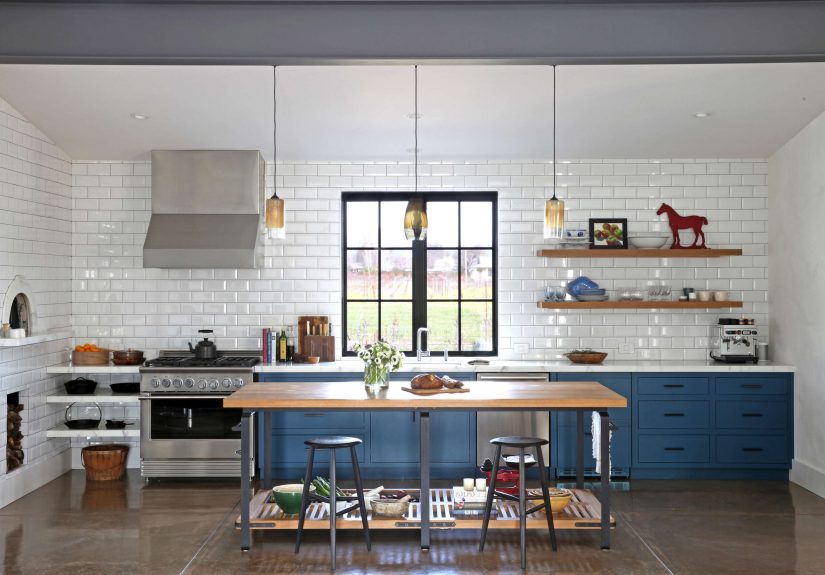
The kitchen’s signature move is a rich blue cabinet color paired with low-cost beveled white subway tile and warm white oak open shelving. It’s a classic wine-country palette: cool, grounded, and not afraid of a little patina over time. The countertops are Calacatta Oro marbledramatic, but still timeless when balanced with simple tile and wood. [1]
A smart lesson here: when you choose one “statement” material (like veined marble), keep everything else straightforward. You get character without visual noiseaka the opposite of a kitchen that looks like it’s yelling.
A worktable instead of a precious island
Rather than a bulky built-in island that dictates how everyone moves, the kitchen is anchored by a large worktablebuilt for chopping, kneading, plating, and gathering. That’s not just charming; it’s practical. Worktables invite people to hover, help, and snack without crowding the cook. (Also: you can walk around it. Revolutionary.) [1]
The pizza oven: because of course there’s a pizza oven
A pizza oven in a wine country modern farmhouse is both delightfully extra and completely logical. It turns a casual night into an event, pulls people toward the kitchen, and pairs beautifully with a bottle of whatever you were “saving for later.” In this home, the oven is integrated as a design feature with a marble surroundand wood storage tucked beneath like it’s a working hearth. [1]
Small upgrades that feel luxe every day
- Pop-up outlets that disappear when not in use (especially handy around prep zones). [1]
- LED shelf lighting for open shelving that’s functional at night and flattering all the time. [1]
- A pantry/mudroom hybrid that hides the refrigerator, laundry, and dog gear so the main kitchen stays serene. [1]
Concrete Floors + Radiant Heat: The Quiet Luxury Nobody Brags About (But Everyone Loves)
Wine country days can be warm, but mornings and evenings can cool off fastespecially inland. That’s where radiant floor heating under concrete shines. In this farmhouse, tinted concrete floors run throughout, finished to a subtle sheen, with radiant heat underneath for steady comfort. [1]
Concrete also fits the lifestyle: it’s tough, easy to clean, and visually calm. Add rugs where you want softness, and you’ve got a floor that can handle wet shoes, spilled wine, and the occasional dropped olive.
The practical trade-off
Radiant heating in a slab is excellent at holding heat, but it’s also slow to change temperaturemeaning it prefers consistency over dramatic thermostat mood swings. Translation: it’s the steady friend, not the spontaneous one. If you’re considering it, plan your insulation and temperature strategy accordingly. [5]
Indoor-Outdoor Living: The Real “Amenity” of California Wine Country
Let’s be honest: the main luxury in wine country isn’t a fancy faucet. It’s the ability to live with doors open, eat outside, and treat your patio like a second living room. That indoor-outdoor lifestyle is so central to wine country design that many homes are essentially built around itcovered dining areas, breezeways, patios, pools, and large openings that dissolve the boundary between inside and out. [8][9]
In this farmhouse, Dutch doors connect key rooms to the patio, and an accordion door creates a full, wide opening to the landscape. Add a pool and hot tub, and you’ve got the kind of setup that turns a normal weekend into a mini vacation. [1][2]
Design tip: make “outside” feel like a room
The most successful outdoor spaces have the same intention as interiors: comfortable seating, good lighting, and a place to set down a glass. Treat the patio like a living room with better air, and people will actually use itespecially around golden hour.
Finishes That Feel Elevated (But Still Livable)
A modern farmhouse for a Brit and a Texan is practically required to have a mix of influences: tailored, calm, and a little bit practical. In this home, that shows up in a combination of clean-lined fixtures, vintage pieces, and artisanal surfaces.
Venetian plaster in the bath: soft texture, big impact
Bathrooms can easily become cold or overly slick. Waxed Venetian plaster brings depth and softnesslike the wall equivalent of good lighting. It’s a finish with history, but in a modern farmhouse it reads as understated luxury, especially paired with stone. Just remember: plaster needs the right sealing and care in wet areas. [1][4]
Mix high-low without apology
One of the smartest wine country design moves is mixing investment pieces with humble ones. This farmhouse does it effortlesslythink simple Ikea pendants (cleverly modified) alongside custom work and meaningful art. The result feels collected, not showroom-staged. [1]
Designing in Wine Country Means Designing for Wildfire Reality
Northern California’s beauty comes with real risk. In many areas, building and remodeling decisions need to consider wildfire resilience: ember intrusion, exterior ignition, defensible space, and material choices that reduce vulnerability. That’s not “doom and gloom”it’s just good stewardship for your home and community.
Codes and best practices for the Wildland-Urban Interface (WUI) emphasize ignition-resistant construction and defensible spaceeverything from roofing and siding to vents, windows, and how you manage vegetation near the house. In California, Chapter 7A sets requirements for many exterior components in fire-prone areas. [10][11][12]
Practical wildfire-smart moves that don’t ruin the aesthetic
- Ember-resistant vents and careful detailing at eaves and openings. [12]
- Fire-resistant exterior materials where requiredpaired with clean modern detailing to keep the look crisp. [10][11]
- Plan outdoor zones intentionally so patios, gravel, and low-fuel landscaping help create defensible space. [13]
The goal isn’t to make a house look like a bunker. It’s to make it quietly tougherwithout sacrificing the warm, relaxed modern farmhouse vibe that makes wine country feel like wine country.
How to Steal the Look (Even If You’re Not Building in Sonoma)
You don’t need acreage, a pool, or a pizza oven to capture the spirit of a California wine country modern farmhouse. You need the right mix of simplicity, texture, and function. Here are approachable ways to borrow the best ideas:
1) Start with a calm palette, then add one bold decision
White walls, warm wood, black accentsthen one confident move like blue cabinetry or a dark Dutch door. Keep it deliberate and the whole house feels more “designed” instantly. [1][6]
2) Replace “decor” with materials
Texture does the heavy lifting in wine country homes: plaster, wood grain, stone veining, concrete, linen. When your materials are strong, you can keep the styling simple and still feel rich.
3) Make one space truly hosting-friendly
It could be as small as a dining nook that opens to a patio or as simple as a worktable-style island. Wine country design is less about perfection and more about generosityspace to gather, cook, and linger.
4) Build in “messy-life” zones
A mudroom, pantry cabinet, or even a simple drop zone near the entry can keep the rest of your house feeling peaceful. The secret to a serene modern farmhouse is not having less stuff. It’s having better places to hide it.
Wine Country Living: of Real-World Experience (The Part No One Puts in the Floor Plan)
Living in a modern farmhouse in California wine country isn’t just about the architectureit’s about how the house choreographs your days. The experience starts early, often with that quiet, almost cinematic morning light that makes a simple kitchen feel like a magazine shoot. You step onto a cool concrete floor, grateful for radiant heat that doesn’t blast air at you like an airport vent. Coffee happens slowly. Dogs patrol the yard like they’re on payroll.
By mid-morning, wine country life tends to nudge you outside. Maybe it’s pruning something, watering something, or simply standing there pretending you’re “checking the garden” when you’re actually just enjoying the view. Houses designed for indoor-outdoor living make this ridiculously easy: doors open wide, thresholds disappear, and suddenly your patio becomes the day’s second living room. Lunch might be eaten outside because the weather is cooperating, and also because eating outside in wine country feels like you’re legally required to.
Then comes the social rhythmbecause wine country has a gravitational pull for visitors. Friends show up with a bottle and the confident belief that you have cheese. (You do. Somehow you always do.) A modern farmhouse layout rewards you here: the kitchen is open and generous, the worktable invites chopping and chatting, and nobody feels banished to a corner. People drift from counter to table to patio like it’s a well-rehearsed dance. Even the mess feels more forgivable when the house is designed around real cooking instead of performative “look but don’t touch” staging.
And yes, the pizza oven experience is exactly as dramatic as you hope. It turns dinner into theater: someone’s stretching dough, someone’s “just checking” the flame, someone’s offering extremely confident opinions about char. A good wine is opened “to pair with the sauce,” and suddenly it’s dark outside and you’re eating under lights that make everything look warmer, slower, kinder. The best part isn’t the appliance. It’s the way it gathers people without effort.
In the quieter moments, the farmhouse proves it’s not only a party house. A reading room becomes a refuge. A bedroom that opens to the landscape makes mornings feel bigger. Even the mudroom earns its keepbecause wine country isn’t precious, and neither are the people who actually live there. Boots, leashes, laundry, muddy paws: a well-designed “messy zone” lets the rest of the home stay calm.
Seasonally, the experience shifts. Harvest time brings energyroads busier, tasting rooms buzzing, the air smelling faintly like possibility. Winter brings rain and green hills, and you’re suddenly grateful for warm floors and good lighting. Through it all, a modern farmhouse in wine country feels like a gentle permission slip: to cook more, gather more, linger more, and treat home as the place where life happensnot the place you’re trying to keep perfect.