Table of Contents >> Show >> Hide
- Why “Hotel California” Feels Like It’s Already Storyboarded
- The Big Creative Decision: Are You Adapting a Plot or a Feeling?
- How I Broke the Song Into Pages Without Quoting It
- The 60+ Day Workflow I’d Actually Recommend (Even If You’re Sane)
- Comics Techniques That Helped Me “Draw Music”
- The Copyright Reality Check (Because the Internet Is Not a Magic Cloak)
- What I Learned (Besides “Never Start a 120-Page Project During a Busy Month”)
- My 60+ Day Diary: The Messy, Human Part (Extra Creator Experiences)
- Final Thoughts
Sixty-plus days. Hundreds of thumbnails. An irresponsible amount of coffee. And one extremely patient eraser.
That’s what it took to turn my favorite songEagles’ “Hotel California”into a graphic novel-style story.
Not a “copy the lyrics into speech bubbles” situation (absolutely not), but a full sequential-art adaptation:
mood, symbolism, pacing, and all the weird little cinematic moments your brain already projects when that intro hits.
If you’ve ever listened to a song and thought, This is basically a movie, you’re not alone. The trick is
translating sound into images without losing what made the music feel haunted, seductive, and slightly suspiciouslike
the world’s fanciest room service is also a trap.
Why “Hotel California” Feels Like It’s Already Storyboarded
Part of why this song begs to become a graphic novel is that it’s built like a short film: a traveler, a threshold,
a place that dazzles and disorients, and an ending that sticks in your teeth. The track first lived on the Eagles’
1976 album Hotel California, then landed as a single in early 1977by which point it had already become
a cultural Rorschach test. Some people hear satire. Others hear confession. Plenty hear a warning label disguised as
a guitar solo.
Quick, useful facts I kept taped to my desk
- Time period & context: Mid-’70s Southern California myth-making, post-innocence, peak excess.
- Structure: Long, cinematic build; the ending is a carefully crafted duet-style guitar statement, not a casual jam.
- Interpretation: The band has described it in broad symbolic termsless “one literal hotel,” more “America and the dream factory.”
The Big Creative Decision: Are You Adapting a Plot or a Feeling?
Here’s the first hard truth: a six-minute song doesn’t automatically contain a 120-page plot. It contains
momentsimages, turns, hints, a voice, a temperature. So I had to choose what kind of graphic novel this
would be:
-
Plot-forward adaptation: Build a clear chain of events (arrival → discovery → escalation → attempted exit).
The risk: you flatten the mystery into a straightforward thriller. -
Mood-forward adaptation: Treat the song like a dream you can’t stop replaying. The risk: gorgeous pages,
but readers ask, “Wait… what happened?” -
Hybrid: A readable “night at the hotel” storyline with symbolic layers baked into environments,
repeated motifs, and panel rhythm.
I chose the hybrid. I wanted the reader to follow a real sequence of events, but I also wanted the hotel to feel like
it’s alivelike it’s reacting to the protagonist, offering comfort with one hand and quietly locking the doors with the other.
My “spine” (the thing everything else hangs on)
I framed the story as a journey from arrival to assimilation to realization.
The hotel isn’t just a building; it’s a system. That let me visualize the song’s themestemptation, status, burnout,
self-delusionwithout turning every page into a lecture wearing a trench coat.
How I Broke the Song Into Pages Without Quoting It
I treated the track like a timeline with “beats,” the way screenwriters map scenes. Each beat became a page goal:
a new location, a new character energy, a new emotional turn. Instead of writing lyrics into panels, I translated
lyric ideas into actions, props, lighting, and expressions.
Example: turning a single image into a full sequence
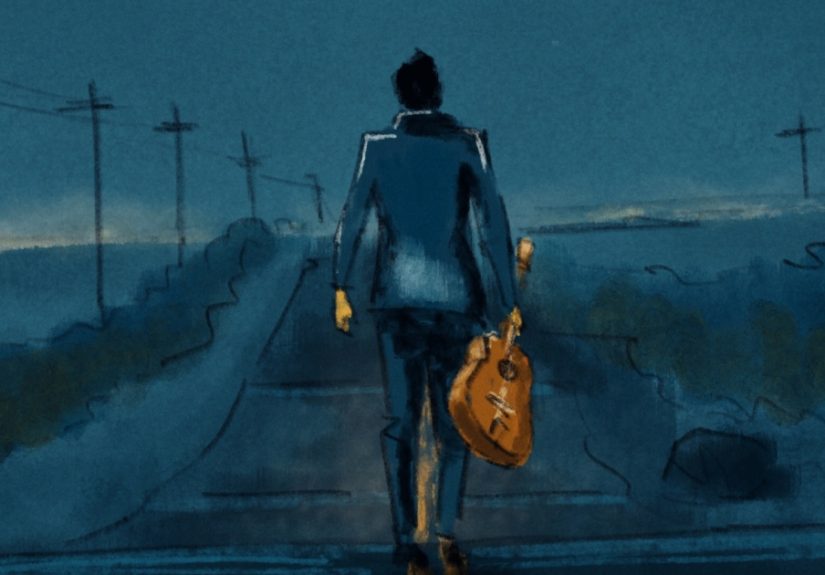
The song paints a vivid arrival: night, distance, a threshold moment that feels both safe and wrong.
In comics, one image can become five pages if you let it breathe:
- Page 1: Wide establishing shot (empty road, heat shimmer, headlights).
- Page 2: Close-ups (hands on wheel, tired eyes, the dashboard clock bullying you with its glow).
- Page 3: First glimpse of the hotel (impossibly inviting architecture; the kind of place that “shouldn’t” be out here).
- Page 4: The threshold (doorway, a figure, a gesture that reads like welcome… or appraisal).
- Page 5: Inside air (a sensory shiftcooler, perfumed, too quiet; the first hint that the rules changed when you walked in).
That’s how you stretch a song into comics: you don’t add random filleryou expand the meaning already implied.
The 60+ Day Workflow I’d Actually Recommend (Even If You’re Sane)
I didn’t wake up on Day 1 with a perfect plan. I woke up with an ambitious idea and the confidence of someone who
has never tried to draw the same character from three angles without creating accidental identical twins.
Over time, the process organized itself into phases.
Days 1–7: Research & reference (a.k.a. “collecting vibes with intent”)
- Mapped the song into 12–18 story beats (no dialogue yet, just actions and reveals).
- Built a reference board: desert highways, 1970s interiors, neon signage, luxury details that feel slightly predatory.
- Studied how comics handle “silence” (gutters, lingering panels, repeated compositions).
Days 8–18: Scripting & thumbnails (tiny drawings, huge decisions)
- Wrote a panel-by-panel outline (what the reader sees, what the reader feels, what changes).
- Thumbnails for every page: stick figures first, dignity later.
- Established visual motifs: keys, mirrors, chandeliers, doorways, and a recurring “golden glow” that slowly becomes sickly.
Days 19–40: Pencils, layouts, and the war on inconsistency
- Locked character sheets (face shapes, hair silhouettes, posture language).
- Redesigned the hotel floor plan so it could “evolve” subtly across chapters (readers should feel lost before they realize they’re lost).
- Balanced dense scenes with breathing space: a page of crowded party energy followed by a page of lonely hallway.
Days 41–60+: Inks, tones, lettering tests, and the final “is this readable?” pass
- Chose a limited palette (warm luxury → poisoned gold → cold dawn that never quite arrives).
- Lettering style tests (even minimal dialogue needs consistent visual voice).
- Final pass focused on clarity: if a reader misreads the order of panels, the spell breaks.
Comics Techniques That Helped Me “Draw Music”
1) Panel rhythm = musical rhythm
Songs have tempo changes, tension builds, and releases. Comics can mimic that with panel density.
Fast sections: more panels, tighter crops, more motion lines. Slow dread: fewer panels, wider frames, more negative space.
I treated the chorus-like returns as visual reprises: similar compositions repeating with subtle corruption each time.
2) The gutter is your silent instrument
In comics, the space between panels is where the reader’s brain supplies motion, time, and meaning.
I used gutters like rests in musicespecially right before “reveal” moments. If you show everything, nothing feels eerie.
If you imply and let the reader connect the dots, the story becomes personal (and scarier).
3) Symbolism works best when it’s functional
I didn’t want symbols that scream, “Hello, I am a symbol!” So every motif had a job:
the key opens doors (plot), reflects status (theme), and becomes a repeating shape that guides the eye across pages (design).
4) Environment as antagonist
Instead of giving the hero a single villain, I made the hotel itself the opposing force:
it offers what the protagonist wants, then quietly raises the cost. That’s the heart of why this song resonates
the trap is attractive.
The Copyright Reality Check (Because the Internet Is Not a Magic Cloak)
Let’s talk about the part nobody wants to talk about when they’re on Day 12 and feeling like a genius.
Turning an existing song into a graphic novel-style adaptation can be considered a derivative work,
which is a legal category for works that recast, transform, or adapt earlier works.
So… is it “fair use”?
Fair use in the U.S. is a case-by-case analysis guided by four factors (purpose/character, nature of the work,
amount/substantiality, and market effect). In plain English: being a fan doesn’t automatically protect you, and
slapping “I don’t own this” on the back cover doesn’t work like garlic on a vampire.
Practical, safer approaches if you want to share your work publicly
- Make it inspired-by, not adapted-from: Create an original story that captures the mood without using the song’s protected expression.
- Avoid lyrics and recognizable chunks: Don’t reproduce lines, and don’t “translate” the song into near-identical scenes beat-for-beat if your goal is publication.
- Be extra careful if money is involved: Commercial use raises stakes and increases market-harm arguments.
- Consider licensing if you want a true adaptation: If the dream is to sell it, talk to a lawyer and explore permissions.
My personal stance for this project: I treated it as a creative exercise and portfolio exploration.
If you’re aiming for a commercial release, get real guidancebecause “I saw someone do it on TikTok” is not a legal strategy.
What I Learned (Besides “Never Start a 120-Page Project During a Busy Month”)
- Constraint is your friend: A limited palette and repeated motifs made the book cohesive and saved time.
- Thumbnailing is where the book is actually written: Beautiful art can’t rescue unclear storytelling.
-
Your first draft will be too literal: Mine absolutely was. The magic appeared when I stopped illustrating “events”
and started illustrating consequences. - Readers don’t need every answer: Mystery isn’t laziness. It’s a choiceespecially for a story built on symbolism.
My 60+ Day Diary: The Messy, Human Part (Extra Creator Experiences)
Around Day 9, I hit my first predictable wall: the “this is awesome” phase evaporated and got replaced by the
quieter question, Do I actually know how to finish things? If you’ve never adapted music into sequential art,
the emotional math is weird. A song gives you momentum for free. A graphic novel demands you manufacture momentum,
page after page, even when your brain wants to stare at reference photos of chandeliers like that counts as progress.
Day 14 was the “continuity crisis.” I drew my protagonist’s jacket three different ways, then tried to convince myself
it was character development. Spoiler: it was not. That’s when I created a one-page “style bible” and taped it to the wall:
head shape, eye spacing, hair silhouette, and three default expressions I could always return to. It felt boring
which is how you know it was the right move.
Day 22 was weirdly joyful. I spent an entire afternoon drawing doors. Not exciting doors. Just doors.
But doors are story machines in a “threshold” narrative: they separate safety from danger, outsider from insider,
choice from consequence. Once I started treating architecture as a character, the book clicked.
The hotel stopped being a backdrop and became a living argument with the protagonist: Stay. Indulge. Forget.
Day 31 was the “panel rhythm breakthrough.” I realized I’d been drawing like I was afraid of silence.
So I forced myself to do a sequence with almost no text and very few panels: a long hallway, a slow walk, a glance into a mirror,
and then a cut to an empty frame where something should be. The story suddenly felt like music againtension, pause, release.
It taught me that “less” isn’t minimalist for aesthetic points; it’s how you let the reader hear what you’re not saying.
Day 45 was the low point: I hated everything. The hotel felt too pretty. The dread felt too polite.
I fixed it by making one ruthless rule: every “beautiful” page needed one unsettling detail.
A smile that lasts a beat too long. A reflection that doesn’t match. A shadow that points the wrong way.
Not jump scaresmicro-discomforts. The kind you can’t explain, which is exactly the point.
By Day 63, I wasn’t chasing perfection anymore. I was chasing coherence. And that’s the secret finish line for a project like this:
not “Does every page look museum-ready?” but “Does every page push the reader deeper into the spell?”
When I finally did a full read-through, start to end, I heard the song in my headwithout writing a single lyric on the page.
That was the win.
Final Thoughts
Making a graphic novel version of “Hotel California” taught me something embarrassing and useful:
I didn’t just love the songI loved the story engine inside it. The hypnotic invitation. The creeping cost.
The way glamour can turn into a maze. If you want to try something similar, do itbut do it thoughtfully:
respect the craft, respect the reader, and respect the reality that art lives in both imagination and law.