Table of Contents >> Show >> Hide
- The bizarre injury that turned into an instant showbiz legend
- Why the Prince connection makes the story even bigger
- Emma Stone and SNL: this was never a random cameo
- Why this story exploded online
- The deeper appeal: show business runs on chaos as much as talent
- Conclusion
- Related Experiences: Why Nights Like This Become Legend
- SEO Metadata
Celebrity stories usually arrive in neat little packages: a glamorous red carpet, a funny backstage memory, a charming anecdote polished within an inch of its life. Emma Stone’s latest Saturday Night Live tale is not that kind of story. This one has broken glass, a hotel chef, a paring knife, tequila, and Prince. In other words, it has everything a great pop-culture legend needs except maybe a waiver form.
The headline sounds almost too weird to be true, which is exactly why it has traveled so fast. Before Stone ended up onstage with Prince during the now-mythic SNL40 celebration, she says she stepped on broken glass at the Plaza Hotel afterparty and had to get the shard removed in the most chaotic way imaginable. It was not a glamorous Hollywood medical moment. It was more like “luxury event meets emergency kitchen improvisation.” And honestly? That may be why the story works so well.
There is also a bigger reason people are eating this story up. Emma Stone and SNL are no casual acquaintances. She is one of the show’s most beloved modern hosts, the youngest person to join the Five-Timers Club, and someone whose personal life is intertwined with the show’s orbit. Add Prince to the mix, and suddenly this is not just a weird injury anecdote. It is a perfect little capsule of how live entertainment, celebrity folklore, and backstage absurdity collide.
The bizarre injury that turned into an instant showbiz legend
According to Stone’s retelling, the trouble started when she kicked off her shoes to dance at the SNL40 afterparty. Somewhere on the floor, broken glass had been left behind. She stepped on it, cut her heel, and wound up being taken to a back room at the Plaza Hotel. That alone would have been enough to derail most people’s evening. Instead, the story swerved into comedy-history territory.
Stone said a chef at the hotel removed the glass with a paring knife. Yes, a chef. Yes, a paring knife. And yes, that detail does make the phrase “emergency surgery” feel both wildly dramatic and somehow still technically undersold. Nobody hears “the hotel chef handled it” and thinks, “Ah, good, a standard procedure.” It sounds like the kind of sentence that should be followed by an insurance investigator fainting into a fern.
Stone also joked that tequila helped dull the pain, which adds another layer of surreal polish to the whole thing. It was not exactly a clean, clinical, Gray’s Anatomy-style emergency. It was a very SNL-adjacent emergency: messy, funny, fast, and oddly functional. Then, because the universe clearly wanted maximum drama, she was asked almost immediately afterward if she wanted to go onstage with Prince.
At that point, there are really only two possible answers. The practical answer is no. The correct answer, in celebrity folklore, is absolutely yes. Stone put her injured foot into a high heel, grabbed a tambourine, and went out anyway. If that sounds like a fever dream, that is because it basically is.
Why this detail matters
There is a huge difference between an ordinary celebrity mishap and a story that sticks. This one sticks because it has stakes, timing, and a ridiculous visual. You can picture it immediately: bleeding heel, backstage scramble, improvised medical help, and then a sudden pivot into one of the coolest music moments of the decade. The tonal whiplash is the point.
It also says something useful about Emma Stone’s public image. She has built a reputation on being talented, funny, and game for almost anything. This story reinforces that image without feeling manufactured. No brand strategist could design something this weird. It feels too specific, too chaotic, and too human.
Why the Prince connection makes the story even bigger
If Stone had limped onto a random hotel stage to clap along with a wedding band, this would still be a funny anecdote. But this was Prince. That one detail turns the whole episode from amusing backstage chaos into real entertainment mythology.
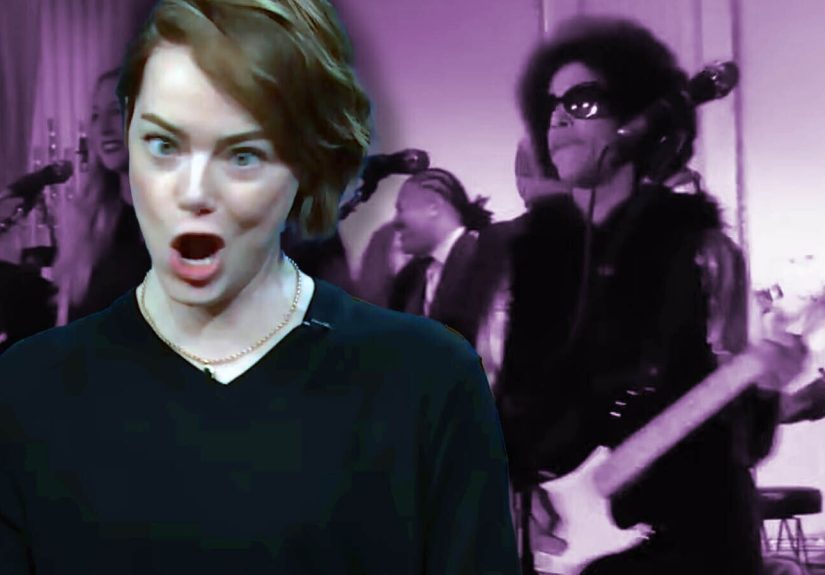
The performance happened after SNL40, the 40th anniversary special that aired in February 2015 and drew an enormous audience. The show was already an event machine, packed with comedy royalty, music icons, and enough famous faces to make a seating chart cry. After the telecast, the party moved to the Plaza Hotel, where the star power somehow became even more concentrated. That is where Prince reportedly took the stage in an impromptu afterparty jam that later became the stuff of internet legend.
When footage from that performance surfaced in 2016, it helped confirm what people had been whispering about: the room was stacked with celebrities, the energy was absurdly high, and Prince was in command of the whole thing. Reports and video coverage described Emma Stone among the famous faces onstage, along with names like Maya Rudolph, Martin Short, Bill Murray, Jim Carrey, Jimmy Fallon, Chris Rock, and Haim. Not bad for a post-show hang.
Why fans still care about that performance
Prince’s afterparty performance has lasted in pop-culture memory partly because it feels unplanned in the best way. It was loose, crowded, electric, and impossible to reproduce. These are the moments fans romanticize because they feel like glimpses behind the velvet rope. Not a formal concert. Not a polished broadcast. Just a legendary artist walking into a room full of famous people and instantly becoming the gravitational center.
Stone’s presence in that moment matters because she was not just watching from the side. She was part of the chaos. The tambourine detail makes the whole thing feel delightfully low-tech. You do not need a perfect instrument or a carefully rehearsed role when the point is simply to be there, contribute to the vibe, and survive the adrenaline rush.
There is also an emotional layer now that did not exist in the same way at the time. Prince died in April 2016, not long after the afterparty performance. That has given the footage and the stories around it a more poignant glow. What may have felt like a wild celebrity jam in 2015 now reads as a rare, vivid snapshot from the final chapter of an icon’s public life.
Emma Stone and SNL: this was never a random cameo
The reason this story lands so well is that Emma Stone is not some occasional celebrity who wandered into an anniversary party by accident. She is deeply connected to Saturday Night Live. Over the years, she has become one of the show’s most reliable and versatile hosts, the kind of performer who can make a pre-tape sing, sell an oddball sketch, and look perfectly comfortable inside Studio 8H’s very particular brand of madness.
That relationship was formalized when Stone joined the Five-Timers Club in 2023, becoming its youngest member at age 35. That matters because it places her in rare company and confirms what many fans already thought: she is not just good at SNL; she is part of the show’s modern identity.
Her personal life is tied to the show too
Stone also met her husband, writer-director Dave McCary, through SNL. The two first crossed paths when she hosted in 2016 and appeared in the now-classic “Wells for Boys” sketch, which McCary directed. That connection gives stories like the Prince afterparty anecdote an extra layer of continuity. Stone is not merely SNL-adjacent. She is woven into the place.
By the time SNL50 rolled around in February 2025, Stone showed up not as a nostalgic guest but as one of the people who genuinely belongs in the building’s orbit. Her popcorn-pocket dress at the anniversary special was funny, stylish, and unmistakably her. It was also very SNL: playful, self-aware, and just a little weird in the most appealing way.
That longer history is what turns the “weird emergency surgery” story into more than a one-off viral clip. It becomes part of the broader Emma Stone-SNL mythology, where hosting gigs become relationships, sketches turn into life milestones, and afterparty stories somehow sound like deleted scenes from a prestige comedy fever dream.
Why this story exploded online
Some stories are built for the internet, and this one showed up wearing a crown. First, it has a perfect hook. “Emma Stone had weird emergency surgery before performing with Prince at SNL40” is the kind of sentence that forces a double take. It sounds exaggerated even when it is true.
Second, it combines two kinds of celebrity storytelling people love: glamorous access and grotesque specificity. “I was at an exclusive party with major stars” is interesting. “A hotel chef removed glass from my foot with a paring knife and then I played tambourine for Prince” is unforgettable. The best viral anecdotes live exactly in that gap.
It feels human, not polished
Another reason the story connected is that Stone tells it in a way that preserves the absurdity. She does not sand the edges off the weirdness. She leaves in the broken-glass detail, the chef detail, the tequila detail, and the high-heel detail. That honesty makes the story funnier and more credible.
It also fits the way fans already see her. Emma Stone often comes across as witty, self-deprecating, and slightly bemused by the pageantry around celebrity life. This anecdote plays directly into that persona. She is not presenting herself as a fragile movie star floating above inconvenience. She is presenting herself as a person who got hurt, got patched up in the strangest possible way, and still thought, “Well, Prince is onstage, so I guess we’re doing this.”
That kind of storytelling travels because it makes fame feel less like a glossy billboard and more like a wildly expensive group chat gone off the rails.
The deeper appeal: show business runs on chaos as much as talent
There is a more serious reason this anecdote resonates. It reminds people that live entertainment is often held together by adrenaline, improvisation, and people making split-second calls in imperfect conditions. Audiences usually see the finished product. They do not see the tiny disasters, bad timing, pain, nerves, wardrobe malfunctions, and accidental slapstick that happen just outside the frame.
Stone’s story strips away some of that polish. It says that even at one of the fanciest parties connected to one of television’s biggest institutions, stuff still goes sideways. Glass breaks. Feet bleed. Plans change. And yet the music starts anyway.
That is part of why the Prince angle matters so much. Great performers generate a kind of urgency around them. When a rare opportunity appears, people ignore discomfort, throw common sense in the glove compartment, and do the thing. Not because it is medically sound. Not because it is elegant. Because it is unforgettable.
So yes, the anecdote is funny. It is also a miniature portrait of performance culture: pain later, story now.
Conclusion
Emma Stone’s bizarre SNL40 story works because it feels like a perfect collision of everything people love about entertainment lore. It has backstage chaos, celebrity absurdity, a dash of physical danger, and a once-in-a-lifetime Prince moment waiting at the other end. More importantly, it sharpens the image of Stone as one of Hollywood’s most game, funny, and genuinely appealing stars.
In a media landscape overflowing with overmanaged anecdotes, this one feels gloriously unvarnished. A broken heel, a chef with a paring knife, a couple of tequilas, and then a tambourine appearance with Prince at one of the most famous SNL celebrations ever. If that is not a proper showbiz war story, nothing is.
Related Experiences: Why Nights Like This Become Legend
Stories like this tend to outlive the event itself because they capture a very specific kind of experience: the moment when discomfort, adrenaline, and opportunity all collide at once. Even people who have never been to an SNL afterparty or stood ten feet from Prince recognize the emotional logic of it. Something goes wrong, the situation becomes mildly ridiculous, and then life hands you a decision so absurdly good that you ignore the problem and move anyway.
That is one reason Emma Stone’s story feels bigger than a celebrity anecdote. It mirrors the way intense experiences actually work in real time. During a high-pressure moment, your brain often does not process events in a neat order. First comes pain. Then confusion. Then a strange practical fix. Then someone asks a question that changes the stakes, and suddenly your body is running on momentum instead of reason. Only later, sometimes much later, do you look back and think, “Wait, that was insane.”
Anyone who has ever had to perform, present, compete, or simply hold it together in public after something went wrong can understand the shape of that experience. Maybe it was not broken glass in a luxury hotel ballroom. Maybe it was a twisted ankle before a school performance, a ripped hem before a wedding speech, a migraine before a big meeting, or a tech disaster five minutes before an important presentation. The details change. The feeling does not. You do the fast internal math. Can I still go on? Can I fake normal for twenty minutes? Will this become a funny story later? And then, somehow, you continue.
What makes entertainment stories especially sticky is that the reward on the other side is often outsized. In Stone’s case, it was not just “finish the evening with dignity.” It was “go onstage with Prince.” That kind of opportunity compresses common sense into a tiny, helpless ball. Of course she said yes. Most people would have said yes with a full cast on their leg and a moderately concerning amount of gauze.
There is also something deeply compelling about the way chaos can make a memory brighter. Perfect nights are pleasant, but messy nights are memorable. You remember the strange fix, the accidental hero, the tiny disaster, and the sudden pivot into something magical. That is why the chef detail is so important in this story. Without it, the anecdote is just celebrity glamor. With it, the whole thing becomes textured and human. It has grit. It has a weird visual. It has that crucial “you cannot make this up” energy.
These stories also remind us that big cultural moments are rarely as polished from the inside as they look from the outside. The public sees the iconic image: Emma Stone onstage at a legendary Prince performance during the orbit of SNL40. The private reality includes pain, improvisation, and someone solving a problem with whatever tool happens to be nearby. That contrast is part of the thrill. It pulls famous people down from poster status and drops them back into the messy realm of actual experience.
And maybe that is why audiences love stories like this so much. They are glamorous, yes, but they are also democratic in a strange way. The scale is different, the room is fancier, and the guest list is definitely stronger than most people’s Friday nights. Still, the emotional structure is familiar. Something breaks. You adapt. The night gets stranger. Then, against all logic, it becomes one of the best memories of your life.
Emma Stone’s SNL40 story is funny because it is bizarre. It lasts because it feels true to how great nights actually happen: not as planned perfection, but as chaos narrowly outrunning disaster and somehow turning into legend.