Table of Contents >> Show >> Hide
- Why Night Sky Illustrations Feel So Magical
- The Power of Animals in Magical Illustration
- Black-and-White Ink: Simple Tools, Big Atmosphere
- How the Illustrations Combine People, Animals, and Stars
- Why the “26 Pics” Format Works So Well
- The Role of Constellations and Cosmic Storytelling
- What Artists Can Learn from This Illustration Style
- Why These Magical Illustrations Connect With Viewers
- Experiences Inspired by Creating Magical Animal and Night Sky Illustrations
- Conclusion
Some artists paint sunsets. Some draw portraits. And then there are artists who look at animals, people, constellations, ink pens, and the deep velvet mystery of the night sky and think, “Yes, all of this belongs in the same universe.” Honestly, they are right.
The illustration series known as “I Combine Animals, People, And The Night Sky To Create Magical Illustrations (26 Pics)” is built around a wonderfully simple idea: blend the natural world with cosmic imagination. The result is a collection of black-and-white drawings where animals do not merely exist on the page; they seem to carry galaxies, memories, myths, and quiet emotions inside them.
The artist behind the series, Bráulio Monteiro, has described a fascination with nature, animals, stars, constellations, darkness, and the poetic atmosphere of the night. Working with a Moleskine sketchbook and fine liners, he uses black ink and white space to create fantasy-like worlds that feel both delicate and powerful. No neon colors. No visual fireworks. Just lines, contrast, patience, and a bit of moonlit wizardry.
Why Night Sky Illustrations Feel So Magical
The night sky has been borrowing human attention since before anyone had calendars, telescopes, or the ability to take blurry phone photos of the moon. Stars have helped people navigate, tell stories, measure seasons, and imagine shapes in the darkness. NASA explains that constellations are often understood as groups of stars that appear to form objects, animals, or people when viewed from Earth. That idea is basically the original cosmic connect-the-dots game.
This is one reason Monteiro’s magical illustrations feel instantly familiar. When we look at a stag filled with stars, a panda surrounded by symbolic plants, or a human figure woven into an animal’s form, we are not just seeing a drawing. We are seeing a visual language humans have used for centuries: nature as story, animals as symbols, and the sky as a giant notebook that nobody has managed to misplace.
Great night-sky art often works because it balances observation and emotion. Vincent van Gogh’s The Starry Night, for example, is famous not because it is a perfectly literal sky report, but because it turns the sky into mood, movement, and feeling. MoMA notes that Van Gogh’s painting embraces mood, symbol, expression, and sentiment through its dramatic night scene. Monteiro’s work is quieter, smaller, and made in ink rather than oil paint, but it shares that same instinct: the sky is not just scenery. It is emotion with stars attached.
The Power of Animals in Magical Illustration
Animals have always been more than animals in art. A lion can suggest courage. A deer can feel gentle, alert, or spiritual. An owl may carry mystery. A bear can feel protective, lonely, or ancient. The Metropolitan Museum of Art notes that animals in medieval art often carried rich symbolic meanings, while Getty points out that animal imagery can reveal a lot about the cultures and beliefs behind artworks.
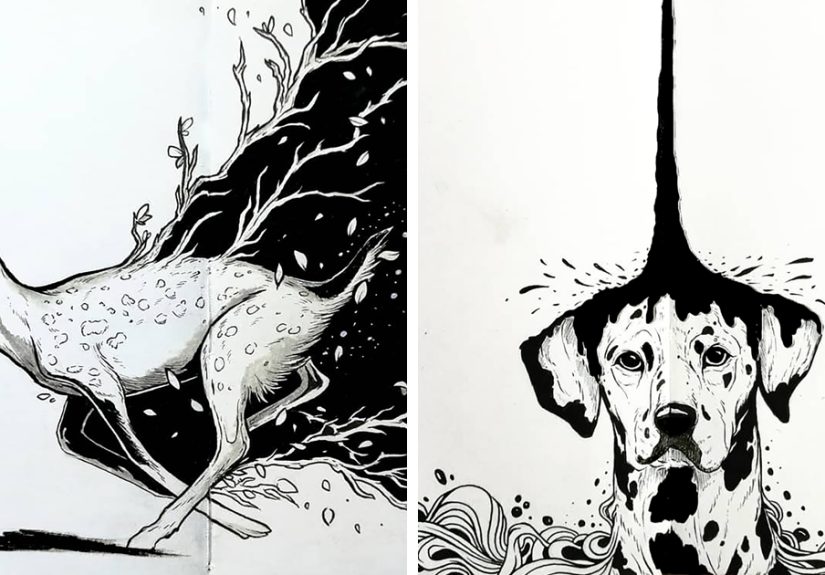
Monteiro’s illustrations tap into that long visual tradition without making the images feel like dusty museum homework. His animals are expressive, but not cartoonish. They feel mythical, but not overloaded. A polar bear connected with Ursa Major immediately links wildlife to the stars. A Dalmatian piece titled The Origin of the Spots turns a familiar animal feature into a cosmic joke, as if the universe casually sprinkled stars onto a dog and called it a day.
That is the clever charm of the series. The drawings do not shout, “Behold, symbolism!” They simply invite viewers to look twice. The first glance sees an animal. The second sees a story hiding inside the animal. The third glance usually makes you wonder why your own notebook contains only grocery lists and three suspiciously similar doodles of cubes.
Black-and-White Ink: Simple Tools, Big Atmosphere
One of the most striking things about this series is that it relies on black-and-white ink. In a world where digital art can summon every color from “glowing nebula purple” to “energy drink green,” Monteiro’s limited palette feels refreshing. The absence of color gives the work room to breathe. It also forces every line to earn its place.
Line art is deceptively demanding. Adobe describes line art as monochromatic illustration made with varying line weights or thicknesses, often in black and white. The artist has to suggest form, shadow, depth, and movement without leaning on color gradients or painterly effects. That means the magic lives in contrast: dense black shapes against untouched paper, tiny stars against dark bodies, thin outlines beside heavy shadows.
Fine liners are especially suited to this kind of precision. Sakura of America notes that Pigma Micron pens are used by illustrators and artists for precise lines and archival-quality work. Tools like these allow an artist to shift between delicate constellation dots, sharp animal silhouettes, soft fur textures, and decorative patterns. In Monteiro’s work, the pen becomes a telescope, a needle, and a storytelling wand all at once.
How the Illustrations Combine People, Animals, and Stars
The title says the artist combines animals, people, and the night sky, but the real beauty is in how these elements overlap. The figures are not always separate objects placed together like stickers on a laptop. Instead, they often merge into one symbolic scene. A person may appear nested inside an animal form. A creature may contain a star field. A natural element may become a doorway into a dream.
This layering creates a feeling of transformation. The animal becomes landscape. The sky becomes body. The human becomes witness, companion, or memory. It is the kind of visual storytelling that makes viewers slow down, because the image does not reveal everything in one quick scroll. It asks for attention, which is rare on the internet, where most of us treat images like speed bumps on the way to snacks.
Several pieces in the series use titles that help guide interpretation. Roots suggests ancestry, grounding, and connection to the earth. The Origin of the Spots feels playful and myth-making. At Night leans into the quiet presence of nocturnal imagination. Ghost gives an owl a mysterious, almost spiritual mood. Mother, featuring a tiger and cub, brings tenderness into the wild.
Why the “26 Pics” Format Works So Well
A single magical illustration can be beautiful. A 26-picture series becomes a small universe. The repeated use of ink, animals, human figures, and celestial imagery gives the collection visual unity, while each drawing introduces a different emotional tone. Some feel gentle. Some feel strange. Some feel humorous. Some feel like they belong in a fantasy novel that smells faintly of old paper and rain.
The format also works well for web audiences. Viewers can move from one drawing to the next, noticing recurring motifs: stars, dark skies, animal silhouettes, decorative details, and the tension between wilderness and imagination. The experience becomes almost like flipping through a bestiary, except the creatures are not being cataloged by a medieval scholar with questionable zoology. They are being reimagined by an artist with a strong sense of atmosphere.
This matters because modern online art often has to fight for attention. A series gives viewers a reason to keep scrolling. It creates rhythm. It invites comparison. It lets the artist develop a theme without explaining it in a long artist statement that begins with “My practice interrogates…” and immediately scares half the audience into another tab.
The Role of Constellations and Cosmic Storytelling
Constellations are one of the most natural bridges between art and astronomy. They are scientific landmarks, cultural stories, and visual patterns at the same time. NASA explains that constellations are not physically connected groups of stars; the stars may be vastly different distances from Earth, but from our perspective they appear to form recognizable shapes. That makes constellations perfect material for artists: they are real, imagined, ancient, and subjective all at once.
In Monteiro’s illustrations, stars are not just decoration. They act like emotional texture. A star field inside an animal can suggest mystery, interior life, or hidden grandeur. A constellation reference can connect a creature to mythology. A dark sky can turn a simple composition into something dreamlike. The night becomes a metaphor for the unknown, but not necessarily a frightening one. It feels like the kind of unknown that offers you tea and asks if you believe in magic.
The best cosmic art understands that space is both huge and intimate. The universe contains galaxies, nebulae, and stars that make human problems look like dust on a windowsill. Yet the night sky also feels personal because we experience it from our own tiny patch of ground. Monteiro’s drawings live in that contrast: vast sky, small page; ancient stars, handmade lines; wild animals, human emotion.
What Artists Can Learn from This Illustration Style
1. Limitations Can Make Art Stronger
Using only black and white may sound restrictive, but limits can sharpen creativity. Without color, the artist must focus on shape, balance, texture, and contrast. This is why the series feels visually confident. The drawings do not need a rainbow to create wonder. They use darkness and light like a stage crew with excellent timing.
2. Symbolism Works Best When It Feels Natural
The animal imagery in the series succeeds because it does not feel forced. A bear can connect to constellations. A tiger and cub can suggest motherhood. An owl can carry ghostly mystery. The symbolism grows from the subject rather than being taped onto it like an awkward party hat.
3. Details Reward the Viewer
Fine-line illustration thrives on detail. Tiny dots, fur marks, leaves, stars, and patterns make the viewer spend more time with the work. That extra attention creates emotional investment. In other words, details are not just decorative sprinkles; they are the breadcrumbs leading viewers deeper into the image.
4. A Strong Theme Can Hold a Series Together
Animals, people, and the night sky are broad enough to allow variety, but specific enough to create identity. This is a smart lesson for illustrators building a portfolio. A memorable theme can help individual works feel like part of a larger artistic world.
Why These Magical Illustrations Connect With Viewers
The series connects because it combines three things people naturally respond to: animals, human emotion, and the cosmos. Animals bring instinct and personality. Human figures bring empathy. The night sky brings mystery and scale. Together, they create images that feel like small myths.
There is also something calming about the handmade quality. In an era of fast images and polished digital effects, ink drawings remind us that art can still be slow. Every line suggests time. Every cluster of stars suggests patience. Every shadow suggests a decision. The viewer can sense the hand behind the image, and that makes the magic feel earned.
Monteiro’s illustrations also appeal to people who love fantasy but prefer subtlety. There are no dragons breathing fireworks over a castle while twelve moons explode in the background. The magic is quieter. It hides in the shape of a bear, the curve of a horn, the darkness inside a silhouette, or the tiny stars scattered like secrets.
Experiences Inspired by Creating Magical Animal and Night Sky Illustrations
Anyone who has tried creating art inspired by animals and the night sky knows the process can feel peaceful, frustrating, and slightly suspicious all at once. Peaceful, because drawing stars and animals can put the mind into a slower rhythm. Frustrating, because one wrong line in ink does not politely disappear. Suspicious, because after twenty minutes of drawing fur, you may begin to wonder whether the fox is judging you.
A useful experience is to begin with observation rather than imagination. Spend time looking at animal references: the curve of a deer’s neck, the heavy softness of a bear’s body, the alert posture of an owl, or the way a cat folds itself into a shape that appears to violate basic physics. Then look at the sky. Notice that stars are not evenly scattered like glitter from a craft accident. Some cluster. Some fade. Some appear brighter. Darkness has texture too.
When combining these elements, sketch lightly first. Choose one main animal and decide what emotional role it plays. Is it protective, lonely, playful, ancient, or mysterious? Then decide how the human element enters the scene. A person can stand beside the animal, sleep inside its silhouette, look up at the same sky, or become part of the animal’s symbolic world. The goal is not to explain everything. The goal is to create a scene that feels like it has a story even before the viewer knows the plot.
One of the most rewarding parts of this style is working with negative space. White paper can become moonlight, mist, fur highlights, or silence. Black ink can become shadow, sky, body, or emotional weight. The trick is knowing when to stop. This is difficult because details are addictive. Add one star and suddenly you want to add six hundred. Add one leaf and now the page is a botanical garden with a deer somewhere under the paperwork.
Another lesson is that mistakes can become part of the image. A smudged dot might become a distant star. A line that went too far might become a branch. A dark patch might become part of the night. Ink teaches flexibility because it does not care about your plans. It is the tiny black cat of art materials: elegant, dramatic, and fully in charge.
For beginners, a simple exercise is to draw an animal silhouette and fill part of it with a night sky. Add a moon, a few constellations, and one small human figure for scale. Keep the composition clean. Let the contrast do the heavy lifting. The first attempt may not look like a gallery-ready masterpiece, but it will teach an important principle: magical illustration is not about adding more things. It is about making different things feel like they belong together.
The emotional experience matters too. Drawing animals with stars inside them can feel surprisingly personal. A wolf full of constellations might represent independence. A whale carrying a moonlit ocean might suggest memory. A bird with a galaxy in its wings might feel like freedom. These images work because they allow viewers to bring their own meanings. The artist opens the door; the audience brings the lantern.
That is the real charm of magical illustration. It does not need to answer every question. It can simply create a place where nature, people, and the universe meet for a quiet conversation. And if that conversation happens to include a panda, a polar bear, a tiger cub, and several hundred stars, even better. The night sky has room.
Conclusion
“I Combine Animals, People, And The Night Sky To Create Magical Illustrations (26 Pics)” is more than a catchy title. It describes an artistic approach that blends observation, symbolism, fantasy, and handmade precision. Bráulio Monteiro’s black-and-white ink drawings show how much atmosphere can be created with limited tools when the idea is strong and the execution is careful.
The series reminds us that animals have always carried stories, the sky has always invited imagination, and people have always searched for themselves somewhere between the two. Whether you are an illustrator, an art lover, a stargazer, or simply someone who enjoys a good cosmic animal moment, these magical illustrations offer a quiet but memorable kind of wonder.
In a noisy digital world, that quietness is part of the magic. The drawings do not beg for attention. They reward it.