Table of Contents >> Show >> Hide
- Why a Towel Wrap Works
- What You Need Before You Start
- How to Wrap a Cat: 11 Steps
- Step 1: Pick the right moment
- Step 2: Prepare the room before bringing in the cat
- Step 3: Place the cat gently in the center of the towel
- Step 4: Encourage a tucked, low body position
- Step 5: Fold one side snugly across the body
- Step 6: Fold the other side over and tuck it in
- Step 7: Keep the head free and the airway clear
- Step 8: Position the wrapped cat securely
- Step 9: Do the task quickly and gently
- Step 10: Watch your cat’s stress signals
- Step 11: Unwrap, reward, and end on a decent note
- Common Mistakes to Avoid
- When a Towel Wrap Is Helpful
- When You Should Not Wrap a Cat at Home
- Tips for Making Future Wraps Easier
- Real-World Experiences: What People Learn the First Time They Try It
- Conclusion
- SEO Tags
If you have ever tried to trim a cat’s nails, give a pill, clean an ear, or perform any tiny act of love that your cat interprets as betrayal, welcome. You are among friends. The good news is that learning how to wrap a cat safely can make grooming and medication much easier. The better news is that you do not need wrestling skills, chain-mail gloves, or a dramatic monologue. You need a towel, a calm setup, and a plan.
This technique is often called a cat burrito, but the goal is not to restrain your cat like a furry enchilada. The goal is low-stress cat handling: keeping your cat secure enough for a short task while reducing scratching, panic, and chaos. Done well, a towel wrap can help with giving cat medicine, trimming cat nails, applying ear drops, or transporting a nervous cat to a safer spot. Done badly, it becomes a tiny domestic rodeo.
Before you begin, one important note: if your cat is injured, in obvious pain, struggling to breathe, or already escalating into full panic mode, do not force the wrap. A veterinarian or trained groomer may be the safest option. The same goes for cats who bite hard, lash out repeatedly, or act as though today is the day they finally settle the score.
Why a Towel Wrap Works
A proper towel wrap helps by gently controlling the limbs, limiting escape routes, and giving many cats a sense of cover and security. It also protects you from surprise claws while allowing you to handle your cat for a brief task. The keyword there is brief. This is not a method for overpowering a terrified cat for ten miserable minutes. It is a short, practical technique for short, practical needs.
Think of it like this: cats do best when the environment is quiet, the handling is predictable, and the human behaves less like a panicked octopus. If you set things up correctly, many cats tolerate the process far better than owners expect.
What You Need Before You Start
- A large bath towel or soft blanket
- A quiet room with the door closed
- Treats or a lickable reward
- Your supplies ready first, whether that is nail clippers, medication, or ear drops
- A helper, if your cat tends to be squirmy or suspicious of your life choices
Choose a towel that is thick enough to block claws but soft enough to feel comfortable. Super tiny hand towels are cute, but this is not their moment. You want enough fabric to wrap around the body without exposing all four paws like little escape hooks.
How to Wrap a Cat: 11 Steps
Step 1: Pick the right moment
Do not begin when your cat is zooming through the hallway, stalking imaginary enemies, or deeply committed to dinner. The best time is when your cat is calm, sleepy, or already resting. A relaxed cat is far easier to towel wrap than a cat who has decided the floor lamp is an intruder.
Step 2: Prepare the room before bringing in the cat
Have everything ready before your cat arrives. Lay the towel flat on a bed, couch, countertop with traction, or your lap if you are comfortable working there. Keep the room quiet and free of other pets, loud children, and any soundtrack that suggests action-movie energy. Cats notice tension quickly, so your setup should say, “We are handling this calmly,” not, “Nobody move, we may lose a finger.”
Step 3: Place the cat gently in the center of the towel
Set your cat in the middle of the towel, ideally facing away from you. This position gives you better control and makes it harder for the cat to lunge forward into your face. Keep one calm hand on the shoulders or chest area, using light but steady contact. Avoid sudden grabbing. Cats are not fans of surprise choreography.
Step 4: Encourage a tucked, low body position
If possible, let your cat settle into a loaf-like or crouched posture with the legs tucked in. This makes the wrap easier because the limbs are already close to the body. If your cat is standing tall like a tiny offended giraffe, wait a moment, stroke gently, and encourage a calmer position rather than forcing the next step too fast.
Step 5: Fold one side snugly across the body
Take one side of the towel and bring it across your cat’s back and side, tucking it under the body. The wrap should be snug enough to keep the legs in place but not tight enough to restrict breathing. You are aiming for secure, not vacuum-sealed. If your cat immediately pops one paw out like a magician revealing a card trick, just reset and try again with a smoother tuck.
Step 6: Fold the other side over and tuck it in
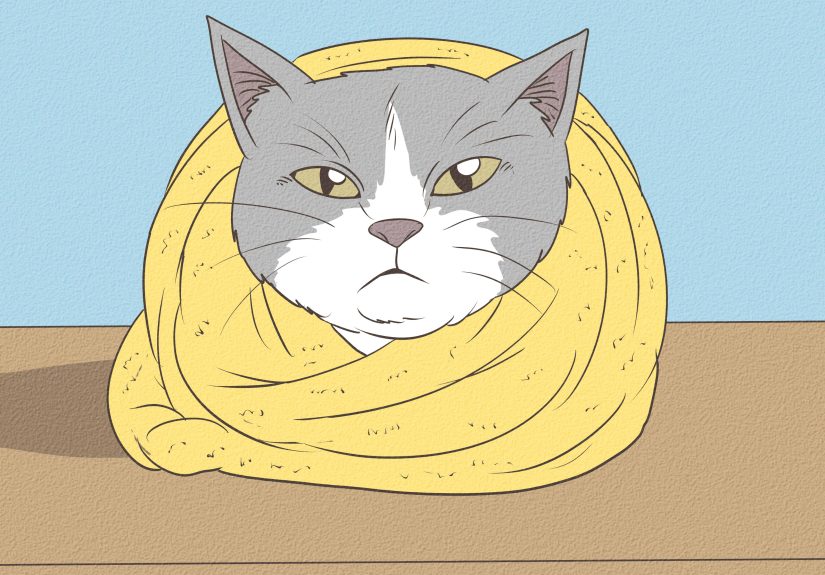
Bring the opposite side of the towel across the body and tuck it under as well. At this point, your cat should look like a compact little parcel with the head exposed. Many cats tolerate this better than owners expect because the towel limits frantic limb movement and provides reassuring contact.
Step 7: Keep the head free and the airway clear
Never cover your cat’s nose or wrap around the neck too tightly. The head can remain exposed, although some cats are calmer if part of the towel rests loosely near the cheeks or behind the head. If you need to briefly drape part of the towel over the top of the head to reduce visual stimulation, keep it light and make sure breathing is completely unobstructed.
Step 8: Position the wrapped cat securely
Once wrapped, place your cat in your lap with the face pointing away from your body, or keep the cat on a stable surface. Put your arms on either side for support. If you have a helper, let one person do the gentle restraint while the other handles the task. Two calm humans usually beat one overwhelmed human trying to manage a cat, a towel, a syringe, and a rising sense of regret.
Step 9: Do the task quickly and gently
This is the whole reason you wrapped the cat, so be efficient. Trim one or two nails, give the pill, apply the ear drops, or complete whatever short care task you need. If you are medicating, follow your veterinarian’s directions exactly. If you are trimming nails, only clip the sharp tip and avoid the quick. If the task is taking too long, pause rather than turning the moment into a marathon.
Step 10: Watch your cat’s stress signals
A successful feline restraint towel wrap is not just about keeping the cat still. It is about reading the cat’s body language. If your cat starts panting, growling, freezing hard, thrashing, twisting violently, or trying to bite through the towel, stop. Those are signs the cat is too stressed or uncomfortable. For some cats, a towel wrap feels secure. For others, it feels intolerable. Respect that difference.
Step 11: Unwrap, reward, and end on a decent note
When you are done, release the towel calmly and let your cat leave at their own speed. Offer a treat, praise, a favorite brush, or a lickable reward. The goal is to teach your cat that being handled does not always end in disaster. Even if the session was not perfect, ending with something pleasant helps the next attempt go better.
Common Mistakes to Avoid
Wrapping too loosely
If the towel is too loose, your cat will simply launch a paw into the open air and begin negotiations with violence. A snug wrap is kinder than a sloppy wrap that forces repeated repositioning.
Wrapping too tightly
If the wrap compresses the chest or neck, it is unsafe. Cats must be able to breathe comfortably at all times.
Starting before your supplies are ready
Nothing ruins a good setup faster than realizing the medicine is in the other room while you are holding an annoyed cat like a fuzzy burrito of broken trust.
Ignoring body language
Some owners mistake stillness for cooperation. Sometimes it is. Sometimes it is shutdown behavior caused by fear. A quiet cat is not automatically a comfortable cat.
Using force when the cat has already escalated
If your cat is already hissing, swatting, twisting, or acting painful, trying harder is often the wrong answer. A veterinary team can suggest safer handling, medication alternatives, or a different approach.
When a Towel Wrap Is Helpful
- Giving a cat a pill or liquid medicine
- Applying ear medication
- Trimming cat nails
- Brushing or checking paws
- Moving a nervous but otherwise stable cat briefly and safely
When You Should Not Wrap a Cat at Home
- If the cat is injured or may have a fracture
- If the cat is having breathing trouble
- If the cat is in significant pain
- If the cat repeatedly tries to bite through the towel
- If you are physically unable to hold the cat safely
- If the task requires more than a brief at-home procedure
There is no prize for “most determined home medicator.” Sometimes the smartest move is to call your veterinarian and ask for a demonstration, a compounded medication, a different dose form, or a professional appointment.
Tips for Making Future Wraps Easier
Practice when nothing important is happening. In other words, do not let the first towel lesson happen five seconds before medicine time. Let your cat sit on the towel, get treats on the towel, and experience a gentle one-second wrap followed by praise. Short practice sessions can make the real thing much less dramatic.
You can also pair handling with positive reinforcement. Touch a paw, reward. Lift a lip, reward. Fold a towel edge across the side, reward. Cats are fully capable of learning routines. They just prefer to pretend they are not.
Real-World Experiences: What People Learn the First Time They Try It
The first time most people try to wrap a cat, they assume the challenge will be the towel. It is not. The real challenge is timing. New cat owners often spend too long adjusting the corners, re-folding the sides, and second-guessing every move while the cat quietly realizes an escape route still exists. Then, in one graceful act of betrayal, a single paw emerges, the towel shifts, and suddenly the “cat burrito” becomes a “cat confetti event.” That is why experienced handlers talk so much about preparation. The towel matters, but the rhythm matters more.
Another common experience is discovering that calm cats are not always calm when grooming or medication enters the chat. A cat who naps like an angel can become a philosopher of resistance the moment you reach for nail clippers. Owners often take that personally, but they should not. Cats are not being mean. They are responding to restraint, novelty, and body handling in ways that make sense for a prey-predator species that values control over its movements. Understanding that changes the whole mood. Instead of asking, “Why is my cat doing this to me?” you begin asking, “How can I make this feel less alarming?” That is a much better question.
People also learn that shorter is better. One nail clipped successfully is more useful than ten nails and a ruined relationship. One clean dose of medication followed by praise beats five minutes of chasing a suspicious cat around the kitchen island. In real life, the best sessions often look boring. The towel is ready. The room is quiet. The cat is wrapped smoothly. The task takes less than a minute. The reward appears. Everyone walks away with dignity mostly intact. That is the dream.
Helpers can make a huge difference too. Many owners discover that a familiar second person changes everything. One person keeps the cat steady and offers a treat, while the other performs the task. The cat stays calmer, the human stays calmer, and the whole event feels less like a slapstick routine. On the other hand, too many people in the room can backfire. Cats do not usually enjoy an audience, especially one giving contradictory advice like, “Hold her tighter,” “No, looser,” and “Wait, where did the pill go?”
Perhaps the biggest lesson is that success is not measured by perfection. Success may mean your cat tolerated the towel for twenty seconds longer than last week. It may mean you got the medication in without a chase scene. It may mean you recognized stress early and stopped before the situation spiraled. Those are wins. Over time, many cats improve when the process stays predictable, gentle, and brief. And many owners improve too. They stop moving nervously, stop apologizing to the towel, and start handling the moment with confidence. Cats notice that. They may never send a thank-you card, but they do respond to steadiness.
So if your first attempt is clumsy, welcome to the club. Most people do not master a safe cat towel wrap on day one. But with patience, practice, and a healthy respect for feline opinions, you can learn how to wrap a cat in a way that is safer, calmer, and much less ridiculous than it first seems.
Conclusion
Learning how to wrap a cat is really about learning how to handle a cat with respect. A good towel wrap is not a trick for overpowering your pet. It is a practical, low-stress tool for short tasks like nail trims, medicine, and basic care. Use a quiet room, a large towel, a gentle touch, and a quick plan. Watch your cat’s signals, stop when the stress is too high, and reward cooperation every time.
That is the real secret. The best cat wrap is not the tightest one. It is the one that keeps everyone safe, gets the job done quickly, and preserves your chances of being forgiven by dinner.