Table of Contents >> Show >> Hide
- Why Jaguar Encounters Are So Dangerous
- The Best Survival Rule Before Step One
- How to Survive a Jaguar Attack: 7 Steps
- Step 1: Stop Immediately and Control the Panic
- Step 2: Gather People Fast and Protect Children
- Step 3: Do Not Turn Your Back, Crouch, or Run
- Step 4: Back Away Slowly and Give the Jaguar a Way Out
- Step 5: If It Approaches, Make Yourself Bigger and Louder
- Step 6: If the Jaguar Charges or Attacks, Fight Back Hard
- Step 7: Once You Escape, Treat Every Bite or Claw Wound as a Medical Emergency
- What Not to Do During a Jaguar Encounter
- How to Reduce the Risk Before You Ever See a Jaguar
- Field-Tested Lessons and Experience-Based Takeaways
- Final Thoughts
Let’s start with the good news: if you ever see a jaguar in the wild, you have stumbled into one of nature’s rarest, most jaw-dropping moments. Let’s continue with the even better news: jaguars usually want absolutely nothing to do with you. They are elusive, solitary, heavily camouflaged ambush predators, and humans are not normal prey. That said, “rare” is not the same as “impossible,” and when the animal in question has the strongest bite of any big cat, “winging it” is a terrible strategy.
This guide is built for real-world safety, not jungle-movie drama. It combines jaguar-specific guidance with well-established big-cat encounter advice used by wildlife professionals and parks agencies. The central idea is simple: your best chance of survival is to avoid triggering a chase, avoid looking like prey, stay upright, create space, and become a problem the jaguar does not want to solve. In other words, this is one situation where being loud, weird, and inconvenient is actually a survival skill.
Why Jaguar Encounters Are So Dangerous
Jaguars are the largest cats in the Americas and are built more like compact tanks than furry track stars. They are powerful, muscular, excellent swimmers, capable climbers, and ambush hunters that prefer stealth over long chases. Their rosetted coats are not just fashion-forward; they are camouflage that helps them disappear into broken light, understory, riverbanks, and vegetation. Many jaguars live near water, hunt at dusk, dawn, or night, and may rest in trees, caves, dense cover, or brushy terrain during the day.
That matters because people often imagine a dramatic open-field charge. A jaguar encounter is more likely to feel sudden and unnervingly close. You may notice the cat only after it has noticed you. So, survival is less about cinematic heroics and more about body language, spacing, group control, and fast decisions. If you do the wrong thingespecially running, crouching, or turning your backyou can accidentally switch yourself from “strange upright animal” into “potential prey item with terrible judgment.”
The Best Survival Rule Before Step One
The smartest way to survive a jaguar attack is to prevent the attack from happening in the first place. If you are hiking or traveling in jaguar range, especially in parts of Mexico, Central America, or South America, do not move quietly through dense habitat like a free-range capybara. Travel in groups when possible. Keep children close. Stay alert near water, dense vegetation, riverbanks, and dawn-or-dusk activity periods. Do not follow tracks into thick cover. Do not approach a cat for photos. Do not get close to a jaguar that is feeding, mating, resting, or traveling with cubs. And do not, under any circumstances, participate in baited wildlife viewing or any tourism setup that conditions big cats to tolerate human proximity. That is bad for conservation, bad for the animal, and very bad for your continued enthusiasm for breathing.
How to Survive a Jaguar Attack: 7 Steps
Step 1: Stop Immediately and Control the Panic
The instant you spot a jaguar, or the instant you realize one is watching you, do not bolt. Do not scream and spin. Do not attempt the old “maybe if I jog casually, no one will notice” maneuver. Running can trigger predatory chase behavior in big cats, and jaguars are built to close short distances with disturbing efficiency.
Instead, stop. Breathe. Face the animal without advancing. Keep it in your field of vision. The goal in the first few seconds is to send a clear message: you are aware, upright, alert, and not behaving like prey. Calm body control matters here. Panic makes people do very prey-like things, and now is not the time to improvise like a malfunctioning inflatable tube man.
Step 2: Gather People Fast and Protect Children
If you are with other people, bring everyone together immediately. Do not let anyone scatter. A separated person, especially a child, is more vulnerable than a tight, upright group. If children are with you, keep them physically close and prevent them from running. If you can lift a small child safely without bending deeply or turning your back, do it. The point is to keep the group compact, tall, and controlled.
Groups are generally more intimidating than lone individuals. A jaguar assessing a cluster of alert adults has a different problem than a jaguar assessing one bent-over hiker and a panicked child zigzagging into the bushes. Survival loves organization. Chaos, meanwhile, is a terrible wilderness accessory.
Step 3: Do Not Turn Your Back, Crouch, or Run
This step deserves its own spotlight because it is the mistake people are most likely to make. Do not turn away and hurry off. Do not crouch down to pick up gear. Do not kneel. Do not bend over if you can avoid it. In big-cat safety guidance, a standing human looks less like normal prey than a crouched or running one. Staying upright also protects your head, neck, and upper torso as much as possible.
If you need to move, move slowly and deliberately. Think “controlled retreat,” not “discount action sequence.” Your job is to preserve your height, keep eyes on the cat, and remove the cat’s opportunity to view you as a fleeing target. Back away or angle away only as fast as you can do so without stumbling.
Step 4: Back Away Slowly and Give the Jaguar a Way Out
Jaguars usually prefer to avoid direct conflict with humans, especially when not cornered. That means your next move is not to challenge the animal or close the gap. It is to create distance while leaving the cat a clear escape route. Keep facing the jaguar. Move slowly backward or diagonally away. Do not block its path, and do not trap it against water, thick cover, rocks, or your group.
If there is a solid barrier nearbya large tree, boulder, vehicle, sturdy structure, or elevated platformuse it wisely. A barrier can help break the line between you and the cat and may make the jaguar feel less threatened while buying you time. But do not dash blindly for shelter if doing so means turning your back or sprinting. Shelter is useful; becoming bait on the way there is less useful.
Step 5: If It Approaches, Make Yourself Bigger and Louder
If the jaguar keeps coming, shows agitation, or begins displaying aggressive behavior such as fixed staring, stalking, flattening low, baring teeth, growling, or closing distance deliberately, you need to raise the cost of continuing. Stand tall. Raise your arms. Open your jacket. Use a backpack, branches, trekking poles, or any safe object to expand your silhouette. Speak in a firm, loud voice. Shout if needed. Clap if appropriate. The mission is not to panic the animal into a chaotic reaction, but to convince it that you are large, aware, and capable of resistance.
This is also the point where the wilderness politely asks you to stop worrying about looking ridiculous. Looking ridiculous and going home is an excellent outcome. Looking graceful and becoming a cautionary tale is not.
Step 6: If the Jaguar Charges or Attacks, Fight Back Hard
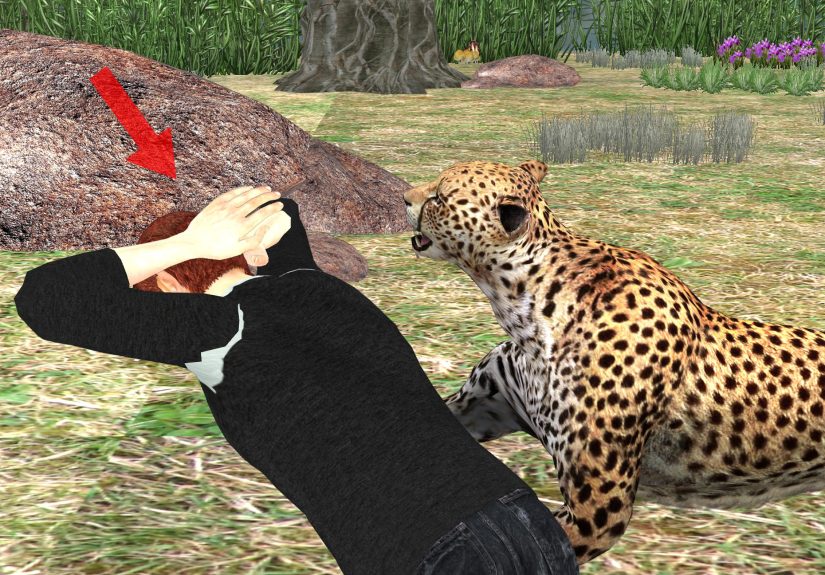
If the encounter becomes physical, the strategy changes from “de-escalate” to “survive now.” Do everything you can to remain standing. Protect your head and neck. Use whatever is at handsticks, rocks, a backpack, a jacket, camera gear, trekking poles, or your handsto strike, block, or drive the animal off. Aim to disrupt the attack and create enough resistance that the jaguar breaks contact.
Do not play dead. This is not a bear-country script, and big-cat guidance strongly favors active resistance. Fight with commitment. Use your full body weight. If you fall, curl to protect your head, throat, and chest while continuing to defend yourself. The objective is ugly, simple, and immediate: make the jaguar decide that attacking you is more trouble than it is worth.
Step 7: Once You Escape, Treat Every Bite or Claw Wound as a Medical Emergency
If you get clear, get to secure shelter, a vehicle, or a populated area as quickly and safely as possible. Call emergency services or local authorities immediately. Any jaguar bite or claw injury can involve deep punctures, crushing damage, contamination, heavy bleeding, infection risk, and the need for urgent wound care. Apply direct pressure to serious bleeding with a clean cloth or bandage. Once bleeding is controlled enough to do so safely, rinse wounds with soap and running water if available, cover them with a clean dressing, and seek medical care right away.
Do not shrug off “just a few punctures.” Animal bites can cause serious internal tissue damage even when the skin opening looks small. Medical professionals may need to evaluate for infection, tetanus updates, antibiotics, wound repair, and other complications. In plain English: if a jaguar put teeth or claws into you, your next stop is not the hotel buffet.
What Not to Do During a Jaguar Encounter
- Do not run.
- Do not crouch or crawl.
- Do not separate from your group.
- Do not approach for a better look or better photo.
- Do not corner the cat or block its retreat.
- Do not get near a jaguar that is feeding, mating, or with cubs.
- Do not assume the animal is “calm” just because it is quiet.
- Do not treat a bite or scratch like a minor souvenir.
How to Reduce the Risk Before You Ever See a Jaguar
Prevention deserves more respect than it usually gets in clicky survival articles. It may not be glamorous, but neither is emergency surgery. If you are entering jaguar habitat, hire experienced local guides, follow posted wildlife rules, avoid hiking alone, keep noise at a reasonable human level in dense areas, supervise children closely, and stay out of places where visibility is terrible unless there is a clear need to pass through. Avoid dawn, dusk, and night travel on foot whenever possible. Watch for signs such as tracks, scat, alarm calls from other animals, or unusual silence near water or dense cover.
Also, respect the animal’s ecosystem. Jaguars help regulate prey populations and play an important ecological role. The goal is not to “beat” the jaguar. The goal is to leave safely while allowing the animal to stay wild, wary of humans, and alive. Good safety and good conservation are not enemies; in jaguar country, they are basically roommates.
Field-Tested Lessons and Experience-Based Takeaways
Across wildlife guidance, ranger advice, ecotourism protocols, and reports from people who work around big cats, the same experience-based lessons come up again and again. First, most dangerous moments begin with surprise. People are relaxed, distracted, or trying to be quiet for wildlife viewing when they suddenly notice movement near a riverbank, a tree line, or a patch of broken vegetation. That pattern matters because jaguars are ambush predators. Their strength is not announcing themselves like a marching band. Their strength is blending into terrain so well that your brain needs a full second to catch up. In practical terms, that means awareness is not paranoia; it is prevention.
Second, people who stay mentally organized tend to make better survival decisions. That sounds obvious, but in the field it is everything. Groups that immediately gather children, stay upright, and move together reduce the number of variables. Nobody runs left while somebody else runs right. Nobody drops into a squat to grab a backpack. Nobody turns a tense wildlife encounter into a slapstick disaster. The groups that do well are not necessarily the strongest; they are the ones that act in the same direction at the same time.
Third, professionals who work in jaguar landscapes repeatedly emphasize respect over bravado. The cat is not a villain, but it is also not a furry celebrity guest waiting for your selfie angle. Trouble often grows from human behavior: approaching too closely, lingering around feeding sites, ignoring cubs, following the animal, or participating in tourism that teaches predators to associate people with opportunity instead of risk. That kind of habituation can erode the natural distance that protects both sides.
Fourth, experience shows that body language matters more than people expect. A person who stays tall, faces the animal, and backs away with intention communicates something very different from a person who folds in half, stumbles, or dashes. Big cats are reading motion constantly. You cannot talk a jaguar into becoming your life coach, but you can avoid sending the wrong visual signal.
Fifth, the medical side is often underestimated. People think survival ends when the cat retreats. In reality, survival continues through the next hour: stopping bleeding, preventing shock, getting to help, and having wounds evaluated properly. Deep punctures, tearing, contamination, and hidden tissue damage can become dangerous fast. That is why experienced responders treat any wild-cat bite as a true emergency, not a dramatic story to polish later.
Finally, the most useful “experience” may be accepting that the smartest survivor is usually the least theatrical one. You do not need movie-star courage. You need calm, space, posture, noise when necessary, aggressive defense if forced, and quick medical follow-up afterward. In jaguar country, surviving is not about dominating the wilderness. It is about understanding the animal well enough to avoid becoming part of its very bad day.
Final Thoughts
If you remember only one sentence from this article, remember this: do not run. After that, the rest falls into placestay upright, keep people together, back away slowly, look bigger if needed, fight hard if attacked, and get medical help fast afterward. Jaguar attacks are rare, but rare emergencies are exactly the ones people mishandle because they assume rarity equals irrelevance.
Respect the animal, respect the habitat, and respect the fact that nature does not care whether you packed confidence. The good news is that preparation works. If you ever do meet a jaguar face-to-face, the right response can turn the encounter from a nightmare into an unforgettable story that ends the way all outdoor stories should: with you going home, telling everyone about it, and maybe walking just a little less casually near suspiciously beautiful riverbanks.