Table of Contents >> Show >> Hide
- Why Hydroponic Strawberries Make Sense
- Choose the Best Hydroponic System for Strawberries
- Pick the Right Strawberry Varieties
- Create the Right Growing Environment
- Get pH, EC, and Nutrients Right
- Planting and Spacing Hydroponic Strawberries
- Weekly Care Routine That Actually Works
- Common Problems and How to Fix Them
- How and When to Harvest
- Mistakes to Avoid
- Real-World Experiences Growing Hydroponic Strawberries
- Conclusion
- SEO Tags
Growing hydroponic strawberries sounds a little futuristic, like something a sci-fi farmer would do while wearing spotless white sneakers. In reality, it is a practical, productive, and surprisingly fun way to grow one of the most beloved fruits on earth. It also solves a classic strawberry problem: beautiful plants, tiny harvest, and berries that somehow vanish right before you planned to pick them. In hydroponics, you control the water, nutrients, growing media, and environment, which means you can grow cleaner fruit, reduce soil-borne issues, and harvest at a comfortable height instead of crawling around the garden like a berry-hunting detective.
If you want sweet fruit, steady production, and a system that feels more precise than guesswork, hydroponic strawberries are worth your attention. They do have opinions, though. Strawberries are not impossible plants, but they are definitely particular. They like balanced nutrition, good airflow, steady moisture, and enough light to act like they mean business. Give them those conditions, and they reward you with glossy red fruit that tastes far better than the sad plastic-clamshell berries that sometimes haunt grocery stores in winter.
This guide walks through how to grow hydroponic strawberries from setup to harvest, with practical examples, common mistakes to avoid, and real-world growing experiences that make the process easier to understand.
Why Hydroponic Strawberries Make Sense
Hydroponic strawberries are popular for good reasons. First, the plants stay off the ground, so the fruit is usually cleaner and easier to harvest. Second, you can grow in a greenhouse, sunroom, protected patio, or dedicated indoor space instead of relying on perfect garden soil. Third, hydroponic systems let you manage water and fertilizer with much more accuracy than traditional beds.
That control matters because strawberries are one of those crops that can be generous one week and dramatic the next. A hydroponic setup helps smooth out the chaos. When done well, it can lead to better plant health, more consistent fruit quality, and a longer harvest window. It also makes growing at counter height or tabletop height possible, which is excellent news for your knees and your patience.
Choose the Best Hydroponic System for Strawberries
Start with a substrate drip system if you are a beginner
If you are just getting started, a substrate-based drip system is usually the easiest path. This means the plants grow in a soilless medium such as coco coir, perlite mix, or rockwool, and nutrient solution is delivered through drip emitters. This setup gives the roots moisture and oxygen while providing a small buffer against mistakes. In plain English, it is more forgiving than a bare-roots-in-water approach.
A common beginner layout uses troughs, gutters, grow bags, or containers filled with coco coir or a coir-perlite blend. The drip system feeds the plants on a timer, and excess solution drains away or is collected for reuse if you run a recirculating system.
NFT and DWC can work, but they demand tighter control
Nutrient film technique, or NFT, grows plants in channels where a thin film of nutrient solution flows past the roots. Deep water culture, or DWC, suspends roots in oxygenated nutrient solution. Both can be used for strawberries, but they leave less room for error. If a pump fails, roots dry out or oxygen levels crash faster than you can say, “Why do these leaves look offended?”
For home growers, substrate drip systems are often the sweet spot between simplicity and performance.
Pick the Right Strawberry Varieties
Not all strawberries behave the same way. For hydroponics, day-neutral varieties are often the best choice because they flower and fruit over a longer period instead of putting on one big seasonal show and then taking a bow. This makes them especially useful in controlled environments where you want steady production.
Popular choices often include Albion, San Andreas, Seascape, and Evie 2. Availability varies by region and supplier, but the general rule is simple: choose varieties known for day-neutral or everbearing performance, good flavor, and strong fruit quality in protected growing systems.
Buy clean, healthy plug plants from a reputable nursery when possible. Starting with strong transplants is easier than trying to rescue weak plants that already look like they have lost faith in the project.
Create the Right Growing Environment
Light is everything
Strawberries can survive under less-than-ideal light, but “survive” and “produce lots of sweet berries” are not the same thing. Hydroponic strawberries need solid daily light exposure to maintain growth, flowering, and fruit quality. In a greenhouse, winter production often benefits from supplemental lighting. Indoors, grow lights are usually essential.
If your plants are producing lots of leaves but few flowers, weak stems, or bland fruit, low light is one of the first suspects. Good light intensity and a consistent photoperiod help keep the plants productive instead of merely decorative.
Temperature matters more than many beginners think
Strawberries like moderate temperatures. In practical terms, aim for warm but not scorching days and cooler nights. Extremely hot conditions can reduce fruit quality and stress the plants, while chilly, damp air can invite disease. Many growers target daytime temperatures in the upper 60s to mid-70s Fahrenheit, with cooler nights to maintain a healthy average temperature.
If you are growing in a greenhouse, pay close attention to temperature spikes on sunny afternoons. A perfectly nice morning can become a berry sauna by 2 p.m. Ventilation, shade cloth, or evaporative cooling may be needed depending on your climate.
Humidity and airflow must stay balanced
Dry air can contribute to leaf edge issues and stress, but overly humid, stagnant air is an engraved invitation to fungal trouble. Good airflow is essential. Use horizontal airflow fans, avoid overcrowding, and remove aging leaves that trap moisture around the crown and fruit.
Hydroponic strawberries do not enjoy sitting in still, muggy air like they are at a bad summer reunion. Keep air moving.
Pollination is not optional
Here is a truth many new growers discover too late: strawberry flowers need proper pollination for full, well-shaped fruit. Poor pollination often leads to lumpy or misshapen berries. In commercial greenhouses, growers often use bees. In a home setup, you can hand-pollinate by gently tapping flower clusters, using a small soft brush, or turning on a light fan during bloom to encourage pollen movement.
If your berries keep looking like abstract sculpture, improve pollination before you blame the nutrients.
Get pH, EC, and Nutrients Right
Hydroponic strawberries are heavy on nuance. They want enough nutrition to stay productive, but they are also sensitive to excess salts in the root zone. That is why pH and electrical conductivity, or EC, should be checked routinely.
A good target for nutrient solution pH is usually around 5.5 to 6.0. This range helps nutrients stay available to the plant. For EC, many growers stay in a moderate range rather than pushing the system too hard. Exact numbers vary by cultivar, growing stage, water quality, and system design, but the general strategy is to avoid extremes and watch how the plants respond.
Use a complete hydroponic fertilizer designed for fruiting crops, and do not mix nutrients like a mad chemist with a YouTube certificate. Follow the manufacturer’s directions, test the water source, and make gradual adjustments. In fruiting systems, calcium and potassium are especially important, but balance matters more than random enthusiasm.
Top tip: monitor the root zone, not just the reservoir. If the medium accumulates salts, plants may show tip burn, marginal leaf issues, or declining vigor even when the tank numbers look fine.
Planting and Spacing Hydroponic Strawberries
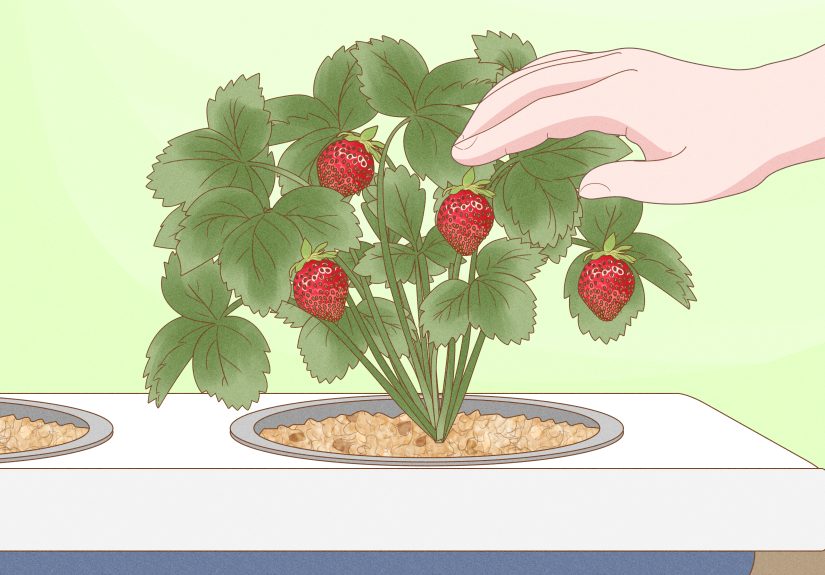
Plant crowns so they sit at the correct height. Bury the crown too deep and it can rot. Plant too shallow and the roots struggle to anchor. The crown should sit just above the media line, with roots spread well into the substrate.
Give plants enough space for airflow and light penetration. Hydroponic strawberries can be grown fairly efficiently, but cramming them together is a false economy. Tight spacing creates shading, slows drying around foliage, and turns disease management into a full-time hobby. In a small home system, it is better to grow fewer plants well than a crowded jungle badly.
Weekly Care Routine That Actually Works
Every day
- Check that pumps, timers, and emitters are working.
- Look for wilted plants, dry media, or standing water.
- Watch for open flowers and signs that pollination is happening.
Two to three times a week
- Measure pH and EC.
- Inspect roots if possible. Healthy roots should look light-colored and fresh, not brown and slimy.
- Check for pests such as spider mites, aphids, and thrips.
Once a week
- Remove runners unless you want to propagate new plants.
- Trim yellow or damaged older leaves to improve airflow.
- Sanitize tools and clean up fallen debris.
- Flush or refresh nutrient solution as needed for your system.
Runners are a big deal. If the plant is sending energy into making baby plants, it is spending less energy on fruit. Unless propagation is your goal, clip runners early and consistently.
Common Problems and How to Fix Them
Small fruit
This often points to low light, weak pollination, excessive heat, or a tired plant. Check all four before overreacting with fertilizer changes.
Misshapen berries
Usually a pollination issue. Improve airflow around flowers, hand-pollinate, or add pollinators in a protected growing space where appropriate.
Leaf tip burn or edge scorch
This can be related to salt buildup, calcium transport issues, or environmental stress. Check EC, irrigation frequency, humidity balance, and root health.
Gray mold on flowers or fruit
Botrytis thrives in damp, stagnant conditions. Improve ventilation, remove infected tissue, reduce prolonged leaf wetness, and avoid overcrowding.
Strong leaves but little fruit
This often means the plants have enough nitrogen to make foliage but not the conditions needed to push bloom and fruit well. Review light, temperature, pollination, and overall nutrient balance.
How and When to Harvest
Harvest strawberries when they are fully colored and fragrant. Unlike some fruit, strawberries do not get significantly sweeter after picking. If the berry is still pale near the tip or shoulder, waiting a little longer usually pays off.
Pick gently by the stem cap instead of squeezing the fruit. Hydroponic strawberries often look so glossy and perfect that it is tempting to admire them for ten minutes first, but once ripe, they should be harvested promptly for the best quality.
For the best flavor, harvest in the cooler part of the day and chill them soon after if you are not eating them immediately. Of course, “not eating them immediately” is a beautiful theory.
Mistakes to Avoid
- Using weak plants: Bad starts lead to disappointing systems.
- Ignoring pollination: Flowers are not fruit until pollination is handled well.
- Overfeeding: More nutrients do not equal more berries.
- Letting salt build up: Strawberries dislike a salty root zone.
- Overcrowding plants: Poor airflow invites disease.
- Keeping old leaves forever: Dead foliage is not sentimental; it is a disease risk.
- Skipping system checks: Pumps and timers fail at the least convenient moment.
Real-World Experiences Growing Hydroponic Strawberries
The most useful thing about growing hydroponic strawberries is that every grower eventually learns the same lesson in a slightly different outfit: precision matters, but observation matters more. On paper, two growers can have nearly identical setups, similar nutrient formulas, and the same cultivar, yet one gets bowls of sweet berries while the other gets a greenhouse full of leaves and disappointment. The difference is often not a secret product or a miracle additive. It is the daily habit of noticing what the plants are saying.
Many first-time growers report that their earliest mistake was treating strawberries like lettuce. Lettuce forgives. Strawberries negotiate. A beginner might set up a hydroponic channel, plug in a pump, and assume the plants will more or less take care of themselves. Then the flowers appear, excitement peaks, and the berries come out tiny, uneven, or weirdly shaped. That is usually when the grower discovers the importance of pollination, air movement, and stable environmental control. It is a humbling moment, but also a useful one.
Another common experience is underestimating heat. A greenhouse can look bright and cheerful in the morning, then turn into a strawberry stress chamber by afternoon. Growers often say their plants looked best during mild weather and quickly lost momentum when temperatures rose too high for too long. This is why successful growers become slightly obsessed with vents, fans, and thermometers. Not because it is glamorous, but because fruit quality depends on it.
Home growers also learn that hydroponic strawberries reward consistency far more than heroics. Dramatic swings in pH, irregular watering, or random fertilizer experiments usually create more problems than they solve. One week of “I adjusted five things at once” can leave you with no idea what actually helped and what quietly made things worse. Experienced growers tend to make one change at a time, then watch the plants for several days before doing anything else. It is not flashy, but it works.
There is also the emotional side of the project, which nobody mentions enough. Growing strawberries hydroponically is deeply satisfying because the crop feels personal. You notice the first bloom, then the first tiny green nub, then the slow color shift from pale to pink to red. By the time you harvest your first really good berry, you have probably checked on it twenty times and considered naming it. That sense of payoff is a huge reason people stay with the crop even after a few frustrating setbacks.
Growers with small backyard greenhouses often describe hydroponic strawberries as one of the most rewarding crops for family use. Kids love spotting ripening fruit, adults love the flavor, and the raised systems make maintenance less physically demanding. Indoor hobby growers, meanwhile, often say strawberries taught them more about environmental balance than any other crop. Once you can keep strawberries happy, most other hydroponic plants feel a little less intimidating.
Commercial and serious hobby growers alike also talk about the importance of sanitation. The systems that stay productive are not always the fanciest ones. They are the ones where old leaves get removed, algae is controlled, water lines are checked, and fallen fruit does not sit around inviting disease. Clean systems win more often than complicated ones.
Perhaps the most repeated experience is this: the first harvest may be modest, but quality improves dramatically once the grower learns the rhythm of the plants. Better pollination, steadier feeding, cleaner pruning, and smarter temperature control all stack together over time. The result is not just more fruit, but better fruit. Sweeter fruit. Fruit that tastes like an actual strawberry instead of a red suggestion. And that, honestly, is the whole point.
Conclusion
If you want to grow hydroponic strawberries successfully, keep the formula simple: choose a day-neutral variety, use a beginner-friendly substrate drip system, maintain good light and moderate temperatures, manage pH and EC carefully, remove runners, protect airflow, and never ignore pollination. That combination gives you the best chance of growing healthy plants and flavorful berries without turning your setup into a science fair that forgot to finish on time.
Hydroponic strawberry growing is part gardening, part system management, and part berry diplomacy. But once you understand what the plants need, it becomes one of the most rewarding crops you can grow at home or in a small greenhouse. Do it well, and your plants will not just survive. They will produce the kind of strawberries that make store-bought fruit seem like a rough first draft.