Table of Contents >> Show >> Hide
- What You Need (No, a Runway Is Not Required)
- The Fold: Build an Aerodynamic Dart-Glider Hybrid
- Why This Works: Aerodynamics Without the Snooze
- Tuning Your Paper Airplane for Distance and Stability
- Troubleshooting: Fix the Drama in Three Throws or Less
- The Aerodynamic Paper Airplane Game: Turn Folding Into a Flight League
- Make It STEM: Mini Experiments That Feel Like Play
- Advanced Tips for People Who Secretly Want to Win
- Safety and “Don’t Get Banned From the Office” Notes
- Conclusion: Fold, Fly, Tweak, Repeat
- Extra: of Real-World Experiences (a.k.a. Flight-Test Folklore)
A paper airplane is basically the world’s smallest aircraft program: one sheet of paper, zero budget, and a test pilot (you) who keeps insisting the next flight will be “more scientific.” Whether you’re chasing distance, hang-time, or bragging rights in the living-room “terminal,” this guide will show you how to fold an aerodynamic paper airplane, tune it like a tiny engineer, and turn the whole thing into a ridiculously fun paper airplane game.
We’ll build a fast, stable “dart-glider hybrid” that’s beginner-friendly but surprisingly competitive. Then we’ll layer in aerodynamics (in plain English), plus a game system with challenges that make everyone feel like they’re running their own flight-test labwithout needing a lab coat or a permission slip.
What You Need (No, a Runway Is Not Required)
- 1 sheet of paper (8.5” x 11” letter is perfect; A4 also works)
- A flat surface for crisp folds (a table, a book, or your friend’s “I keep my desk tidy” fantasy)
- Optional tuning tools: 1 paper clip, a small piece of tape, ruler or tape measure, and a pen
The Fold: Build an Aerodynamic Dart-Glider Hybrid
This model borrows the best traits from classic darts (speed, stiffness) and gliders (stable lift). The goal is a clean fuselage (body), symmetric wings, and a center of gravity that doesn’t behave like it’s trying to start drama.
Step-by-Step Folding Instructions
- Start with the paper vertical (portrait). Fold it in half lengthwise (top to bottom edge aligned), crease sharply, then unfold. You’ve just created the “spine.”
- Fold the top corners to the center line. Bring the top left and top right corners down so their edges meet the center crease. Make them as even as possiblesymmetry is your autopilot.
- Fold the new slanted edges to the center line again. You’re narrowing the nose to reduce drag and stiffen the body.
- Create a “locking” nose fold. Fold the top point down so it lands about 1–1.5 inches from the bottom of the triangular section (exact distance isn’t sacred; consistency is). Crease firmly.
- Fold the plane in half along the center crease. Keep the nose on the outside. Press the fold flat so the fuselage becomes a strong beam.
- Fold the wings down. Starting near the nose, fold one wing down so the top edge of the wing aligns with the bottom edge of the fuselage. Flip and repeat for the other wing.
- Add “winglets” (optional but powerful). Fold the outer 0.5 inch of each wing tip upward. These act like tiny stabilizers and can help reduce tip wobble.
- Set a slight dihedral. Gently bend both wings upward a little so the plane looks like a shallow “V” from the front. Don’t overdo itthink “confident posture,” not “victory pose.”
First Test Flight (The “Don’t Blame the Air” Launch)
Hold the plane near the front underside of the fuselage. Aim level or slightly upward (just a little). Throw with a smooth, medium-fast motion. If you hurl it like you’re pitching the final inning, a light paper airplane may stall or dive dramaticallygreat for theater, not great for distance.
Why This Works: Aerodynamics Without the Snooze
Paper airplanes obey the same big ideas as real aircraft. When your plane flies, four forces are throwing a tiny physics party: lift pushes up, weight pulls down, thrust pushes forward (your throw), and drag resists motion like a very judgmental headwind.
Lift: The Wing’s Job Interview
Your wings push air down, and the air pushes back uplift. Bigger wings can create more lift, but they can also add drag. That’s why a dart-style plane tends to be fast (less wing area, less drag) while a glider tends to float longer (more wing area, more lift). Our hybrid tries to balance both so it doesn’t immediately become a paper lawn dart.
Drag: The Unpaid Villain
Drag increases when your folds are messy, your wings are uneven, or your plane has extra “features” like wrinkles, tears, or that mysterious bite mark from your dog. Crisp folds and a smooth nose reduce drag and improve the odds your plane goes straight instead of interpreting your throw as modern dance.
Center of Gravity (CG): Where the Plane “Feels” Heavy
A plane with the CG too far back tends to stall (it climbs, loses speed, then flops). CG too far forward can dive like it’s late for a meeting. A good starting point is a CG about 1/3 of the wing’s depth back from the leading edge, near the fuselage. The exact sweet spot depends on your folds, paper, and wing angleso yes, you’re allowed to tinker like a proud nerd.
Tuning Your Paper Airplane for Distance and Stability
Folding gets you a working airplane. Tuning gets you a plane that makes your friends ask, “Okay, what kind of sorcery is that?” Here are the clean, repeatable tweaks used in classroom STEM challenges and flight tests.
Micro-Adjustments That Actually Matter
- Elevators (tiny upturn at the back of the wings): If the plane dives, gently bend the trailing edges up a little. If it stalls, flatten them back down.
- Ailerons (asymmetry control): If it veers left, slightly raise the left trailing edge or lower the right trailing edge. Small changesmillimetersare plenty.
- Dihedral adjustment: More dihedral can increase stability; too much can add drag and reduce distance. Aim for a subtle “V.”
- Winglets: If you see wingtip wobble or spiraling, winglets can help. If the plane becomes sluggish, reduce winglet size.
Adding Weight: Paper Clip Science (Not Cheating)
A single paper clip near the nose can stabilize flight by moving the center of gravity forward. That can improve straight-line distance for many dart-style designsespecially if your plane tends to stall. But too much weight, or weight too far forward, will turn your aircraft into a very polite projectile that immediately requests the ground.
Try this: do three throws with no paper clip, then three with one clip at the nose. Measure distance and compare the average. You’re not just playingyou’re running a controlled experiment with extremely low paperwork.
Troubleshooting: Fix the Drama in Three Throws or Less
If Your Plane Nose-Dives
- Raise the back edges of both wings slightly (add elevator).
- Reduce nose weight (remove tape/clip) if you added any.
- Throw slightly less steeply downward (level is your friend).
If Your Plane Stalls (Climbs Then Flops)
- Flatten the elevators (trailing edges).
- Add a small amount of nose weight (paper clip) to move CG forward.
- Throw flatter and smoother, not harder.
If It Turns Left or Right
- Check wing symmetry first: same shape, same fold angle.
- Use tiny aileron tweaks (one trailing edge up/down by a hair).
- Confirm the nose is centerednot folded slightly off to one side.
The Aerodynamic Paper Airplane Game: Turn Folding Into a Flight League
Now for the best part: the aerodynamic paper airplane game. This turns random throwing into a structured set of challenges that rewards both design and piloting. It also stops the classic argument: “Mine went farther!” / “Yeah, but yours hit the lamp.” We will settle this like civilized humans: with a scoreboard.
Setup
- Players: 2–10
- Location: hallway, gym, backyard, or any space where you won’t accidentally invent “Ceiling Fan Roulette”
- Flights per event: 3 (use the best 2 or the average of all 3)
- Standard rule: Same paper type for everyone (unless one player “accidentally” uses cardstock)
Event 1: Distance Dash
Mark a launch line with tape. Measure from the line to the first touch-down point. Score:
- 3 points = farthest flight in the round
- 2 points = second farthest
- 1 point = everyone else who completes a valid flight (no throwing it straight into the floor “for speed”)
Event 2: Hang-Time Challenge
Use a timer. Score the longest time aloft. This event favors gliders and well-tuned wing angles. If someone claims their plane “was still airborne spiritually,” remind them the timer is not impressed.
Event 3: Precision Landing
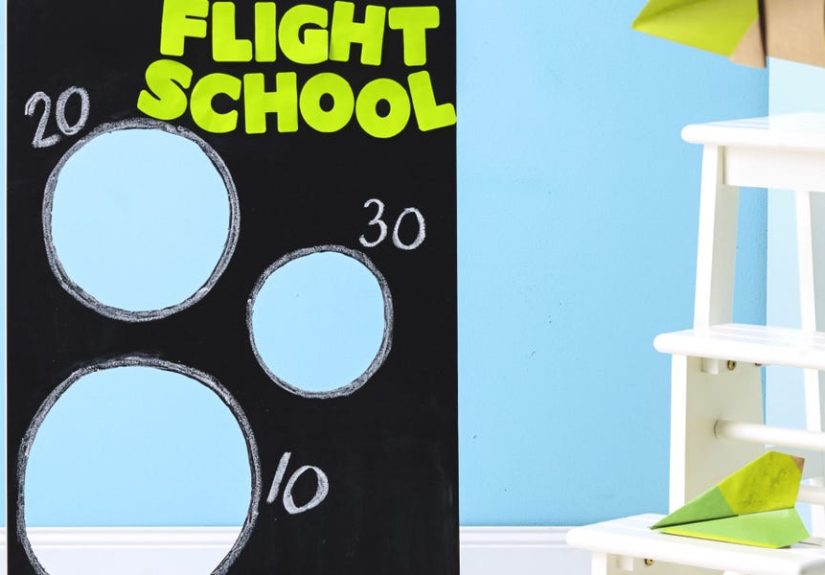
Put down a target (a plate, a hoop, a towel, or a printed bullseye). Score based on where the plane lands:
- 5 points = inside the center circle
- 3 points = on the target
- 1 point = within 3 feet
- 0 points = “explored the couch ecosystem”
Event 4: Engineering Bonus (The “Make It Better” Round)
Each player gets two minutes to modify their plane using only: one paper clip and/or one small piece of tape and two tiny wing tweaks. Then they fly a single attempt for distance. If the modified flight beats their best previous distance by 10%, they earn +3 bonus points. This rewards real iteration, not random chaos.
Make It STEM: Mini Experiments That Feel Like Play
If you want to upgrade from “fun” to “fun that teaches something,” run quick experiments like the ones used in classroom paper-airplane challenges:
Experiment A: Weight Placement
Try the same paper clip in three positions: nose, mid-fuselage, and near the wing area. Record distance and flight behavior (dives? stalls? stable glide?). You’ll see how weight distribution changes stability and performance.
Experiment B: Wing Area
Fold a second plane with slightly wider wings (move the wing fold line a bit lower). Compare hang-time and distance. Discuss the tradeoff: more lift vs. more drag.
Experiment C: Dihedral vs. Flat Wings
Make one plane with flat wings and one with slight dihedral. Compare how “forgiving” each one is if the throw is a little crooked. The more stable plane often wins in real life because pilots are human, not robots.
Advanced Tips for People Who Secretly Want to Win
- Consistency beats power. A smooth, repeatable throw usually outperforms random arm-cannon launches.
- Fresh folds matter. Crisp edges and a stiff fuselage help maintain wing shape during flight.
- Use “tiny changes.” If you can see your adjustment from across the room, it’s probably too big.
- Standardize the conditions. Same launch line, same paper, similar throws, minimal wind. Otherwise you’re measuring luck, not design.
Safety and “Don’t Get Banned From the Office” Notes
- Don’t throw at faces, pets, or anyone holding hot coffee. This should not need saying, but here we are.
- Avoid ceiling fans, lamps, and the one coworker who takes everything personally.
- If using paper clips, keep them secured. A loose clip is basically a tiny chaos coin.
Conclusion: Fold, Fly, Tweak, Repeat
Learning how to fold a paper airplane is the easy part. Learning how to make it fly well is where the magic happens: clean folds, balanced wings, and small aerodynamic tweaks that turn “meh” flights into “wait, do that again.” And when you add a structured aerodynamic paper airplane game, you get the best kind of learning the kind that feels like play, sparks friendly competition, and accidentally teaches physics while everyone laughs.
So grab a sheet of paper, build your fleet, and start your flight league. Your runway is ready. Your test pilot is caffeinated. And your best plane is probably the one you haven’t folded yet.
Extra: of Real-World Experiences (a.k.a. Flight-Test Folklore)
Paper airplanes have a special talent: they show up in the exact moments when humans need a tiny win. Waiting for a meeting to start? Someone folds. Stuck inside on a rainy day? Someone folds. Group project going off the rails? Someone foldsusually the person who says, “I think we need a quick prototype,” and means it in the most literal way.
In classrooms, the vibe is almost always the same: the first launches are pure optimism. Planes soar, drift, and sometimes immediately faceplant, which is a humbling lesson in gravity delivered with perfect comedic timing. The fun part comes right afterwhen people realize the plane isn’t “bad,” it’s just “untuned.” Suddenly, everyone becomes a micro-engineer. Someone discovers that lifting the back edge of a wing by a millimeter turns a nosedive into a glide. Someone else adds a paper clip and feels like they’ve hacked the laws of the universe. The quiet kid who didn’t say much all period launches a perfectly straight dart and instantly becomes the person everyone asks for advice. Paper aviation is a remarkably fair meritocracy.
In offices, paper airplanes turn into a low-stakes Olympics. People pretend it’s “just for fun,” but you can tell when competition kicks in because suddenly there’s a launch line, a measuring tape, and a coworker taking notes like it’s a quarterly earnings call. The funniest part is watching design philosophies clash. One person builds a sleek speed machine and throws it like a laser. Another builds a floaty glider that drifts forever and lands gently like it pays rent. The speed person claims gliders are “cheating.” The glider person claims speed planes are “emotionally unstable.” Both are correct in their own way.
Family game nights get even better because paper airplane games even the playing field. Little kids can win accuracy. Older kids can win hang-time. Adults can win distance until they pull a muscle and realize they are not, in fact, a professional quarterback. The best moment is when someone’s plane clearly has potential but keeps turning left like it has an appointment. Everyone crowds around, offering suggestions: “It needs more winglet,” “No, less winglet,” “Add a clip,” “Remove the clip,” “Have you tried… believing in it?” Eventually someone makes a tiny aileron tweak and the plane flies straight. The room erupts as if you just landed on Mars. And honestly? In that moment, it kind of feels like you did.
That’s the real experience of the aerodynamic paper airplane game: it rewards curiosity. You test, you adjust, you learn, you laugh, and you try again. And when someone asks why you’re taking it so seriously, you can always say, with complete sincerity: “This is flight science.” Then you launch another one.