Table of Contents >> Show >> Hide
- What Narcolepsy Actually Looks Like
- Symptoms That Make a Sleep Specialist Think, “We Should Test This”
- What Does Not Automatically Mean Narcolepsy
- How Doctors Test for Narcolepsy
- The Official Criteria for Narcolepsy
- So, How Do You Know If You Have Narcolepsy?
- Common Real-Life Experiences on the Road to Diagnosis
- Final Thoughts
You know that feeling when you sit down “just for a second” and your brain immediately files for a nap? Everyone has lazy afternoons. Narcolepsy is different. It is a neurologic sleep-wake disorder that can cause overwhelming daytime sleepiness, sudden sleep episodes, and in some people, cataplexy, which is a sudden loss of muscle tone triggered by strong emotions. In plain English: your body starts acting like sleep and REM rules apply while you are still very much trying to be a functioning human in public.
If you have been wondering whether your symptoms are more than simple exhaustion, the answer is not found in a personality quiz, a viral video, or your coworker saying, “Wow, you’re always tired.” Narcolepsy is diagnosed using a combination of symptom history, sleep specialist evaluation, and formal sleep testing. There are specific medical criteria, and yes, they are more serious than “fell asleep during a Zoom call twice.”
This guide breaks down how doctors figure out whether someone has narcolepsy, what tests are used, what the official criteria look like, and what the whole process often feels like in real life.
What Narcolepsy Actually Looks Like
Narcolepsy is not the same thing as being tired after a brutal week, staying up too late, or having a boring staff meeting. The defining issue is excessive daytime sleepiness that keeps showing up even when a person believes they got enough sleep. This sleepiness can feel irresistible. Some people describe “sleep attacks,” while others notice they drift off in quiet situations, during reading, while watching TV, or even in more dangerous situations like driving.
There are two main types of narcolepsy. Narcolepsy type 1 involves either cataplexy or very low levels of hypocretin, also called orexin, a brain chemical involved in wakefulness. Narcolepsy type 2 also causes significant daytime sleepiness, but cataplexy is absent and hypocretin is not low if it is measured. That distinction matters because it changes how doctors interpret symptoms and test results.
One sneaky thing about narcolepsy is that nighttime sleep is not always beautifully solid. Many people think, “If I were sleepy all day, I’d sleep like a rock at night.” Not necessarily. Some people with narcolepsy have fragmented nighttime sleep, frequent awakenings, vivid dreams, and REM sleep that barges in early like it forgot to knock.
Symptoms That Make a Sleep Specialist Think, “We Should Test This”
Excessive Daytime Sleepiness
This is the big one. The sleepiness is usually persistent, not a one-off rough patch. It tends to show up daily and can affect school, work, driving, concentration, and mood. People may doze unintentionally, feel mentally foggy, or keep fighting a constant urge to sleep even after what seems like a full night in bed.
Some people also experience automatic behaviors, meaning they continue a simple activity while half-asleep and later barely remember it. That might look like typing nonsense, writing something that makes zero sense, or walking into a room with full confidence and no idea why you are there. To be fair, many healthy adults also do that last one, but narcolepsy takes it to another level.
Cataplexy
Cataplexy is one of the most important clues for narcolepsy type 1. It is a sudden loss of muscle tone triggered by strong emotions such as laughter, excitement, surprise, or anger. It can be dramatic, like a full-body collapse, but it can also be subtle. A person’s knees may buckle, the jaw may drop, the head may slump, or speech may suddenly sound slurred. The person is awake during the episode, which is one reason cataplexy can be so confusing and frightening.
If you have strong emotional triggers followed by brief weakness, especially without losing consciousness, that is worth telling a sleep specialist in detail. Doctors care about those details more than you might think.
Sleep Paralysis and Vivid Hallucinations
Sleep paralysis happens when a person is waking up or falling asleep and cannot move for a short time. Hallucinations around sleep, often called hypnagogic or hypnopompic hallucinations, can be extremely vivid. They may involve seeing, hearing, or sensing things that feel real enough to make your heart try to leave the building.
These symptoms can happen in people without narcolepsy too, so they are not diagnostic by themselves. But when they show up alongside severe daytime sleepiness, they add to the overall pattern.
Broken Nighttime Sleep
Another clue is poor-quality sleep at night despite plenty of time in bed. A person may fall asleep fast but wake frequently, toss and turn, or feel unrefreshed in the morning. That mismatch can be maddening: sleepy all day, but not sleeping smoothly at night.
What Does Not Automatically Mean Narcolepsy
Here is where diagnosis gets serious. A lot of problems can mimic narcolepsy, including chronic sleep deprivation, shift work, circadian rhythm disorders, obstructive sleep apnea, certain medications, substance use, depression, and other hypersomnia disorders. In other words, being exhausted does not automatically equal narcolepsy.
That is why sleep specialists do not diagnose narcolepsy from symptoms alone unless the picture is extremely classic and even then, they usually confirm it with testing. The goal is not just to slap a label on the problem. It is to make sure the label is the right one.
How Doctors Test for Narcolepsy
1. Clinical History and Sleep Review
The first step is a detailed conversation. A doctor will ask about daytime sleepiness, cataplexy-like episodes, sleep paralysis, hallucinations, nighttime sleep quality, medications, work schedule, caffeine use, mental health, and whether there are signs of another sleep disorder such as sleep apnea.
You may also be asked to complete a sleepiness questionnaire, such as the Epworth Sleepiness Scale, and keep a sleep diary. Some specialists also use actigraphy, a wrist-worn device that tracks sleep-wake patterns over time. These tools do not diagnose narcolepsy on their own, but they help show whether you are getting adequate sleep and whether your sleep schedule is stable enough for formal testing.
2. Overnight Polysomnography (PSG)
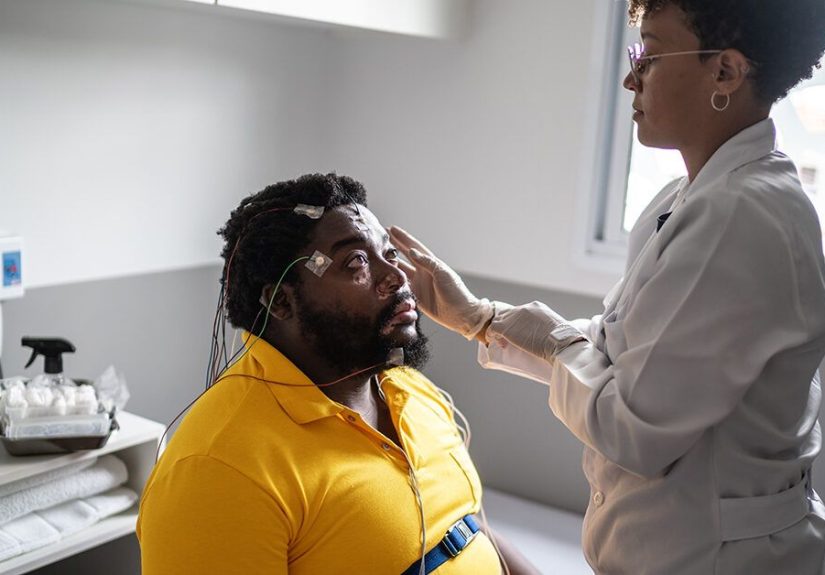
The overnight sleep study, called polysomnography, is usually done first in a sleep lab. During the study, sensors monitor brain waves, breathing, oxygen levels, heart rate, eye movements, and leg movements while you sleep.
This test serves two major purposes. First, it helps identify other disorders that could explain daytime sleepiness, such as sleep apnea or periodic limb movements. Second, it documents how your sleep is structured and whether REM sleep is showing up unusually early. That matters because narcolepsy is strongly linked to abnormal REM timing.
No, sleeping in a lab with wires attached is not exactly a spa retreat. But it gives doctors objective information they cannot get from symptoms alone.
3. Multiple Sleep Latency Test (MSLT)
The Multiple Sleep Latency Test is the daytime test that usually happens the day after the overnight study. This is the headline act in narcolepsy testing. During an MSLT, you are given four or five nap opportunities spaced about two hours apart. The test measures how quickly you fall asleep and whether you enter REM sleep unusually fast.
Two numbers matter most:
- Mean sleep latency: how quickly you fall asleep on average across the nap trials
- SOREMPs: sleep-onset REM periods, meaning REM sleep starts soon after you fall asleep
For narcolepsy, doctors look for a mean sleep latency of 8 minutes or less and two or more SOREMPs on the MSLT. That pattern suggests pathologic sleepiness plus REM sleep intruding earlier than it should.
The MSLT is powerful, but it has to be interpreted carefully. Poor sleep before the test, an unstable sleep schedule, medications, substances, and other sleep disorders can affect the results. That is one reason sleep specialists are picky about preparation. They are not being dramatic. They are protecting the accuracy of the diagnosis.
4. CSF Hypocretin Testing
In selected cases, a doctor may recommend measuring hypocretin-1 in cerebrospinal fluid through a lumbar puncture. This is not the first test most people get, but it can be especially useful when the diagnosis is unclear or when narcolepsy type 1 is strongly suspected.
Very low CSF hypocretin supports narcolepsy type 1. It is one of the most definitive biologic markers in the condition. Not every patient needs this test, but when it is used, it can be extremely helpful.
5. Genetic Testing
You may hear about the HLA-DQB1*06:02 gene marker. It is associated with narcolepsy type 1, but it is not diagnostic by itself. Plenty of people have that marker and do not have narcolepsy. So if you ever see a post online claiming a gene test alone can prove it, that claim deserves a hard side-eye.
The Official Criteria for Narcolepsy
This is where medicine puts on its glasses and starts speaking in exact thresholds. The formal criteria help separate narcolepsy from other causes of sleepiness.
Narcolepsy Type 1 Criteria
A diagnosis of narcolepsy type 1 generally requires daily periods of an irrepressible need to sleep or daytime lapses into sleep, plus one of the following:
- Cataplexy and supportive REM findings on formal sleep testing
- Very low CSF hypocretin-1
When cataplexy is part of the picture, the supporting sleep-test findings may include a mean sleep latency of 8 minutes or less with two or more SOREMPs on MSLT, or an early REM period on the overnight polysomnogram. The symptoms also must not be better explained by chronic insufficient sleep, a circadian rhythm problem, another sleep disorder, a mental disorder, or medication or substance effects.
Narcolepsy Type 2 Criteria
Narcolepsy type 2 has a slightly different checklist. The person must have:
- Daily irresistible sleepiness or daytime lapses into sleep for at least 3 months
- A mean sleep latency of 8 minutes or less on MSLT
- Two or more SOREMPs on MSLT, with an early REM period on the preceding overnight study allowed to count as one of them
- No cataplexy
- Hypocretin that is not low, if it is measured
- No better explanation from insufficient sleep, circadian issues, another disorder, or substances
That last point matters more than people realize. A technically abnormal test does not mean much if the person was chronically sleep-deprived, on REM-suppressing medication, or dealing with another untreated sleep disorder. Context is everything.
So, How Do You Know If You Have Narcolepsy?
The honest answer is this: you suspect narcolepsy from the pattern, but you know through proper evaluation and testing. Suspicion usually starts with symptoms like persistent daytime sleepiness, cataplexy, sleep paralysis, vivid dream-like hallucinations, or unrefreshing sleep. Confirmation comes from a sleep specialist who reviews the story, rules out look-alikes, and uses overnight PSG plus MSLT, and sometimes CSF hypocretin testing, to match your symptoms against formal diagnostic criteria.
If you are sleepy all the time but have never had a proper sleep workup, that is your sign to stop guessing and start documenting. Track your sleep schedule, note any episodes of sudden weakness with emotions, write down unsafe sleepiness moments such as drowsy driving, and bring the whole messy timeline to a specialist. The details that seem random to you may be exactly what helps a doctor connect the dots.
Common Real-Life Experiences on the Road to Diagnosis
One of the hardest parts of narcolepsy is that many people spend a long time feeling misunderstood before they ever reach a sleep lab. They may assume they are just bad at adulthood, bad at mornings, bad at focus, or somehow failing a life skill that other people seem to manage without falling asleep in the middle of it. They hear things like “go to bed earlier,” “cut back on screens,” or “everyone is tired.” That advice is not always wrong, but for someone with narcolepsy, it often feels like trying to fix a leaking roof with a motivational quote.
A common experience is noticing that the sleepiness does not behave like normal tiredness. It is not simply feeling sluggish after lunch. It can feel like being pulled underwater by your own brain. A person may be fine for a while and then suddenly hit a wall during a meeting, in class, on public transit, or while reading a page they have now “read” six times without absorbing a single word. Some people describe fighting sleep with every ounce of determination they have, only to doze off for a few minutes and wake feeling embarrassed, confused, or briefly refreshed.
For people with cataplexy, the experience can be even stranger. They may laugh hard and suddenly feel their knees turn to noodles. Their face might slacken during excitement. Their voice may weaken right when they are trying to tell a funny story. Because they stay conscious, these episodes can be deeply unsettling. Some people hide them for years because they worry others will think they are being dramatic, intoxicated, or anxious. In reality, that emotional trigger pattern is one of the most useful clues in the entire diagnostic process.
The testing journey itself also has its own texture. Keeping a sleep diary can feel oddly revealing, because it forces you to see the pattern on paper. The overnight sleep study often makes people nervous, mostly because sleeping in a lab sounds about as natural as napping in a supermarket aisle. Then comes the MSLT, which can feel both boring and bizarre. You are told to nap on command several times in a row, and meanwhile trained professionals are measuring whether your brain slips into sleep and REM faster than expected. It is one of those rare life moments where being exceptionally sleepy is not a character flaw, but actual diagnostic data.
Many people also describe relief when the process finally produces an answer. A diagnosis does not make narcolepsy fun, convenient, or magical. But it can explain years of confusing symptoms. It can make work and school accommodations possible. It can guide treatment. Most of all, it replaces self-blame with something far more useful: a medically grounded explanation. For many patients, that is the moment the whole story changes. They are not lazy. They are not careless. They are dealing with a real neurologic sleep disorder, and now they can treat it like one.
Final Thoughts
If you are wondering whether you might have narcolepsy, the biggest takeaway is this: symptoms matter, but formal testing matters more. Narcolepsy has recognizable patterns, and modern sleep medicine has clear criteria for diagnosing it. If your daytime sleepiness is persistent, disruptive, or dangerous, especially if you also have cataplexy-like episodes, sleep paralysis, or vivid hallucinations around sleep, do not brush it off as “just being tired.”
Get evaluated by a sleep specialist. The right diagnosis can save you years of frustration, and in some cases, it can also protect your safety, your job performance, your education, and your sanity. That is a pretty strong return on investment for a night in a sleep lab.