Table of Contents >> Show >> Hide
- Introduction: When Springfield Put on a Prestige-TV Overcoat
- The Spark: A Peak-TV Parody Finds Its Perfect Neighborino
- Why the Story Needed Two Parts
- The Plot: Money, Debt, Vanity, and Gosh-Darn Consequences
- The Cast: Prestige Voices for a Prestige Nightmare
- The Look and Sound: Springfield Gets Snow, Silence, and Suspense
- Why the Fargo Parody Works
- Out-of-Continuity Freedom: How the Episode Breaks the Rules Without Breaking the Show
- Critical Reception: A Modern Classic Emerges
- The Emotional Core: Ned Flanders as Tragic Hero
- Why It May Be the Best Modern Simpsons Episode
- Experience Notes: Watching “A Serious Flanders” as a Modern Simpsons Fan
- Conclusion: The Dark-Diddly Miracle of “A Serious Flanders”
- SEO Tags
Note: This article is written as an original, oral-history-style feature using publicly reported facts, production details, criticism, and episode analysis. It does not reproduce any source text or claim to be a verbatim interview transcript.
Introduction: When Springfield Put on a Prestige-TV Overcoat
For decades, The Simpsons has survived by being several shows at once: a family sitcom, a political cartoon, a movie parody machine, a pop-culture archive, and, when the writers are feeling spicy, a chainsaw aimed at television itself. Then came “A Serious Flanders,” the two-part Season 33 experiment that asked a wonderfully ridiculous question: what if Ned Flanders wandered into a snowy prestige crime drama and nobody bothered to tell him?
The result was not just another Simpsons parody. It was a full-on Simpflix event, a darkly comic, out-of-continuity, chapter-divided crime saga inspired by Fargo, streaming dramas, Coen Brothers tension, and the modern habit of turning every quiet small town into a murder buffet. Airing in two parts in November 2021, the episode followed Homer and Ned after Ned discovers a hidden bag containing $173,296 and donates it to an orphanage. Unfortunately, that cash belongs to the sort of criminal who does not accept “okily dokily” as repayment.
Why does “A Serious Flanders” still feel like the best modern episode of The Simpsons? Because it does what the show has always done at its highest level: it understands the thing it is spoofing, loves it enough to get the details right, and then lets Springfield make a complete mess of it.
The Spark: A Peak-TV Parody Finds Its Perfect Neighborino
The origin story begins with an idea that sounds simple on paper: The Simpsons should parody prestige television. But that could have produced a shallow jokeHomer staring dramatically out a window while sad cello music plays, roll credits. Instead, executive producer Matt Selman and writer Cesar Mazariegos treated the premise as a serious creative opportunity. The goal was not merely to reference streaming dramas. It was to make a Simpsons episode that behaved like one.
That meant flashbacks, chapter titles, ominous music cues, sudden violence, moral rot, time jumps, slow-burn suspense, and a villain who talks like he has a podcast about fate, debt, and extremely bad life choices. In classic Simpsons fashion, the premise became funnier because the show played it straight. Springfield did not simply dress up as Fargo for Halloween. It moved into the Fargo house, rearranged the furniture, and accidentally set fire to the curtains.
The key decision was choosing Ned Flanders as the emotional center. Ned is one of the few Springfield residents who can make goodness interesting. He is sincere, charitable, repressed, vain in tiny human ways, and constantly one bad day away from discovering that the universe has a cruel slapstick department. A bag of money in the woods is the perfect Ned test. He does the right thing, but he does it with just enough pride to invite disaster. That small crack in his righteousness lets the whole story pour in.
Why the Story Needed Two Parts
Most Simpsons episodes move like a sugar-rushed monorail. They start with one plot, take a wild turn, and somehow end with Homer causing international tension or buying a horse. “A Serious Flanders” needed a different rhythm. Prestige TV loves patience. It lets the camera breathe, lets danger creep into the room, and lets minor characters speak as if they are carrying three generations of guilt in their pockets.
That slower pace would have been impossible to squeeze into a single 22-minute episode. The two-part structure gave the writers room to build tension, kill off characters in shocking non-canon fashion, and stage a story that felt larger than the usual weekly trip through Springfield. It also allowed the parody to mimic the shape of a limited series. The episode is divided into chapters, and each chapter feels like it could have been stretched into its own overly expensive streaming hour with a moody poster and a snow-covered road.
The Plot: Money, Debt, Vanity, and Gosh-Darn Consequences
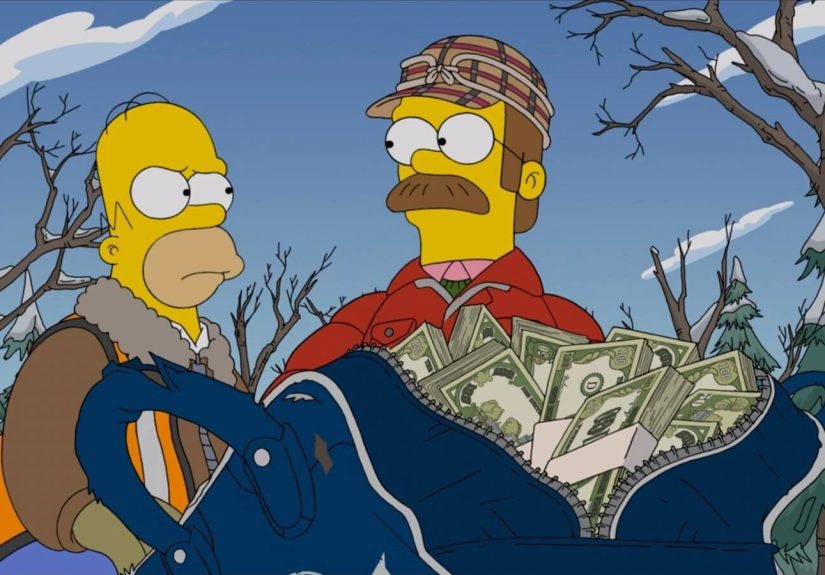
The story begins with Ned and Homer collecting trash in the woods. Ned tumbles down a hill and discovers a hidden bag of money in a log. Rather than keeping it, he donates it to a local orphanage in honor of his grandfather, Sheriff Ned Flanders. That detail matters. Ned is not stealing, but he is not entirely anonymous either. His good deed comes with a tiny nameplate. In the moral universe of prestige crime, tiny nameplates are how avalanches begin.
The money draws the attention of Kostas Becker, a ruthless debt collector voiced by Brian Cox with wonderful menace. Suddenly, Ned’s pious little life is dragged into a world of guns, threats, buried secrets, and grimly funny violence. Homer becomes entangled because Homer is basically Springfield’s gravitational mistake: stand too close to him and your life plot will collapse.
As the story unfolds, Ned learns that his family history is not as saintly as he imagined. His grandfather, presented like a noble frontier lawman, is revealed through flashback to have been tied to corruption, crime, and the original hiding of the money. That twist is one of the episode’s smartest moves. It does not just put Ned in danger; it forces him to confront the mythology of goodness. What happens when a man who defines himself through faith, family, and decency learns that even his heroic inheritance has mud on its shoes?
The Cast: Prestige Voices for a Prestige Nightmare
The guest cast gives “A Serious Flanders” extra authority. Brian Cox brings a granite-dark presence to Kostas Becker, a villain who feels imported from the coldest corner of cable drama. Timothy Olyphant voices Sheriff Flanders, a casting choice that instantly evokes lawmen, western cool, and the kind of morally complicated authority prestige television adores. Cristin Milioti, Chris O’Dowd, Jessica Paré, and Joe Mantegna round out a voice lineup stacked with performers connected to acclaimed dramas, crime stories, and character-driven television.
This casting is part of the joke, but it is not only a joke. The voices help the episode shift tone without losing its identity. The guest stars sound like they belong in a serious drama, which makes it even funnier when they collide with Homer, Wiggum, Disco Stu, Fat Tony, and the rest of Springfield’s walking safety violations.
The Look and Sound: Springfield Gets Snow, Silence, and Suspense
The direction by Debbie Bruce Mahan in Part One and Matthew Faughnan in Part Two gives the special its visual bite. The Simpsons usually favors bright clarity and rapid comedic timing. Here, the show leans into shadows, wide compositions, empty spaces, and tension-building pauses. It borrows the visual language of prestige crime while keeping just enough yellow-skinned absurdity to remind us that, yes, this is still the same universe where a man once got stuck in a vending machine.
The sound design also matters. Gunshots feel harsher. Music cues feel stranger. The episode uses silence and atmosphere in ways that traditional Simpsons episodes rarely do. Even the pacing has a different pulse. Scenes are allowed to become uncomfortable before the punchline arrives. That discomfort makes the humor sharper, like a rake in the face but with better cinematography.
Why the Fargo Parody Works
Many parodies fail because they simply point at recognizable details. “A Serious Flanders” succeeds because it understands structure. It knows that Fargo is not just snow, accents, and sudden violence. It is a moral machine. Ordinary people make small choices, those choices awaken old debts, and soon everyone is standing in the cold wondering why fate owns a wood chipper.
The episode translates that logic into Springfield language. Ned’s charitable act becomes the inciting crime-drama mistake. Homer’s selfishness becomes both comic engine and emotional problem. The villain’s obsession with debt turns money into moral weight. Flashbacks complicate the present. The past refuses to stay buried. The whole thing feels like a joke about prestige TV and a functioning prestige story at the same time.
Out-of-Continuity Freedom: How the Episode Breaks the Rules Without Breaking the Show
One reason “A Serious Flanders” feels so fresh is that it refuses to be trapped by canon. Like a Treehouse of Horror segment, it allows Springfield to become dangerous in ways the weekly show usually cannot sustain. Characters can die. Homer and Marge’s marriage can darken. Ned can flee. A flash-forward can show altered family dynamics. The normal reset button still exists, but it is hidden behind the Simpflix interface.
That freedom is crucial. Modern Simpsons sometimes struggles because viewers know the status quo will return. “A Serious Flanders” turns that limitation into permission. By placing the story in a special streaming-style frame, the writers create a pocket universe where consequences can feel real for 44 minutes. It is not canon, but it is emotionally coherent. That is a neat trick, and it is harder than Sideshow Bob stepping on rakes with dignity.
Critical Reception: A Modern Classic Emerges
When “A Serious Flanders” aired, it surprised many longtime viewers who had grown used to treating modern The Simpsons with cautious nostalgia. Critics praised the ambition, the darkness, the specificity of the Fargo parody, and the fact that the episode seemed genuinely excited to try something new. Part One earned strong reviews for its immersive spoof, while Part Two was widely discussed as a bold conclusion with a body count large enough to make even Treehouse of Horror glance nervously at the legal department.
Its reputation has only grown because it represents a larger shift in late-era Simpsons: more format experiments, more self-contained stories, and more willingness to treat the show’s longevity as a playground rather than a burden. Instead of pretending it is still 1994, the series uses its enormous library of characters and history to test new shapes.
The Emotional Core: Ned Flanders as Tragic Hero
The best thing about “A Serious Flanders” is that it never forgets Ned. Beneath the parody, the violence, and the streaming satire, the episode is about a man who wants to be good in a world where goodness is constantly misread, exploited, or complicated. Ned’s mistake is not greed. It is the desire to attach his family name to virtue. That is painfully human.
By making Ned the tragic hero, the episode finds a richer emotional register than a Homer-led farce might have produced. Homer still matters, especially in the way his actions strain his relationship with Marge, but Ned gives the story its soul. His faith, politeness, and moral anxiety become dramatic fuel. The joke is not “Ned is secretly bad.” The joke is “Ned is good, and prestige television is about to punish him for it.”
Why It May Be the Best Modern Simpsons Episode
Calling any modern episode the “best” invites debate, because The Simpsons fandom treats rankings like sacred scripture written in nacho cheese. Still, “A Serious Flanders” makes a strong case. It has ambition, visual style, sharp parody, emotional stakes, memorable guest voices, and a concept that could only work on a show with decades of character history behind it.
Most importantly, it feels alive. It is not an episode coasting on catchphrases or nostalgia. It is a creative swing. Not every joke lands perfectly, and some viewers may find the violence too far removed from classic Springfield comfort food. But that risk is part of the appeal. A long-running show does not stay interesting by polishing the same trophy forever. Sometimes it has to put Ned Flanders in a prestige crime thriller and see who survives.
Experience Notes: Watching “A Serious Flanders” as a Modern Simpsons Fan
Watching “A Serious Flanders” today feels different from watching a normal episode of The Simpsons. Usually, the show is comfort television: familiar couch, familiar family, familiar town, familiar Homer scream echoing through the halls of American animation. This two-parter feels like returning to that familiar house and discovering that someone has replaced the living room carpet with black ice. You recognize everything, but the floor is suddenly dangerous.
The first experience that stands out is the surprise of tone. Viewers who approach Season 33 expecting a casual Sunday-night comedy may need a minute to adjust. The violence is darker, the pacing is slower, and the jokes often arrive through atmosphere rather than setup-punchline rhythm. That shift can be jarring, but it also wakes up the viewer. Instead of passively waiting for the next gag, you start watching the frame. You notice how scenes are composed. You listen to the music. You wonder why a quiet pause in a Simpsons episode suddenly feels like someone is about to be buried behind a pancake house.
The second experience is appreciation for Ned Flanders. Many fans think of Ned as a comic accessory: the cheerful neighbor, the religious foil, the man whose mustache looks like it pays taxes early. But this episode reminds us that Ned works because he contains real sadness and restraint. He has lost people. He has endured Homer. Frankly, enduring Homer should qualify a person for federal disaster relief. In “A Serious Flanders,” Ned’s decency becomes active rather than decorative. His kindness starts the plot, his pride complicates it, and his family mythology gives it weight.
The third experience is the fun of recognizing prestige-TV habits as they are being gently roasted. The chapter divisions, the ominous villain speeches, the mythic debt language, the sudden flashbacks, the chilly landscapes, the deadpan brutalityall of it feels familiar if you have spent any time with cable crime dramas or streaming limited series. The episode does not simply say, “Prestige TV is silly.” It says, “Prestige TV is often brilliant, but let’s admit it has some very funny habits.” That affectionate accuracy is why the parody holds up.
Finally, there is the rewatch factor. On a second viewing, the story plays less like a stunt and more like a miniature alternate-universe film. You can enjoy the jokes, but you can also admire the construction. The money, the orphanage, the debt collector, the old sheriff, the time jump, Homer’s moral failure, Marge’s disappointment, and Ned’s exile all fit together with unusual care. For a show with hundreds of episodes behind it, that kind of renewed precision feels exciting. “A Serious Flanders” proves that late-era The Simpsons can still surprise usnot by pretending to be young again, but by being old enough, strange enough, and bold enough to try anything.
Conclusion: The Dark-Diddly Miracle of “A Serious Flanders”
“A Serious Flanders” stands as one of the clearest examples of how The Simpsons can still reinvent itself. It takes a beloved supporting character, drops him into the machinery of prestige crime television, and lets the collision produce comedy, suspense, and genuine character insight. The episode is funny because it is specific. It is memorable because it is risky. And it is modern because it understands the streaming era without sounding like an out-of-touch uncle asking where the Netflix cartridge goes.
For fans who wonder whether late-era The Simpsons still has something to offer, this two-parter is the answer hiding inside a log full of cash. It is stylish, weird, affectionate, violent, clever, and unmistakably Springfield. In other words: perfectly cromulent prestige television.