Table of Contents >> Show >> Hide
- Why Aurasell is showing up at exactly the right moment
- What Aurasell actually is
- What makes an AI-native CRM different from “CRM + AI features”?
- Why the “replace 15 tools” story lands
- Where Aurasell looks strongest
- Where buyers should stay skeptical
- Who should pay attention to Aurasell right now?
- The bigger takeaway
- Experience section: what living with an AI-native CRM could actually feel like
Note: This article synthesizes publicly available product information and U.S. reporting current as of March 2026, and removes placeholder artifacts or citation markers so it is ready for web publishing.
Every few years, software gets one of those “this changes everything” speeches. Usually, that speech is delivered by a person wearing expensive sneakers, holding a wireless clicker, and standing in front of a slide that says something like Reimagining the Future of Revenue. Then you try the product and discover it is basically your old dashboard with a chatbot glued to the side like a refrigerator magnet.
Aurasell is trying very hard not to be that.
The startup has positioned itself as an AI-native CRM, not a legacy CRM with a fresh AI paint job. That distinction matters. In plain English, Aurasell is betting that sales teams do not need one more assistant, one more browser tab, one more enrichment plug-in, one more forecast sheet, or one more “copilot” that politely summarizes the mess created by the other 14 tools. They need fewer tools, cleaner data, and a system that actually runs the work.
That is why Aurasell is getting attention. It launched in 2025 with $30 million in seed funding and a big promise: collapse a bloated go-to-market stack into one intelligent operating system for prospecting, outreach, pipeline management, forecasting, conversational intelligence, quoting, analytics, and RevOps workflows. In February 2026, it pushed that idea further by launching an AI-native GTM OS that can also sit on top of an existing CRM, which is a much smarter sell for companies that are not emotionally prepared to rip out their entire revenue engine before lunch.
Why Aurasell is showing up at exactly the right moment
Let’s be honest about the state of modern sales software: it is a little ridiculous.
For years, revenue teams have been told to solve every problem with another app. Need outreach? Buy a sequencing tool. Need better notes? Add a call recorder. Need cleaner data? Plug in enrichment. Need better forecasting? Grab a pipeline tool. Need quotes? Add CPQ. Need coaching? Install conversation intelligence. Need automation? Congrats, you now employ three workflows, four dashboards, and one exhausted RevOps person who has not seen natural sunlight since Q3 planning.
That fragmentation is not just annoying. It is expensive, slow, and productivity-draining. Harvard Business Review has noted that the average sales organization uses about 10 sales tools, and more recent sales research keeps circling the same problem: sellers are overloaded, adoption is messy, and context-switching eats time that should go to actual selling. HubSpot has argued that sellers can spend nearly 70% of their week on administrative work, while Salesforce says AI agents and unified platforms are becoming central to how sales teams expect to grow.
This is the hole Aurasell wants to jump into wearing a cape.
Its pitch is simple enough to fit on a whiteboard: if AI is truly going to change sales, then the system of record, execution layer, and automation layer should not live in separate universes. They should live in one place, built from the ground up to handle structured and unstructured data, automate repetitive work, and give sales teams a unified operating rhythm.
What Aurasell actually is
Aurasell describes itself as a full-featured AI-native GTM platform. That means it is trying to be more than a database of contacts and deals. It wants to cover the full revenue lifecycle, from prospecting and account research to opportunity management, forecasting, quoting, coaching, and analytics.
The core idea: one system instead of a software scavenger hunt
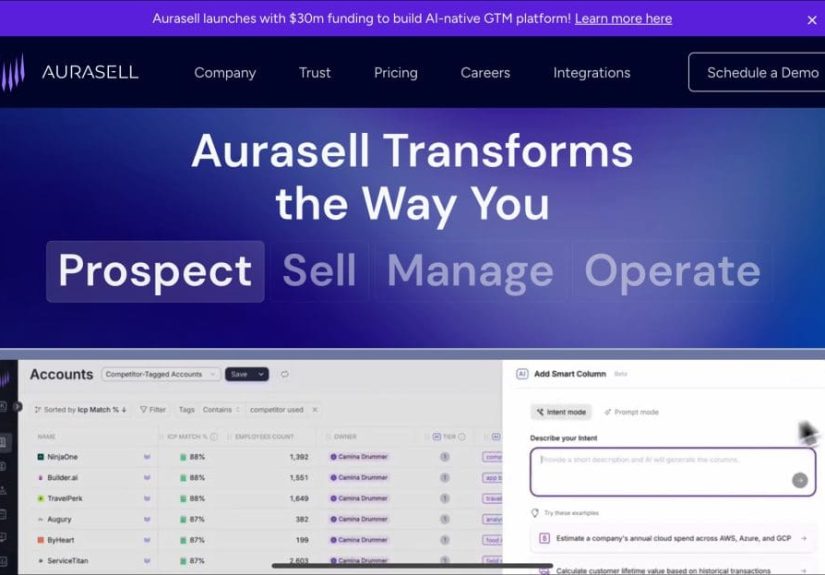
On its product pages, Aurasell breaks the platform into four broad motions: Prospect, Sell, Manage, and Operate. The company says the platform can handle account sourcing, contact enrichment, buyer persona intelligence, AI-personalized outreach, intent signals, conversation intelligence, AI-driven opportunity management, forecasting, scenario planning, dashboards, workflow automation, and AI-powered CPQ.
That is why people keep repeating the “replacing 15 tools” line. It is not just marketing theater. The product is explicitly aimed at collapsing categories that have traditionally lived in separate vendors and separate budgets.
In Aurasell’s version of the world, one platform can absorb functions that used to belong to:
- CRM software
- Sales engagement platforms
- Contact and account intelligence tools
- Data enrichment platforms
- Conversation intelligence software
- Forecasting and scenario modeling tools
- Quote-to-cash or CPQ layers
- Workflow automation tools
- Lead routing systems
- Sales framework automation tools
- Coaching and performance tools
- Analytics dashboards
That is a giant ambition. It is also the reason Aurasell feels more interesting than the average AI sales app. Most AI sales products optimize a single slice of the motion. Aurasell is trying to reorganize the whole kitchen instead of selling you a prettier spoon.
What makes an AI-native CRM different from “CRM + AI features”?
This is the part where the phrase AI-native CRM either becomes meaningful or turns into wallpaper.
Aurasell’s argument is that legacy CRM systems were built for record-keeping first and intelligence second. That means AI often gets bolted onto an architecture that was never designed for agentic workflows, real-time context, or automated execution. The result is what many teams are seeing right now: expensive software stacks where AI can summarize an email thread, but cannot reliably move the business process forward without five integrations and a prayer.
Aurasell is taking the opposite route. It says the platform was built from first principles for the post-2022 AI era, with a unified data model and agentic workflows at the center. In other words, AI is not supposed to sit in a side panel waiting for instructions. It is supposed to be embedded in the process itself.
That matters because modern sales work is not just text generation. It is decision support. It is signal aggregation. It is task automation. It is coaching. It is data hygiene. It is quote creation. It is forecasting. And increasingly, it is orchestration across systems.
McKinsey has argued that agentic AI will create a meaningful share of the value AI delivers in marketing and sales. So the companies that win here may not be the ones with the flashiest writing assistant. They may be the ones that make the entire revenue workflow feel less broken.
Why the “replace 15 tools” story lands
Because sales teams are tired. That is the sophisticated industry analysis.
More specifically, they are tired of tool sprawl, duplicate data, hidden costs, inconsistent adoption, and the awkward reality that every “best-in-class” point solution creates another handoff. The sales rep feels it when they jump between tabs. The manager feels it when forecasts are shaky. RevOps feels it all the time, usually while rebuilding a workflow someone accidentally broke.
Aurasell’s website leans hard into this pain. It says reps juggle 15-plus disconnected tools, lose large chunks of time to admin work, and spend only a minority of time actually selling. It also claims measurable upside from consolidation, including lower manual effort, higher sales velocity, reduced ramp time, and more selling capacity.
Now, to be fair, every vendor has optimistic math. No software company has ever launched with the slogan, “Honestly, results may vary and Gary in procurement will still hate it.” So the important thing is not taking every metric as gospel. The important thing is understanding why the proposition resonates.
It resonates because the pitch is not “here is one more AI feature.” The pitch is “what if your sales stack stopped acting like 15 roommates sharing one bathroom?”
Where Aurasell looks strongest
1. It targets a real, expensive problem
Tool sprawl is not theoretical. Buyers have been complaining about it for years, and the AI boom has often made it worse by adding yet another layer of assistants, copilots, prompt libraries, and task automations. Aurasell is addressing a pain point executives already understand: too many tools, too much overlap, too little clarity.
2. It speaks to both sales and RevOps
Some tools sell to reps. Some sell to managers. Some sell to operations. Aurasell tries to speak to all three by combining revenue execution with operational control. That broad appeal matters because CRM buying decisions are never just about a rep liking the interface. The real buyer asks whether data quality, security, reporting, process discipline, and integrations are good enough to trust.
3. It offers a coexistence path
The February 2026 GTM OS launch is a big deal because it lowers the adoption barrier. Not every mid-market or enterprise team wants to replace Salesforce or HubSpot in one dramatic weekend. Aurasell’s “coexist” motion lets companies add intelligence and automation on top of what they already have, then expand over time. That is strategically much more realistic than demanding an immediate rip-and-replace.
4. It was built in the agent era, not retrofitted into it
That does not guarantee success, but it does matter. Legacy platforms are carrying years of design assumptions that were made before large language models became a serious workflow layer. Aurasell is not dragging that same architectural baggage.
Where buyers should stay skeptical
This would not be a useful review if it just sprayed confetti.
Aurasell is compelling, but it is still early. The company only launched publicly in late August 2025. That means the long-term proof is still forming. Buyers should look beyond the category story and ask the boring, important questions:
- How mature is the implementation motion?
- How reliable is the data model under real enterprise complexity?
- How flexible are permissions, controls, and governance?
- How good is the AI when your process is messy, not idealized?
- How much of the “15 tools” promise holds up in your specific stack?
There is also the classic platform challenge: the broader the promise, the higher the execution bar. Replacing one tool is hard. Replacing fifteen means your product has to be credible in multiple categories at once. That is a huge product and go-to-market challenge, even with fresh funding and a sharp founding team.
Still, there is a difference between an ambitious pitch and an empty one. In Aurasell’s case, the ambition maps to a very real industry problem, which is why people are paying attention.
Who should pay attention to Aurasell right now?
Aurasell looks especially relevant for three groups.
Startups and SMBs building a modern revenue stack
If you are early enough to avoid buying six overlapping systems in the first place, Aurasell’s all-in-one positioning is attractive. A tighter stack can mean fewer integration headaches, faster onboarding, and a lower chance of waking up one day to discover your CRM is basically an archaeological dig.
Mid-market teams drowning in point solutions
These companies often have enough scale to feel the pain, but not enough tolerance for massive enterprise bloat. A platform that can centralize forecasting, enrichment, outreach context, and quoting without endless swivel-chair work is a strong proposition.
Enterprise RevOps leaders who want an intelligence layer without immediate replacement
The GTM OS approach may be the bridge. It lets teams experiment with AI-native workflow orchestration while preserving existing CRM investments. In a market full of chest-thumping AI demos, that is refreshingly practical.
The bigger takeaway
Aurasell matters not just because of what it is selling, but because of what it signals.
For years, CRM has been the center of gravity for revenue teams, but not always the center of productivity. Many systems became bloated systems of record rather than systems of action. The next wave of winners may be the platforms that make CRM less like a digital filing cabinet and more like an active operating system for go-to-market execution.
Aurasell is clearly trying to be one of those platforms.
Will it truly replace 15 tools for every company? Probably not, at least not in exactly the same way for every stack. But that is almost beside the point. The smarter reading is this: Aurasell is part of a growing push to consolidate fragmented sales tech into fewer, smarter, more agentic systems. And unlike a lot of AI products that feel like a novelty with a nice logo, this one is aimed at a pain buyers already feel in their budgets, workflows, and sanity.
That is why Aurasell is this week’s AI app worth watching. It is not merely adding AI to CRM. It is making a serious attempt to redesign the CRM category around AI.
And honestly? About time.
Experience section: what living with an AI-native CRM could actually feel like
The most interesting part of Aurasell is not the feature list. It is the experience it is trying to create.
Imagine a sales rep starting Monday morning without opening a dozen tabs just to understand their day. Instead of bouncing between CRM records, enrichment tools, call summaries, forecasting sheets, Slack threads, and quote templates, the rep opens one system and sees a prioritized view of accounts, risks, next actions, and outreach recommendations. The account context is already assembled. The call notes are already captured. The follow-up tasks are already suggested. The quote does not require a separate pilgrimage through spreadsheet country. That is the emotional promise of an AI-native CRM: less scavenger hunt, more momentum.
For managers, the experience shift is different but just as important. Traditional sales leadership often means asking three annoying questions on repeat: Is the pipeline real? Are reps following the process? Why does every forecast call feel like live improvisational theater? A consolidated platform changes that feeling because coaching, call signals, deal activity, and forecast movement live in the same environment. Instead of stitching together storylines from scattered tools, leaders can spend more time on pattern recognition and better questions. The meeting becomes less “please update your fields” and more “here is how we unblock this deal.”
RevOps may feel the biggest emotional relief of all. In fragmented stacks, operations teams become part architect, part janitor, part therapist. They are forever cleaning data, patching integrations, reconciling mismatched fields, and explaining why the dashboard says one thing while the sequence tool says another. A platform like Aurasell promises something unusually valuable: fewer handoffs, fewer failure points, and fewer moments where one broken sync quietly detonates reporting accuracy for half the quarter.
There is also a cultural angle. When every rep brings their own prompts, their own AI tools, and their own shadow workflow, AI adoption gets messy fast. One team member looks like a wizard, another looks confused, and leadership has no real idea what is repeatable. A unified AI-native platform can create guardrails without killing speed. That is a subtle but meaningful advantage. It turns AI from a science fair project into an operating model.
Of course, no product creates utopia. Bad process can still be bad process, even with shinier software. But the experience Aurasell is chasing feels directionally right for where B2B sales is headed: fewer disconnected apps, more shared context, more automation inside the workflow, and more time for the thing software keeps claiming to protect but often quietly destroys actual human selling.