Table of Contents >> Show >> Hide
Some characters enter a scene. Thing skitters into it, steals the moment, and leaves everyone wondering whether they should applaud or check under their couch. That is exactly why Wednesday turned the Addams Family’s most famous hand into an instant fan favorite, and why the idea of building a fully animatronic version for Netflix feels so irresistible. It is creepy, clever, and a little ridiculous in the best possible way. In other words, it is peak maker bait.
What makes this story especially fascinating is that it lives at the intersection of film craft, robotics, prosthetics, performance, and pure problem-solving stubbornness. On screen, Thing became memorable because artists, performers, makeup teams, and visual-effects specialists made a detached hand feel like a real character with loyalty, sarcasm, rhythm, and emotional timing. Off screen, the Make:-style engineering challenge was even more deliciously weird: could a shop actually build a self-contained animatronic hand that could crawl through the real world and still feel alive rather than like a haunted glove having a software issue?
The answer, wonderfully, was yes. But getting there required more than a cool mold and a few servos. It required rethinking what a “hand” even is from an engineering standpoint. A human hand was never designed to walk. It is a manipulator, not a creature. Yet for Netflix promotional work inspired by Wednesday, makers pushed past that biological inconvenience and treated Thing less like anatomy and more like a five-legged robot wearing a silicone disguise. That leap in thinking is what turned a beloved screen icon into a practical animatronic possibility.
Why Thing Is Harder to Build Than It Looks
At first glance, Thing seems simple. It is just a hand, right? That assumption lasts about five seconds. Then reality taps you on the shoulder with one bony finger and says: hands are terrible at being hands-free creatures. They do not support their own weight elegantly. Their proportions are uneven. Their “legs” are different lengths. Their center of mass is awkward. And if the motion is even slightly off, the illusion collapses faster than cheap Halloween décor in a rainstorm.
That is the first genius insight behind the animatronic build: the team had to stop thinking like sculptors for a minute and start thinking like roboticists. The goal was not simply to replicate a human hand. The goal was to design a moving machine that could read as a hand while performing impossible movement in a believable way. That distinction matters. A great prop does not just resemble the thing it represents. It behaves in a way the audience is willing to emotionally accept.
Thing has always thrived in that liminal zone between absurd and plausible. In classic Addams Family lore, the character works because Charles Addams’ macabre sense of humor treated the bizarre as ordinary. A detached hand was not a horror centerpiece; it was part of the household staff, more competent than half the living people in the room. The Netflix version keeps that spirit, but adds texture, scars, stitches, and a moodier gothic design language that fits Tim Burton’s visual world. Suddenly, Thing is not just a gag. It is a little survivor.
The Big Distinction: Screen Performance vs. Full Animatronic Performance
This is where the story gets deliciously nuanced. The version of Thing audiences loved in Wednesday was not mostly a fully autonomous robot crawling around set like a smug little mechanical spider. The show relied heavily on performer Victor Dorobantu, a magician whose dexterity, control, and expressive hand acting gave Thing personality. Prosthetic stumps, makeup, costume tricks, blue-suit compositing, and VFX completed the illusion. In plain English: the performance came first, and the technology supported it.
That is actually an important creative lesson. Too many people assume movie magic begins with hardware. In reality, it begins with character. Dorobantu’s gestures, pauses, reactions, and timing are what gave Thing a sense of intent. The makeup department then added visual storytelling through scars, stitches, color, and silhouette. The VFX team removed the rest of the performer and polished the illusion. The result feels tactile because it was tactile. It had a human soul inside the trick.
The Make: animatronic effort tackled a different mission: build a self-contained, walking Thing for real-world promotional use. That meant no hidden actor inside furniture, no conveniently framed camera angle, and no post-production fairy dust swooping in to save an awkward step. The machine had to move on its own, on actual streets, in actual gravity, under the merciless judgment of actual pedestrians. That is a far harsher test than a studio shot, and honestly, New Yorkers are not known for grading on a curve.
The Make: Build Turned a Hand into a Robot in Disguise
The Raptor House FX team approached the challenge with exactly the kind of twisted practicality a project like this needs. They were asked to explore whether Thing could be created as a self-contained walking animatronic puppet for Netflix promotional videos. From there, what followed was months of research and development, proof-of-concept testing, refinement, fabrication, and aesthetic finishing. This was not a casual weekend build. It was a full-blown engineering campaign dressed in monster makeup.
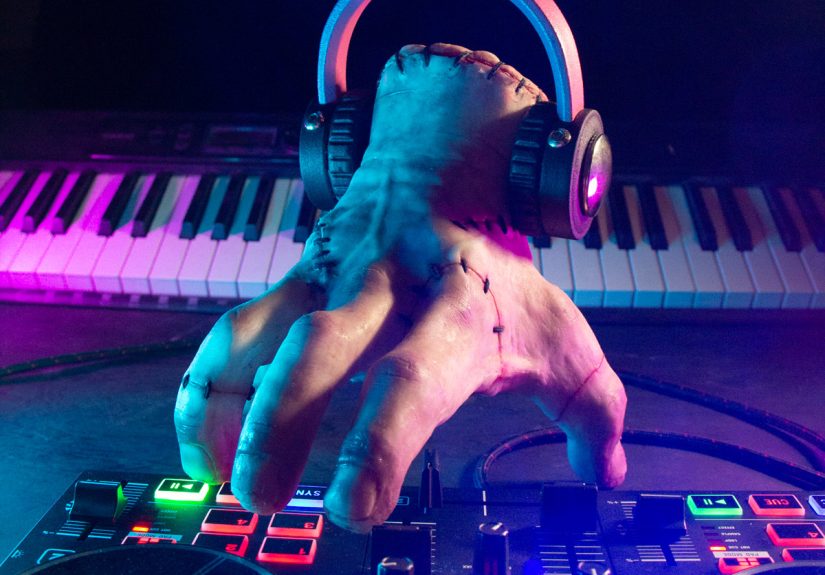
The critical breakthrough was reframing the prop as a pentapod robot with uneven leg placement and a human-looking silicone skin. Once that mental switch flipped, the design process became more tractable. Instead of forcing a literal hand to do what a hand cannot do, the makers developed a machine that could distribute movement, stability, and momentum in ways that produced a convincing crawl. The mechanical logic came first. The creepy charm came second.
Borrowing from Kinetic Sculpture and Robotics
One of the most interesting details in the Make: story is the influence of Theo Jansen’s Strandbeest-style thinking. That is not a random artsy reference tossed in to sound clever. It gets to the heart of how makers solve impossible motion. Jansen’s linkage-based walking mechanisms prove that elegant locomotion does not always come from brute-force motors at every joint. Sometimes it comes from carefully tuned geometry, timing, and momentum.
For Thing, that principle helped inspire a finger-linkage system capable of pulling and pushing the puppet forward. A single drive motor handled the main walking action, while additional servomotors provided secondary character animation. That is a beautiful design choice because it separates locomotion from expression. The machine can move as a creature while still having enough nuance in the thumb and pinky to feel like a performer. In practical-effects terms, that is gold. Motion gets you across the floor; personality gets you remembered.
Even better, the team reportedly designed the robot with a bottom-heavy mass gradient. In other words, they placed heavier materials where stability mattered most and lighter materials where they could reduce unnecessary load. That sounds dry on paper, but it is the difference between “hauntingly lifelike” and “expensive paperweight with abandonment issues.” The fingertips and leg structures needed strength and grounding, while upper structures could be lighter. Good effects design is often just physics wearing eyeliner.
Materials Matter More Than Hype
The final animatronic reportedly combined machined metal components, lighter structural materials, 3D-printed housing elements, and a stitched silicone skin. That mix makes perfect sense. A project like this needs rigidity in load-bearing parts, precision in the mechanism, flexibility in the outer form, and enough serviceability to survive production life. It also needs to look unsettlingly organic without becoming so realistic that it wanders into accidental anatomy-lab territory.
The stitched silicone finish is especially important because surface storytelling sells the illusion. The Netflix-era design of Thing is not pristine. It is weathered, scarred, and visibly assembled, which gives it history. That aesthetic choice is brilliant because it hides the problem of perfection. A spotless fake hand might look like a store mannequin. A damaged, textured, stitched hand invites the audience to believe there is a backstory there. Imperfection makes the illusion stronger.
Another smart production decision was building duplicate puppets. Anyone who has spent time around practical effects knows the unofficial motto: if it moves, it breaks; if it breaks, it breaks five minutes before the important shot. Redundancy is not wasteful. It is survival. Having two matching builds allows a production to keep moving while repairs happen, and on a schedule-driven shoot, that is the difference between professionalism and panic.
Why Tim Burton’s Aesthetic Made the Whole Idea Better
Thing has existed in different forms for decades, but Tim Burton’s take gave the character a richer visual identity for modern audiences. Rather than presenting the hand as a neat, anonymous appendage, the Burton-era design leans into scars, seams, grime, and gothic eccentricity. That makes Thing feel less like a prop and more like a creature with mileage. The design practically whispers, “I have seen things you people would not believe, and some of them were probably in this dorm room.”
That aesthetic also benefits the animatronic version. A perfect mechanical skin would be much harder to believe. But a hand that already looks stitched, patched, and a little battle-worn allows the engineering to hide behind character. Every visible seam can feel intentional. Every tiny asymmetry becomes a feature, not a flaw. Burton’s visual language gives practical builders room to be clever.
The broader production design of Wednesday helps too. The show’s neo-gothic atmosphere, practical locations, stylized costumes, and tactile production values make a physical Thing feel at home in the world. When the surrounding universe already honors texture and physicality, a practical creature reads more naturally. It is easier to believe in a crawling hand when the rest of the world feels built rather than merely rendered.
What Makers and Filmmakers Can Learn from This Build
Start with the Character, Not the Mechanism
The biggest lesson here is that engineering alone does not create movie magic. If the movement is mechanically impressive but emotionally empty, the audience admires the hardware and forgets the character. Thing works because every department served the same performance goal. The hand is curious. Loyal. Slightly cheeky. Protective. Sometimes offended. Occasionally dramatic. Basically, it is the best roommate in the Addams universe.
So if you are building your own creature, animatronic prop, or display character, begin by asking what it is like, not just what it does. Is it shy? Twitchy? Regal? Ferocious? Playful? Once you know the emotional vocabulary, you can decide which gestures actually matter. You may not need twenty axes of movement. You may just need one perfect pause and a thumb tilt that says, “I absolutely saw that, and I am judging you.”
Prototype Ugly, Finish Beautiful
Another lesson is the value of ugly prototypes. The Make: project moved through proof-of-concept phases before arriving at the polished final build. That is how good fabrication works. Early versions are not there to win beauty contests. They are there to answer hard questions: Does it stand? Does it walk? Does it recover from a stumble? Does the geometry still work when skinned? Does the mechanism survive more than one glorious test before exploding into shame?
Only after those questions are answered should the project chase surface beauty. This workflow saves time, money, and heartbreak. It also keeps teams honest. Fancy paint can hide poor engineering for exactly one demo. After that, gravity becomes the toughest critic in the room.
Blend Disciplines Without Ego
This whole Thing story also proves that the best effects work is collaborative by nature. Performers, designers, engineers, makeup artists, sculptors, machinists, painters, and VFX artists all contributed to the final illusion. Nobody “won” by replacing the others. The magic came from overlap. That is worth emphasizing in an era when people love to argue about practical effects versus CGI as though only one is allowed to sit at the cool kids’ table.
The truth is simpler: use the best tool for the moment. Human performance gave Thing life. Prosthetics gave it physical detail. VFX erased what needed erasing. Animatronics expanded what could happen in the real world. This is not a story of one technique beating another. It is a story of craft departments acting like grown-ups and making something wonderful together.
The Experience of Giving a Hand a Soul
There is a particular kind of experience that comes with building or studying a project like this, and it is hard to explain to anyone who has never fallen in love with an impossible prop. On paper, you are discussing a severed hand. In the workshop, you are suddenly discussing weight transfer, surface translucency, gesture timing, failure tolerance, performer language, and how many tiny stitches it takes before something stops looking fabricated and starts looking oddly alive. It is absurd. It is also deeply thrilling.
What makes the experience memorable is not just the finished object, but the emotional roller coaster of trying to make an inert thing feel intentional. The first successful motion test is rarely elegant. It usually looks like a creature from a parallel universe where evolution gave up halfway through lunch. But then a linkage improves. A fingertip flick lands just right. The pacing changes. The silicone skin settles over the mechanism more naturally. Suddenly everyone in the room goes quiet because the prop has crossed an invisible line. It is no longer just moving. It is performing.
That moment is addictive. Makers know it. Puppeteers know it. Effects artists definitely know it. You spend days, weeks, sometimes months wrestling with geometry, tolerances, glue, mold seams, calibration drift, paint tests, material failures, and the kind of small production disasters that make coffee feel like a spiritual requirement. Then, in one weird little instant, the object looks back at you without having eyes, and you realize the character has arrived.
Thing is such a perfect example because the character lives entirely in gesture. There is no face to rescue a weak performance. No dialogue to explain motivation. No broad body language to hide behind. Every emotional beat has to be communicated through speed, rhythm, posture, and finger articulation. That makes the experience of building or observing a Thing-like animatronic unusually pure. It is all signal, no fluff. If the audience believes, they believe because the movement told the truth.
There is also something delightfully human about how much care goes into creating something so gleefully unnatural. You shape scars that imply a past. You dirty the nails just enough. You adjust the wrist angle because one version looks dead while another looks curious. You test whether a pause should be half a second longer so the hand seems to “think.” This is where creature work stops being engineering and becomes acting by other means. The shop turns into a rehearsal space.
And then there is the public reaction, which may be the best part of all. A successful build does not need a technical explanation to work. People either respond instantly or they do not. With Thing, the response is almost primal: surprise, laughter, delight, a quick step backward, then the irresistible urge to keep watching. That blend of fear and affection is hard to earn, and when a practical build gets it right, the effect is electric. You are not just showing someone a robot. You are giving them a tiny encounter with impossible life.
That is why this topic resonates so strongly with makers, film fans, and practical-effects nerds alike. It is a reminder that craftsmanship is still one of the most powerful storytelling tools in entertainment. Long after people forget which software cleaned up a shot, they remember how a character made them feel. Thing works because it feels present. The hand seems to think, decide, react, and care. For a pile of metal, silicone, paint, and performance tricks, that is a minor miracle.
And maybe that is the real experience at the heart of this story: not merely bringing an animatronic Thing to life for Netflix, but rediscovering how much joy there is in making audiences believe that lifeless materials can carry personality. That is old-school movie magic. It is also future-proof movie magic. As long as artists keep asking impossible questions and engineers keep answering with prototypes, sketches, and a dangerous amount of optimism, characters like Thing will keep crawling off the screen and into pop-culture immortality.
Conclusion
Bringing an animatronic Thing to life for Netflix is the kind of project that sounds like a gimmick until you look closely and realize it is a masterclass in design thinking. The screen version of Thing succeeded because performance, prosthetics, production design, and VFX all served one sharply defined character. The Make:-style animatronic build succeeded because engineers and fabricators translated that character into motion, balance, materials, and repairable real-world mechanics.
Together, those efforts show why practical effects still matter. They give filmmakers texture, give performers something real to play against, and give audiences that delicious sensation that what they are seeing might actually be there. In an industry that often chases bigger, cleaner, shinier spectacle, Thing reminds us that sometimes the most unforgettable magic comes from a dirty little hand with impeccable comic timing.