Table of Contents >> Show >> Hide
- Why Do People Pronounce the Same Words Differently?
- How to Use This Pronunciation Guide
- 90+ Words People Say Differently and How to Pronounce Them
- Common Patterns Behind Mispronounced Words
- Quick Tips for Pronouncing Difficult Words Better
- Words People Say Differently in Everyday Conversations
- Real-Life Experiences With Words People Say Differently
- Conclusion
English pronunciation is a party where the invitation says “casual,” but half the guests arrive wearing tuxedos and the other half bring potato salad. In the United States alone, people can disagree passionately about pecan, caramel, route, aunt, and GIFand somehow everyone still understands each other while quietly judging the dessert table.
This guide covers more than 90 words people say differently, including regional pronunciations, commonly mispronounced words, food names, borrowed words, and everyday terms that sound nothing like they look. The goal is not to shame anyone’s accent. Accents are part of identity. The goal is to help you recognize common pronunciation variations, choose the clearest option for standard American English, and avoid those little verbal potholes that make conversations wobble.
Why Do People Pronounce the Same Words Differently?
American English is shaped by immigration, geography, history, education, media, and plain old habit. A person from Boston, Atlanta, Chicago, Los Angeles, and rural Texas may all speak standard English, yet pronounce certain vowels, consonants, and syllable stresses differently. That is why caramel may have two syllables in one region and three in another, while aunt may rhyme with “ant” for one speaker and “haunt” for another.
Some differences are regional. Some are dictionary-approved variants. Some come from foreign-language origins. Others are classic spelling traps: English borrowed the word, kept the spelling, changed the sound, and then walked away whistling like nothing happened.
How to Use This Pronunciation Guide
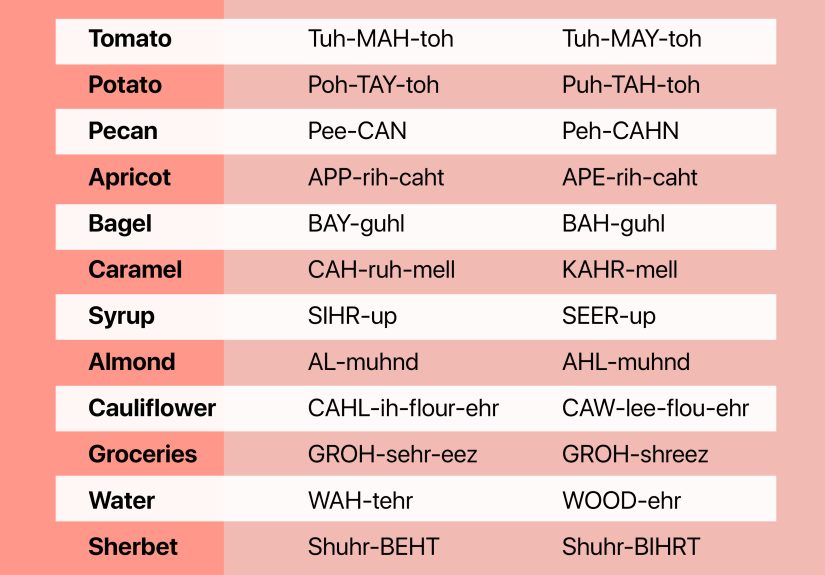
The pronunciations below use simple American-style respelling rather than complex phonetic symbols. Capital letters show the stressed syllable. When two or more pronunciations are common or accepted, they are listed together. When one pronunciation is especially recommended for standard American English, the note makes that clear.
90+ Words People Say Differently and How to Pronounce Them
| Word | Common Pronunciation Difference | Helpful Standard American Pronunciation |
|---|---|---|
| 1. Aunt | Some say “ant,” others say “ahnt.” | ANT or AHNT are both widely heard. |
| 2. Pecan | One of America’s great pie-related debates. | puh-KAHN, pee-KAHN, or PEE-kan are common. |
| 3. Caramel | Two syllables or three? | KAR-mul or KAIR-uh-mel. |
| 4. Crayon | Can sound like “cray-ahn,” “cran,” or “crown.” | KRAY-ahn is clear and common. |
| 5. Coupon | “KOO-pon” vs. “KYOO-pon.” | KOO-pon is very common; KYOO-pon is also accepted. |
| 6. Syrup | “SEER-up” vs. “SIR-up.” | Both are common in American English. |
| 7. Route | Some rhyme it with “boot,” others with “out.” | ROOT or ROUT; usage often depends on region and context. |
| 8. Either | “EE-thur” vs. “EYE-thur.” | Both are correct. |
| 9. Neither | “NEE-thur” vs. “NYE-thur.” | Both are correct. |
| 10. Data | “DAY-tuh” vs. “DA-tuh.” | Both are accepted; DAY-tuh is especially common in U.S. tech and business speech. |
| 11. GIF | Hard “g” vs. soft “g.” | GIf and JIF are both used; hard-G GIF is extremely common. |
| 12. Vase | “VAYSS,” “VAYZ,” or “VAHZ.” | VAYSS and VAHZ are both common. |
| 13. Often | With or without the “t.” | OFF-en and OFF-ten are both accepted. |
| 14. Almond | Some pronounce the “l,” some reduce it. | AH-mund or ALL-mund, depending on region. |
| 15. Apricot | First syllable may sound like “ap” or “ape.” | AP-ri-kot or AY-pri-kot. |
| 16. Pajamas | Middle vowel changes by region. | puh-JAM-uhz or puh-JAH-muhz. |
| 17. Mayonnaise | Full form vs. shortened casual form. | MAY-uh-nayz; “mayo” is MAY-oh. |
| 18. Envelope | “EN-vuh-lohp” vs. “AHN-vuh-lohp.” | Both are accepted. |
| 19. Insurance | Stress may fall on the first or second syllable. | in-SHOOR-uhns is common in careful speech. |
| 20. Adult | First-syllable stress or second-syllable stress. | uh-DULT and AD-ult are both heard. |
| 21. Address | Noun and verb can differ. | AD-dress for a location; uh-DRESS as a verb. |
| 22. Garage | French-style ending or Americanized ending. | guh-RAHZH or guh-RAHJ; GAR-ij is also common. |
| 23. Laboratory | Four syllables or five. | LAB-ruh-tor-ee or LAB-uh-ruh-tor-ee. |
| 24. Leisure | “LEE-zhur” vs. “LEH-zhur.” | LEE-zhur is common in American English. |
| 25. Schedule | American “sk” vs. British “sh.” | SKED-jool is standard American. |
| 26. Buoy | Looks like “boy,” often pronounced differently. | BOO-ee is common in American English. |
| 27. Niche | “Nitch” vs. “neesh.” | NITCH and NEESH are both accepted. |
| 28. Homage | English-style or French-style. | HOM-ij or OH-mahzh. |
| 29. Foyer | Two common pronunciations. | FOY-er or foy-YAY. |
| 30. Forte | Meaning affects pronunciation. | FORT for a strength; FOR-tay in music. |
| 31. Primer | Paint primer and reading primer may differ. | PRY-mer for paint; PRIM-er for a beginner’s book. |
| 32. Mobile | Device, city, or adjective? | MOH-bul for a phone; moh-BEEL for Mobile, Alabama. |
| 33. Semi | “SEM-ee” vs. “SEM-eye.” | SEM-ee is common; SEM-eye is also heard. |
| 34. Vehicle | Two or three syllables. | VEE-uh-kul is clear and standard. |
| 35. Lawyer | Vowel changes by region. | LOY-er or LAW-yer. |
| 36. Been | “Bin” vs. “ben.” | BIN is common in American speech. |
| 37. Again | Rhymes with “ten” or “rain.” | uh-GEN and uh-GAIN are both accepted. |
| 38. Caribbean | Stress shifts between syllables. | kuh-RIB-ee-un or kair-uh-BEE-un. |
| 39. Harass | First or second syllable stress. | huh-RASS is common; HAIR-iss is also heard. |
| 40. Detail | Stress may change. | DEE-tail as a noun; dih-TAIL as a verb in some uses. |
| 41. Process | “PRAH-sess” vs. “PROH-sess.” | PRAH-sess is common in American English. |
| 42. Progress | Noun and verb stress may differ. | PRAH-gress as a noun; pruh-GRESS as a verb. |
| 43. Research | Stress varies. | REE-search or ri-SERCH. |
| 44. Resource | Stress and vowel vary. | REE-source or ri-SOURCE. |
| 45. Kilometer | Stress can fall in different places. | kuh-LAH-muh-ter or KILL-uh-mee-ter. |
| 46. Nuclear | Often distorted by extra “yoo.” | NOO-klee-er, not “NOO-kyoo-ler.” |
| 47. Mischievous | Often given an extra syllable. | MIS-chuh-vus, not “mis-CHEE-vee-us.” |
| 48. Sherbet | Often gets an extra “r.” | SHER-bit, not “SHER-bert.” |
| 49. Espresso | Often confused with “express.” | es-PRESS-oh, not “ex-PRESS-oh.” |
| 50. Et cetera | The first sound is often changed. | et SET-er-uh, not “ex SET-er-uh.” |
| 51. Supposedly | Often replaced with a different word. | suh-POH-zid-lee. |
| 52. Library | The first “r” disappears in casual speech. | LYE-brer-ee, not “LYE-berry.” |
| 53. February | The first “r” may be reduced. | FEB-roo-air-ee or FEB-yoo-air-ee. |
| 54. Wednesday | Spelling hides the sound. | WENZ-day. |
| 55. Comfortable | Often compressed. | KUMF-ter-bul or KUMF-tuh-bul. |
| 56. Vegetable | The middle syllable shrinks. | VEJ-tuh-bul. |
| 57. Jewelry | Syllables often shift. | JOO-el-ree or JOOL-ree. |
| 58. Realtor | Often gets an extra syllable. | REEL-ter, not “REE-luh-ter.” |
| 59. Athlete | Often gets an extra syllable. | ATH-leet, not “ATH-uh-leet.” |
| 60. Height | Sometimes confused with “width.” | HITE, not “HITE-th.” |
| 61. Escape | Initial sound is often changed. | ess-KAPE, not “ex-KAPE.” |
| 62. Especially | Often confused with “ex.” | ess-PESH-uh-lee. |
| 63. Arctic | The first “c” is often dropped. | ARK-tik. |
| 64. Antarctic | Both “c” sounds matter. | ant-ARK-tik. |
| 65. Candidate | Often shortened in casual speech. | KAN-di-date or KAN-did-it. |
| 66. Prescription | First syllable is often flipped. | pre-SKRIP-shun, not “per-SKRIP-shun.” |
| 67. Probably | Casual speech may shrink it. | PRAH-buh-blee; “probly” is casual. |
| 68. Temperature | Middle syllable compresses. | TEM-pruh-cher. |
| 69. Miniature | Often stretched oddly. | MIN-ee-uh-cher or MIN-yuh-cher. |
| 70. Prerogative | First syllable is often reversed. | pre-RAH-guh-tiv. |
| 71. Dilate | Often incorrectly stretched. | DYE-late. |
| 72. Comparable | Two stress patterns exist. | KAHM-per-uh-bul or kum-PAIR-uh-bul. |
| 73. Applicable | Stress varies. | AP-li-kuh-bul or uh-PLIK-uh-bul. |
| 74. Electoral | Middle syllables can blur. | ih-LEK-tor-ul. |
| 75. Cache | Often mistaken for “cachet.” | CASH. |
| 76. Epitome | Looks like it should rhyme with “home.” | ih-PIT-uh-mee. |
| 77. Hyperbole | Not pronounced like “bowl.” | hy-PER-buh-lee. |
| 78. Segue | Spelling is a trapdoor. | SEG-way. |
| 79. Indict | The “c” is silent. | in-DYTE. |
| 80. Colonel | Looks nothing like it sounds. | KER-nul. |
| 81. Quay | Looks like “kway,” sounds like “key.” | KEE. |
| 82. Awry | Stress is on the second syllable. | uh-RYE. |
| 83. Genre | Borrowed from French. | ZHAHN-ruh. |
| 84. Quinoa | A common menu-word challenge. | KEEN-wah. |
| 85. Acai | Often seen in smoothie shops. | ah-sah-EE. |
| 86. Chipotle | The final syllable is not silent. | chih-POHT-lay. |
| 87. Jalapeño | The “ñ” makes a “ny” sound. | hah-luh-PAY-nyoh. |
| 88. Gnocchi | Italian spelling surprises English speakers. | NYOH-kee. |
| 89. Bruschetta | Italian “sch” sounds like “sk.” | broo-SKET-uh. |
| 90. Worcestershire | The bottle label is scarier than the sauce. | WOOS-ter-sher. |
| 91. Charcuterie | Fancy board, tricky word. | shar-KOO-tuh-ree. |
| 92. Bologna | Lunch meat ignores the spelling. | buh-LOH-nee. |
| 93. Acquiesce | Often misread because of the “cq.” | ak-wee-ESS. |
| 94. Chiaroscuro | An art-history tongue twister. | kee-ar-uh-SKYOOR-oh. |
| 95. Debris | The final “s” is silent. | duh-BREE. |
| 96. Faux | The “x” is silent. | FOH. |
| 97. Mauve | Several pronunciations exist. | MAWV or MOHV. |
| 98. Meme | Not “me-me.” | MEEM. |
| 99. Meme-worthy bonus: Pronunciation | Often said as if it contains “noun.” | pruh-nun-see-AY-shun, not “pro-noun-see-AY-shun.” |
Common Patterns Behind Mispronounced Words
1. Silent Letters Are Sneaky
Words such as salmon, indict, debris, and faux remind us that English spelling is not always a sound map. It is more like a historical museum where old letters are kept behind glass. They are visible, but you are not supposed to touch them.
2. Borrowed Words Keep Their Luggage
English borrows heavily from French, Italian, Spanish, Greek, and many other languages. That is why genre, foyer, gnocchi, jalapeño, and bruschetta do not behave like simple English phonics words. They arrived with their own pronunciation habits, and English speakers have been negotiating with them ever since.
3. Regional Pronunciation Is Not Automatically Wrong
When people say aunt, pecan, caramel, syrup, or route differently, the difference is often regional rather than incorrect. In SEO terms, think of American pronunciation as a keyword cluster: different forms, same search intent.
4. Stress Changes Meaning
Some words change pronunciation depending on how they are used. Address, progress, detail, and primer can shift stress based on whether they are nouns, verbs, or specialized terms. This is why pronunciation is not just about letters; it is also about grammar and context.
Quick Tips for Pronouncing Difficult Words Better
Listen Before You Repeat
Before using a new word in a meeting, podcast, video, or speech, listen to it in a reliable dictionary or pronunciation audio tool. This is especially useful for names, medical terms, legal terms, food words, and anything that looks like it escaped from a spelling bee.
Break Long Words Into Chunks
Long words become easier when you divide them into syllables. For example, epitome becomes ih-PIT-uh-mee, and charcuterie becomes shar-KOO-tuh-ree. Small chunks are less intimidating than one giant word-monster wearing a cape.
Notice the Stress
Many pronunciation mistakes happen because the speaker stresses the wrong syllable. Awry is uh-RYE, not AW-ree. Acquiesce is ak-wee-ESS, not ACK-wee-ess. Stress is the rhythm of a word; get the rhythm right and the word usually starts behaving.
Do Not Panic About Accepted Variants
If a dictionary recognizes multiple pronunciations, you do not need to treat one as a moral victory and the other as a linguistic crime scene. Choose the version that fits your audience, region, and context. Clarity matters more than sounding like a pronunciation robot with a clipboard.
Words People Say Differently in Everyday Conversations
In everyday speech, pronunciation differences often appear in low-stakes moments: ordering food, reading a label, asking for directions, or presenting a slide at work. Nobody plans to turn Worcestershire into a public speaking event, but there it is, sitting on the menu like a final exam.
Food words are especially tricky because they travel across languages. A person may confidently say quinoa, then immediately hesitate over acai. Another may know jalapeño but stumble on gnocchi. The good news is that food conversations are forgiving. If you pronounce bruschetta with a “sh” sound, the server will probably still bring the toast, not a grammar citation.
Professional settings can feel less forgiving. Words like nuclear, applicable, comparable, electoral, research, and resource often appear in presentations, reports, interviews, and academic conversations. Practicing them out loud before using them can make your speech sound more confident and polished.
Real-Life Experiences With Words People Say Differently
One of the funniest things about pronunciation is that most people do not realize they say a word differently until they leave their hometown, start a new job, or order lunch with someone from another region. A person may grow up saying “CAR-mul” with absolute confidence, then move across the country and discover that everyone around them says “KAIR-uh-mel.” Suddenly, a harmless candy word becomes a tiny identity crisis wrapped in sugar.
Many people first notice pronunciation differences in school. A teacher reads a word aloud, a student repeats it differently, and the room reacts as if someone just dropped a tray in the cafeteria. Words like often, either, vase, route, and data are classic classroom debate starters because more than one pronunciation may be acceptable. The lesson is not simply “say it this way.” The better lesson is that English has variation, and good speakers learn to recognize both standard pronunciation and regional speech.
Workplaces create another layer of pronunciation experience. In a meeting, someone may say nuclear as “NOO-kyoo-ler,” realtor as “REE-luh-ter,” or espresso as “ex-PRESS-oh.” Sometimes nobody says anything. Sometimes one brave soul gently corrects it. The most effective approach is usually not embarrassment but modeling: repeat the word naturally in your response. For example, “Yes, the NOO-klee-er energy report is ready.” It keeps the conversation moving and saves everyone from a dramatic courtroom scene over syllables.
Travel also makes pronunciation differences more noticeable. Ask for directions and you may hear route pronounced ROOT in one state and ROUT in another. Visit relatives and discover that aunt changes from ANT to AHNT. Order dessert and learn that pecan has enough pronunciations to form a small committee. These differences are not flaws. They are evidence that language is alive, social, and wonderfully messy.
There is also a confidence side to pronunciation. Many people avoid words they are unsure how to say, especially in public. They may skip charcuterie on a menu, replace epitome with “perfect example,” or avoid acquiesce entirely because it looks like it was assembled during a thunderstorm. But every difficult word gets easier after a few careful repetitions. Say it slowly, break it apart, listen to a reliable audio example, and use it in a sentence. The first attempt may feel awkward. The fifth sounds better. By the tenth, you own it.
The best experience-related advice is simple: be curious, not cruel. Pronunciation differences can be funny, but they should not become a reason to mock someone’s background, education, or accent. Correct yourself freely. Correct others kindly when it matters. And when a word has two accepted pronunciations, let people enjoy their syrup, caramel, pecan pie, and linguistic freedom in peace.
Conclusion
Words people say differently are part of what makes American English colorful, flexible, and occasionally ridiculous in the best possible way. Some pronunciations are regional, some are formal, some are casual, and some are simply mistakes that became popular because English enjoys chaos before breakfast.
If you want to sound clearer, start with the most common troublemakers: mischievous, espresso, nuclear, realtor, athlete, library, pronunciation, epitome, and Worcestershire. Practice them slowly, listen to standard American examples, and remember that pronunciation is a skill, not a personality test.
Note: This article is based on commonly documented American English pronunciation patterns, dictionary-recognized variants, and widely observed regional usage. No source links or citation placeholders are included so the HTML remains clean for web publishing.