Table of Contents >> Show >> Hide
- Quick Leaf-Hole Detective Checklist (2 minutes, zero lab coat)
- 1) Nighttime grazers: slugs, snails, and earwigs
- 2) Caterpillars: the leaf-chomping teenagers of the insect world
- 3) Flea beetles: tiny “shotgun blast” holes
- 4) Japanese beetles and other leaf-chewing beetles: skeletonized leaves
- 5) Grasshoppers: big bites, often from the edges
- 6) Leafcutter bees: neat circles that are mostly cosmetic
- 7) Wildlife: rabbits and deer take “one big bite”
- 8) Not a bug at all: leaf-spot diseases and weather injury that “punch out” holes
- How to prevent holes (without turning your garden into a chemistry experiment)
- When to worry (and when to shrug and keep gardening)
- Extra 500+ Words: “Real-Life” Garden Experiences and Patterns People Notice
- Conclusion
You walk outside (or glance at your windowsill jungle) andbamyour once-perfect leaves now look like they lost a tiny sword fight.
Holes can be annoying, but they’re also a clue. And like any good mystery, the “who did it?” is usually hiding in the pattern:
ragged edges, neat circles, tiny “shotgun” specks, or holes that appear after a storm.
The good news: most holey-leaf situations are fixable, and many don’t even threaten the plant’s long-term health.
The goal isn’t to create a leaf museum. The goal is to stop active damage and help your plant push out healthy new growth.
(Because spoiler: you can’t “un-hole” a leaf. Plants don’t do Photoshop.)
Quick Leaf-Hole Detective Checklist (2 minutes, zero lab coat)
- Check timing: Did holes appear overnight? Think nocturnal feeders (slugs/snails/earwigs).
- Check shape: Neat circles or half-moons often point to leafcutter bees. Tiny peppered holes can mean flea beetles.
- Check location: Outer leaves and edges hit hardest? Grasshoppers and larger chewers often start there.
- Look for “evidence”: Slime trails, droppings (frass), skeletonized veins, or leaf spots that “fall out.”
- Look under leaves: Many pests hang out on the undersides, along midribs, or in tight new growth.
- Rule out weather: If a storm rolled through, hail or wind abrasion can mimic pest holes.
A smart approach is Integrated Pest Management (IPM): identify first, start with the least risky controls,
and escalate only if the plant is truly suffering. That means fewer panic-sprays and more actual results.
1) Nighttime grazers: slugs, snails, and earwigs
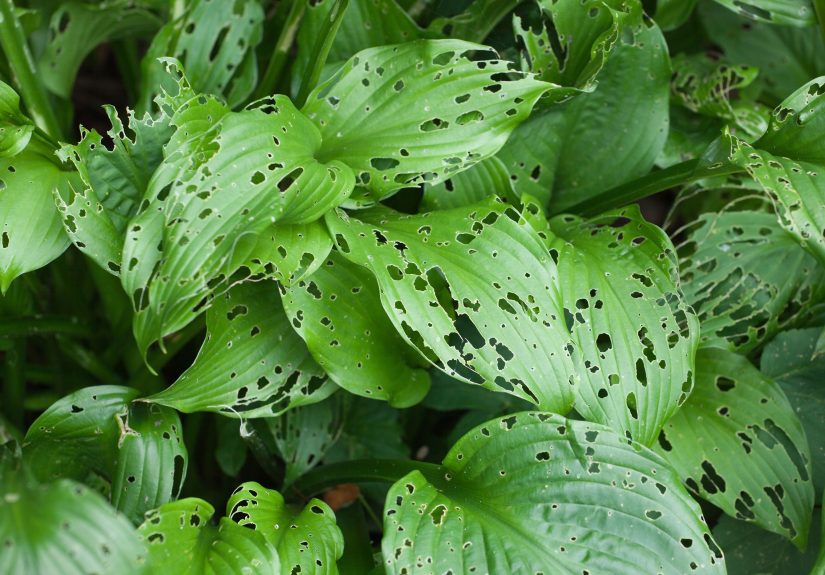
If your leaves look like someone took random bites out of themespecially on tender plantsnocturnal munchers are prime suspects.
Slugs and snails “scrape” leaves and can leave irregular holes with smoother edges. Earwigs also chew irregular holes,
but they don’t leave a slime trail.
What it looks like
- Irregular holes, often on soft, low foliage (hostas, lettuce, seedlings).
- Slime trails can point to slugs/snails; no slime may suggest earwigs.
- Damage often seems to appear overnight.
How to confirm
- Go out at dusk or early morning with a flashlight and look around the plant base and underside of leaves.
- Check damp hiding spots: mulch, boards, pots, rocks, edging.
How to fix it
- Hand-pick at night/early morning (gloves recommended if you prefer your hands slug-free).
- Reduce hiding places: pull mulch back from the crown, remove boards and debris near plants.
- Water in the morning so soil surface dries before nightfall.
- Traps: simple boards or damp cardboard laid nearby can collect them; flip and remove in the morning.
- Baits: if you use any, follow the label carefully and keep them away from pets and kids.
2) Caterpillars: the leaf-chomping teenagers of the insect world
Caterpillars can turn leaves into confettisometimes politely (a few holes), sometimes like they’re training for a competitive eating contest.
A big clue is frass (tiny dark droppings) near the damage and ragged holes that get larger over time.
What it looks like
- Ragged holes, sometimes starting small and growing as caterpillars mature.
- Dark specks of frass on leaves or below the plant.
- On some crops, chewing may concentrate on outer leaves first, then move inward.
How to confirm
- Inspect undersides of leaves and along veins; caterpillars often blend in impressively.
- Look for rolled leaves or light webbing in some species.
How to fix it
- Hand-remove when populations are small (fastest win).
- Protect new growth with lightweight row cover/netting where appropriate.
- Targeted treatments: products containing Bacillus thuringiensis (Bt) can be effective on many caterpillars when used as directed and timed to small larvae.
- Avoid broad-spectrum spraying that harms beneficial insects unless damage is severe and confirmed.
3) Flea beetles: tiny “shotgun blast” holes
Flea beetles are small, jumpy beetles that pepper leaves with many tiny holes, creating a classic “shot-hole” look.
Seedlings and young transplants are especially vulnerable because they don’t have much leaf area to spare.
What it looks like
- Numerous small holes scattered across the leaf surface (“shotgun” pattern).
- Most noticeable on young plants; damage can slow growth.
How to confirm
- Gently disturb foliage; adults often jump like fleas.
- Check early in the day when insects are less active.
How to fix it
- Row covers can protect young plants during peak activity.
- Weed control helps because many flea beetles build up on weedy hosts.
- Keep plants vigorous: consistent watering and nutrition helps them outgrow minor damage.
- If using insecticides, choose the least disruptive option for your garden and follow the label precisely.
4) Japanese beetles and other leaf-chewing beetles: skeletonized leaves
When beetles feed between leaf veins, they can leave a lacey, “skeletonized” look.
Japanese beetles are famous for this, but other beetles can create similar damage.
What it looks like
- Leaf tissue missing between veins; veins remain like a “skeleton.”
- Damage can be clustered because beetles often feed in groups.
How to confirm
- Check plants in sunny areas; many beetles feed in daylight.
- Look for metallic or striped beetles on leaves and flowers (varies by species).
How to fix it
- Hand-pick in the morning when beetles are sluggish; drop into soapy water.
- Protect prized plants with fine netting during peak feeding.
- Avoid over-fertilizing with high nitrogen, which can push tender growth that some pests prefer.
- Consider plant choice: if a plant is a “beetle buffet” every year, swap for less-preferred varieties.
5) Grasshoppers: big bites, often from the edges
Grasshopper damage often shows up as irregular holes along leaf margins, and bigger hoppers can remove large chunks quickly.
They’re mobile, bold, and not above relocating from your neighbor’s yard like they pay rent.
What it looks like
- Irregular holes starting at the leaf edge; sometimes large portions missing.
- Damage can accelerate in warm, dry periods depending on local outbreaks.
How to confirm
- Watch the plant during the day; grasshoppers are often visible if you stand still for a moment.
- Look for them hopping away as you approach.
How to fix it
- Physical exclusion: row covers or fine netting work well on smaller beds.
- Habitat cleanup: reduce tall weeds and rank growth nearby that can shelter them.
- Hand removal can help in small gardens, especially early in the season when they’re smaller.
- Use labeled controls only if necessary and targeted to the plant and pest stage.
6) Leafcutter bees: neat circles that are mostly cosmetic
If your leaves have perfectly cut circles or half-moons, congratulations: you may be hosting leafcutter bees.
They cut pieces of leaves to line their nests. The damage looks dramatic, but on healthy plants it’s usually just a cosmetic issue.
These bees are valuable pollinators, so “fixing” the problem often means protecting a specific prized plantnot wiping out the visitor.
What it looks like
- Clean, rounded cutoutsoften on roses, redbud, azalea, serviceberry, and similar plants.
- No ragged tearing; it looks like a craft punch did it.
How to confirm
- Look for cuts that repeat in a similar size and shape.
- You may spot a small bee flying with a leaf piece (they’re oddly committed to interior design).
How to fix it
- Often, the best fix is doing nothingplants typically tolerate this well.
- For a treasured plant, use temporary netting/row cover until the bee’s nesting phase passes.
- Avoid insecticides; they’re not effective for preventing the cutting and can harm pollinators.
7) Wildlife: rabbits and deer take “one big bite”
Sometimes the culprit is not tiny and sneakyit’s tall, hungry, and casually browsing like your garden is a salad bar.
Deer often leave torn, ragged ends on stems and leaves because they tear rather than neatly cut.
Rabbits, on the other hand, tend to leave clean, angled cuts and usually feed closer to the ground.
What it looks like
- Large missing sections; stems may be snapped or stripped.
- Deer damage often occurs higher up and looks shredded/torn.
- Rabbit damage is lower and looks clipped on an angle.
How to confirm
- Check plant height of damage and look for nearby tracks or pellets.
- Notice if damage repeats in the same area nightly.
How to fix it
- Barriers work best: fencing, cages, or netting around vulnerable plants.
- Protect young plants first; once established, some plants can tolerate occasional browsing.
- Use repellents only as a supplement and reapply as directed, especially after rain.
8) Not a bug at all: leaf-spot diseases and weather injury that “punch out” holes
Some leaves develop holes because tissue dies in a spot and then drops outcreating a “shot hole” effect that can mimic insect damage.
Certain leaf spot problems on plants like cherry laurel and other Prunus relatives are well-known for this.
Separately, hail can physically puncture leaves, leaving scattered holes without any pest signs.
What it looks like
- Spots first, holes second: you may see purple/brown spots that later fall out.
- Yellow halos, scattered spotting, or a pattern that matches wet weather can suggest disease pressure.
- After storms: holes may be more random, with bruising or tearing on exposed leaves.
How to confirm
- Look for remaining leaf spots with defined margins.
- Think about recent conditions: frequent rain, overhead watering, crowding, or a hailstorm.
How to fix it
- Improve airflow: thin crowded growth, space plants appropriately, and prune for ventilation.
- Water smart: water at the base in the morning; avoid soaking foliage late in the day.
- Sanitation: remove heavily infected leaves on the plant and clean up fallen debris.
- If a specific plant repeatedly suffers and the disease is severe, ask a local extension service about resistant varieties and properly timed treatments.
- For hail damage: remove badly shredded leaves if they’re likely to rot, then focus on consistent care (water, light, gentle feeding) to help regrowth.
How to prevent holes (without turning your garden into a chemistry experiment)
- Keep plants vigorous: stressed plants can’t “outgrow” damage as easily. Match light, water, and pot size to the plant.
- Scout weekly: flip leaves, check new growth, and look near the soil line. Early detection is everything.
- Reduce pest hotels: manage weeds, remove rotting debris, and avoid thick mulch pressed against stems.
- Use barriers strategically: row covers for seedlings, cages for wildlife, and netting for a prized rose.
- Be selective with treatments: target the confirmed pest, at the right life stage, with the least harmful method.
When to worry (and when to shrug and keep gardening)
A few holes on mature plants are often just cosmetic. Worry more when:
new growth is being destroyed, seedlings are getting defoliated, or
damage is accelerating week to week.
If the plant is still producing healthy new leaves, you’re usually winning.
Extra 500+ Words: “Real-Life” Garden Experiences and Patterns People Notice
Gardeners tend to describe leaf holes in three emotional stages: (1) denial (“It’s probably just the lighting”),
(2) detective mode (“I will find the criminal”), and (3) acceptance (“Okay, the tomatoes are still alive, so… fine.”).
What’s interesting is how often the same patterns repeat across totally different plants and regions.
One common story: a gardener wakes up to hostas that look like lace. They assume caterpillars, spray something broad-spectrum,
and nothing changes. Then they step outside at 10 p.m. with a flashlight and see the real culpritslugs and snailsslowly
working the buffet line. The “fix” that actually moves the needle is rarely dramatic: watering earlier in the day, pulling
mulch back from the plant crown, and using simple traps or hand removal for a couple of weeks. Once the nighttime pressure drops,
the plant pushes out fresh leaves and suddenly looks respectable again (even if the older leaves remain holey until they’re replaced).
Another repeat scenario happens with brassicas (like kale, cabbage, and broccoli): tiny holes appear, then the holes get bigger,
and thenmysteriouslylittle black specks show up on leaves. That last clue is frass, and it’s often the giveaway for caterpillars.
Gardeners who get good results usually do two things: they check the undersides of leaves consistently (because caterpillars are
excellent at hiding), and they target small larvae early rather than waiting until the plant looks like it lost an argument.
The “experience” lesson is simple: a five-minute weekly inspection beats a frantic weekend rescue mission.
Leafcutter bees create a different emotional arc: the holes are so neat that gardeners either panic (“Something is surgically removing my leaves!”)
or get weirdly proud (“Look at my pollinator ecosystem!”). People who’ve seen this a few seasons usually treat it like a temporary phase.
If it’s a prized rose bush being used as a craft supply store, netting during peak activity is a practical compromise.
But many gardeners ultimately decide the cosmetic damage is worth the pollination benefitsespecially because healthy plants typically keep growing
without missing a beat.
Weather injury is another sneaky one because it looks like pest damage but doesn’t behave like it. After a hail event, the holes often appear
across multiple plants at once, especially those most exposed. The plants may look rough for a week, then stabilize. Gardeners who respond best
usually avoid overreacting: they remove only the most shredded leaves (if needed), keep watering consistent, and wait for new growth rather than
“treating” with products that won’t help. The biggest practical takeaway is that pattern and timing are your best friends. If ten different
plants suddenly develop holes the day after a storm, it’s probably not ten different insect infestations coordinating a garden heist.
Finally, wildlife damage often becomes obvious once someone stops focusing on the leaves and starts looking at height and bite style.
Gardeners learn quickly that a clean angled cut near the ground screams “rabbit,” while torn, shredded ends higher up suggest deer.
The most successful “fixes” are almost never sprays alone; they’re physical barriers and smart placement. People who win the wildlife battle
tend to protect the plants they care about most (young shrubs, tender annuals) rather than trying to make an entire yard equally fortified.
Across all these experiences, the biggest lesson is surprisingly calming: holes are a symptom, not a sentence.
Identify the pattern, confirm the culprit, pick the least risky solution that fits your situation, and let your plant do what it’s built to do
grow new leaves. Your job is to stop the repeat performance.
Conclusion
Holes in leaves look alarming, but they’re usually solvable with a little detective work and a smart, targeted response.
Start by reading the “clues” (hole shape, timing, and extra evidence like slime or frass), then choose fixes that match the culprit:
barriers, hand removal, improved airflow, or carefully selected treatments when truly needed.
With the damage stopped, healthy new growth is your plant’s way of saying, “Thanks. I’ve got this.”