Table of Contents >> Show >> Hide
- What Did UNESCO Actually Recognize?
- The 8 Frank Lloyd Wright UNESCO World Heritage Sites
- 1. Unity Temple Oak Park, Illinois
- 2. Frederick C. Robie House Chicago, Illinois
- 3. Taliesin Spring Green, Wisconsin
- 4. Hollyhock House Los Angeles, California
- 5. Fallingwater Mill Run, Pennsylvania
- 6. Herbert and Katherine Jacobs House Madison, Wisconsin
- 7. Taliesin West Scottsdale, Arizona
- 8. Solomon R. Guggenheim Museum New York, New York
- Why This UNESCO Recognition Matters
- What Modern Designers Can Learn From Wright
- Experiences Related to the 8 Frank Lloyd Wright UNESCO Buildings
- Conclusion
Frank Lloyd Wright probably would have enjoyed the drama of it: eight of his buildings, scattered across the United States like architectural Easter eggs, officially joining the UNESCO World Heritage List. Not one building. Not two. Eight. That is not a polite nod from the global heritage community; that is a standing ovation with a well-designed cantilever.
The inscription, formally titled “The 20th-Century Architecture of Frank Lloyd Wright,” recognizes a group of buildings that helped reshape modern architecture. These are not simply pretty houses, famous museums, or places where architecture fans whisper reverently while trying not to trip over polished floors. They are works that changed how people think about space, nature, materials, movement, and daily life.
From the horizontal calm of Robie House in Chicago to the spiraling ramp of the Solomon R. Guggenheim Museum in New York, the eight Frank Lloyd Wright UNESCO sites show an architect constantly experimenting. Wright did not treat architecture as a box-making business. He treated it as a conversation between people, land, light, materials, and mood. Sometimes the conversation was serene. Sometimes it was bold enough to make engineers reach for coffee.
What Did UNESCO Actually Recognize?
UNESCO added the eight Wright buildings to the World Heritage List because together they demonstrate an important shift in 20th-century architecture. The sites represent Wright’s idea of organic architecture, a philosophy based on harmony between buildings, people, and their surroundings. In plain English: the building should not look as if it crash-landed on a property. It should feel as if it belongs there.
Wright’s organic architecture often used open floor plans, strong connections between interior and exterior spaces, local materials, innovative construction methods, and a deep response to landscape. Today, open-plan living rooms and big windows are everywhere, including apartments that can barely fit a toaster. But when Wright was developing these ideas, they were radical.
The eight UNESCO-recognized buildings are located in six states and span about five decades of Wright’s career. That range matters. It shows Wright moving from Prairie-style domestic architecture to experimental desert living, affordable Usonian housing, monumental museum design, and houses that seem to flirt outrageously with gravity.
The 8 Frank Lloyd Wright UNESCO World Heritage Sites
1. Unity Temple Oak Park, Illinois
Unity Temple, built between 1905 and 1908, is one of Wright’s most important early public buildings. Designed for a Unitarian congregation in Oak Park, Illinois, it used reinforced concrete in a way that felt startlingly modern for its time. Instead of building a traditional church with a steeple, stained-glass sentimentality, and the architectural equivalent of a raised eyebrow, Wright created a compact, geometric, inward-focused space.
The sanctuary is designed to draw attention toward community and shared experience. Light enters from above, creating a spiritual atmosphere without relying on old church clichés. Unity Temple is not trying to impress visitors with height alone. It creates intimacy, rhythm, and quiet power. It is proof that modern architecture could serve worship without wearing historical costume.
2. Frederick C. Robie House Chicago, Illinois
The Frederick C. Robie House, completed in 1910, is often considered the ultimate expression of Wright’s Prairie style. Long horizontal lines, broad overhanging roofs, ribbons of windows, and a strong connection to the flat Midwestern landscape make the house look as if it is stretching comfortably across the earth.
Robie House was not just a stylish residence. It helped redefine American domestic architecture. Instead of chopping the home into stiff little rooms, Wright opened up the interior and allowed spaces to flow into one another. The result feels more like modern living than Victorian formality. In other words, the house politely declined the parlor-and-doily lifestyle and moved on.
Its built-in furniture, art glass, and careful integration of structure and decoration show Wright’s belief that a building should be designed as a complete work. Nothing feels accidental. Even the smallest details appear to have attended the same planning meeting.
3. Taliesin Spring Green, Wisconsin
Taliesin was Wright’s home, studio, school, and living laboratory in Wisconsin. Set in the rolling landscape of the Driftless Region, Taliesin reflects Wright’s deep relationship with the land of his childhood. The name means “shining brow,” and Wright positioned the building not on top of the hill but along its brow, as if the architecture were part of the hill’s expression.
Taliesin changed over time because Wright changed over time. It was not a frozen masterpiece sealed under glass. It was a place of work, teaching, rebuilding, experimentation, and personal history. That makes it especially important among the Frank Lloyd Wright buildings on the UNESCO list. It shows architecture as a living process rather than a finished object sitting politely in a brochure.
Visitors often notice how Taliesin blends stone, wood, terraces, courtyards, and views into a larger landscape experience. The building does not simply frame nature. It participates in it.
4. Hollyhock House Los Angeles, California
Hollyhock House, designed for oil heiress and arts patron Aline Barnsdall, was Wright’s first major Los Angeles project. Completed in the early 1920s, it sits on a hilltop in what is now Barnsdall Art Park. The building is often described as a bridge between Wright’s Prairie work and the developing language of California modernism.
The house gets its name from Barnsdall’s favorite flower, the hollyhock, which Wright transformed into a stylized decorative motif. But do not picture dainty floral wallpaper. Wright’s hollyhock is geometric, abstract, and architectural. It looks less like a garden-party accessory and more like a flower that enrolled in design school.
Hollyhock House helped introduce ideas that became central to Southern California living: indoor-outdoor flow, terraces, courtyards, and a relaxed relationship between house and climate. It also demonstrates Wright’s willingness to adapt his ideas to a new region rather than simply copy himself from the Midwest.
5. Fallingwater Mill Run, Pennsylvania
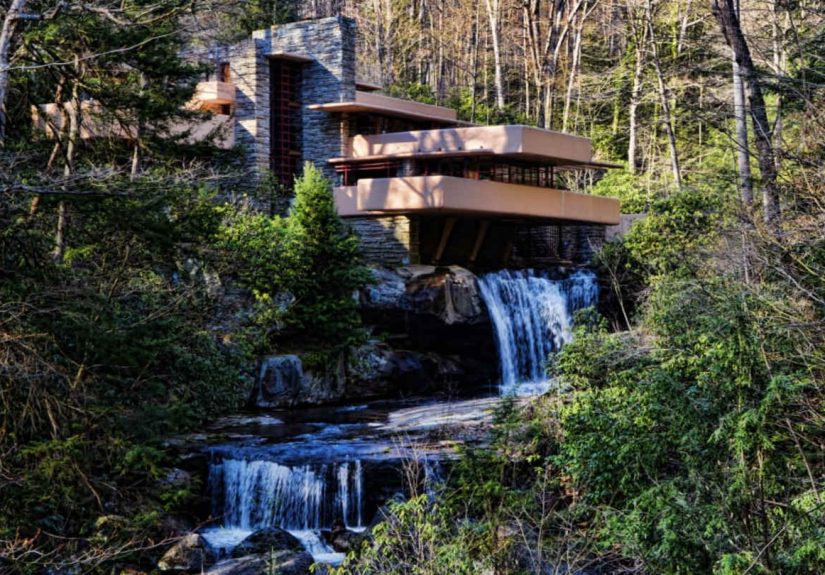
If Frank Lloyd Wright has one building that regularly makes people gasp like they have just seen architecture perform a magic trick, it is Fallingwater. Designed for Edgar and Liliane Kaufmann and completed in the late 1930s, the house is famously built over a waterfall in southwestern Pennsylvania.
Fallingwater is one of the clearest examples of organic architecture. It does not merely look at nature through a window. It sits inside the experience of nature. The sound of water, the stone surfaces, the projecting terraces, and the forested setting all work together. The house feels daring, but also strangely inevitable, as if the landscape had been waiting for someone bold enough to draw it.
The cantilevered terraces are visually unforgettable. They extend over the stream in layered horizontal planes, creating a sense of motion and balance. Fallingwater’s genius is that it feels both dramatic and calm. That is not easy. Most buildings attempting this level of drama would end up looking like a luxury treehouse with commitment issues.
6. Herbert and Katherine Jacobs House Madison, Wisconsin
The Herbert and Katherine Jacobs House, also known as Jacobs I, may be less famous than Fallingwater or the Guggenheim, but its influence is enormous. Built in 1936–1937, it is widely recognized as Wright’s first Usonian house. The Usonian concept was Wright’s answer to affordable, practical, middle-class American housing.
The Jacobs House used a simple plan, modest scale, natural materials, radiant heating, built-in furniture, and a strong relationship to the garden. It rejected unnecessary ornament and expensive formal spaces. The idea was not to make a cheap house feel poor. The idea was to make a smaller house feel intelligent, warm, and dignified.
In many ways, the Jacobs House feels surprisingly contemporary. Open living space, efficient planning, carport instead of garage, and close connection to outdoor areas all sound familiar today. Wright was not just designing a house. He was testing a housing idea that would echo through American residential design for decades.
7. Taliesin West Scottsdale, Arizona
Taliesin West was Wright’s winter home and desert laboratory in Scottsdale, Arizona. Built beginning in 1938, it is one of the most vivid examples of architecture responding to climate and landscape. The building rises from the desert foothills with stone, wood, canvas, and angular forms that seem to belong to the sharp light and rugged terrain.
Unlike a building that tries to tame the desert, Taliesin West studies it. Low rooflines, shaded spaces, desert masonry, and careful orientation show Wright adapting his principles to a harsh but beautiful environment. The result is not cozy in the traditional sense; it is adventurous, sun-baked, and full of personality.
Taliesin West also served as a school and workshop, making it central to Wright’s later career and influence. It was a place where ideas were not only displayed but produced. Think of it as part home, part studio, part campus, and part architectural campfire around which modern design stories were told.
8. Solomon R. Guggenheim Museum New York, New York
The Solomon R. Guggenheim Museum in New York City is Wright’s great late-career urban statement. Completed in 1959, the museum is famous for its spiral form and continuous ramp. In a city of boxes, grids, and vertical ambition, the Guggenheim arrived like a white seashell that had somehow taken a cab to Fifth Avenue.
Wright challenged the traditional museum layout. Instead of moving from room to room, visitors travel along a spiraling ramp around a central rotunda. The building turns art viewing into a continuous spatial experience. Whether every curator has loved that idea is another matter, but architecturally it remains unforgettable.
The Guggenheim shows Wright still experimenting near the end of his life. It is bold, sculptural, controversial, and instantly recognizable. Many buildings are admired. The Guggenheim is remembered.
Why This UNESCO Recognition Matters
The UNESCO listing matters because it places Wright’s work in a global conversation. These buildings are not only American treasures; they are part of world architectural heritage. They show how Wright influenced modern design far beyond the United States, especially through his open plans, spatial flow, integration with nature, and creative use of new materials.
The recognition also highlights the importance of preservation. Wright’s buildings can be challenging to maintain. Flat roofs, experimental materials, dramatic cantilevers, custom details, and strong environmental exposure do not always make life easy for preservation teams. Beauty, as it turns out, sometimes comes with a maintenance schedule.
But preserving these buildings is not nostalgia. It is cultural memory. Each site helps explain how modern architecture became more human, more flexible, and more connected to place. They remind us that innovation is not only about new technology. It is also about asking better questions: How should a house feel? How should a public building gather people? How can a structure respond to land instead of dominating it?
What Modern Designers Can Learn From Wright
Wright’s work still feels relevant because many of his concerns remain current. Today’s architects and homeowners care about natural light, efficient space, sustainable materials, indoor-outdoor living, and emotional comfort. Wright was thinking about those issues long before they became real estate buzzwords.
One lesson is that design should be specific. Fallingwater belongs to its waterfall. Taliesin West belongs to the desert. Robie House belongs to the prairie. Hollyhock House belongs to Southern California’s light and landscape. A building loses something when it could be dropped anywhere and mean the same thing.
Another lesson is that small spaces deserve big ideas. The Jacobs House proves that modest housing can still be thoughtful and beautiful. Luxury is not the only path to architectural quality. Good proportions, smart planning, honest materials, and connection to nature can make everyday living feel richer.
Finally, Wright’s buildings show the value of total design. He cared about furniture, windows, circulation, views, fireplaces, terraces, and even how people entered a room. The result is architecture that feels immersive. You do not just look at a Wright building. You move through an argument about how life could be better arranged.
Experiences Related to the 8 Frank Lloyd Wright UNESCO Buildings
Experiencing the eight Frank Lloyd Wright UNESCO World Heritage Sites is less like checking landmarks off a list and more like following a map of architectural ideas across America. Each site has its own mood, and together they create a surprisingly emotional journey. The trip begins with a simple realization: photographs are helpful, but Wright’s buildings are designed to be felt in motion. A picture can show the terraces of Fallingwater, but it cannot fully deliver the sound of the stream below, the coolness of stone, or the sense that the house is somehow both shelter and landscape.
At Unity Temple, the experience is quieter and more internal. From the outside, the building looks almost severe, but inside it becomes warm, focused, and meditative. It teaches visitors that sacred space does not need decorative noise to feel powerful. Robie House offers a different lesson. Walking through its long, low rooms, visitors can sense the Prairie style stretching horizontally, almost like music written for the Midwest. The house feels disciplined but not cold, elegant but not fussy.
Taliesin in Wisconsin feels personal because it carries Wright’s life in its walls. It is not merely a preserved building; it is a record of ambition, reinvention, tragedy, teaching, and persistence. Taliesin West, by contrast, feels like a desert experiment still humming with energy. The sun, stone, angles, and shadows make the building feel alive throughout the day. It reminds travelers that climate is not a background detail. In Wright’s hands, climate becomes a design partner.
Hollyhock House brings a distinctly Los Angeles personality to the UNESCO group. Its terraces, courtyards, and theatrical ornament make it feel like a bridge between architecture and stagecraft. The Jacobs House, although privately owned and less accessible than some of the others, adds an essential democratic note to the story. It shows Wright thinking about ordinary family life, budget, efficiency, and dignity. Not every masterpiece needs to shout. Some quietly change the future from a residential street in Madison.
The Guggenheim Museum provides the grand finale. Visitors may come for the art, but the building insists on being part of the exhibition. Moving along the ramp, looking across the rotunda, and watching people appear on different levels creates a sense of architecture as choreography. The experience can be debated, and that is part of its charm. Wright did not design buildings that politely disappeared. He designed buildings that asked visitors to participate.
For travelers, the best way to approach these sites is slowly. Notice how each building handles arrival, light, ceiling height, views, and transitions between rooms. Notice how Wright compresses a space, then releases it. Notice how often the outdoors is pulled into the experience. These details turn a sightseeing trip into a design education. By the end, the UNESCO inscription feels completely justified. The eight buildings are not museum pieces from a vanished past. They are still teaching, still provoking, and still making ordinary walls look slightly underprepared.
Conclusion
The addition of eight Frank Lloyd Wright buildings to the UNESCO World Heritage List confirms what architecture lovers have argued for years: Wright’s best work is not only beautiful, but globally important. These buildings changed the way architects think about modern space, nature, materials, and human experience.
From the spiritual geometry of Unity Temple to the spiraling drama of the Guggenheim Museum, the eight sites reveal an architect who refused to repeat easy formulas. Wright kept testing what buildings could do and how people could live inside them. Some results were serene, some were daring, and some were wonderfully impractical in the way genius occasionally is. But together, they form one of the most important architectural legacies of the 20th century.
For readers, travelers, designers, and homeowners, these UNESCO-recognized landmarks offer more than a history lesson. They offer a challenge: build and live with more attention to place, light, proportion, nature, and meaning. That may sound ambitious, but Wright would probably approve. He was never very interested in thinking small.