Table of Contents >> Show >> Hide
- Why Fragile Items Break During a Move
- 1. Use the Right Box, Not Just Any Box You Found in the Garage
- 2. Wrap Every Fragile Item Individually
- 3. Cushion the Bottom, Sides, Top, and Every Empty Space
- 4. Pack Plates Vertically and Glasses Upright
- 5. Double-Box High-Risk Items
- 6. Pack by Weight and Load With Physics in Mind
- 7. Label Clearly and Keep a “Do Not Trust Anyone Else With This” Box
- Common Mistakes to Avoid When Packing Fragile Items
- Final Thoughts
- Real-Life Experience: What Packing Fragile Items Actually Feels Like
- SEO Tags
Moving is exciting in the same way a root canal is “an opportunity for personal growth.” You get a fresh start, a new space, and a very real chance of discovering that one mysteriously heavy box is apparently filled with nothing but candles and regret. But when it comes to packing fragile items for your move, the stakes get higher. Nobody wants to arrive at the new house, open a box marked “Kitchen,” and find a modern art installation made entirely of broken mugs.
The good news is that most fragile-item disasters are preventable. Packing breakables is less about luck and more about method. When you use the right moving boxes, enough cushioning, and a little common sense, your dishes, glasses, picture frames, electronics, and family keepsakes stand a much better chance of arriving in one piece. Think of it as defensive driving, but for your wine glasses.
This guide breaks down seven practical, pro-level tips for packing fragile items safely, with clear examples and realistic advice you can actually use. Whether you are moving across town or across the country, these strategies will help you protect delicate belongings without turning your living room into a bubble-wrap factory explosion.
Why Fragile Items Break During a Move
Before getting into the tips, it helps to understand the problem. Most breakage happens for one of three reasons: the item can move inside the box, the box is too weak for the weight, or the box is loaded badly in the truck. In other words, fragile items usually do not break because the universe hates your favorite serving platter. They break because they are underprotected, overpacked, or tossed into a carton that never had a fighting chance.
The fix is simple in theory: immobilize the item, cushion it on all sides, and make sure the container itself can survive the trip. In practice, that means a little more prep and a lot less wishful thinking.
1. Use the Right Box, Not Just Any Box You Found in the Garage
The first pro tip for packing fragile items for your move is also the most ignored: choose the right box. Not the biggest box. Not the cheapest box. Not the one that once carried a blender in 2019 and has been slowly aging in your basement ever since.
Fragile items need boxes that are sturdy, appropriately sized, and in good shape. A box that is too large invites shifting. A box that is too small can force you to cram items together like they are rushing onto a crowded elevator. Neither option ends well.
What works best
- Small boxes for heavy breakables like dishes, books with fragile decor, or dense kitchenware
- Medium boxes for lighter ceramics, lampshades, and wrapped home decor
- Specialty boxes for TVs, mirrors, artwork, stemware, and dishes
- Double-wall boxes for extra-delicate or valuable items
A small box full of plates is far safer than a huge box full of plates. Why? Because giant heavy boxes are harder to lift, more likely to bow at the bottom, and more likely to be handled badly. Professionals often put heavier items in smaller cartons for that exact reason.
Example: If you are packing a set of stoneware dinner plates, use a dish pack or a small heavy-duty box. If you are packing a lightweight porcelain vase, a medium box with lots of padding may be the better fit.
2. Wrap Every Fragile Item Individually
If two breakable items touch each other directly, they are basically auditioning for a collision. Individual wrapping is what keeps fragile surfaces from chipping, scratching, and cracking during the move.
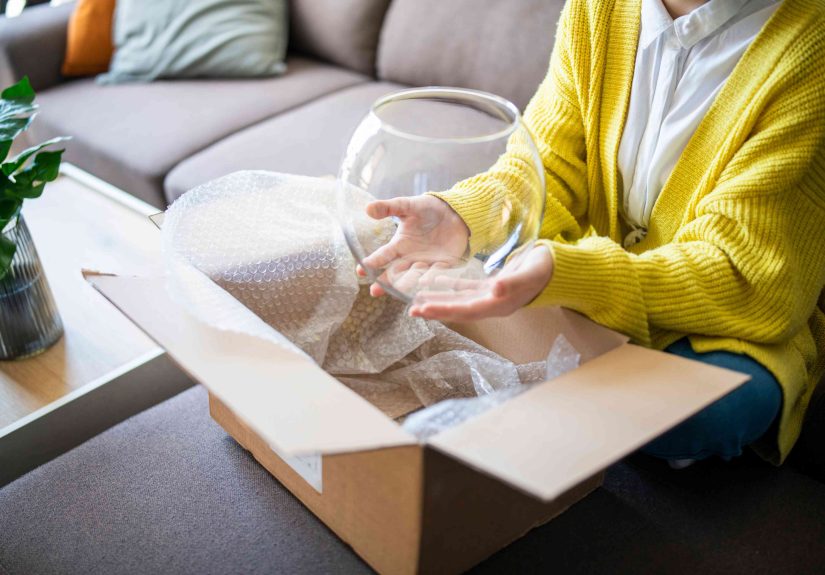
Packing paper is ideal for the first layer because it molds neatly around the item and helps prevent rubbing. Bubble wrap can go over that for additional shock absorption. The goal is not to create a plastic cocoon worthy of a science fiction movie. The goal is to give each item its own protective shell.
Best items to wrap one by one
- Plates and bowls
- Glasses and stemware
- Mugs and pitchers
- Ceramic decor
- Picture frames and mirrors
- Small appliances with delicate components
Pay special attention to handles, corners, rims, and protruding parts. Those are the spots most likely to snap. For example, a coffee mug is rarely going to fail in the middle. The handle is the drama queen. Wrap it accordingly.
For stemware, stuff a little packing paper inside the glass first, then wrap the whole piece carefully. For picture frames, protect the corners separately before wrapping the full frame. These small steps make a big difference.
3. Cushion the Bottom, Sides, Top, and Every Empty Space
Here is one of the golden rules of packing fragile items: if the contents can rattle, they can break. Cushioning is not just about softness. It is about control. You are trying to stop movement in every direction.
Start by creating a padded base in the box. Then place the wrapped item inside and surround it with more cushioning. Finish with a protective layer on top before sealing the carton. Think of the box as a suspension system, not a storage bin.
Good cushioning options
- Packing paper
- Bubble wrap
- Foam sheets or foam pouches
- Cardboard dividers
- Soft household textiles like towels or T-shirts for added support
Soft items like towels can be useful as supplemental padding, especially around less delicate objects or to fill dead space. They are helpful, but they should not be your entire strategy for a crystal bowl you inherited from your grandmother. Use real packing materials first, then let linens play a supporting role.
A good test is this: after the box is packed but before you tape it shut, gently shake it. If anything shifts, open it and add more fill. Yes, it is annoying. It is still less annoying than replacing your wedding champagne flutes.
4. Pack Plates Vertically and Glasses Upright
This is one of the most useful pro packing tricks because it feels backward at first. Plates should usually be packed vertically, like records on a shelf, rather than stacked flat in a pile. Why? Because stacked plates absorb force directly through the stack. A sharp bump can crack several at once.
When plates are packed on edge with paper or foam between them, the pressure is distributed differently and they are generally less vulnerable. The same principle applies to many flat, breakable kitchen items.
Glasses, meanwhile, should usually ride upright. Laying them sideways can put stress on weaker points. Fill empty spaces inside the glasses with paper, wrap each one, and separate layers with cushioning if you stack them.
Kitchen packing example
Imagine you are packing a box of six dinner plates, four salad plates, and a handful of wine glasses. Put a cushioned layer on the bottom, place the plates vertically with paper between each one, then use dividers or a separate section for glasses. Add paper around every edge and finish with cushioning on top. What you do not want is one giant box full of loose optimism.
5. Double-Box High-Risk Items
Some items deserve extra protection. If it is delicate, expensive, sentimental, oddly shaped, or all four, double-boxing is one of the smartest things you can do.
Double-boxing means packing the item securely in one smaller box, then placing that box inside a larger one with cushioning around all sides. It creates a second barrier against drops, pressure, and rough handling. This method is especially useful for antiques, crystal, fine china, electronics, framed art, and anything that would ruin your month if it arrived damaged.
How to double-box correctly
- Wrap the item individually.
- Place it in a snug inner box with cushioning on all sides.
- Seal that box.
- Place the inner box inside a larger outer box.
- Fill all surrounding space with padding so the inner box cannot move.
- Seal and label the outer box clearly.
This is also the right time to consider custom crating or specialty cartons for large mirrors, glass tabletops, artwork, or valuable collectibles. Some things are simply too fragile or too awkward for a standard box. If an item is rare, expensive, or irreplaceable, upgrading the packaging is often cheaper than replacing the damage.
6. Pack by Weight and Load With Physics in Mind
Packing fragile items safely is not just about the box itself. It is also about how that box behaves when lifted, stacked, and loaded into the truck. If a carton is top-heavy, overloaded, or buried beneath a mountain of hardback books, your careful wrapping job may not matter much.
Keep heavy breakables in smaller boxes so they stay manageable. Put heavier items at the bottom of the box and lighter items on top, but only if they are compatible. Do not place a heavy ceramic serving dish on top of delicate stemware and call it “organization.” That is chaos with tape.
Once the truck is being loaded, fragile boxes should stay upright whenever possible and should not be crushed under heavier cargo. Fill gaps in the truck to reduce shifting during transit. A box packed perfectly can still get wrecked if it slides around like it is training for a stunt sequence.
Smart loading example
A box of wrapped dishes belongs on a stable, flat surface in the truck, with heavier furniture or appliance boxes secured elsewhere. A fragile lamp box should not be the thing wedged between a dresser and a treadmill. Common sense matters here, and so does restraint.
7. Label Clearly and Keep a “Do Not Trust Anyone Else With This” Box
Labeling is not glamorous, but it is one of the most effective moving tips for fragile items. A clearly marked box is more likely to be handled carefully, placed in the right room, and opened with the right expectations.
At minimum, label each box with:
- The destination room
- A short description of contents
- “FRAGILE” on multiple sides
- “THIS SIDE UP” when relevant
Go a step further and create one personal transport box for the most delicate, high-value, or sentimental items. This can include jewelry, heirlooms, cameras, important electronics, prescription items, or one-of-a-kind keepsakes. In other words, if losing it would ruin your week or your family group chat, keep it with you.
Professional movers can do a great job, but there is nothing wrong with deciding that a few items are getting VIP treatment in your own car. Sometimes the safest moving box is the one that never leaves your sight.
Common Mistakes to Avoid When Packing Fragile Items
- Reusing weak or damaged boxes: Old boxes can collapse when weight shifts.
- Underfilling or overfilling boxes: Too much empty space causes movement; too much pressure can crack items.
- Skipping individual wrapping: “They’ll probably be fine” is not a packing strategy.
- Using only soft goods as protection: Towels help, but they are not a substitute for proper cushioning.
- Packing everything into one giant box: This saves time until your lower back and your dishes file a complaint.
- Failing to label: Unmarked fragile boxes often get treated like ordinary cargo.
Final Thoughts
If you want to pack fragile items for your move like a pro, the formula is pretty simple: use the right box, wrap each item individually, cushion every side, limit movement, load intelligently, and label like your future self depends on it. Because it does.
The real secret is not fancy gear or some magic mover trick. It is consistency. Protect each breakable item with the same level of care, even when you are tired, even when you are behind schedule, and especially when you are tempted to toss “just one more thing” into a full box. That one more thing is often the villain in the story.
Done right, your move does not have to end with shattered plates and a vow to eat off paper towels forever. A little planning now means your fragile belongings can arrive intact, your unpacking can stay civilized, and your favorite mug can keep doing what it does best: judging you quietly from the kitchen counter.
Real-Life Experience: What Packing Fragile Items Actually Feels Like
The first time I helped pack a full household for a move, I assumed fragile items were just the obvious things: plates, glasses, and maybe a lamp or two. I was wrong. Fragile items are everywhere. The ceramic planter on the windowsill. The framed print in the hallway. The blender jar. The oddly sentimental snow globe that no one has looked at in five years but would absolutely cause heartbreak if it broke. Once you start packing, you realize the house is basically a museum curated by chaos.
One lesson that shows up fast is that rushing creates damage. People get impatient and start combining random items in the same box because the space is there. A bowl goes next to a candleholder. A picture frame slides in beside a vase. It feels efficient in the moment, but it usually means those pieces spend the ride bumping into each other. The moves that go smoothly are usually the ones where someone slows down, wraps each item properly, and refuses to play moving-day Tetris with breakables.
Another thing experience teaches you is that box size matters more than beginners think. Many people assume a larger box is better because it holds more. In reality, a giant box full of fragile kitchenware becomes awkward, heavy, and just plain dangerous. Smaller, well-packed boxes are easier to carry, easier to stack, and far less likely to fail when someone grabs them by the bottom and discovers gravity has other plans.
There is also a big psychological difference between “packed” and “protected.” A fragile item can be technically inside a box and still be nowhere near safe. The boxes that survive a move well are the ones with no wasted space, no loose rattling, and no mystery shifting when you lift them. That usually means more paper, more padding, and a little more tape than people first expect.
And then there is the human side of it. Fragile belongings are often the most personal things we own. They are wedding gifts, family heirlooms, souvenirs, handmade ceramics, framed memories, and the kind of everyday objects that quietly become part of a home. Packing them well is not just about preventing financial loss. It is about preserving the pieces of life that are hardest to replace. That is why the best packing jobs are rarely the fastest ones. They are the most thoughtful. When people treat fragile items with patience and strategy, the entire move feels calmer, more organized, and a lot less heartbreaking at the other end.