Table of Contents >> Show >> Hide
- Who Is Avogado6, and Why Do His Illustrations Feel So Personal?
- Why “Simple” Illustrations Can Punch So Hard
- 50 Powerful Illustrations (and the Questions They Leave You With)
- How to “Use” These Illustrations Without Over-Explaining Them
- Experiences: What It Feels Like to Spend Time With Thought-Provoking Illustration
- Final Thoughts
Some art tries to impress you. Other art tries to catch youlike a sentence you didn’t expect, or a dream that won’t stop replaying.
That’s the lane Japanese illustrator Avogado6 lives in: simple, clean visuals that quietly shove big feelings into the room and then
politely leave you alone with them. No jump scares. No neon arrows. Just sharp metaphors for modern lifeburnout, loneliness, social pressure,
anxiety, and that weird sensation of being “connected” to everyone while feeling close to no one.
This article isn’t here to spoil the experience by over-explaining every image like a tour guide with a megaphone. Instead, it’s built to help you
look longer, connect the dots, and notice why these illustrations hit so hardeven when they use only a few objects and a handful of colors.
Who Is Avogado6, and Why Do His Illustrations Feel So Personal?
Avogado6 is known for staying private while sharing highly relatable work online. He’s described himself on social media as an “ordinary person who likes
chemistry,” which is a funny humble-brag if your “ordinary” includes turning emotions into visual metaphors that thousands of people immediately recognize.
His illustrations often look minimal at first glanceclean lines, strong silhouettes, carefully chosen symbols. But the longer you stare, the more the image
starts behaving like a mirror. You don’t just see a character on a page; you see a feeling you’ve had but never named. That’s the trick: the drawings don’t
hand you the message. They invite you to supply it.
Quick respect note: Avogado6 has publicly pushed back against unauthorized reprints of his work. If you share or repost, credit properly and support official
releases when you can. Art that makes you think deserves better than being treated like “free wallpaper.”
Why “Simple” Illustrations Can Punch So Hard
1) They use metaphors your brain understands instantly
A locked door. A cracked mask. A heart shaped like a machine. You don’t need a 12-page explanationyour mind fills in the missing story automatically.
That’s why visual metaphor is so powerful: it compresses a complicated idea into one scene your brain can unpack at its own pace.
2) They leave space for your experiences to move in
If an artwork is too specific, it can feel like someone else’s diary. But if it’s symbolic, it becomes a room you can walk into with your own memories.
Avogado6 often keeps faces simplified and settings sparse, which makes the emotion louder.
3) They make you do the “meaning-making” (and that sticks)
When you interpret an imagereally interpret ityou’re not passively consuming. You’re participating. And the ideas you build yourself tend to stick
longer than the ones someone hands you pre-chewed like a baby bird. (Sorry. Accurate, though.)
50 Powerful Illustrations (and the Questions They Leave You With)
Avogado6 has created a large body of work, and people interpret individual pieces in different ways. The entries below highlight common, recognizable
motifs in his illustrations and the kinds of thoughts they tend to trigger. Use them as a “slow looking” guide, not a final answer key.
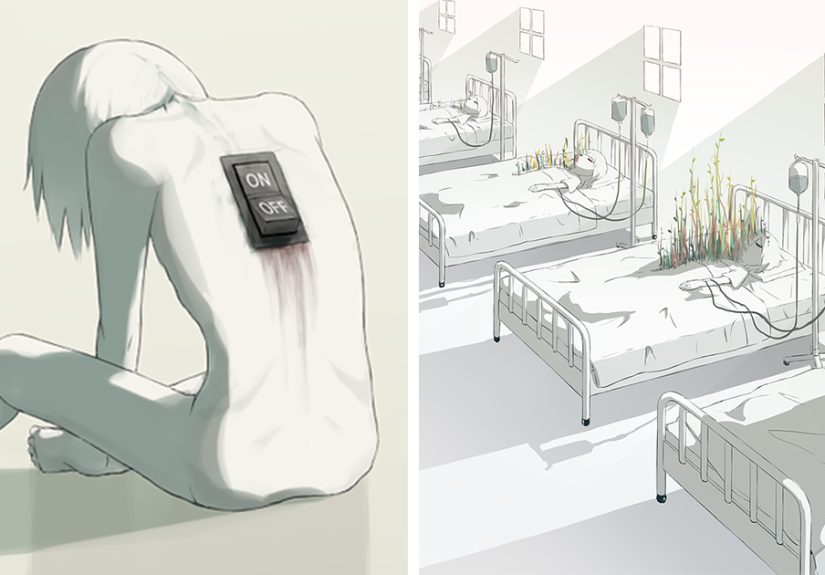
- The smartphone as a face Are you using tech, or wearing it?
- A heart treated like a device When did feelings become “maintenance”?
- A person made of fragile glass What parts of you feel one bump away from shattering?
- A mask that won’t come off If you’re always “fine,” who knows the real you?
- A crowd of identical silhouettes Do you belong, or are you blended?
- Hands pulling someone like a puppet Who’s writing your decisions lately?
- A battery running low inside a person What drains you fastest: work, people, or pretending?
- A body with a hole where something should be What’s missing, and when did it leave?
- A character stitched together Are you healing, or just holding?
- A smile drawn like a label Is your “happy” a feeling or a uniform?
- A figure carrying an impossible load What responsibilities did you never volunteer for?
- Chains made of everyday objects Which habit looks harmless but acts like a lock?
- A person shrinking inside a room What makes your world feel smaller than it used to?
- A megaphone drowning someone out Who gets heard, and who gets erased?
- A “like” button as currency Are you paid in approval instead of peace?
- A calendar that looks like a trap Are your days scheduled, or captured?
- A clock fused into a body When does “time management” become self-management?
- Rain inside a person Can sadness exist even on a sunny day?
- A window that shows a different life Is comparison your hobby or your injury?
- A mouth sealed shut What truth do you keep swallowing?
- Words as literal weapons Which comment still echoes longer than it should?
- A heart in a box Are you protecting it, or imprisoning it?
- A character replaced by a job title If your role disappeared, who would you be?
- Flowers growing from cracks Are you rebuilding, or just surviving beautifully?
- A ladder that never reaches Who promised success would feel like arrival?
- A door with “normal” written on it Who decided what “normal” costs?
- A person made of paper Are you flexible, or one tear away from collapse?
- A mirror that shows someone else Are you seeing yourself or expectations?
- A character dissolving into pixels Where does your identity live: offline or online?
- A hug that looks like a cage Can love ever become control?
- A spotlight that feels like a burn Do you want attention, or safety?
- A mouth full of noise Is your mind loud because life is loud?
- A hand offering help with strings attached What’s the hidden price of “support”?
- A character drowning in notifications What if urgency is just a design choice?
- A face split into “public” and “private” Which one feels more real lately?
- A crowd watching someone fall Why do we spectate instead of intervene?
- A person glued to a screen like a shadow Are you resting, or escaping?
- A staircase built from other people Who gets stepped on for “progress”?
- A tiny figure in a giant city How can you feel lonely in a crowd?
- A heart patched with tape What “fix” is actually just a pause button?
- A character wearing a price tag When did worth become a number?
- A person split into multiple versions Who are you when nobody’s watching?
- A balloon that’s also a burden Can something lift you and exhaust you?
- A character feeding a machine with emotions Where does your energy go after you spend it?
- A stage with no exit Do you feel trapped in performance?
- A “perfect” mask cracking What breaks first: the image or the person?
- A character shrinking beside someone else’s highlight reel Are you living or measuring?
- A message bottle that never arrives What if your honesty keeps missing its audience?
- A character rebuilding themselves quietly What does healing look like when it’s not dramatic?
How to “Use” These Illustrations Without Over-Explaining Them
Try slow looking
Give one illustration a full minute. First, list what you literally see (objects, shapes, posture). Then ask: what emotion does the scene carry?
Finally, connect it to real life: what situation would create that feeling?
Journal prompts that don’t feel like homework
- What part of this image feels familiarand why?
- What detail is the “real message” for you?
- If this illustration could speak one sentence, what would it say?
Share thoughtfully
If an illustration resonates, you can share it as a conversation starterbut always credit the artist and avoid reposting in ways that remove attribution.
And if any artwork stirs up heavy feelings, consider talking it through with someone you trust. Art can be a door; you don’t have to walk through it alone.
Experiences: What It Feels Like to Spend Time With Thought-Provoking Illustration
The first “experience” many people have with Avogado6’s work is the scroll-stopping moment: you’re moving fast, half-reading captions, and then an image
quietly hooks your attention. It doesn’t shout. It just sits there with a weird calm confidence, like it already knows your schedule is busy and is willing
to wait. That’s usually when the second experience happens: you realize you’re not looking at the illustration anymoreyou’re looking at yourself reacting
to it. Your brain starts supplying context. “That’s what my week feels like.” “That’s exactly the kind of pressure I couldn’t explain.” “That’s the part I
never say out loud.”
Another common experience is the tug-of-war between “I get it immediately” and “I can’t stop thinking about it.” A good metaphor does both. It lands fast
because the symbols are familiar, but it stays because the meaning keeps shifting as you replay it. The same illustration can feel like burnout on Monday,
loneliness on Thursday, and social pressure on Saturdaybecause your life is the changing variable, not the picture. In that sense, the artwork behaves like
a mood ring for your inner world, except instead of turning purple, it turns into a question you didn’t plan on answering today.
There’s also the oddly comforting experience of realizing you’re not the only one who “reads” the images that way. When people discuss these illustrations,
you’ll often see a pattern: different stories, same emotional core. One person talks about work stress; another talks about feeling invisible at school; someone
else sees a relationship dynamic. The details vary, but the recognition is shared. That shared recognition can feel like a small antidote to isolationlike a
quiet group chat where nobody has to overshare, because the image already did the heavy lifting.
And then there’s the final experience: the reset. Not a magical cure, not a life-changing epiphany (life is rarely that cinematic), but a subtle shift. After
you sit with an illustration long enough, your mind starts naming things more clearly. You might catch yourself later thinking, “Ohthis is that ‘battery-drain’
feeling,” or “This is me wearing the mask again.” That’s the underrated power of visual metaphor: it gives you a compact label for a complex emotion, and labels
make it easier to communicate, set boundaries, or ask for support. Sometimes “thinking” isn’t about finding the perfect answer. Sometimes it’s about finally
finding the right wordsor in this case, the right pictureto start the conversation.