Table of Contents >> Show >> Hide
- Why “death humor” works when it’s done right
- Meet The Immortal Grind: the afterlife, but make it slice-of-life
- 30 stereotype-busting comic moments from The Immortal Grind
- Category 1: Death as a stressed-out professional (not a villain)
- Category 2: Hell as administration (not just fire)
- Category 3: Heaven isn’t perfectjust better at branding
- Category 4: God, Devil, and Death as coworkers (awkwardly believable)
- Category 5: The afterlife has feelings (and they’re not all doom)
- Category 6: Modern life follows us into death (because of course it does)
- What makes these afterlife comics feel fresh (and not just “edgy”)
- How to read, share, and enjoy death humor without being “that person”
- Bonus: 500-word experience section what these comics feel like in real life
- Conclusion
Death is usually written like a bouncer: hood up, scythe out, no eye contact, no questions. But The Immortal Grind shows up with a very different vibe
more “overworked public servant” than “ominous smoke machine.” The result is a set of afterlife comics that feel surprisingly modern: funny without being mean,
dark without being hopeless, and weirdly comforting in the way a well-timed joke can be when life gets… aggressively life-y.
If you’ve been hunting for afterlife comics and death comics that don’t default to the same old stereotypes (Halo Good, Horns Bad,
Grim Reaper Always Angry), you’re in the right place. Below you’ll find the big ideas behind The Immortal Grindand a guided tour through 30
stereotype-busting comic moments that make the afterlife feel less like a sermon and more like an office break room with questionable coffee.
Why “death humor” works when it’s done right
Joking about death can sound like playing dodgeball in a porcelain shop. But culturallyand psychologicallyhumor has long been a way to touch scary topics without
getting swallowed by them. The trick is intention: is the joke punching down, or is it letting air into a room that feels too tight to breathe in?
The best dark humor doesn’t erase grief; it shares space with it. It gives your brain a tiny exit ramp from dread, then gently merges you back onto the highway of
being human. That’s exactly where The Immortal Grind lives: in the narrow lane between “we’re all mortal” and “okay, but can Death please stop replying-all?”
Meet The Immortal Grind: the afterlife, but make it slice-of-life
The premise: eternity is a job… and everyone’s in meetings
The Immortal Grind frames the afterlife as an everyday workplace. Heaven and hell aren’t just moral destinationsthey’re systems with schedules, policies,
petty annoyances, and an endless parade of “quick questions” that are never quick. Death isn’t a mythic finale so much as the employee who’s been covering three
shifts since the invention of time.
The cast: big cosmic roles, small relatable problems
Familiar figures show upDeath, the Devil, sometimes even Godbut they’re not cardboard cutouts. They’re characters with personalities, blind spots, and the kind
of awkward social friction you’d recognize from any group chat that’s one typo away from chaos. Instead of preaching, the comic pokes at the mundane details:
customer complaints, PR disasters, moral gray areas, and the eternal question: “Who approved this policy?”
The tone: dark, but not cruel
The humor lands because it’s not trying to win points for being edgy. It’s playful, observant, and often oddly tender. The afterlife feels less like a threat and
more like a mirrorshowing how we carry our same weird habits and anxieties into whatever comes next.
30 stereotype-busting comic moments from The Immortal Grind
Instead of retreading the “grim and scary” formula, these comics flip the script: the afterlife has bureaucracy, customer service, awkward diplomacy, and the kind
of workplace drama that makes you whisper, “Honestly… relatable.”
Category 1: Death as a stressed-out professional (not a villain)
- The complaint desk from beyond. Death isn’t fearedDeath is interrupted, mid-task, by someone filing a complaint like the afterlife has a returns policy.
- “Can you not?” requests. Mortals try to negotiate with Death like they’re rescheduling a dentist appointment. Death’s patience clock hits zero.
- Performance reviews, but cosmic. The job is endless, the metrics are unclear, and somehow Death is still getting “needs improvement” energy.
- Overtime is forever. The punchline isn’t doomit’s the idea that even supernatural beings would like one (1) uninterrupted lunch break.
- Uniform issues. The classic cloak-and-scythe look becomes less terror and more “HR says this is the dress code.”
Category 2: Hell as administration (not just fire)
- Hell’s customer service voice. The Devil answers problems with the calm tone of someone who’s been yelled at since the dawn of sin.
- Policy over pitchforks. Punishment isn’t creative tortureit’s paperwork, forms, approvals, and the horror of being “sent back for revisions.”
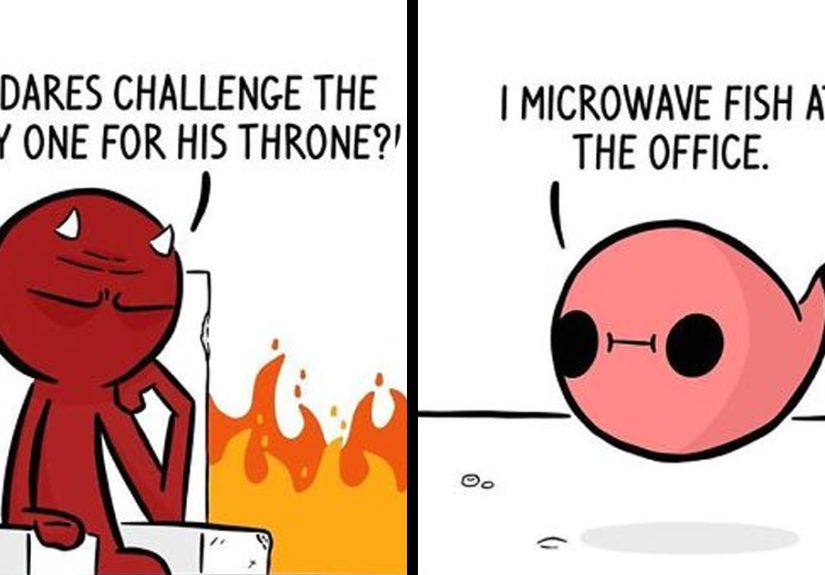
- Microwave crimes. Hell’s true evil? Someone reheating something that smells like a war crime in the shared kitchen.
- Training day in the underworld. New hires learn the ropes, and suddenly eternity feels like onboarding with slightly more screaming.
- Scheduling the apocalypse. Even chaos has a calendar invite. Someone has to coordinate the doom like it’s a product launch.
Category 3: Heaven isn’t perfectjust better at branding
- Halo maintenance. Angels act like their glow is effortless, but the comic hints it’s basically skincare, discipline, and mild insecurity.
- Heavenly bureaucracy. Paradise still has rules. The difference is the signage is nicer and the emails use more exclamation points.
- Good deeds, questionable motives. The comic side-eyes performative virtuebecause even in heaven, someone is doing it for the optics.
- “We’re like a family here.” If you’ve ever heard that at work, you already know why it’s funny when eternity says it too.
- Joy as a KPI. Imagine being evaluated on “blessedness,” then having a rough day and getting a gentle-but-terrifying smile from management.
Category 4: God, Devil, and Death as coworkers (awkwardly believable)
- Cosmic group chat energy. The big three don’t feel like mythic absolutesthey feel like people trying to coordinate across egos.
- PR disasters from miracles. “Good intentions” collide with “unintended consequences,” and suddenly heaven has to do damage control.
- Power, but petty. Immense authority doesn’t remove small annoyancesit just gives you more dramatic ways to be mildly irritated.
- Office politics, eternal edition. The afterlife has alliances, rivalry, and that one person who always “circles back” without circling back.
- Existential workplace banter. The jokes land because they treat cosmic beings like they have the same social awkwardness we do.
Category 5: The afterlife has feelings (and they’re not all doom)
- Unexpected kindness from Death. Instead of cruelty, you get moments where Death feels like a calm guidemore tired than terrifying.
- Grief without sermons. The comic nods at loss in a way that feels human: not dramatic speeches, just small truths and uncomfortable pauses.
- Pets and purity. Animals cut through the cosmic drama because love is simple, even when the universe is complicated.
- Second chances, awkwardly offered. Redemption shows up not as a grand prophecy but as someone hesitating, then trying anyway.
- The quiet punchline. Sometimes the funniest thing is the softest: the realization that everyone’s just doing their best with eternity.
Category 6: Modern life follows us into death (because of course it does)
- Climate anxiety in the underworld. The Devil tries to “solve” a problem humans createdan ironic twist that hits because it’s uncomfortably plausible.
- Technology, but immortal. Imagine the afterlife adopting modern tools: the comedy comes from how quickly “convenience” becomes chaos.
- Social-media morality. Judgment becomes less biblical thunder and more “who posted what, and why is it trending?”
- Burnout is universal. Even supernatural beings need boundaries. The punchline is recognizing ourselves in their exhaustion.
- The stereotype flips. The final wink: the afterlife isn’t a dramatic finaleit’s a continuation of personalities, habits, and all our weird little systems.
What makes these afterlife comics feel fresh (and not just “edgy”)
1) Death is humanized, not glamorized
Plenty of modern stories soften Death into something approachablelike the famously warm, compassionate take on Death in The Sandman universe. That version
of Death isn’t a monster; it’s a necessary part of reality, portrayed with empathy. The Immortal Grind taps into the same idea: Death as a role, not a
threatsomething you might fear, but also something you might understand.
2) It uses gallows humor as a pressure valve, not a weapon
The comedy leans into absurdity: meetings, policies, exhaustion, and workplace nonsensestuff we recognize. That recognition matters. It lets you laugh at the
shape of the fear without mocking real pain. Dark humor can be a coping strategy when it creates connection and relief, but it can also backfire if it becomes a
way to dodge feelings. The comic’s best moments thread that needle by being silly and sincere at the same time.
3) It fits a “death-positive” cultural shift
There’s a growing appetite for talking about death more openlyless taboo, more honest, less “shhh, don’t say it.” Death-positive communities argue that clarity
and conversation reduce fear and improve how we support one another. A funny afterlife webcomic can be a surprisingly effective doorway into that mindset:
you laugh first, then you notice you’re not as scared to think about it.
4) It’s not trying to be your therapist (and that’s a compliment)
These comics don’t lecture. They don’t demand that you “learn a lesson.” They just offer a different angle: death as a part of life, the afterlife as a
continuation of personality, and cosmic power as something that still has to answer emails.
How to read, share, and enjoy death humor without being “that person”
Know your audience
Dark humor is contextual. A comic that’s comforting to one person can feel like sandpaper to anotherespecially around fresh grief. If you’re sharing, consider
timing, closeness, and consent. (A good rule: if you wouldn’t make the joke at a memorial service, don’t drop it in someone’s inbox at 8:03 a.m.)
Let the joke open a door, not shut one
The healthiest death jokes don’t end the conversation; they make it possible. They’re a bridge, not a barricade. The Immortal Grind works because its
humor often implies empathy: everyone’s dealing with the same big mystery, and nobody has the user manual.
Bonus: 500-word experience section what these comics feel like in real life
The most relatable part of The Immortal Grind isn’t the hellfire or the halosit’s the emotional whiplash you get when something “cosmic” behaves like
your everyday life. You scroll past a strip where Death looks exhausted, and your brain does this weird little double-take: “Wait… Death has the same face I
make when I open my email?” That’s the secret sauce. The comic turns mortality into something you can approach sideways, with a smirk, instead of head-on with
a panic spiral.
A lot of readers fall into these afterlife comics the same way they fall into any good webcomic: five minutes between tasks, a quick break, a harmless distraction.
Thensurpriseyou laugh and immediately feel a tiny bit lighter. Not because the topic is light, but because the comic doesn’t treat you like you’re fragile glass.
It assumes you can handle truth in small doses, delivered via punchline.
There’s also a specific comfort in the “mundane afterlife” idea. Many stories present death as either a terrifying void or a glittering reward. Both extremes can
feel alienating when you’re already stressed, grieving, or just tired. The Immortal Grind offers a third option: the afterlife as a place where existence
continues with quirks, routines, and relationships. That framing doesn’t claim to be correct; it just feels emotionally plausible. It gives your imagination
something to hold that isn’t pure dread.
The humor can even change how you talk about death with other people. Not in a dramatic “I have been transformed” waymore like a gentle permission slip. When a
strip makes you chuckle about eternal bureaucracy, it becomes easier to say things like, “Yeah, I’ve been thinking about mortality lately,” without feeling like
you just dropped a bowling ball in the conversation. In that sense, the comic functions like a social lubricant for a topic we usually keep locked in the attic.
And when you’re dealing with real loss, the experience can be surprisingly nuanced. On some days, a death joke feels healinglike a reminder that love and grief
can coexist with laughter. On other days, it lands wrong, and you close the tab. Both reactions are normal. The point isn’t to force yourself to laugh; it’s to
have options. Sometimes you need silence. Sometimes you need a friend. Sometimes you need a comic where the Devil has to run a meeting and looks just as miserable
as everyone else.
That’s why these death-and-afterlife comics stick: they’re not just jokes about dying. They’re jokes about livingabout systems, personalities, anxieties, hope,
and the odd fact that even the scariest concepts become less powerful when you can name them, look at them, and laugh a little.
Conclusion
The Immortal Grind stands out in the world of afterlife comics because it refuses the usual extremes. It doesn’t sell death as a cheap scare
or a shiny fantasy. Instead, it treats the afterlife like a place where personality survives, bureaucracy thrives, and even cosmic entities deal with the daily grind.
The laughs are sharp, the tone is surprisingly warm, and the stereotypes don’t survive the first staff meeting.