Table of Contents >> Show >> Hide
- Before You Light Anything: Quick Safety Checks
- Way 1: Light a Gas Fireplace with a Standing Pilot and Igniter
- Way 2: Light a Gas Fireplace with a Wall Key
- Way 3: Light a Gas Fireplace with a Wall Switch or Remote
- How to Tell Which Lighting Method You Need
- Troubleshooting Tips Before You Book Service
- Safety Habits That Make Gas Fireplaces Easier to Live With
- Real-World Experiences: What Lighting a Gas Fireplace Actually Feels Like
- Conclusion
- SEO Tags
There are two kinds of people in winter: the ones wrapped in three blankets like a burrito, and the ones who know exactly how to turn on a gas fireplace without summoning confusion, panic, or a suspicious clicking noise. If you landed here, you are probably trying to become the second kind.
The good news is that lighting a gas fireplace is usually simple. The slightly less-good news is that “simple” depends on what kind of ignition system you actually have. Some fireplaces use a standing pilot with a control knob and igniter. Some gas log setups use a wall key. Others are modern enough to start with a wall switch or remote, which feels delightfully futuristic until the batteries die on the coldest night of the year.
This guide breaks down the three main ways to light a gas fireplace, along with the safety steps that matter most, the mistakes homeowners make most often, and the real-world experience of figuring out what your unit wants from you. The goal is not just to get flames. The goal is to get flames safely, correctly, and without turning your living room into an accidental troubleshooting seminar.
Before You Light Anything: Quick Safety Checks
Before you try to light a gas fireplace, pause for a minute. This is the least glamorous part of the process, but it is also the part that keeps the glamorous part from going terribly wrong.
1. Know what type of fireplace you have
Not every gas fireplace lights the same way. A sealed direct-vent unit, a vented gas log set, and a vent-free model can all look similar from across the room, but the controls may be completely different. Check the owner’s manual or look inside the lower access panel before guessing.
2. Smell for gas first
If you smell gas, do not try to light the appliance. Do not test your luck, do not press the igniter “just once,” and do not decide this is the moment to become a fireplace philosopher. Stop immediately and contact your gas supplier or a qualified service technician.
3. Make sure the area is clear
Move blankets, paper, décor, pet beds, and anything else flammable away from the fireplace opening. Gas fireplaces may be tidy, but the heat they produce is not subtle.
4. Be careful with hot glass
One of the most overlooked gas fireplace safety issues is the glass front. It can become extremely hot during operation and stay hot long after the fire is off. That makes it a burn risk for children, pets, guests, and one overconfident adult who thinks, “It’s probably fine now.” It may not be fine now.
5. Use carbon monoxide alarms
Because gas-burning appliances can create carbon monoxide if something is wrong, a working CO alarm is part of smart fireplace ownership, not optional flair. Test the alarm regularly and replace batteries on schedule.
6. Know whether your unit uses a flue or sealed vent
This matters more than people think. A traditional vented gas log set installed in a masonry fireplace may require the damper or flue to be open during use. A sealed direct-vent fireplace is a different animal and does not operate the same way. In other words, do not borrow instructions from your neighbor unless your fireplace and your neighbor’s fireplace are secretly twins.
Way 1: Light a Gas Fireplace with a Standing Pilot and Igniter
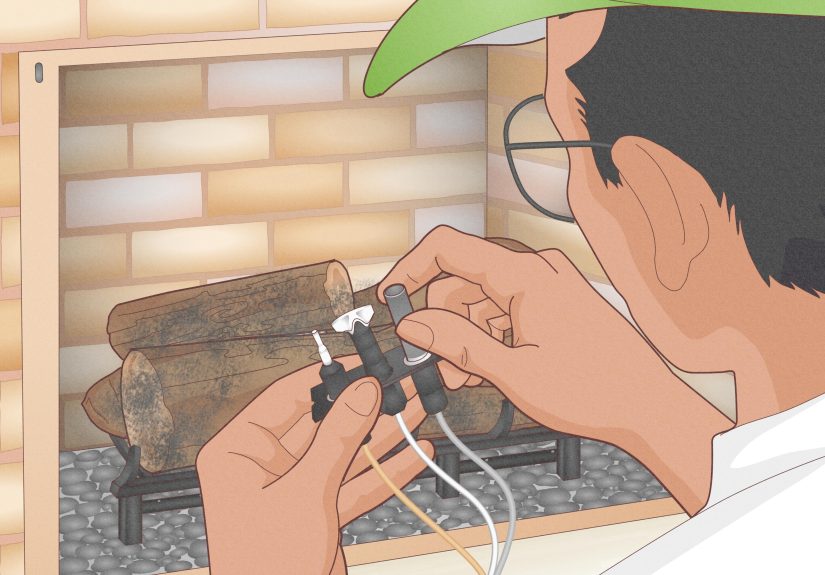
This is the classic method many homeowners picture when they hear “light a gas fireplace.” You open the lower panel, find the control valve, turn a knob from OFF to PILOT, and use a built-in igniter button to spark the pilot flame.
How to identify this system
You likely have a standing-pilot or manual-light setup if you see:
- An access panel below the firebox
- A gas control knob labeled OFF, PILOT, and ON
- A red or black igniter button
- A pilot assembly inside the combustion area
Step-by-step instructions
- Turn everything off first. If your fireplace also has a wall switch, thermostat, or remote, set it to off so you are only dealing with the pilot.
- Open the access panel. Look for the gas control valve and the igniter button.
- Turn the control knob to OFF and wait five minutes. This gives any residual gas time to clear.
- Turn the knob to PILOT. You usually need to push the knob inward while turning it.
- Press and hold the knob in. While holding it, press the igniter button repeatedly until the pilot lights.
- Keep holding the knob for 30 to 60 seconds. This helps the safety system confirm the pilot is stable.
- Release the knob slowly. If the pilot stays lit, turn the knob to ON.
- Turn on the main burner. Depending on your model, that may happen with a rocker switch, wall switch, thermostat, or remote once the control valve is set to ON.
What trips people up
The most common mistake is not holding the knob long enough after the pilot lights. The second most common mistake is forgetting the five-minute wait after turning the knob to OFF. The third is trying to force the controls. Fireplace valves are not jar lids. If something will not turn, stop and check the manual instead of muscling through it like you are opening pickle day at the gym.
When to stop and call a pro
If the pilot will not light after a few proper attempts, will not stay lit, or the controls feel loose, stuck, or damaged, schedule service. The same goes for soot buildup, unusual odors, or a flame pattern that looks weak or erratic.
Way 2: Light a Gas Fireplace with a Wall Key
This method is common on gas log fireplaces that use a key valve. Instead of a control panel with a pilot knob, you insert a removable metal key into a nearby valve and slowly turn on the gas while using a long lighter or match at the burner.
How to identify this system
You probably have a wall-key setup if you see:
- A small keyed valve in the wall, floor, or hearth near the fireplace
- No obvious remote control receiver or electronic ignition panel
- A gas log set in a more traditional fireplace opening
Step-by-step instructions
- Confirm the fireplace is ready. Make sure the firebox is clear and that the setup is intended for manual lighting.
- Check venting requirements. If this is a vented gas log set in a traditional fireplace, verify the flue or damper is open according to the manufacturer’s instructions.
- Insert the wall key. Place it fully into the gas valve slot.
- Position a long lighter near the burner. Keep your hand clear of the immediate ignition area.
- Turn the key slowly counterclockwise. The gas should begin to flow and the burner should ignite.
- Adjust the flame gradually. Turn the key farther if you want a larger flame.
- Remove the key and store it safely. That reduces the chance of accidental movement or damage.
Why “slowly” matters
A wall-key system is not the time for dramatic gestures. Turning the key too fast is a great way to startle yourself and a poor way to look cool in front of houseguests. A slow, controlled turn allows the flame to catch properly and makes it easier to adjust the burner height.
Common wall-key mistakes
- Trying to light it without a long lighter already in place
- Forgetting the venting requirement on vented gas log systems
- Turning the key too low after ignition and accidentally extinguishing the flame while gas is still flowing
- Leaving the key inserted where children can reach it
If your wall-key fireplace does not ignite promptly, turn the gas off, wait, and reassess. Do not keep feeding gas into the firebox while hoping the flame eventually gets the memo.
Way 3: Light a Gas Fireplace with a Wall Switch or Remote
This is the easiest method and the one most people secretly hope they have. If your fireplace has electronic ignition, you may be able to turn it on by flipping a wall switch or pressing a button on the remote. In many systems, the pilot lights automatically and the main burner follows a few seconds later.
How to identify this system
You likely have an electronic ignition fireplace if you see:
- A wall switch near the fireplace
- A handheld remote control
- A control module in the lower compartment
- No need to light the pilot by hand during normal operation
Step-by-step instructions
- Confirm the gas supply is on. A switched-on remote cannot fix a closed gas valve.
- Check the control settings. Some fireplaces need the system set to ON or REMOTE to respond properly.
- Use the wall switch or press ON on the remote. The fireplace should begin the ignition sequence automatically.
- Wait a few seconds. The pilot may ignite first, followed by the burner.
- Adjust flame or heat settings if your model allows it. Many remotes also control flame height, timers, or thermostatic modes.
What to do during a power outage
Some electronic ignition systems can still operate during an outage using backup batteries or by switching the control box from REMOTE to ON. That means your fireplace may still save movie night even when the rest of the house is acting dramatic. Check your specific model, because battery requirements and control-box behavior vary.
Why your switch or remote may not work
- Dead remote batteries
- The control box is set to the wrong mode
- The unit needs to be re-initialized after maintenance or battery replacement
- The gas supply is off
- The fireplace needs service
If the unit clicks but never lights, or lights briefly and shuts off, it is time for real troubleshooting, not optimistic button mashing.
How to Tell Which Lighting Method You Need
If you are still unsure which method applies to your fireplace, use this quick rule of thumb:
- Control knob plus igniter button? You likely have a standing-pilot or manual-light system.
- Metal key near the fireplace? You likely have a wall-key gas log setup.
- Wall switch or remote with automatic startup? You likely have electronic ignition.
When in doubt, the owner’s manual wins. Your fireplace may look modern on the outside and still use an older ignition design behind the panel. Fireplaces are a bit like people that way: the exterior only tells part of the story.
Troubleshooting Tips Before You Book Service
Pilot will not stay lit
Try holding the knob longer after ignition. If that does not work, the pilot assembly may be dirty or the system may need service.
No spark at all
Check whether your unit actually uses a manual spark igniter. If it does, the igniter may be worn or disconnected.
Remote does nothing
Start with batteries. Then check whether the control box is in ON, OFF, or REMOTE. This simple setting causes a surprising number of “broken fireplace” mysteries.
You smell gas
Stop immediately. Do not continue trying to light the fireplace. Leave the area and follow emergency guidance from your gas supplier or local authorities.
The flame looks strange
A flame that seems weak, unstable, or unusually sooty can signal a venting, burner, or maintenance issue. That is a professional-service problem, not a “let’s see what happens” problem.
Safety Habits That Make Gas Fireplaces Easier to Live With
Lighting a gas fireplace is only half the story. Keeping it safe over time is what separates a cozy upgrade from a recurring household headache.
- Schedule annual service. A qualified professional should inspect the burner, pilot, venting, and controls at least once a year.
- Keep the glass and surrounding area clean. Dust and lint do not improve combustion or appearance.
- Supervise children and pets. The glass can stay dangerously hot even after the flames are off.
- Do not store flammables nearby. Gasoline, aerosols, and household clutter do not belong near a heat source.
- Use the exact lighting process for your unit. “Close enough” is not a safety standard.
Real-World Experiences: What Lighting a Gas Fireplace Actually Feels Like
The first time many homeowners try to light a gas fireplace, they expect one dramatic movie moment: flip a switch, enjoy instant cozy magic, and stare meaningfully into the flames while soup simmers somewhere off-camera. Real life is usually a little messier, and a lot more human.
One common experience is simple uncertainty. You open the lower panel and suddenly discover a tiny universe of knobs, labels, wires, and one button that looks important but not friendly. The fireplace that seemed elegant from the couch now resembles a mechanical riddle. This is especially true with standing-pilot systems. People often hesitate because they are worried about doing something wrong, and honestly, that caution is not a bad instinct. Gas appliances deserve respect. Once you identify the OFF-PILOT-ON knob and understand the five-minute wait, though, the process gets much less intimidating.
Another common experience is impatience. A lot of first-time users release the pilot knob too early, assume something is broken, then start over with rising frustration. The lesson is that fireplaces are not always fast, even when they are convenient. Holding the knob for the extra 30 seconds feels long in the moment, but it is often the difference between a stable pilot and a flame that vanishes the instant you let go. The same goes for remote-operated fireplaces. People press ON, hear clicking, wait two seconds, and press it again because nothing “happened.” Meanwhile, the system was already working through its normal ignition sequence like a machine begging for just a little patience.
Wall-key fireplaces create a different kind of experience. They tend to make people nervous because they feel more manual and a little less guided. You have one hand on the key, one hand on the lighter, and just enough self-awareness to realize this is not the best time for distractions. Once you do it correctly, though, it becomes surprisingly straightforward. Many homeowners end up liking the control because adjusting the flame feels immediate and tactile. It is the fireplace equivalent of driving a stick shift: a little clunky at first, then oddly satisfying once you get the rhythm.
Then there is the seasonal experience. At the start of fall, many people discover their fireplace has been ignored since last winter. The remote batteries are dead, the instruction manual has achieved mythological status, and nobody remembers whether the wall switch should be ON, OFF, or REMOTE. This is where routine helps. Homeowners who do a quick preseason check, test the CO alarm, clean the area, and review the startup procedure usually avoid the mid-November comedy of errors.
The most reassuring experience, though, is the moment the process becomes normal. You stop treating the fireplace like an unpredictable dragon and start treating it like a household system you understand. You know where the controls are. You know what the startup sounds like. You know when something seems off. That confidence is the real payoff. The warmth is great, of course, but the ability to light a gas fireplace safely, calmly, and correctly every time is what makes the whole feature genuinely enjoyable.
Conclusion
Learning how to light a gas fireplace is mostly about identifying the ignition system in front of you. A standing pilot uses a control knob and igniter. A wall-key fireplace uses a key valve and lighter. An electronic unit usually starts with a wall switch or remote. Once you match the method to the machine, the process becomes much easier.
The key is to stay patient, follow the proper sequence, and never skip the safety basics. Smell for gas first, keep combustibles away, respect hot glass, and schedule yearly maintenance. Do that, and your gas fireplace can deliver exactly what it is supposed to deliver: fast warmth, low drama, and a very respectable cozy factor.