Table of Contents >> Show >> Hide
- Why Coincidences Hit So Hard
- 29 Coincidences That Shred Reality
- 1. John Adams and Thomas Jefferson died on the same day.
- 2. They died on the 50th anniversary of the Declaration of Independence.
- 3. James Monroe also died on July 4.
- 4. Abraham Lincoln and Charles Darwin were born on the exact same day.
- 5. Edwin Booth saved Robert Todd Lincoln’s life.
- 6. Robert Todd Lincoln was present when James Garfield was shot.
- 7. Robert Todd Lincoln was also nearby when William McKinley was shot.
- 8. Lincoln signed legislation creating the Secret Service on the day he was assassinated.
- 9. The Civil War began in Wilmer McLean’s front yard.
- 10. The Civil War ended in Wilmer McLean’s parlor.
- 11. Mark Twain arrived with Halley’s Comet in the sky.
- 12. Twain predicted he would leave with Halley’s Comet too.
- 13. He died as Halley’s Comet returned.
- 14. Violet Jessop was aboard the Olympic when it collided with another ship.
- 15. She later survived the sinking of the Titanic.
- 16. She also survived the sinking of the Britannic.
- 17. Tsutomu Yamaguchi survived Hiroshima.
- 18. Then he went home to Nagasaki and survived that bombing too.
- 19. The “Jim twins” were separated at birth and still developed eerie similarities.
- 20. Their similarities went beyond just one or two habits.
- 21. Anne Parrish found her own lost childhood book in Paris.
- 22. Edgar Allan Poe invented a doomed Richard Parker before history did.
- 23. Bell and Elisha Gray filed rival telephone claims within hours of each other.
- 24. Darwin and Wallace independently arrived at natural selection.
- 25. Newton and Leibniz independently developed calculus.
- 26. The Great Chicago Fire and the Peshtigo Fire erupted on the same night.
- 27. The Great Fires of 1871 were not just one blaze or even two.
- 28. A fake Carmania ran into the real Carmania.
- 29. On the day of Edwin Booth’s funeral, Ford’s Theatre collapsed.
- So, Do Coincidences Mean Anything?
- What It Feels Like When Coincidences Crash Into Real Life
- Final Thoughts
Every now and then, reality stops acting like reality and starts acting like a novelist with a deadline. A president dies on the nation’s birthday. A writer arrives with Halley’s Comet and exits with it. A woman browses a Paris bookstall and somehow finds the exact childhood book she lost years earlier. At moments like these, the normal response is not a careful statistical analysis. It is usually something closer to: Excuse me, what?
That reaction is part of what makes coincidences so irresistible. They feel like tiny tears in the fabric of ordinary life. They make history look scripted, chance look suspicious, and random timing look like it has a grin on its face. But here is the twist: coincidences can be both real and weird without being supernatural. In fact, the stranger they seem, the more they reveal about two things at oncehow chaotic the world is and how hungry the human brain is for meaning.
So let’s do what every curious person secretly wants to do when the universe starts acting a little dramatic: stare directly at the weirdness. Below are 29 real coincidences, strange overlaps, and history-bending timing glitches that seem to shred reality, even when they don’t technically break any laws of physics.
Why Coincidences Hit So Hard
Before diving into the list, it helps to understand why eerie coincidences feel so personal. Human beings are elite pattern-finding machines. That talent is useful when you are spotting danger, reading social cues, or figuring out whether that weird smell in the kitchen means “burnt toast” or “call someone immediately.” But the same brain that keeps you alive also loves connecting dotssometimes faster than evidence deserves.
Psychologists often talk about apophenia, which is the tendency to see meaning in random information. That does not mean people are foolish. It means people are human. We notice repeated dates, matching names, mirrored events, and uncanny timing because our minds are built to detect patterns. Add emotion, memory, or a little historical drama, and suddenly an ordinary coincidence can feel like a message delivered by the universe in a velvet envelope.
Still, not every strange coincidence is just a trick of perception. Some are genuinely improbable. Some are statistically explainable but emotionally shocking. And some are so oddly specific that they continue to make even skeptical readers lean back in their chairs and mutter, “Nope. I don’t like that.”
29 Coincidences That Shred Reality
1. John Adams and Thomas Jefferson died on the same day.
America’s second and third presidents died within hours of each other on July 4, 1826. That alone is a strong entry in the coincidence hall of fame. These were not minor figures. They were former allies, later political rivals, and eventually reconciled correspondents whose lives were deeply tied to the American founding.
2. They died on the 50th anniversary of the Declaration of Independence.
As if the same-day death was not enough, that date was the 50th anniversary of the Declaration they helped bring into being. History occasionally lacks subtlety, and this is one of those times.
3. James Monroe also died on July 4.
Five years later, on July 4, 1831, former president James Monroe died too. That meant three of the first five U.S. presidents all died on Independence Day. If history were pitching this in a writers’ room, someone would probably ask for a rewrite because it sounds too on the nose.
4. Abraham Lincoln and Charles Darwin were born on the exact same day.
February 12, 1809 gave the world both Abraham Lincoln and Charles Darwin. One would reshape politics, democracy, and the moral direction of the United States. The other would transform biology forever. Same day. Same planet. Different kinds of revolution.
5. Edwin Booth saved Robert Todd Lincoln’s life.
A few months before John Wilkes Booth assassinated Abraham Lincoln, Booth’s brother Edwinone of the most famous actors of his erasaved Robert Todd Lincoln from falling between a platform and a moving train. It is one of those historical details that sounds invented by a screenwriter who has had too much coffee.
6. Robert Todd Lincoln was present when James Garfield was shot.
Robert Lincoln did not just have one terrible brush with presidential tragedy in his orbit. In 1881, he was present at the Washington train station when President James A. Garfield was shot. This is the part where coincidence stops being cute and starts feeling deeply cursed.
7. Robert Todd Lincoln was also nearby when William McKinley was shot.
Because apparently one presidential assassination was not enough for history’s sense of irony, Robert Lincoln was also at the Pan-American Exposition in Buffalo in 1901 when President McKinley was shot. At that point, if Robert Lincoln RSVP’d to your event, you might politely suggest a nice evening at home.
8. Lincoln signed legislation creating the Secret Service on the day he was assassinated.
On April 14, 1865, Abraham Lincoln signed legislation creating the U.S. Secret Service. That evening, he was shot at Ford’s Theatre. The agency was originally formed to fight counterfeiting, not protect presidents, but the timing still lands with a cold, historical thud.
9. The Civil War began in Wilmer McLean’s front yard.
Wilmer McLean lived near Manassas, Virginia, where the First Battle of Bull Run unfolded around his property. Imagine moving because war showed up too close to home, which is already an excellent reason to pack every dish you own.
10. The Civil War ended in Wilmer McLean’s parlor.
McLean moved away from the fighting and ended up in Appomattox Court House. There, in one of history’s least believable housing coincidences, Robert E. Lee surrendered to Ulysses S. Grant in McLean’s parlor. The war quite literally followed him home.
11. Mark Twain arrived with Halley’s Comet in the sky.
Samuel Langhorne Clemens, better known as Mark Twain, was born in 1835 just after Halley’s Comet made its appearance. For a writer who specialized in wit, timing, and the absurdity of human life, this was already a pretty theatrical entrance.
12. Twain predicted he would leave with Halley’s Comet too.
Twain later joked that he came in with the comet and expected to go out with it. That sounds like vintage Twainfunny, grand, and lightly mischievous. It also sounds like the kind of line people remember because it definitely could not come true. Except, well…
13. He died as Halley’s Comet returned.
Twain died in April 1910, just as Halley’s Comet returned to the neighborhood. Whether you call it poetic timing or cosmic showmanship, it remains one of the most famous literary coincidences in history.
14. Violet Jessop was aboard the Olympic when it collided with another ship.
Violet Jessop worked as a stewardess on the White Star Line’s massive ships. In 1911, she was on the Olympic when it collided with HMS Hawke. That alone would be enough maritime drama for most human beings.
15. She later survived the sinking of the Titanic.
Jessop then served aboard the Titanic during its doomed maiden voyage in 1912 and survived. Surviving the Titanic automatically places a person in rare historical territory. Doing it after already experiencing another major ship disaster is where the coincidence meter starts overheating.
16. She also survived the sinking of the Britannic.
Because apparently the ocean had not finished being weird, Jessop later served aboard the Britannic, which sank in 1916 after an explosion. She survived that too. By this point, “Miss Unsinkable” was not a nickname. It was basically a résumé.
17. Tsutomu Yamaguchi survived Hiroshima.
In August 1945, Tsutomu Yamaguchi was in Hiroshima on business when the first atomic bomb was dropped. He was injured, but survived. That fact alone is almost too much to process.
18. Then he went home to Nagasaki and survived that bombing too.
Yamaguchi returned home to Nagasakiwhere, three days later, the second atomic bomb exploded. He survived both blasts. Sometimes coincidence is not quirky or charming. Sometimes it is a brutal reminder of how chance and survival can collide in unimaginable ways.
19. The “Jim twins” were separated at birth and still developed eerie similarities.
Jim Lewis and Jim Springer, identical twins raised apart, were reunited as adults and discovered a pileup of strange similarities. Both were called Jim, both had tension headaches, both smoked Salem cigarettes, and both drove similar cars. This is the kind of story that makes genetics quietly clear its throat.
20. Their similarities went beyond just one or two habits.
What made the Jim twins famous was not one matching detail but the stack of them. Shared mannerisms, preferences, and routines made the story feel less like a reunion and more like the universe accidentally reusing a character file.
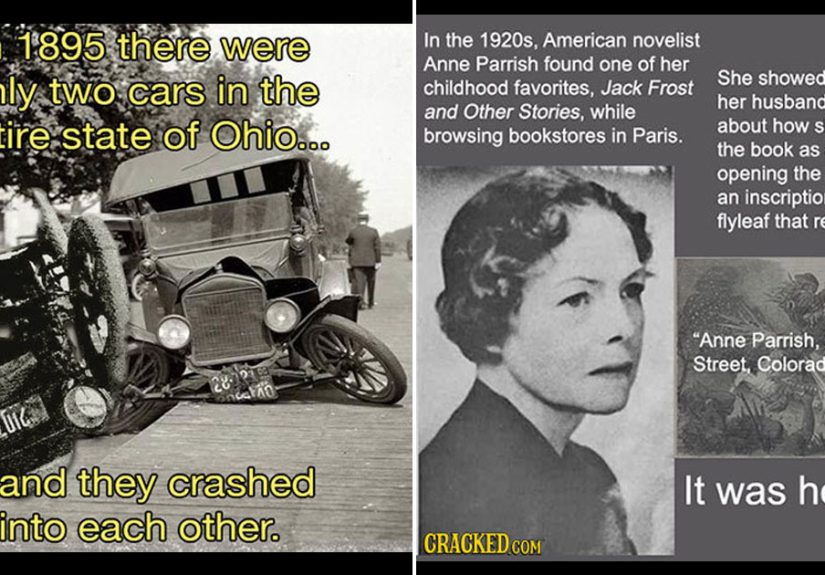
21. Anne Parrish found her own lost childhood book in Paris.
American author Anne Parrish spotted a beloved children’s book at a Paris stall along the Seine and bought it out of nostalgia. When it was opened, it turned out to be her exact childhood copy, complete with her name and old address written inside. If that happened in a novel, readers would accuse the author of showing off.
22. Edgar Allan Poe invented a doomed Richard Parker before history did.
In Poe’s novel The Narrative of Arthur Gordon Pym of Nantucket, shipwrecked sailors kill and eat a cabin boy named Richard Parker. Decades later, after the real yacht Mignonette sank, desperate survivors killed and ate the real cabin boy. His name was also Richard Parker. That is not “hmm, interesting” weird. That is “absolutely not” weird.
23. Bell and Elisha Gray filed rival telephone claims within hours of each other.
On February 14, 1876, Alexander Graham Bell filed his telephone patent application. Just hours later, Elisha Gray filed a caveat for a very similar idea. The race to invent the telephone was not just close. It was close enough to make intellectual history feel like a photo finish.
24. Darwin and Wallace independently arrived at natural selection.
Charles Darwin spent years developing his theory, only to receive a paper from Alfred Russel Wallace laying out a strikingly similar idea. Two naturalists, working separately, reached nearly the same revolutionary conclusion. Sometimes coincidence does not repeat people. It repeats insight.
25. Newton and Leibniz independently developed calculus.
Another case of parallel genius: Isaac Newton and Gottfried Wilhelm Leibniz both developed calculus independently. The feud over credit became legendary, but the deeper story is even strangertwo minds, in different places, arriving at mathematics that would change science forever.
26. The Great Chicago Fire and the Peshtigo Fire erupted on the same night.
October 8, 1871 is remembered for the Great Chicago Fire, but on that same night the deadlier Peshtigo Fire tore through Wisconsin. One disaster became famous; the other killed far more people. The overlap is one of those historical coincidences that shows how attention and reality are not always close friends.
27. The Great Fires of 1871 were not just one blaze or even two.
The Upper Midwest saw multiple major fires burning in the same period, which makes the Chicago-Peshtigo overlap even more unsettling. Sometimes coincidence is not one strange event. It is a cluster, a swarm, a whole weather system of terrible timing.
28. A fake Carmania ran into the real Carmania.
During World War I, the German ship Cap Trafalgar was disguised to resemble the British liner Carmania. Then, in a twist too on-the-nose for fiction, the disguised vessel ended up battling the actual Carmania. This is less “history” and more “history winking at the camera.”
29. On the day of Edwin Booth’s funeral, Ford’s Theatre collapsed.
Edwin Booth, the brother who saved Robert Lincoln, died in 1893. On the day of his funeral, Ford’s Theatrethe site of Lincoln’s assassinationcollapsed, killing 22 people. By the end of this chain of connections, coincidence is no longer walking. It is tap dancing in steel-toed boots.
So, Do Coincidences Mean Anything?
Usually, the safest answer is: not in the supernatural sense people often hope for. Strange coincidences do not automatically prove fate, hidden design, or secret forces behind the curtain. What they do prove is that the world produces enormous amounts of information, and the human brain is very, very good at noticing the moments that rhyme.
But brushing coincidences off as “just randomness” can also miss the point. Their power is not only in whether they reveal a cosmic plan. Their power is in how they expose the drama hidden inside ordinary probability. They remind us that reality is not neat, life is not linear, and history often behaves like a pile of dominoes knocked over by an unseen comedian.
In other words, coincidences matter even when they do not mean what we first think they mean. They matter because they reveal how memory works, how stories form, how patterns grip us, and how human beings create meaning from the chaos. That is not magic, exactly. But it is close enough to feel electric.
What It Feels Like When Coincidences Crash Into Real Life
Here is the part that makes the topic stick: almost everyone has experienced some tiny, unsettling version of this. You think about an old friend for the first time in years, and then your phone lights up with their name. You mention a bizarre word at lunch, and suddenly it appears three more times before dinner. You travel to another city, meet a total stranger, and discover you grew up ten minutes apart, shared a teacher, or know the same person from college. Nothing supernatural has happened, and yet your day has acquired a weird electrical charge.
That charge is hard to explain to anyone who was not there. On paper, the event often looks ordinary. In the moment, though, it can feel like reality leaned across the table and tapped your glass. Coincidences seem to make the world smaller and stranger at the same time. They collapse distance. They yank unrelated moments together. They make random life events feel like they were stitched with invisible thread.
Part of the thrill comes from speed. Most of life feels slow and messy. Cause and effect usually arrive late, if they arrive at all. Coincidences are different. They happen with unnerving neatness. The setup and payoff are suddenly side by side, like a joke that tells itself. That is why even skeptical people remember them so vividly. The brain loves surprise, but it absolutely throws a party for surprise with pattern.
There is also something deeply emotional about coincidences because they often arrive when people are already vulnerableduring grief, transition, uncertainty, travel, heartbreak, or major decisions. A repeated number, a perfectly timed song lyric, a strange reunion, or an improbable overlap can feel enormous because the mind is already searching for structure. When life is confusing, pattern feels like relief. Even if we know, intellectually, that not every coincidence carries a message, the emotional effect can still be real. Sometimes it comforts us. Sometimes it rattles us. Sometimes it just makes us laugh because the timing is so absurd.
And honestly, that may be the healthiest way to meet the subject. Not with blind belief. Not with cynical eye-rolling. Just with curiosity. Coincidences do not have to prove destiny to be worth enjoying. They do not need to rewrite science to make a dinner conversation unforgettable. They are one of the clearest reminders that the world is larger, busier, and less predictable than our tidy daily routines suggest.
So when a coincidence lands in your own lifesmall or spectacularit is okay to pause. It is okay to feel a little goosebump moment. It is okay to tell the story three times in one day like you have been hired by your own publicity team. That is part of the experience too. Coincidences are not just events; they are story generators. They turn people into witnesses, witnesses into narrators, and regular afternoons into something with a pulse.
Maybe that is why we keep collecting them. Not because every eerie coincidence is proof of fate, but because each one briefly makes the world feel more connected than it did five minutes earlier. And in a life that can often feel random, rushed, and fragmented, that sensation is powerful. Even when the explanation is probability, the experience still feels like wonder. Sometimes that is enough. Sometimes that is more than enough.
Final Thoughts
The best coincidences do not just surprise us. They expose the strange seam where statistics, memory, emotion, and storytelling all meet. They can be tragic, funny, poetic, or downright creepy. They can remind us that history is full of real events more unbelievable than fiction. And they can make even the most rational person glance at the ceiling for a second, as if reality itself might owe us an explanation.
It probably does not. But it definitely owes us a good story. And these 29 coincidences deliver exactly that.