Table of Contents >> Show >> Hide
- The Vacation Drama In Plain English
- Was This “Excluding” HimOr Did He Exclude Himself?
- Why This Fight Happens In So Many Families
- The Real Lesson: Boundaries Aren’t MeanThey’re Maintenance
- How To Prevent This Exact Situation Next Time
- If You’re The Planner Sibling, Here Are Scripts You Can Steal
- If You’re The “Late Decider,” Here’s How To Fix It Without Blowing Up The Family
- If You’re The Parents In The Middle, Here’s The Balance
- So… Did She Teach A Life Lesson?
- of Relatable Family Vacation Experiences (Because This Happens Everywhere)
Planning a family vacation sounds wholesomeuntil you remember that family vacations are basically a group project with
emotions, money, and at least one person who “just needs a little more time to decide.” Add airline prices that change
faster than a toddler’s mood, and you’ve got the recipe for a blow-up that doesn’t even wait for the suitcase to zip.
In one viral scenario, a woman tried to do something genuinely sweet: organize a trip so her parents could enjoy a getaway,
with the adult siblings splitting costs fairly. The younger brother was on board. The older brother? He treated “yes or no”
like a philosophical debateand then acted shocked when the consequences arrived with a price tag.
The Vacation Drama In Plain English
Here’s the situation, simplified: a 29-year-old woman planned a family vacation well in advance. The idea was straightforward:
each sibling pays their own way, and the siblings also split the parents’ costs as a gift. Everyone involved is an adult, and
the brothers have stable jobsso this wasn’t a “nobody can afford it” crisis. It was a “somebody doesn’t want to commit”
crisis.
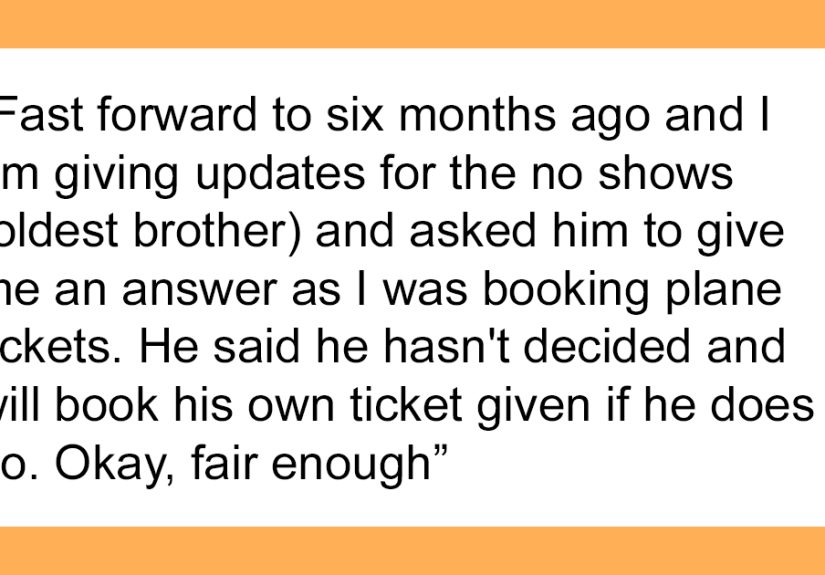
Over many months, the older brother kept floating excuses: maybe he’d be busy, maybe it was too expensive, maybe he’d decide
later. The planner repeatedly asked for a clear answer because, shockingly, plane tickets are not sold on the “whenever you
feel like it” schedule. Eventually she set a final deadline, got no real commitment, and counted him as a no.
Thenright before the tripthe older brother suddenly decided he was going after all… but only after everyone else had
already booked. When he learned that late changes would raise his share (because last-minute travel typically costs more),
he got angry, blamed the planner, and complained it “wasn’t fair.”
The parents felt bad and offered to pay for him. The planner refused, arguing the trip was meant as a gift for the parents,
and bailing out an adult who ignored months of check-ins would just reward the same behavior again.
Was This “Excluding” HimOr Did He Exclude Himself?
Words matter, especially in families. “You excluded me” sounds like someone slammed a door in your face. But in group travel,
there’s a big difference between exclusion and non-participation.
If a trip requires deposits, reservations, and shared costs, the “ticket” into the group isn’t just your presenceit’s your
commitment. When someone repeatedly refuses to give a yes or no, what they’re really doing is pushing the risk onto everyone
else: “You plan it. You stress. You lock in prices. And if it works for me later, I’ll jump in.”
That might feel harmless to the person doing it. To everyone else, it’s like being asked to hold a place in lineforeverwhile
someone wanders off to browse the snack aisle. Eventually, the line moves. And if you’re not there, you’re not “excluded.”
You’re just… not in line anymore.
Why This Fight Happens In So Many Families
1) Indecision Costs Real Money
Airfare, hotels, and group reservations reward early decisions. Waiting can mean fewer options, worse flight times, and higher
costsespecially if you’re trying to coordinate multiple people. The “I’ll decide later” approach often quietly transfers the
financial penalty to the group.
In this scenario, the older brother wanted the benefits of early planning without doing the one thing early planning requires:
committing. When he finally decided yes, he expected the group to absorb the difference. That’s not a travel strategythat’s a
social tax.
2) “Family Helps Family” Can Turn Into “Family Enables Family”
Plenty of families have a default setting: keep the peace at all costs. If one adult child throws a tantrum, someone else pays,
apologizes, or smooths it over. It feels kind in the momentuntil it becomes a pattern where the responsible siblings fund the
consequences of the irresponsible one.
The planner’s biggest challenge wasn’t even her brother’s refusal to commit. It was the emotional pressure that followed:
parents feeling guilty, the family wanting harmony, and the unspoken message that the easiest solution is for the most reliable
person to do more.
3) The “Oldest Sibling” Dynamic Can Get Weird
Sometimes the oldest sibling grows up with an invisible crown: the family expects them to be mature and responsible… but also
gives them extra leeway because “that’s just how they are.” That combination can create a perfect storm: entitlement plus a
safety net.
When the older brother complained about fairness, what he seemed to want was not equal treatment. He wanted special treatment
that still felt “fair” to himmeaning he didn’t want to pay extra for his delay, and he didn’t want to be told no.
The Real Lesson: Boundaries Aren’t MeanThey’re Maintenance
A boundary isn’t a punishment. It’s a rule that protects time, money, and relationships from slowly corroding into resentment.
In family settings, boundaries are also the difference between a vacation and a traveling stress conference.
In healthy families, boundaries sound like: “We’d love for you to come, but we need an answer by Friday because we’re booking.”
In unhealthy families, boundaries get treated like betrayal: “How could you do this to us?”
Here’s the uncomfortable truth: if your boundary makes someone furious, it often means the boundary is blocking a benefit they
were getting from your flexibility.
How To Prevent This Exact Situation Next Time
Use a “Commitment Ladder,” Not Endless Check-Ins
Instead of asking “Are you going?” fifteen times, build a simple ladder:
- Step 1 (Interest): “We’re planning this trip. Reply by X date if you want in.”
- Step 2 (Deposit): “To hold your spot, send your share of the deposit by Y date.”
- Step 3 (Final Payment): “Remaining balance due by Z date. No payment = not booked.”
The ladder removes ambiguity. It turns “maybe” into a concrete choice: commit or opt out.
Split Costs Upfront (Or Don’t Split Them At All)
If you’re covering parents as a gift, make the split crystal clear early. And decide whether the parents’ portion is divided
equally among confirmed travelers. This matters because “Mom and Dad will pay for him” can quietly become “you and your brother
will pay for him,” especially if the gift budget is fixed.
A practical approach: once the booking deadline passes, the group’s costs are locked. Anyone joining later pays the difference
for their own changes. Nobody else gets re-billed for someone else’s delay.
Put It In WritingYes, Even If It Feels Too Formal
You don’t need a legal document. You need one message everyone can point back to when emotions flare:
- Trip dates
- What’s included (lodging, flights, activities, parents’ gift portion)
- Deadlines
- Refund/cancellation rules
- What happens if someone joins late
Families often resist “formal” planning because it feels cold. But you know what else feels cold? A group chat full of
passive-aggressive texts and a surprise $400 charge because somebody “wasn’t sure.”
Use Conflict-Reducing Language (Yes, It’s CheesyYes, It Works)
When you set boundaries, skip the character attacks (“You’re stingy,” “You’re impossible,” “You always do this”) and stick to
observable behavior and consequences:
- Try: “We needed a final answer to book tickets, and we didn’t get one.”
- Try: “Prices increased because the booking window passed.”
- Try: “We’re happy you want to come. The current cost is X if you’d like to join.”
- Avoid: “This is your fault and you’re acting like a child.” (Even if it’s true. Especially if it’s true.)
Calm language doesn’t mean you’re weak. It means you’re not giving the other person a new argument to fight about.
If You’re The Planner Sibling, Here Are Scripts You Can Steal
Deadline Script
“Hey! We’re booking flights on Friday. If you’re in, send your yes by Thursday night. If we don’t hear from you, we’ll assume
you’re sitting this one out so we can finalize plans.”
Late Join Script
“Good news: you can still come. The cost is higher now because we’re close to the date. If you want in, your share is $X by
tomorrow so we can lock it in.”
Parents Want To Pay Script
“I know you feel bad. But we gave him multiple deadlines and he didn’t commit. If you pay for him, it teaches him that he
doesn’t have to respect anyone else’s time or money. This trip is supposed to be a gift for you.”
If You’re The “Late Decider,” Here’s How To Fix It Without Blowing Up The Family
- Own the delay: “I should’ve decided earlier. That’s on me.”
- Accept the premium: Late booking often costs more. Paying more is the natural consequence, not a personal attack.
- Stop recruiting allies: Calling parents to pressure siblings turns a logistics issue into a loyalty test.
- Offer a compromise that doesn’t punish others: “I’ll cover my higher flight. Can I still join lodging and activities?”
The fastest way to make everyone defensive is blaming the planner for your own non-commitment. The fastest way to rebuild trust
is acting like an adult who understands cause and effect.
If You’re The Parents In The Middle, Here’s The Balance
Parents often hate the idea of “leaving someone behind.” But there’s a crucial difference between compassion and rescue.
- Compassion: “We’re sad you can’t make it. We hope you can join next time.”
- Rescue: “Don’t worry, we’ll pay so you don’t have to face the consequences of waiting.”
If parents consistently pay when an adult child throws a fit, it can create two long-term problems: the entitled child keeps
expecting bailouts, and the other siblings build quiet resentment that eventually erupts at the worst possible momentlike, say,
while everyone is trapped together in a rental car.
So… Did She Teach A Life Lesson?
Whether the older brother learns anything depends on what happens next. If the family caves and pays, the lesson becomes:
“If I wait long enough and complain loudly enough, the system bends for me.” If the boundary holds, the lesson becomes:
“Decisions have deadlines, and relationships run on mutual respect.”
The planner didn’t “exclude” him for fun. She enforced the basic rule that makes group travel possible: commitment is part of
participation. You can’t RSVP with vibes.
And honestly? That’s not just a vacation lesson. That’s an adulthood lessonserved with a side of boarding pass.
of Relatable Family Vacation Experiences (Because This Happens Everywhere)
If you’ve ever tried to organize a family trip, you already know the hidden truth: vacations don’t start at the airport.
They start in the group chatwhere one person becomes the unofficial travel agent, one person becomes the budget detective,
and one person becomes mysteriously allergic to answering a simple question.
One common experience is the “I’ll book later” family member who treats planning like a suggestion. Everyone else locks in
flights, coordinates time off, and picks accommodations that work for the group. Meanwhile, the late decider floats in with
“I’m still figuring things out,” as if plane seats regenerate like video game health bars. Then, when prices spike, they act
personally betrayed by the concept of supply and demand. The real tension isn’t the moneyit’s the assumption that the group
should absorb the chaos so they don’t have to feel uncomfortable.
Another classic: the “parents as peacekeepers” moment. The trip is supposed to be fun, but parents hear “He can’t afford it”
and their instincts fire: fix it, pay, smooth it over. It’s lovingand it’s also how patterns get reinforced. Siblings who
plan ahead start to feel like the responsible ones are being penalized while the loudest complainer gets rescued. Over time,
that turns into a weird family economy where responsibility is taxed and indecision is subsidized.
You also see the “fairness debate” pop up in surprising places. Someone wants the best bedroom because they’re older. Someone
wants the cheapest option but also wants the most expensive activities. Someone insists the itinerary stay flexible, but then
gets mad when the group doesn’t magically align with their last-minute preferences. Most of these fights aren’t actually about
bedrooms, excursions, or flightsthey’re about control, recognition, and whose needs get prioritized without question.
The best group trips usually share one thing: clear expectations that are stated early and enforced calmly. People know the
deadlines. They know what’s split and what’s separate. They know what happens if they join late. And they know that “family”
isn’t a magic word that cancels consequences. When boundaries are clear, everyone relaxesbecause the trip isn’t being held
hostage by one person’s indecision.
In the end, a “life lesson” doesn’t have to be dramatic. Sometimes it’s simply letting reality do its job. If you want the
group benefitsbetter prices, better options, smoother logisticsyou also accept the group rules. And if you opt out until the
last minute, you don’t get to be shocked that the world didn’t wait.