Table of Contents >> Show >> Hide
- What Does “Doi Doi Doi” Mean?
- Where Did “Doi Doi Doi” Come From?
- How the “Doi Doi Doi” TikTok Trend Works
- Is “Doi Doi Doi” an Insult?
- Why Is “Doi Doi Doi” So Popular?
- How to Use “Doi Doi Doi” in a Sentence
- “Doi Doi Doi” vs. “Doy Doy Doy”: Which Spelling Is Correct?
- Is “Doi Doi Doi” Related to “Girl Girl Girl”?
- What Parents Should Know About the Trend
- What “Doi Doi Doi” Says About Modern Slang
- Is “Doi Doi Doi” Still Popular?
- Experience Section: Living Through the “Doi Doi Doi” Era
- Conclusion
“Doi doi doi” is one of those internet phrases that sounds like a secret password, a broken doorbell, and a middle school lunch table joke all at once. If you have heard someone cup their hand near their mouth, stick up a pinky, and repeat “doi doi doi” in a silly voice, congratulations: you have encountered one of TikTok’s most gloriously pointless trends.
So, what does “doi doi doi” mean in slang and on TikTok? The short answer: it usually does not have a deep meaning. It is a goofy sound effect, a meme phrase, and a revived hand-and-mouth trick that people use to act silly, exaggerate confusion, mock dramatic moments, or simply join a viral joke. Think of it as the internet’s way of saying, “There is no serious thought here, only vibes.”
The longer answer is more interesting. “Doi doi doi” connects modern TikTok humor, Gen Alpha classroom slang, streamer culture, older playground jokes from the 1990s and early 2000s, and the internet’s endless talent for turning nonsense into a full-time social event. Let’s unpack the trend without over-explaining it so much that it files for retirement.
What Does “Doi Doi Doi” Mean?
In slang, “doi doi doi” is a nonsense phrase used as a funny sound. It is not a traditional word with a dictionary definition. It works more like an audio gag, similar to “blah blah blah,” “wah wah,” “derp,” or a cartoonish noise people make when something feels ridiculous.
On TikTok, “doi doi doi” is often used in videos where someone is acting clueless, chaotic, overly confident, awkward, or unserious. The phrase can also be used as a reaction when a situation is so silly that normal words feel too emotionally responsible.
Simple Meaning
If someone says “doi doi doi,” they probably mean one of these:
- “I’m being goofy.”
- “This moment is dumb in a funny way.”
- “I’m copying a viral TikTok sound.”
- “I have chosen nonsense over explanation.”
- “Please do not ask me to be serious right now.”
That is the beauty of it. The phrase does not need a full meaning to be useful. In meme language, sometimes the joke is the lack of meaning. The internet loves a sound that walks into the room, knocks over a lamp, and refuses to elaborate.
Where Did “Doi Doi Doi” Come From?
The modern TikTok version of “doi doi doi” became widely associated with streamer Kai Cenat. During a viral livestream moment involving Howie Mandel and a talent-show-style setup, Cenat performed a funny sound through his hand, and the result came out like “doi, doi, doi.” Clips of that moment spread across TikTok, YouTube, X, meme pages, and reaction videos.
But here is where things get fun: many millennials and older internet users quickly pointed out that the hand gesture itself was not brand-new. A similar trick existed on playgrounds and in classrooms during the 1990s and early 2000s. Kids would cup a hand around the mouth, raise the pinky, and repeat a word or sound quickly until it became distorted and funny. Some people remember versions that sounded like “girl girl girl,” “boy boy boy,” or other strange vocal effects.
In other words, TikTok did not invent “doi doi doi.” TikTok did what TikTok does best: found an old silly thing, put it under bright lights, gave it a remix, and acted like it had discovered electricity.
How the “Doi Doi Doi” TikTok Trend Works
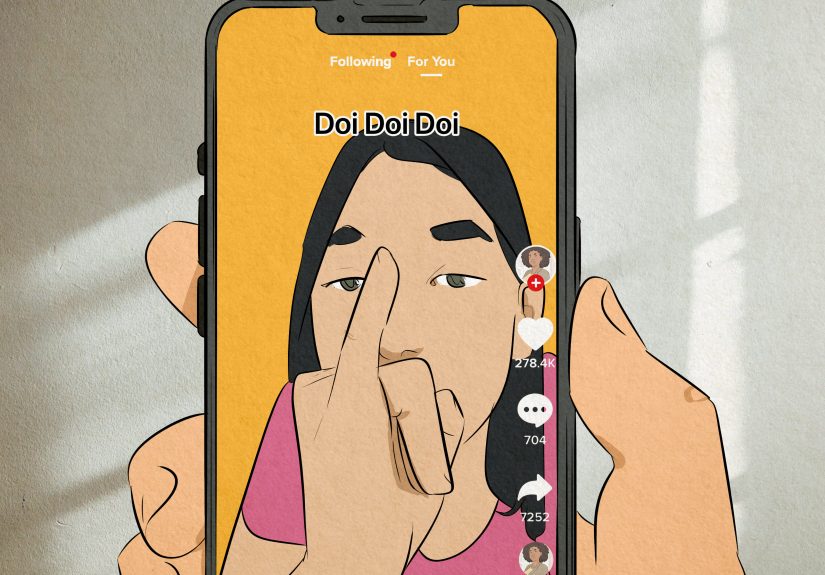
The trend usually has two parts: the sound and the gesture. The sound is the repeated “doi doi doi” phrase, usually delivered in a nasal, muffled, intentionally goofy voice. The gesture often involves placing a hand near the mouth, almost like pretending to hold an invisible tiny microphone, with the pinky sticking up.
People use it in different ways depending on the video. Some creators copy the original Kai Cenat-style moment. Others use the sound as background audio for memes. Some kids do it in school because it is easy, repeatable, and perfectly designed to annoy adults within three seconds. That is not a criticism. That is basically the job description of school slang.
Common TikTok Uses
You might see “doi doi doi” used in videos like these:
- A creator pretends to perform a “talent” that is obviously ridiculous.
- Someone reacts to a friend making a questionable decision.
- A video shows a person confidently failing at something simple.
- Students repeat the sound in class, hallways, or group chats.
- A meme uses the audio to make a normal moment feel absurd.
For example, imagine someone tries to push a door clearly labeled “PULL.” Instead of adding dramatic music, a creator might overlay “doi doi doi.” The joke is not that the person is terrible at doors. The joke is that the moment has been transformed into cartoon-level silliness.
Is “Doi Doi Doi” an Insult?
Usually, no. “Doi doi doi” is not automatically an insult. Most of the time, it is just a playful meme sound. However, like many slang phrases, tone and context matter.
If someone uses it to laugh with friends, it is probably harmless. If someone uses it to mock a person who made a mistake, it can feel rude. The phrase itself is not deeply offensive, but people can turn nearly anything into teasing if they aim it at someone in a mean way. A rubber duck is adorable until someone throws it at your head.
In general, “doi doi doi” is best understood as silly, not hateful. It belongs more to the family of nonsense memes than serious insults.
Why Is “Doi Doi Doi” So Popular?
The popularity of “doi doi doi” comes from a perfect mix of simplicity, repeatability, and absurdity. Viral slang works best when it is easy to copy. You do not need editing skills, a costume, a dance routine, or a ring light that costs more than your desk. You just need a hand, a mouth, and the willingness to sound like a cartoon pigeon with Wi-Fi.
1. It Is Easy to Imitate
Great memes are portable. “Doi doi doi” can be done at home, at school, in a group chat, during a video, or while annoying a sibling who is trying to eat cereal in peace. Because the barrier to entry is low, more people participate.
2. It Sounds Funny Without Context
Some jokes require background knowledge. “Doi doi doi” does not. Even if you have never seen the original clip, the sound itself is ridiculous enough to work. It is basically slapstick comedy in syllable form.
3. It Fits TikTok’s Meme Culture
TikTok trends often move fast because users remix sounds, gestures, and captions. A single clip can become a reaction format, then a classroom phrase, then a family complaint, then a parenting article, then a thing everyone claims they hated from the beginning. This is the circle of meme life. Somewhere, a digital lion is holding up a tiny viral sound.
4. It Has Nostalgia Power
For millennials, the trend feels familiar. Many remember doing similar hand-mouth tricks years ago. That gives “doi doi doi” two audiences at once: younger users who think it is fresh and older users who remember it from school days. When a trend can make one generation laugh and another generation say, “Wait, we did that first,” it has strong staying power.
How to Use “Doi Doi Doi” in a Sentence
Because “doi doi doi” is more of a sound than a normal phrase, it works best as a reaction. You probably would not use it in a formal email unless your goal is to be remembered by HR forever.
Examples
- “He dropped his phone, picked it up, then dropped it again. Doi doi doi.”
- “My little brother has been doing the doi doi doi thing all week.”
- “That TikTok with the dog missing the treat? Perfect doi doi doi energy.”
- “She walked into the wrong classroom and just went ‘doi doi doi’ like nothing happened.”
- “The group chat is now 70 percent homework questions and 30 percent doi doi doi.”
Notice that the phrase is flexible. It can describe a sound, a trend, a mood, or a type of unserious behavior. It is less about grammar and more about comedic timing.
“Doi Doi Doi” vs. “Doy Doy Doy”: Which Spelling Is Correct?
You may see people spell it as “doi doi doi” or “doy doy doy.” Both spellings refer to the same general sound. “Doi” is common in meme captions and trend explainers, while “doy” may appear when people write the sound phonetically.
There is no official spelling committee for nonsense TikTok noises. If there were, meetings would be loud and extremely unproductive. For SEO and search purposes, “doi doi doi” is the version most people are likely to search, especially when looking for the TikTok trend.
Is “Doi Doi Doi” Related to “Girl Girl Girl”?
Yes, in many versions of the trend, “doi doi doi” is connected to a similar hand-mouth sound where people say something like “girl girl girl” very quickly. Depending on how the mouth is shaped and how the hand muffles the voice, the phrase can come out sounding distorted, buzzy, or funny.
This is part of why older users recognized the trend. The modern “doi doi doi” meme may have gone viral through streamer culture, but the vocal trick has playground roots. It is the kind of thing kids pass around without needing a manual. One person does it, another person tries it, three people fail, and suddenly the entire cafeteria sounds like a malfunctioning kazoo orchestra.
What Parents Should Know About the Trend
For parents, “doi doi doi” may sound like another mysterious Gen Alpha code. Fortunately, this one is usually harmless. It is not a secret dangerous phrase, and it is not a hidden adult acronym. It is mostly a noisy joke.
The bigger issue is repetition. A sound that is funny once can become slightly less magical after the 400th performance from the back seat of a car. Parents and teachers are not confused because the phrase is complex. They are confused because children have discovered a sound with unlimited replay value.
Should Adults Worry?
In most cases, no. The trend is silly, not serious. Adults may want to step in only if the sound is being used to mock someone, disrupt class, or create a situation where nobody can focus. Otherwise, it is just another short-lived internet joke passing through the cultural airport with one tiny suitcase.
What “Doi Doi Doi” Says About Modern Slang
The rise of “doi doi doi” shows how slang has changed in the TikTok era. Slang used to spread mostly through neighborhoods, schools, music, television, and movies. Now a streamer’s random moment can become a global inside joke in days. The phrase does not need to be logical. It only needs to be recognizable.
Modern slang is often audiovisual. It is not just about words; it is about the face, the hand motion, the tone, the clip, the caption, and the remix. “Doi doi doi” is hard to explain fully in plain text because the meaning lives in performance. Reading it is one thing. Hearing someone do it while making a dramatic little hand gesture is the full cinematic experience.
This is why some adults feel lost when trying to decode TikTok slang. They are looking for a definition, but the definition is often “the sound from that video, used in the same emotional flavor.” It is less like a vocabulary word and more like a meme costume people put on for a moment.
Is “Doi Doi Doi” Still Popular?
Like many TikTok trends, “doi doi doi” may rise quickly, peak loudly, and then slowly fade as the internet sprints toward the next strange noise. However, because the gesture has older roots, it may return again in the future. Playground jokes are surprisingly durable. They disappear for years, then come back wearing a new hoodie and pretending they were never gone.
Even if the exact trend loses momentum, the phrase will likely remain searchable because people keep encountering old clips, reaction videos, meme compilations, and classmates who refuse to let the sound rest peacefully.
Experience Section: Living Through the “Doi Doi Doi” Era
Experiencing the “doi doi doi” trend in real life is different from simply reading about it. Online, it looks like a quick joke. Offline, it becomes a social signal. Someone does the sound, another person recognizes it, and suddenly there is a tiny shared moment of “you know this too?” That is one reason trends like this spread so easily. They create instant membership in a joke that requires almost no explanation.
For students, “doi doi doi” can become a quick way to break tension. A classmate makes a dramatic entrance after being late, someone quietly does the sound, and half the room understands the reference. A friend misses an easy shot in basketball, drops a pencil twice, or sends a message to the wrong group chat, and “doi doi doi” becomes the soundtrack. It is not always elegant, but neither is adolescence. Comedy at that age is often built from repetition, timing, and the joy of being mildly irritating.
For parents, the experience is usually more complicated. At first, they ask, “What does that mean?” Then, after hearing it all weekend, they ask, “Can it mean silence?” This is the natural life cycle of youth slang inside a household. A phrase enters as a mystery, becomes an explanation, turns into background noise, and eventually gets banned from the dinner table. The funny part is that many adults later realize they did similar things when they were young. Maybe it was a playground chant, a TV catchphrase, a weird voice, or a joke that made absolutely no sense outside their friend group.
For content creators, the trend is a reminder that not every successful video needs a polished idea. Sometimes the most shareable content is simple, strange, and instantly repeatable. A creator can use “doi doi doi” as a reaction sound, a punchline, or a way to make a normal moment feel absurd. The best uses are usually short. When a nonsense trend is stretched too long, it loses sparkle fast. A little “doi doi doi” is seasoning; too much is like pouring the whole salt shaker into soup and calling it personality.
From an SEO and culture-writing perspective, “doi doi doi” is also a perfect example of why internet language cannot always be explained like traditional vocabulary. The phrase does not mean “happy,” “confused,” or “embarrassed” in a strict sense. It means whatever the clip, tone, and social context make it mean. It is a flexible meme sound that can point to silliness, awkwardness, fake talent, playful failure, or group humor.
The best way to understand it is to see it as a tiny performance. The hand gesture matters. The voice matters. The timing matters. Without those pieces, “doi doi doi” looks like someone fell asleep on a keyboard with only three letters available. With those pieces, it becomes a joke people recognize immediately.
And honestly, that is the charm. The internet can be serious, stressful, and overloaded with opinions. Then along comes a phrase like “doi doi doi,” asking nothing from us except a laugh and possibly a little patience. It is silly. It is repetitive. It is probably annoying if you hear it too many times. But it is also a reminder that online culture is not always about deep meaning. Sometimes it is just about making a ridiculous sound with your hand near your mouth and letting the world be goofy for five seconds.
Conclusion
“Doi doi doi” means a playful, nonsense sound used in TikTok videos, memes, and real-life joking. It became popular through viral streamer and TikTok culture, especially connected to Kai Cenat’s “doi doi doi” moment, while also echoing older playground-style hand-mouth tricks from the 1990s and 2000s.
The phrase is not usually an insult, not a secret code, and not a complicated slang term. It is a sound-based meme used to express silliness, confusion, fake talent, awkward timing, or unserious energy. Its popularity proves that internet humor does not always need a plot. Sometimes all it needs is three repeated syllables and a generation willing to run with them.
So the next time you hear “doi doi doi,” do not panic. You are not missing a complex cultural thesis. You are simply witnessing another moment in the grand tradition of people being weird together online. And really, that might be the most human trend of all.