Table of Contents >> Show >> Hide
- The Interview Moment That Sent Everyone Into Detective Mode
- Why One Joke About Hollywood Felt A Little Too Real
- Powell Has Already Described Hollywood As A Pressure Cooker
- The Dark Side May Not Be ScandalIt May Be Performance
- His Own PR History Makes The Clip Even More Loaded
- Even Powell’s Other Stories Point To Hollywood’s Optics Game
- So Did He Actually Expose Hollywood’s Dark Side?
- Why This Moment Matters For Glen Powell’s Image
- Experiences Related To The Topic: Why Hollywood Moments Like This Feel So Familiar
- Final Thoughts
Every so often, a celebrity says something that lands with the force of a spit take. Not because it was polished, rehearsed, or delicately approved by a publicist wearing a headset and a brave smile, but because it slipped out sideways, half-joke and half-truth. That is exactly why Glen Powell’s now-viral interview blunder hit such a nerve. One second, he was doing what celebrities do best in the modern age: sweating attractively on camera while promoting a project. The next, he was accidentally stepping into one of Hollywood’s favorite minefields, where a throwaway joke can sound suspiciously like a confession.
The moment was funny. Very funny. But it also carried that extra little spark that makes people sit up straighter and go, “Wait a minute… why did that feel so believable?” Powell’s line about how you “make it in Hollywood,” followed by a quick verbal panic and a “we don’t talk about that,” was delivered like a punch line. Yet for a lot of viewers, it landed like a peek behind the curtain. And in Hollywood, curtains are usually there for a reason.
The Interview Moment That Sent Everyone Into Detective Mode
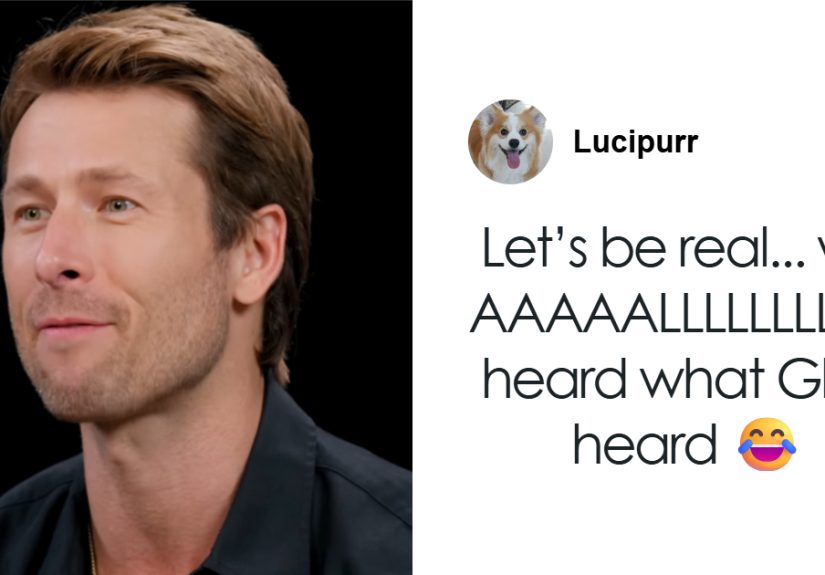
During his chaotic, sweat-soaked appearance on Hot Ones, Powell got tripped up by a simple piece of action-movie jargon. Sean Evans asked him about a “jerk vest,” which is stunt equipment used to yank performers on a wire for impact. Powell, however, heard something much more scandalous. His face changed instantly. He froze, blurted out a confused “I’m sorry, what?!” and then admitted he thought Evans had said “jerk fest.” That misunderstanding derailed the interview in the best possible way.
Then came the line that launched a thousand side-eyes. Laughing through the heat and the absurdity, Powell cracked, “That’s how you make it in Hollywood!” before catching himself and adding, “Oh, s! We don’t talk about that!” On paper, it reads like a comedian’s riff. On camera, it felt more like an actor briefly opening the wrong file in his brain and realizing the audience could see it.
That is why the clip spread so quickly. It was not just a handsome movie star losing the battle against hot sauce and double entendres. It was a rare moment of visible unscripted panic in an industry built on script control. And the internet, being the internet, immediately treated it like a Rosetta Stone for every cynical theory people have ever had about celebrity culture.
Why One Joke About Hollywood Felt A Little Too Real
To be fair, Powell did not expose a specific conspiracy. He did not name names, point fingers, or reveal some secret initiation ritual involving dim lighting and a suspiciously enthusiastic producer. But jokes do not become viral cultural moments unless they connect with something people already suspect. In this case, the suspicion is simple: Hollywood runs on things people say out loud and things people absolutely do not say out loud.
That is the real reason the clip resonated. Viewers were not responding only to a misheard phrase. They were reacting to the way Powell’s joke seemed to summarize, in one messy little burst, the transactional reputation of the entertainment business. The audience has heard for years about networking, packaging, “heat,” buzz, optics, chemistry, rebranding, strategic relationships, and carefully choreographed spontaneity. Powell’s comment sounded like it belonged in that universe.
In other words, the line worked because it fit the mythology. Hollywood has always been sold as a dream factory, but it also has a long-standing reputation as a place where ambition gets translated into coded language. People rarely say, “This industry is obsessed with visibility, leverage, and performance in every sense of the word.” They say, “It’s all part of the business.” Powell’s blunder was funny because it briefly skipped the code and went straight to the subtext.
Powell Has Already Described Hollywood As A Pressure Cooker
What makes this moment more interesting is that Powell himself has been unusually candid about the machinery surrounding fame. In past interviews, he has described struggling in Hollywood as emotionally brutal. He has talked about the town treating relevance like currency, making actors “oppressively self-aware,” and creating an atmosphere where even getting an audition can feel luxurious. That is not the language of a guy who thinks Hollywood is just lights, smiles, and a flattering press portrait.
He has also spoken about the roulette-wheel effect of the business. You keep spinning because you want to stay at the table. You hustle for parts, connections, introductions, meetings, and whatever sliver of opportunity can get you closer to the velvet rope. That kind of environment does something to people. It teaches them to self-edit. It teaches them to read rooms. It teaches them that sometimes what matters most is not whether something is true, but whether it plays well from across the room.
That larger context is what turns a silly interview mistake into a more revealing cultural moment. When Powell jokes that something unsavory is “how you make it in Hollywood,” people are not hearing a random quip from a random celebrity. They are hearing it from someone who has openly described Hollywood as a place where status, access, and perception are always humming in the background like a very expensive air conditioner.
The Dark Side May Not Be ScandalIt May Be Performance
Here is where the conversation gets more interesting. The “dark side of Hollywood” is often imagined as something explosive: scandal, abuse, betrayal, backroom manipulation, giant egos in tiny chairs. Those things certainly exist in entertainment lore. But Powell’s viral line points toward a darker truth that is less cinematic and maybe more unsettling: the exhausting requirement to perform all the time.
Not just onscreen. Everywhere.
In Hollywood, a red carpet is a performance. A panel is a performance. A magazine profile is a performance. A party photo is a performance. A flirty press-tour exchange is a performance. Even trying to appear like you are not performing can become its own performance. Powell has hinted at exactly this kind of pressure, especially when he talked about not wanting life to feel like one long press tour or to become “a derivative” of himself. That line says a lot. The fear is not merely being famous. The fear is becoming a character version of yourself because the market likes that version better.
That is the part of Hollywood many fans intuitively understand now. The public is more media-literate than ever. People know when chemistry is being sold, when spontaneity feels suspiciously well-lit, and when an interview answer has been polished until it shines like a rental tuxedo. So when Powell accidentally made a joke that sounded like a blunt summary of career advancement in the industry, people laughedbut they also believed it just enough to keep replaying it.
His Own PR History Makes The Clip Even More Loaded
Powell’s recent career has made him a fascinating spokesperson for this conversation, whether he meant to volunteer or not. On one hand, he has admitted that he and Sydney Sweeney leaned into audience fascination with their chemistry while promoting Anyone But You. He framed it as part of selling a romantic comedy, arguing that fun and chemistry matter and that audiences often want what they see onscreen to spill offscreen too. In pure movie-marketing terms, that is not shocking. It is savvy.
On the other hand, Powell has also said the earlier rumor frenzy around him and Sweeney felt “disorienting and unfair.” That tension is the whole story in miniature. Celebrity publicity is no longer just about promoting a film; it is about creating a narrative environment around the film. Stars are expected to be authentic, but only in ways that are useful. They are encouraged to be charmingly open, but not so open that the machine loses control of the plot.
Then things get even murkier. Powell’s ex, Gigi Paris, later described feeling humiliated by the public swirl and said she felt “fed to the dogs,” characterizing the situation as PR that came at the expense of a real relationship. Whether one takes that framing as definitive or not, it shows how blurry the line has become between promotion and private life. A movie can be marketed with a wink. A rumor can be strategically tolerated. A narrative can be “part of the business.” But the emotional fallout is still real for the people inside it.
That is why the Hot Ones joke lingers. It did not emerge in a vacuum. It came from an actor who has already lived through the weird modern collision of fame, internet speculation, strategic chemistry, and public image maintenance. So when he jokingly implied there are certain truths about Hollywood that “we don’t talk about,” people were primed to hear it as more than a bit.
Even Powell’s Other Stories Point To Hollywood’s Optics Game
Powell has also told stories that underline how intensely image management shapes celebrity behavior. In one later anecdote, he described meeting a “recently canceled” celebrity at a Hollywood party and refusing a photo because he realized the person’s “face is toxic.” That phrasing is brutal, but it is also revealing. The problem was not simply personal discomfort. It was optics. The wrong picture, at the wrong time, with the wrong person, can become a public statement whether you intended one or not.
Welcome to Hollywood in the social-media era: a place where every pose can imply allegiance, every joke can become a headline, and every public interaction gets filtered through risk assessment. That is not evil in the comic-book sense. But it is undeniably dark in a psychological sense. It turns ordinary human interaction into brand calculus. Smile here, step away there, flirt a little, deny a lot, never blink on camera.
Seen through that lens, Powell’s blunder almost feels like the accidental thesis statement of his fame era. He is charismatic enough to sell the fantasy, self-aware enough to describe the machinery, and candid enough to occasionally let the machinery show. That combination is rare. It is also why people keep leaning in when he talks.
So Did He Actually Expose Hollywood’s Dark Side?
Not literally. Not in the courtroom-drama sense. Powell did not crack open a vault and dump confidential files onto a hot sauce table. But culturally? Maybe yes. In a small, sharp, telling way.
What he exposed is the public’s growing belief that Hollywood often operates through soft manipulation rather than dramatic villainy. The business sells chemistry, mystery, reinvention, and aspiration. It rewards hustle and punishes stillness. It invites stars to be “real” while also encouraging them to remain marketable. It offers access, then makes people obsessed with keeping it. And it can make even very successful people feel like they are one bad narrative away from becoming the wrong kind of famous.
Powell’s line became viral not because it proved a secret, but because it sounded like a truth people already half-believed. That is the power of a good blunder. It does not need to be fully intentional. It just needs to brush against something real enough to sting.
Why This Moment Matters For Glen Powell’s Image
Oddly enough, the whole thing may help him. Powell’s appeal has always depended on a mix of old-school movie-star charm and modern self-awareness. He is polished, but not robotic. Handsome, but not humorless. Ambitious, but willing to joke about ambition. In an era when audiences can smell pre-packaged sincerity from a mile away, a messy, hilarious, faintly incriminating soundbite can feel refreshingly human.
That does not mean it is risk-free. In Hollywood, even being “relatable” is dangerous because people may start assuming every joke is a confession and every confession is a strategy. Still, Powell’s viral interview stumble worked because it reminded viewers that beneath the media coaching, actor branding, and franchise calculations, he is still a guy whose brain short-circuited on camera and said the loud part almost all the way out loud.
And maybe that is what made the moment so delicious. It was not perfect. It was not neat. It was not approved by twelve people in a conference room. It was a flash of improvisational honesty dressed up as a dirty joke, which is often the closest Hollywood gets to telling the truth.
Experiences Related To The Topic: Why Hollywood Moments Like This Feel So Familiar
If Powell’s viral blunder felt instantly recognizable, that is because it echoed experiences people have been watching in Hollywood for years. Anyone who has followed a press junket knows the rhythm: the same movie gets promoted in twenty rooms, stars repeat the same charming anecdotes, and every answer has to sound fresh even when it has clearly been road-tested within an inch of its life. The actor is expected to be funny, warm, memorable, and maybe a tiny bit vulnerablebut never so vulnerable that the whole promotional structure wobbles. That balancing act is exhausting, and sometimes the mask slips for a second. When it does, audiences notice.
There is also the social experience of Hollywood itself, which Powell has hinted at in multiple interviews. He has talked about parties where you are sizing up rooms, trying to get inside the velvet rope, figuring out who matters, and understanding that relevance can change overnight. That experience is not unique to him. It is practically an industry rite of passage. A young actor may enter the room hoping for a conversation, a connection, a meeting, or at least a reason to believe the struggle means something. Then suddenly, years later, that same actor is the person others are reading, watching, and trying to photograph. The room is the same, but the stakes feel entirely different.
Then there is the experience of celebrity chemistry as commerce. Hollywood has always sold fantasy, but modern marketing has turned the fantasy into a 24/7 ecosystem. Co-stars banter. Fans speculate. A harmless red-carpet look becomes a headline. A joke in an interview turns into proof of something bigger. The stars may be in on it, halfway in on it, or trying desperately not to be in on it at all. Either way, the audience becomes part of the engine. That is why Powell’s Hot Ones moment felt bigger than a joke: people have seen too many examples of fame being packaged, flirtation being monetized, and “realness” being curated not to hear extra meaning in it.
And finally, there is the personal experience Powell has described of wanting distance from Hollywood altogether. His comments about Texas, family, and the need to unplug suggest the industry can create a strange emotional static, where every public move feels slightly presentational. That is an experience many stars hint at but do not define so plainly. Once life starts feeling like content, once dinners feel like networking opportunities, once your own personality begins to risk becoming a brand asset, the joke stops being only a joke. It becomes a release valve. That is probably why Powell laughed so hard after the blunder. Sometimes the funniest line in the room is the one that gets dangerously close to the truth.
Final Thoughts
Glen Powell’s viral interview blunder was hilarious on the surface, but it stuck around because it tapped into something deeper than a dirty misunderstanding. His “we don’t talk about that” line captured the strange tension at the center of modern fame: Hollywood wants stars to be spontaneous, but never too spontaneous; sexy, but controlled; authentic, but strategic; relatable, but still mythic. That is a tough needle to thread, especially when hot sauce is melting your brain on camera.
Did Powell expose the dark side of Hollywood? Not in the sense of dropping hard evidence. But he absolutely revealed the mood around it. The public no longer sees celebrity culture as a pure fantasy machine. People understand that behind the charm is calculation, behind the chemistry is campaign strategy, and behind the smile is often a person trying not to become a product. Powell’s joke worked because it sounded like the kind of truth people suspect gets buried under better lighting.
And that is what makes the moment memorable. It was funny, messy, a little dangerous, and impossible to fully take back. In other words, it was a very Hollywood kind of accident.