Table of Contents >> Show >> Hide
- Why This SaaStr Roundup Hit Different
- SaaStr Annual 2023 Party Guide: More Than a Social Calendar
- Jason Lemkin’s CEO Lessons: Welcome to the Era of Grown-Up SaaS
- Cockroach Labs’ CEO: Sustainable Growth Is Not a Buzzword, It Is a Survival Skill
- The Rest of the Week’s Standout SaaStr Themes
- The Bigger 2023 Backdrop: Why These Lessons Landed So Hard
- Why This Week of SaaStr Content Still Matters
- Experience Section: What a Week Like This Actually Feels Like
- Conclusion
If you want one tidy snapshot of what mattered in SaaS during late 2023, this particular SaaStr roundup is a pretty great place to start. It has everything: the official SaaStr Annual 2023 party guide, Jason Lemkin in full “friendly but brutally honest” mode, Cockroach Labs CEO Spencer Kimball talking about sustainable growth, and a supporting cast of fundraising, metrics, and go-to-market lessons that felt painfully relevant at the time. In other words, it was a week of content for people who enjoy a healthy mix of strategy, spreadsheets, and mild existential dread.
What makes this roundup especially useful is that it was not just a random pile of blog posts. It captured a genuine moment in the SaaS market. The cloud economy was still growing, but investors had stopped throwing money around like confetti at a vendor happy hour. Founders were being asked harder questions. Operators were being judged less on swagger and more on efficiency. And events like SaaStr Annual were becoming less about “look at my startup hoodie” and more about “show me your retention, your burn multiple, and your actual path to durable growth.”
That is why this week’s collection stood out. It blended the festival energy of SaaStr Annual with the cold-water reality of running a software company in a far stricter market. And honestly, that mix is what made it useful. The party guide got people in the door. The CEO lessons told them what to do once they sobered up.
Why This SaaStr Roundup Hit Different
The roundup centered on the official party guide for SaaStr Annual 2023, but the real value was the ecosystem around it. This was not just about where to grab a drink after panels. It was about where the SaaS conversation actually lived that week: on stage, in side events, in founder dinners, in hallway chats, in investor meetings, and in the endless stream of “so, how’s pipeline really looking?” conversations that define every serious B2B event.
SaaStr Annual 2023 was built like a giant real-world dashboard for the cloud industry. It gathered founders, executives, investors, operators, and revenue leaders in one place, then threw a week’s worth of content at them with the subtlety of a fire hose. That is part of the magic. At a good SaaS event, the formal sessions tell you what people are willing to say on the record. The side events tell you what they actually believe.
So yes, the party guide mattered. Not because founders desperately needed another excuse to network near a branded cocktail napkin, but because the party map doubled as a map of influence. If you wanted to know where operators, VCs, and top SaaS leaders would be gathering, the guide was useful. If you wanted to know what the industry cared about, the rest of the week’s content was even more revealing.
SaaStr Annual 2023 Party Guide: More Than a Social Calendar
On the surface, the SaaStr Annual 2023 party guide looked exactly like what you would expect: a rolling list of side events, networking meetups, themed gatherings, and after-hours action surrounding the main conference. But underneath that, it was also a signal that SaaStr Annual had become a true industry hub. The event itself was positioned as a major gathering for cloud and SaaS leaders, with thousands of attendees, hundreds of speakers, mentoring sessions, VC matchmaking, and nonstop networking. In plain English: if you could not find a founder, CRO, VP of Sales, or investor there, they were probably hiding on purpose.
The genius of the guide was that it acknowledged a simple truth: conference value does not only happen in keynotes. Some of the most useful conversations happen before badge pickup, after the final session, or while two strangers bond over churn, bad onboarding, and whether AI is about to save their team or just generate more demos nobody asked for.
There was also something very on-brand about SaaStr putting real attention into side events. SaaS has always been part operating model, part community theater. The best founders know that ecosystems matter. Partnerships matter. Warm intros matter. A casual conversation over tacos can turn into a customer, candidate, advisor, or investor relationship. No, tacos are not technically a growth strategy. But they have been adjacent to several.
That is why the party guide fit so neatly beside the week’s more tactical content. It reminded readers that scaling is not just math. It is also access. It is timing. It is being in the room where the smart people are comparing notes before the rest of the market catches up.
Jason Lemkin’s CEO Lessons: Welcome to the Era of Grown-Up SaaS
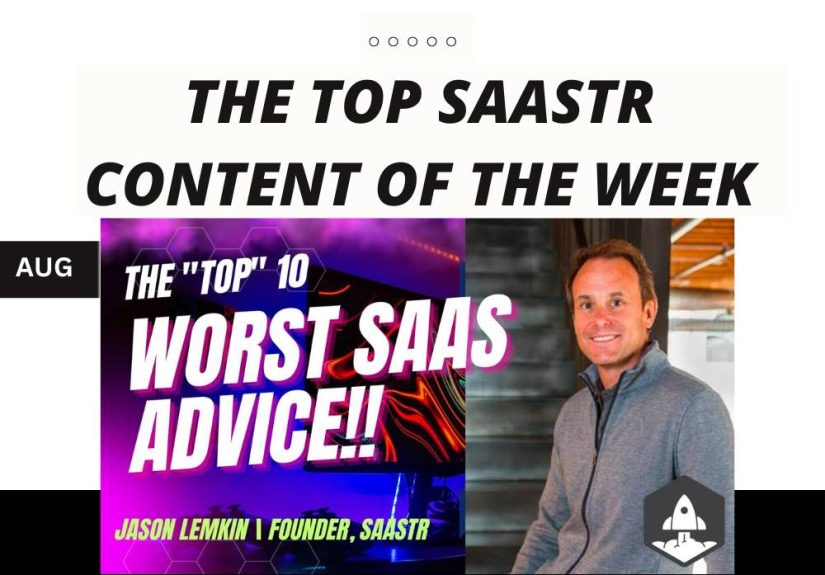
Then came Jason Lemkin, who has a rare talent for sounding both encouraging and mildly terrifying at the same time. His “cold truths” content from 2023 landed because it described the market with very little perfume sprayed over it. The message was not that SaaS was broken. The message was that easy-mode SaaS was over.
One of the sharpest themes in Lemkin’s advice was that efficiency mattered again. That sentence sounds boring until you remember how much of the prior era rewarded growth at almost any cost. In 2023, that changed. Teams had to pay for themselves. Sales efficiency mattered. Bootstrapped founders suddenly looked less like outsiders and more like people who had accidentally been training for this exact Olympic event all along.
Lemkin’s perspective was particularly strong because it was practical, not abstract. He talked about where SDRs should report, what specialization should look like, how early employees need to fit the mission, and why the operating assumptions of the “free money” era were no longer reliable. This was not TED Talk fluff. This was operating advice for founders who still needed to make payroll on Monday.
His most important subtext was this: the modern CEO cannot outsource judgment. You cannot hire your way out of weak fundamentals. You cannot hide behind vanity metrics. And you definitely cannot assume the market will reward your company just because you hired a large revenue org and taught everyone to say “category leader” with a straight face.
That is why his content worked so well in the same roundup as the party guide. One piece told you where the crowd was going. Lemkin told you what the crowd was finally admitting: better software businesses are built on rigor, not vibes.
Cockroach Labs’ CEO: Sustainable Growth Is Not a Buzzword, It Is a Survival Skill
If Lemkin provided the market reality check, Spencer Kimball provided the scaling framework. His appearance in the roundup was not just interesting because he led Cockroach Labs. It was interesting because his guidance focused on sustainable growth across stages, which was exactly the obsession of the moment.
Kimball’s breakdown of growth stages was refreshingly clear. He framed the journey as three distinct phases: getting from zero to one million, growing from one to ten million, and then scaling from ten million to one hundred million and beyond. That structure matters because too much SaaS advice acts like every company is solving the same problem. They are not. A startup struggling to get early customers should not copy the operating model of a later-stage company building repeatability and systems. That is how founders end up with enterprise-grade org charts and pre-revenue-level chaos.
What stood out in Kimball’s approach was how strongly he emphasized customers. At the later stages, customer success was not treated as a nice department to have near the onboarding team. It was treated as central to the business. If customers were failing, the company was failing. That sounds obvious, but software history is full of businesses that treated closed deals as victory and adoption problems as someone else’s emotional support ticket.
His point about leadership evolution also mattered. The founder’s job changes as the company grows. At first, the founder is dragging the product into existence. Later, the founder has to build systems, teams, and communication layers without losing touch with the customer. That balance is harder than it sounds. A lot of CEOs become professional calendar managers right around the moment they most need to stay close to users.
Kimball’s message fit the moment because it did not chase glamour. It chased durability. In 2023, that made him sound less like a motivational speaker and more like the adult in the room.
The Rest of the Week’s Standout SaaStr Themes
1. monday.com and the Metrics That Actually Matter
The monday.com conversation added another key layer to the week: how to think about SaaS metrics when the market is no longer impressed by decorative math. ARR still mattered. NRR mattered even more. But perhaps the most useful reminder was that CAC and CLTV can become dangerously abstract if they are disconnected from cash flow reality.
That was a major theme of 2023. Software leaders could not just wave around dashboard screenshots and call it discipline. They had to show how money moved, how quickly it came back, and how retention held up across segments. monday.com’s perspective pushed readers toward a more mature lens: segment your customer base, watch gross and net retention carefully, and do not mistake a clever metric for a healthy business.
2. Raising Capital in 2023 Meant Showing Up With Receipts
Peter Specht’s fundraising advice rounded out the week with the least shocking revelation in SaaS history: investors had standards again. The bar had moved. Series A expectations were no longer built around magical storytelling and a heroic slide deck with twelve TAM circles. More traction was expected. More ARR was expected. Efficiency mattered more. Burn multiples mattered more. AI outliers existed, but they were outliers, not permission slips for everyone else to act like it was 2021.
This part of the roundup was valuable because it helped founders separate market reality from startup folklore. Yes, capital was still available. No, it was not available on the old terms for average companies. That distinction matters. In tough markets, vague optimism is almost as dangerous as panic.
3. Low-CAC Growth and the Return of Smarter Go-to-Market
The inclusion of Guillaume Cabane’s low-CAC growth tactics was another clue to the week’s deeper theme. SaaS teams were re-learning that efficient growth is not boring. It is creative. When budgets tighten, operators get sharper. They experiment more carefully. They build systems that scale instead of brute-forcing acquisition and hoping future investors will admire the bravery.
In that sense, the roundup felt less like a content buffet and more like a curriculum. Party strategy, CEO judgment, customer obsession, fundraising discipline, and metric maturity all pointed in the same direction.
The Bigger 2023 Backdrop: Why These Lessons Landed So Hard
Context matters. The broader cloud market was still expanding, which meant the long-term demand story for software had not vanished. But the venture environment was much tougher, global startup funding was sharply lower in 2023, and founders were operating under far more scrutiny than they had during the boom years. At the same time, high-profile moves like Klaviyo’s IPO suggested the exit window was not completely shut; it was just narrow, selective, and in no mood to hand out participation trophies.
That backdrop explains why this particular SaaStr roundup felt so relevant. The industry was not collapsing. It was recalibrating. That is a big difference. Recalibration forces better questions. Which metrics really matter? Which hires actually create leverage? Which customers should you win? Which growth levers are repeatable? Which habits were only tolerated because capital was cheap?
In other words, this was not a week about panic. It was a week about standards. SaaStr was packaging those standards in a way operators could actually use, and that is why the content had legs.
Why This Week of SaaStr Content Still Matters
Years later, the specific party invites may be old news, but the substance still holds up. That is because the roundup captured a transition point in modern SaaS: the moment the industry started acting a little more like a real business sector and a little less like a caffeine-powered valuation parade.
The best takeaway from the week was not “go to more events” or “memorize more acronyms.” It was this: durable SaaS companies are built by leaders who can hold two ideas at once. Community matters, and fundamentals matter. Brand matters, and cash matters. Growth matters, and retention matters. Great events create opportunity, but great operators know what to do with it.
So yes, the SaaStr Annual 2023 party guide deserves its place in the headline. But the deeper reason this roundup worked is that it paired energy with discipline. It said, go meet people, learn fast, stay curious, and enjoy the week. Then it added the line every founder needed to hear in 2023: now get back to building a company that deserves to exist.
Experience Section: What a Week Like This Actually Feels Like
A week built around SaaStr content like this does not feel like reading a tidy newsletter. It feels more like stepping into a fast-moving software city where every conversation starts with a smile and ends with someone asking about net retention. There is a weird, specific energy to it. In the morning, you are excited. By lunch, you have three new ideas, two mild identity crises, and one strong opinion about whether your pricing page is secretly sabotaging your company.
For founders, operators, and SaaS leaders, the experience is a mix of adrenaline and accountability. The party guide makes everything look fun, and to be fair, a lot of it is. The side events are lively, the people are smart, and the energy can be contagious in the best way. You can walk into a casual gathering and end up in a discussion about expansion revenue, founder psychology, AI positioning, enterprise procurement, or why everyone suddenly cares about burn multiples again. It is networking, yes, but not the awkward kind where everyone pretends they are “just here to learn.” People are there to learn, hire, partner, sell, fundraise, and compare notes on what is actually working.
At the same time, a week like this can be humbling. Jason Lemkin’s style of content tends to follow you around in your head. You hear the big themes in a session, then you hear the same themes in private conversations: be more efficient, hire better, understand your customers more deeply, stop hiding behind vanity metrics, and build something resilient enough to survive a market that no longer hands out gold stars for enthusiasm alone. It is the kind of advice that is useful precisely because it can sting a little.
Then there is the emotional whiplash of hearing someone like Spencer Kimball talk about sustainable growth while you are also bouncing between founder dinners, customer meetups, and random chats with people who somehow seem both exhausted and wildly optimistic. That is the SaaS event experience in a nutshell. One minute, someone is explaining how to scale from $10 million to $100 million with systems and customer obsession. The next minute, someone else is telling you they got their first ten enterprise customers through one ugly but highly effective workflow that would never survive a brand review. Both stories are useful. That is the trick.
What makes the experience memorable is that it compresses months of market learning into a few intense days. You see which ideas have momentum. You see which talking points are just recycled LinkedIn wallpaper. You start to notice a gap between companies that sound polished and companies that sound honest. The honest ones are usually more interesting. They admit what broke. They explain what changed. They tell you which metric they were overvaluing and which customer segment they misunderstood. That kind of candor is gold.
By the end of a week like this, most attendees leave with more than notes. They leave with a sharper sense of what kind of company they are actually trying to build. Not the fantasy version from the zero-interest-rate era. The real version. The one that can win customers, keep them, scale responsibly, and still have enough personality left to show up at a party without sounding like an annual report in sneakers. And honestly, that is probably the best outcome SaaStr could hope for.
Conclusion
This week of SaaStr content worked because it balanced atmosphere with substance. The SaaStr Annual 2023 party guide captured the human side of the ecosystem. Jason Lemkin captured the pressure of the market. Spencer Kimball captured the discipline needed to scale. monday.com brought metric maturity. Peter Specht brought fundraising realism. Together, they created a snapshot of SaaS at a moment when the industry was growing up fast.
If you were building, buying, selling, or funding software in 2023, this roundup was not just useful reading. It was a field guide. And for many teams, it still is.