Table of Contents >> Show >> Hide
- First: Do You Even Need to Peel Apples?
- Meet the Apple Peeler Family
- What Makes an Apple Peeler “Ultimate” (The Checklist That Actually Matters)
- How to Choose the Best Apple Peeler for Your Kitchen
- How to Peel Apples Faster (Without Turning Your Counter Into a Slip ‘N Slide)
- Crank-Style Apple Peelers: Getting the Best Results
- Maintenance: Keep Your Apple Peeler Sharp, Safe, and Not Gross
- Troubleshooting: When Peeling Goes Sideways
- FAQ: Quick Answers From People Who Just Want the Apples Peeled
- Conclusion: So, What’s the Ultimate Apple Peeler?
- Extra: Real-World Experiences With “The Ultimate Apple Peeler” (The Part You’ll Recognize)
There are two kinds of people in this world: people who love apples, and people who love apples until it’s time to peel them.
If you’ve ever stared down a mountain of Granny Smiths like they personally offended you, you already know the truth:
the “ultimate” apple peeler isn’t just a toolit’s a peace treaty between you and pie season.
This guide breaks down what actually makes an apple peeler great (not just “shiny”), which styles work best for
different apple missions (snacking vs. baking vs. “I bought a 10-pound bag and now I live here”), and how to peel
faster, safer, and with less wasted fruit. We’ll keep it practical, a little funny, and extremely pro-apple.
First: Do You Even Need to Peel Apples?
Sometimes yes. Sometimes no. The peel is edible, and leaving it on can add texture, color, and a bit of structuregreat for rustic bakes,
skillet apples, and quick snacks. But peeling still matters when:
- You want a smoother texture: applesauce, apple butter, purées, and silky fillings.
- You’re going for a “melt-in” bake: certain pies, tarts, and cakes where peel pieces can feel chewy.
- You’re doing fancy presentation: thin, uniform slices for tarts, roses, chips, or candying.
- You just prefer it peeled: the most powerful reason of all.
One key food-safety habit no one brags about (but everyone should): rinse apples before you peel them.
That way you’re not dragging surface dirt (or whatever the apple encountered on its long journey) across the flesh with your blade.
Meet the Apple Peeler Family
“Apple peeler” can mean a simple handheld peeler or a countertop crank machine that looks like it escaped from a 1900s general store.
The ultimate choice depends on how you actually cook.
1) The Y-Peeler (a.k.a. the speed demon)
A Y-peeler has a horizontal blade and a grip that lets you peel quickly with a push/pull motion.
Many product testers and home cooks like Y-peelers for speed and controlespecially on round produce like apples, where you can rotate the fruit
and keep your strokes consistent.
- Best for: everyday peeling, batch prep, fast strokes, lots of apples.
- Watch-outs: super-sharp blades plus distraction equals “why is my thumb bleeding?” (Stay focused.)
2) The Swivel (straight) Peeler (classic, comfy, familiar)
The swivel peeler is the “traditional” shape: a straight handle with a swiveling blade at the end.
People who learned on this style often find it more intuitiveespecially for peeling toward a cutting board.
A good swivel peeler glides cleanly and is easy to angle around curves.
- Best for: controlled peeling, people who dislike Y-peelers, and quick touch-ups on spots and blemishes.
- Watch-outs: cheap ones can chatter, skip, or dig too deep (which is how apples get “haircuts” instead of peels).
3) The Serrated Peeler (for delicate skins and slippery moments)
Serrated peelers have tiny teeth that “bite” into thin or soft skins. They’re often used for tomatoes, peaches, and citrusbut they can also help
when apples are waxy or your blade keeps skating across the surface.
- Best for: delicate produce, thin skins, and “why won’t this peel grab?” situations.
- Watch-outs: not always the smoothest finish; you’re trading finesse for grip.
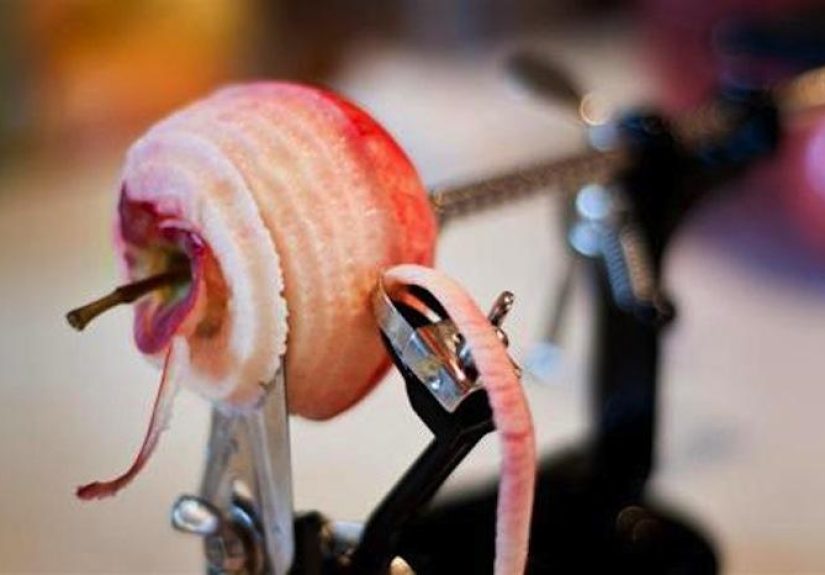
4) The Crank-Style Apple Peeler-Corer-Slicer (the batch-boss machine)
If you routinely prep a lot of applespies for holidays, dehydrating for snacks, canning, or applesauce by the potcrank-style machines are hard to beat.
You mount them to a counter (clamp or suction), spear the apple on prongs, and turn a handle while a blade peels and a cutter cores/slices.
It’s oddly satisfying, like sharpening a pencil, but for dessert.
- Best for: big batches, consistent peel thickness, fast prep for pie filling or dehydrator slices.
- Watch-outs: takes a minute to set up, needs space, and very small or oddly shaped apples can be finicky.
What Makes an Apple Peeler “Ultimate” (The Checklist That Actually Matters)
Ignore marketing words like “premium” and “chef-grade” (every tool is chef-grade if a chef uses it).
The ultimate apple peeler earns its title with the following:
1) A sharp blade that stays sharp
Sharp beats strong. A sharp blade needs less pressure, which means smoother peels, less fruit waste, and fewer slips.
You’ll commonly see stainless steel blades (rust-resistant, easy care) and carbon steel blades (often very sharp, but can rust if neglected).
2) Comfort you notice after the fifth apple
The handle matters more than you think. A non-slip grip and a shape that doesn’t create pressure points makes a real difference
when you’re peeling multiple apples for a pie or a big pot of applesauce.
3) Control on curves
Apples aren’t flat. (Shocking, I know.) A good peeler tracks curves without digging in or skipping.
Swiveling blades and well-designed Y-frames help maintain consistent contact.
4) Clean-up that doesn’t ruin your momentum
If it’s annoying to clean, you’ll “forget” to use it and go back to a paring knife like it’s 1847.
Look for simple geometry (fewer crevices), easy rinsing, and materials that tolerate regular washing.
5) A built-in “potato eyer” (bonus for apples, too)
Many peelers include a small scoop for potato eyes, but it’s also handy for quick apple blemishes and tiny bruised spots.
It’s not mandatoryjust satisfying when it works well.
How to Choose the Best Apple Peeler for Your Kitchen
If you peel 1–3 apples at a time
Go handheld. A quality Y-peeler or swivel peeler is fast, easy to store, and perfect for daily fruit or a quick bake.
If you’re unsure which style you’ll like, start with the shape that feels natural in your handcomfort wins.
If you bake often (pies, crisps, cakes) but not in bulk
Consider owning two peelers: a main peeler (Y or swivel) plus a serrated peeler for odd jobs and delicate skins.
This is not “extra.” This is “prepared.” (And also “less annoyed.”)
If you do big batches (holidays, dehydrating, canning, applesauce marathons)
A crank-style peeler-corer-slicer can be the ultimate upgrade. The time savings add up quickly when you’re prepping a whole bag of apples.
It’s also a great “make it a project” toolespecially if you recruit helpers who like turning handles and feeling useful.
How to Peel Apples Faster (Without Turning Your Counter Into a Slip ‘N Slide)
Step 1: Rinse first, then peel
Rinse apples under running water and rub the surface with your hands. For firmer produce, a clean brush can help.
The key is doing this before peeling so you don’t transfer surface dirt to the flesh.
Step 2: Stabilize the apple
For handheld peelers: hold the apple firmly and peel in smooth strokes, rotating the apple as you go.
Keep your peeling hand moving away from fingers and knucklesyour future self will appreciate it.
Step 3: Let the blade do the work
If you find yourself squeezing the handle like it owes you money, the blade is probably dullor the peeler is low quality.
Use light pressure and aim for thin peels. Thin peels waste less fruit and usually feel more controlled.
Step 4: Prevent browning if you’re prepping ahead
Peeled apples oxidize. If you’re slicing a bunch for pies or snacks, toss them with a little lemon juice diluted in water,
or hold them briefly in lemon-water while you finish peeling the rest. (You’re not “ruining” themjust slowing the color change.)
Crank-Style Apple Peelers: Getting the Best Results
These machines are simple, but a few small tweaks can turn “pretty good” into “wow, that was fast.”
- Mount it securely: clamps need a solid edge; suction bases love smooth surfaces.
- Center the apple: spear it straight so it spins evenly and the blade tracks the curve.
- Adjust the blade: most models let you fine-tune pressure so you don’t shave off extra apple.
- Know the limit: very small apples, lumpy heirloom apples, or super-soft fruit may not behave perfectly.
Maintenance: Keep Your Apple Peeler Sharp, Safe, and Not Gross
The best peeler in the world still needs basic care. Luckily, it’s low effort.
- Rinse promptly: dried-on apple sugar turns into a sticky souvenir.
- Dry well: especially for carbon steel blades, which can rust if left wet.
- Store safely: tossing peelers loose in a drawer is how blades get dull and fingers get surprised.
- Replace when dull: a dull peeler requires more force, which can increase slipping and injuries.
Troubleshooting: When Peeling Goes Sideways
“My peeler skips on the skin.”
Try a sharper peeler, rinse the apple well, and consider a serrated peeler if the surface feels especially slick.
Also check your angletoo flat and the blade won’t bite.
“It digs in and wastes apple.”
Use lighter pressure and shorter strokes. With crank machines, reduce blade tension if possible.
With handheld peelers, make sure the blade swivels freely and isn’t clogged.
“The crank machine peels unevenly.”
Re-center the apple on the prongs, tighten the mounting base, and make sure the apple isn’t wobbling as it rotates.
Oddly shaped apples may need a second pass or a quick handheld touch-up.
FAQ: Quick Answers From People Who Just Want the Apples Peeled
What’s the best peeler style for apples: Y or swivel?
Either can be excellent. Many testers prefer Y-peelers for speed and efficiency, while swivel peelers often feel more familiar and controlled.
The “best” is the one that feels steady in your hand and stays sharp.
Do I need a special “apple” peeler?
Not for everyday use. A high-quality vegetable peeler works beautifully on apples.
Crank-style apple peelers are “special” only because they add coring/slicing and batch speed.
Are crank peelers worth it?
If you routinely prep lots of apples, yestime savings and uniform results can be huge.
If you peel a couple apples a week, a great handheld peeler is simpler and takes less space.
Conclusion: So, What’s the Ultimate Apple Peeler?
The ultimate apple peeler is the one that matches your real life. If you’re a casual apple snacker, a sharp, comfortable handheld peeler is the fastest path
to “apple now.” If you’re a frequent baker, owning a reliable main peeler (Y or swivel) plus a serrated option is a smart, low-cost upgrade.
And if you’re the hero who makes pies for a crowd or turns a whole bag of apples into sauce, a crank-style peeler-corer-slicer is the power move.
Whatever you choose, remember the secret ingredient is not “premium stainless steel.” It’s a sharp blade, a steady grip, and the confidence to peel apples
like you’ve got places to be (even if that place is “standing over the sink eating apple slices like a goblin”).
Extra: Real-World Experiences With “The Ultimate Apple Peeler” (The Part You’ll Recognize)
Ask enough home cooks about apple peelers and you’ll hear the same story in different costumes: someone starts out peeling apples with a paring knife,
swears it’s “fine,” and thenone ambitious weekendmakes pie filling for a crowd and has a small existential crisis.
That’s often when people go looking for “the ultimate apple peeler,” not because they love gadgets, but because they love their wrists.
One common experience is the holiday pie sprint. You buy a big bag of apples, fully confident, and then realize each apple takes longer than expected.
Halfway through, the peels are everywhere, your cutting board is slippery, and you’re negotiating with yourself like, “What if we just… make brownies instead?”
This is the moment when a comfortable Y-peeler feels like a cheat code: faster strokes, thinner peels, and less apple sacrificed to the compost gods.
People who upgrade here often say the biggest surprise isn’t speedit’s how much calmer the whole process feels when you’re not forcing a dull blade.
Another relatable moment is the “kids want to help” phase. Apple prep is a gateway kitchen task because it feels real and useful,
but it can also be a little chaotic. Many families find crank-style peelers are great for supervised helping because turning a handle is straightforward,
predictable, and oddly funlike an old-school machine that gives instant results. It becomes a mini assembly line:
one person rinses, another cranks, someone else slices for snacks, and suddenly your kitchen feels like a cheerful apple factory (minus the hard hats).
Then there’s the applesauce marathon. If you’ve ever made applesauce from scratch, you know it’s not one taskit’s a sequence:
wash, peel, core, cook, stir, taste, adjust, and try not to eat it all straight from the pot.
People who do this often talk about the “peeling wall,” where motivation drops right around apple number seven.
This is where a crank peeler-corer-slicer earns its keep: it turns the slowest, most repetitive part into something almost automatic.
Even if you still do a quick trim afterward, the mental relief of seeing a pile of prepped apples grow quickly is huge.
A quieter but very real experience is the “I got nicked by a dull tool” lesson.
Many cooks report that the most annoying peelers aren’t the cheapest onesthey’re the ones that used to be good and slowly became questionable.
A slightly dull blade makes you press harder, which makes the tool more likely to slip.
That’s why experienced cooks often replace peelers sooner than they replace other tools: it’s a small cost that can prevent a lot of frustration (and bandages).
When people switch to a new sharp peeler after struggling with an old one, the reaction is usually the same:
“Wait… peeling is supposed to be this easy?”
Finally, there’s the gadget graveyard experience: drawers full of random single-use tools that promised joy and delivered clutter.
Apple peelers can end up there if they’re bulky, annoying to clean, or fussy with different apple sizes.
The best experiences come from matching the tool to the habit.
If you’re mostly peeling one apple for oatmeal or lunch, the “ultimate” is a simple handheld peeler you’ll actually grab daily.
If you’re the person who turns produce into projectschips, pies, preservesthe crank machine can feel like a beloved seasonal tradition.
In both cases, the happiest cooks aren’t the ones with the most tools; they’re the ones with the right tool that quietly does its job and gets out of the way.
So if you’re looking for “The Ultimate Apple Peeler,” you’re not just buying a peeler. You’re buying back time, reducing mess, and making sure the next time
apples enter your kitchen, they don’t come with a side of annoyance. That’s a pretty great deal for something that fits in a drawer.