Table of Contents >> Show >> Hide
- What Is Winter Fertilizer, Exactly?
- First, Figure Out Whether You Have Cool-Season or Warm-Season Grass
- The Right Time to Apply Winter Fertilizer on Cool-Season Lawns
- When to Skip Winter Fertilizer on Warm-Season Lawns
- Why Soil Temperature and Active Growth Matter More Than the Calendar
- What Kind of Fertilizer Should You Use?
- Should You Do a Soil Test Before Applying Winter Fertilizer?
- How to Apply Winter Fertilizer the Right Way
- Common Mistakes That Turn “Winterizer” Into Wishful Thinking
- Regional Examples: What “Right Time” Often Looks Like
- Bottom Line
- Experience Section: What Homeowners Commonly Learn the Hard Way About Winter Fertilizer Timing
- SEO Tags
If lawn care had a favorite hobby, it would be confusing perfectly normal people with phrases like winterizer, dormancy, and slow-release nitrogen. Add one chilly Saturday, one giant fertilizer bag, and one neighbor who “does it every year,” and suddenly your yard is starring in a drama called Will This Help or Hurt?
Here’s the good news: the right time to apply winter fertilizer on your lawn is not a mystery. It depends mostly on what type of grass you have, whether the lawn is still actively growing, and if the ground is still workable and unfrozen. For many cool-season lawns, a late-fall feeding can be useful when top growth slows but roots are still active. For many warm-season lawns, however, a late nitrogen application is exactly the wrong move.
So before you roll out the spreader like you’re launching a mission to save suburbia, let’s break down what winter lawn fertilizer actually does, when to apply it, when to skip it, and how to avoid giving your grass a poorly timed energy drink right before bed.
What Is Winter Fertilizer, Exactly?
A winter fertilizer, often sold as a winterizer fertilizer, is typically a lawn fertilizer marketed for late-season use. In many cases, these products emphasize nitrogen and potassium. The idea is simple: give turf nutrients late enough in the season to support root function and energy storage, but not so late that you waste product or create tender new growth at the worst possible moment.
That sounds straightforward until you realize the phrase winterizer gets used loosely. Some products are appropriate for certain northern lawns in late fall. Others are marketed so broadly that they trick warm-climate homeowners into feeding grass that should be heading toward dormancy, not auditioning for spring in November.
In other words, the bag may say “winter,” but your lawn still expects you to think.
First, Figure Out Whether You Have Cool-Season or Warm-Season Grass
This is the fork in the road. If you choose the wrong path, your lawn may still forgive you, but it will absolutely judge you.
Cool-Season Grasses
Cool-season lawns include turf types such as Kentucky bluegrass, tall fescue, fine fescue, and perennial ryegrass. These grasses do much of their best growing in the cooler parts of the year, especially in fall. That is why fall lawn fertilization is such a big deal for them.
Warm-Season Grasses
Warm-season lawns include Bermuda grass, zoysia grass, centipedegrass, and St. Augustinegrass. These grasses thrive in warm weather and slow down as temperatures cool. Feeding them too late with nitrogen can encourage fresh top growth that is vulnerable to cold injury, disease pressure, and plain bad timing.
If you only remember one thing from this article, remember this: cool-season and warm-season lawns do not follow the same winter fertilizer schedule.
The Right Time to Apply Winter Fertilizer on Cool-Season Lawns
For a cool-season lawn, the ideal late-season application usually comes after the lawn’s top growth has slowed down but before the ground freezes. A practical rule of thumb is that the grass is still green, you are near or just past the last mow of the season, and the soil is not frozen.
That timing often lands in late October through November, depending on your region. In colder northern areas, that window may arrive earlier. In milder transition-zone areas, it may stretch later. The goal is not to blindly follow a date on the calendar. The goal is to catch the lawn when roots can still take up nutrients, but blades are no longer trying to explode into a full-on spring musical number.
Why Late Fall Works for Cool-Season Turf
When cool-season grass heads into late fall, root activity can continue even after visible leaf growth slows. At that stage, a properly timed fertilizer application can help support root development, improve turf density, maintain color longer into fall, and support earlier spring green-up. That is why many turf experts recommend putting a good portion of annual nitrogen into the fall season instead of dumping it all in spring.
Spring feeding may make you feel productive, but too much spring nitrogen can push lush top growth when the plant would be better off building a strong root system. Fall is where cool-season lawns quietly do some of their smartest work.
Signs You’re in the Right Window
- The lawn is still green, but growth has clearly slowed.
- You are around the time of the final mowing or about one week after it.
- Soil is not frozen, snow-covered, or saturated.
- Air is cool, but the turf is not fully dormant.
- You are not applying ahead of a major freeze or heavy runoff event.
If your lawn has already shut down, the ground is frozen, or snow is in the forecast, the window has likely closed. At that point, you are not feeding your lawn. You are feeding the drainage system.
When to Skip Winter Fertilizer on Warm-Season Lawns
If you have a warm-season lawn, late-fall nitrogen is usually not your friend. Bermuda, zoysia, centipede, and St. Augustine grass are meant to ride out winter by slowing down or going dormant. A nitrogen-heavy “winterizer” application at that stage can encourage tender growth that is more likely to suffer from cold damage.
For many warm-season lawns, the better strategy is to finish nitrogen applications during the active growing season, not as winter arrives. In some regions, a potassium application may be useful for winter hardiness, but that decision should be guided by a soil test rather than a seasonal marketing slogan slapped on a shiny bag.
So if you live in the South and the garden center is whispering sweet nothings about a winterizer, pause. A product can be available locally and still be wrong for your grass.
Why Soil Temperature and Active Growth Matter More Than the Calendar
A lot of homeowners want a single date for when to fertilize lawn in fall. That would be convenient, but lawns do not read calendars. They respond to temperature, growth stage, moisture, and soil conditions.
For cool-season grass, root growth remains strong in the cooler part of fall, which is exactly why that season is so valuable for lawn recovery and nutrient uptake. For warm-season grass, cooler weather signals the opposite trend. This is why the same fertilizer bag can be a smart move for one lawn and a terrible decision for the one three states south.
Think of it this way: the correct timing is less “November 3 at 2:17 p.m.” and more “late enough that the lawn has slowed down, early enough that the roots can still use the nutrients.”
What Kind of Fertilizer Should You Use?
Once the timing is right, the next question is the fertilizer itself. For many mature lawns, the main nutrient of interest is nitrogen. Phosphorus is not always needed, and in established lawns it is often better to avoid extra phosphorus unless a soil test specifically says you need it.
Look for These Qualities
- Appropriate nitrogen rate: Many lawn programs use about 0.5 to 1 pound of actual nitrogen per 1,000 square feet per application, depending on grass type, condition, and the overall annual plan.
- Low or zero phosphorus when appropriate: Mature lawns often do not need more phosphorus unless soil test results show a deficiency.
- Nitrogen source that fits the season: For late-fall cool-season feeding, readily available nitrogen is often preferred so the turf can use it while still active.
- Potassium only when needed: Potassium can support stress tolerance, but more is not automatically better.
And please, for the love of your local watershed, do not assume a general-purpose garden fertilizer is close enough. Lawns are not petunias in a giant trench coat.
Should You Do a Soil Test Before Applying Winter Fertilizer?
Yes, especially if you have been fertilizing regularly, struggling with patchy performance, or buying products based purely on seasonal displays and optimism. A soil test for lawn fertilizer helps you avoid applying nutrients your lawn does not need, especially phosphorus. It can also reveal pH issues that affect how well turf uses the nutrients already present.
This matters because some lawns are not underfed at all. They are simply unable to access nutrients efficiently due to soil chemistry. Tossing more fertilizer onto that situation is like yelling directions at a GPS with no signal.
How to Apply Winter Fertilizer the Right Way
1. Mow First
Mow the lawn as usual before applying fertilizer. For cool-season turf, many homeowners make the late-season application around the final mow or about a week after it.
2. Use a Calibrated Spreader
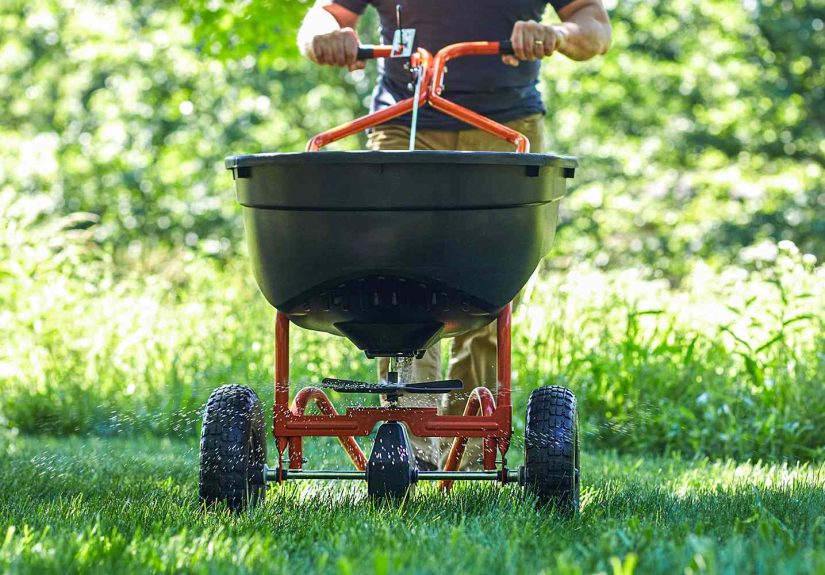
Too much fertilizer is not a bonus. It is how people create stripes, burn spots, and regret. Follow the label, know your square footage, and set the spreader properly.
3. Apply to Dry Grass
Dry blades help distribute granules more evenly and reduce clumping.
4. Water Lightly if the Product Calls for It
Many granular fertilizers benefit from a light watering to move nutrients into the soil. Follow the label instructions rather than improvising with a heroic two-hour sprinkler session.
5. Sweep Hard Surfaces
Always sweep or blow fertilizer granules off sidewalks, driveways, and streets. That material should go back on the lawn, not into storm drains.
6. Never Apply to Frozen or Snow-Covered Ground
If the ground is frozen, nutrients are far more likely to run off instead of reaching the root zone. That is bad for your lawn, bad for the environment, and bad for your wallet.
Common Mistakes That Turn “Winterizer” Into Wishful Thinking
- Applying too early: This can stimulate excessive blade growth when the lawn should be easing into the season.
- Applying too late: Once the soil is frozen or the turf is dormant, uptake drops and runoff risk rises.
- Ignoring grass type: The best timing for tall fescue is not the best timing for St. Augustinegrass.
- Using high-phosphorus fertilizer without a soil test: Established lawns usually do not need that habit.
- Fertilizing stressed turf: Drought-stressed or disease-stressed lawns do not always benefit from a late feeding.
- Believing labels more than biology: Marketing can be seasonal. Turf physiology is not.
Regional Examples: What “Right Time” Often Looks Like
Midwest or Northeast cool-season lawn: A late-season feeding may make sense in late October to November, after growth slows and near the final mow, while the lawn is still green and soil remains unfrozen.
Transition-zone tall fescue lawn: Fall is still the star season, but exact timing may shift a bit later than in colder northern areas. A sensible schedule often includes early fall feeding first, then an optional late-fall application if conditions still support uptake.
Southern warm-season lawn: Late nitrogen is often discouraged. If winter hardiness is the concern, rely on a soil test and local recommendations rather than throwing a high-nitrogen winterizer at grass that is already preparing for dormancy.
That is the real answer to the right time to apply winter fertilizer on your lawn: the right time changes by grass type, region, and actual growing conditions, but the wrong time is surprisingly consistent.
Bottom Line
If you have a cool-season lawn, the best late-fall fertilizer timing is usually when top growth has slowed, the lawn is still green, and the ground has not frozen yet. Think near the final mowing, not after the first snow shovel workout.
If you have a warm-season lawn, late nitrogen is often a mistake. Your grass is trying to rest, not bulk up.
And if you are standing in the aisle holding a bag labeled winterizer while wondering whether your lawn wants it, remember this: the smartest lawn care move is not buying what sounds seasonal. It is matching the product and timing to how your grass actually grows.
Experience Section: What Homeowners Commonly Learn the Hard Way About Winter Fertilizer Timing
One of the most common experiences homeowners describe goes something like this: the lawn looked tired in fall, the nights turned cold, and a winterizer bag at the store seemed like the obvious fix. So they applied it either very early, while the grass was still growing fast, or very late, when the lawn had nearly shut down. In both cases, the result often felt underwhelming. The lawn did not suddenly become the envy of the block. Instead, it either pushed extra top growth at the wrong time or showed almost no response at all.
People with cool-season lawns often report the best results when they stop thinking in terms of “before winter” and start thinking in terms of “while roots are still active.” That small mindset shift changes everything. Homeowners who wait until mowing slows down, but apply before frozen conditions arrive, often notice the lawn keeps a healthier color into late fall and wakes up more evenly in spring. It is rarely an overnight miracle. It is more like better posture for your lawn: subtle at first, then obvious later.
Another common experience happens in transition zones, where homeowners with tall fescue lawns assume their schedule should match both northern and southern advice at once. That usually leads to overthinking, missed timing, or too many applications. In practice, lawns there tend to respond better when owners focus on fall as the primary feeding season and avoid heavy spring fertilizing. Many people say the big “aha” moment came when they realized the best fall lawn fertilizer plan was less about doing more and more about doing the right thing once or twice at the right time.
Warm-season lawn owners tell a very different story. Many have learned, after one late-season mistake, that a high-nitrogen winterizer can make a lawn look briefly greener right before a cold snap turns that decision into a cautionary tale. Tender growth, patchy color, or greater disease frustration can follow. The lesson they usually share is simple: just because a lawn product is sold in fall does not mean it belongs on every lawn in fall.
Homeowners who get the most consistent results also tend to become fans of soil testing. At first, many expect a soil test to be too technical, too slow, or too “master gardener” for normal life. Then they try one and realize it saves guesswork, especially with phosphorus and potassium. Instead of buying the loudest bag on the shelf, they buy the one that fits the lawn’s real needs. That shift often saves money and reduces the urge to keep correcting problems with more product.
Finally, experienced lawn owners almost always mention that success comes from stacking good habits together. Fertilizer works better when mowing height is sensible, leaves are removed, compaction is managed, and the lawn is not smothered under debris all fall. In other words, winter fertilizer is not a magic trick. It is more like the final smart move in a season of smart moves. And once homeowners see that pattern, lawn care gets a lot less mysterious and a lot more effective.