Table of Contents >> Show >> Hide
- Why the Macintosh Plus Still Matters
- The Official Story: 128 KB ROMs and Three Revisions
- What Made the Japanese ROM Different?
- The Search: A ROM Rumor Becomes a Real Object
- The Dumping Problem: Two Chips, Extra Addressing, and Vintage Mischief
- Testing the ROM on Real Hardware
- Why 113 KB of Saved RAM Was a Big Deal
- The Emulation Challenge
- Why This Discovery Matters Beyond Apple Collectors
- KanjiTalk and the Bigger Story of Text on the Mac
- The Joy of a Tiny ROM With a Huge Backstory
- Experiences and Reflections: What This Discovery Feels Like for Retrocomputing Fans
- Conclusion
- SEO Tags
Some historical discoveries arrive with gold coins, ancient pottery, or a dramatic museum press conference. This one arrived with old Macintosh logic boards, yellow ROM stickers, floppy disks, emulator headaches, and the kind of detective work that makes retrocomputing people lean forward like someone just whispered, “There’s a prototype in the attic.”
The lost 256 KB Japanese ROM for the Macintosh Plus has been found, dumped, tested, and preserved. That may sound tiny in a world where a phone photo can casually swallow several megabytes before breakfast, but in 1980s Macintosh history, 256 KB of ROM is a big deal. Specifically, it confirms the existence of a rare Japanese Macintosh Plus ROM that bundled Kanji fonts directly into hardware, reducing boot-time disk swapping and saving precious RAM for users running KanjiTalk, Apple’s Japanese system software.
For collectors, emulator developers, Apple historians, and anyone who enjoys a good “wait, that actually existed?” moment, this discovery is more than a footnote. It is a reminder that computer history is not always neatly filed away in official manuals. Sometimes it is hiding on a motherboard, waiting for someone patient enough to look.
Why the Macintosh Plus Still Matters
The Macintosh Plus, introduced in January 1986, was one of Apple’s most important compact Macs. It looked familiar to anyone who knew the original Macintosh: small beige body, built-in monochrome display, friendly face, and a handle that made it technically portable if your definition of portable includes “lift with your knees.” But inside, the Plus was a major upgrade.
It shipped with 1 MB of RAM, expandable to 4 MB, an 800 KB double-sided floppy drive, and the first built-in SCSI port on a Macintosh. That SCSI port mattered because it opened the door to external hard drives and other peripherals. The Macintosh Plus also used 128 KB ROMs in the standard configuration, adding support for the Hierarchical File System, 800 KB floppies, and better storage behavior than earlier compact Macs.
In plain English, the Plus was the Mac that helped the Macintosh line grow up. Earlier Macs were charming but limited. The Plus still had limitations, of course, but it became a durable workhorse. It remained on the market for years, was used in homes, schools, design studios, and offices, and became one of those machines that seems to appear in every serious vintage Apple collection sooner or later.
The Official Story: 128 KB ROMs and Three Revisions
For years, the standard story was simple: the Macintosh Plus had 128 KB of ROM, and those ROMs existed in three known revisions. These revisions mostly mattered because of SCSI behavior and compatibility quirks. If you were not trying to boot from ancient hard drives, write an emulator, or compare ROM checksums for fun, you probably did not lose sleep over them.
But there was a quiet wrinkle in that story. Apple documentation had mentioned a Japanese Macintosh Plus with Kanji fonts in ROM. This was not the usual international localization model. Apple did not make a different ROM for every script system. The Japanese Macintosh Plus was unusual because Japanese text support required much more memory than Roman-character systems.
That small documentation clue created a tantalizing question: was there really a fourth Macintosh Plus ROM, larger than the others, made for the Japanese market? And if so, where was it?
What Made the Japanese ROM Different?
The newly preserved ROM is 256 KB, twice the size of the standard Macintosh Plus ROM. Its special trick was including Kanji font data directly in ROM. This mattered because KanjiTalk needed Japanese fonts to display and work with Japanese text. On a standard Macintosh Plus, those fonts had to be loaded from floppy disk into RAM at startup.
That may sound like a small inconvenience until you remember the world of 1986. A Macintosh Plus with 1 MB of RAM was considered nicely equipped, but Kanji fonts were not tiny. Apple’s technical notes explained that the 12-point Kanji font was required, while the 18-point font was optional. Loading those fonts from disk took time, used memory, and made startup feel like a tiny office ritual involving floppy swaps and patience.
By putting the fonts in ROM, the Japanese Macintosh Plus could start KanjiTalk more efficiently. The machine could avoid loading at least some font data from floppy disk into RAM. In practical terms, that meant faster startup and more available memory. In emotional terms, it meant fewer moments staring at a screen while your computer behaved like it was requesting a snack.
The Search: A ROM Rumor Becomes a Real Object
The discovery was led by Pierre Dandumont, known for deep dives into obscure Apple hardware and software. The ROM had been discussed before, and clues existed in old documentation, but finding a real board with the right chips was the hard part. This was not a case of clicking “buy now” on a clearly labeled “rare Japanese Macintosh Plus ROM, guaranteed historically spicy.” The search involved hunting through Japanese Macintosh Plus logic boards and identifying candidates that might contain the special ROM.
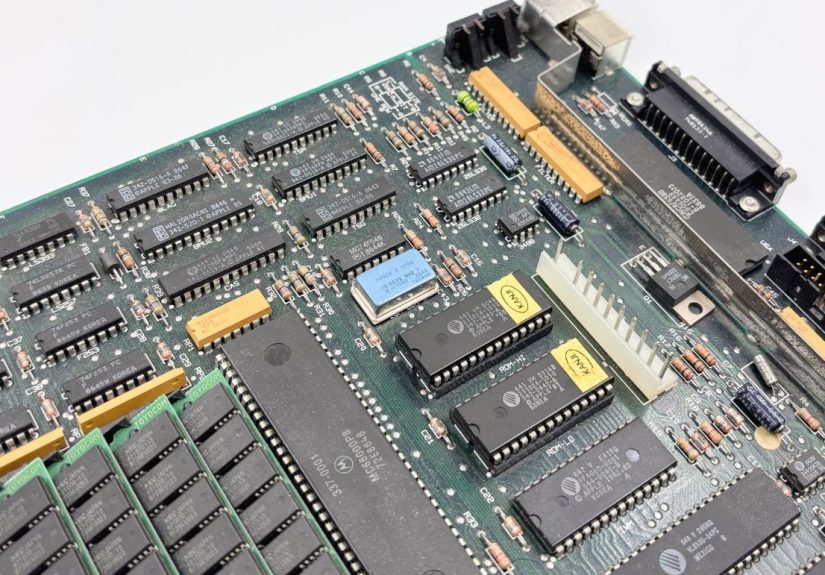
Eventually, the right board appeared. The ROM chips had the telltale markings and yellow stickers. That was exciting, but owning the chips was only step one. Preservation requires dumping the ROM data accurately, and this particular ROM was not completely straightforward.
The Dumping Problem: Two Chips, Extra Addressing, and Vintage Mischief
The Macintosh Plus ROM arrangement used two chips. For the Japanese version, each chip was 128 KB, making 256 KB total. The twist is that the Macintosh Plus ROM sockets use a pin that would normally serve as programming voltage on standard EPROMs as an extra address line. That allows the socket to address more data than a simple reader might expect.
At first, attempts to dump the ROM produced only 64 KB files from each chip, which did not match the expected size. That kind of moment is familiar in hardware preservation: the object is real, the excitement is real, and then the tool says, “Nope, I brought a teaspoon to a swimming pool.”
With help from people experienced in ROM dumping and vintage hardware, the chips were read properly. The result was a 256 KB dump of the Japanese Macintosh Plus ROM. Because the Macintosh Plus stores ROM data across two interleaved chips, a reconstructed version also became important for emulator use and analysis.
Testing the ROM on Real Hardware
Dumping a ROM is one thing. Proving that it works is another. At first, testing was difficult because Pierre did not have a complete Macintosh Plus ready for the job. Eventually, a working setup came together: a Macintosh Plus, keyboard workaround, floppy disks, and a copy of KanjiTalk 1.0.
KanjiTalk 1.0 was Apple’s Japanese system software for the early Macintosh era. It was designed to let the Mac display and input Japanese text at a time when multilingual computing was still a serious engineering puzzle. The software came on floppy disks, including system and font components. On a standard Mac Plus, booting KanjiTalk meant loading required fonts from disk. With the Japanese ROM, the 12-point font could come from ROM instead.
The test confirmed the key benefit. The Japanese ROM reduced disk swapping and shortened the boot process. Pierre’s testing showed that a normal setup could take over a minute with multiple disk requests, while the Japanese ROM could be ready faster, especially if the optional 18-point font was skipped. The exact numbers depend on the boot path and disk behavior, but the practical result is clear: the Japanese ROM made KanjiTalk more usable on limited hardware.
Why 113 KB of Saved RAM Was a Big Deal
Modern users often treat memory like tap water: open another app, keep 47 tabs alive, and assume the machine will survive. On a 1 MB Macintosh Plus, memory was a careful budget. Saving around 113 KB of RAM by using ROM-based font data was meaningful. That could be the difference between an application running comfortably, running badly, or refusing to cooperate like a cat near bathwater.
For Japanese users, this was not just a performance tweak. It was accessibility and practicality. Supporting Kanji required more data than English text. Apple’s solution for the Japanese Macintosh Plus shows how hardware and software had to work together before modern operating systems made multilingual text feel ordinary.
The Emulation Challenge
Once the ROM was dumped, another challenge appeared: emulators. Many classic Mac emulators expect known ROM sizes and checksums. A 256 KB Macintosh Plus ROM was not part of the usual assumptions. That meant the ROM could be historically authentic and still fail to boot in software that did not recognize it.
Support work followed. MAME was modified to allow the Japanese ROM, and Mini vMac later gained a Kanji model option for using the newly discovered 256 KB ROM. That matters because preservation is not complete when a file is archived. Preservation becomes more useful when people can study, test, and experience the software environment connected to it.
In other words, the ROM was not merely found and placed on a digital shelf. It began entering the living ecosystem of emulation, where historians and hobbyists can compare behavior, document differences, and keep obscure machines understandable.
Why This Discovery Matters Beyond Apple Collectors
At first glance, the lost Japanese Macintosh Plus ROM may seem like a narrow story. It is about one vintage computer model, one regional variant, one ROM image, and one operating environment. But the larger meaning is much broader.
It Preserves International Computing History
Most computer history is written from the perspective of English-language markets. That can accidentally make localization look like a side quest, when in reality it was one of the hardest problems in personal computing. Japanese computing required careful handling of character sets, fonts, input methods, memory limits, and display constraints. The Japanese Macintosh Plus ROM shows that Apple was experimenting with hardware-level solutions to make the Mac viable in Japan.
It Corrects the Historical Record
For years, many references described the Macintosh Plus ROM as 128 KB, with three revisions. That was true for the standard models, but incomplete. The 256 KB Japanese ROM proves that the story had a missing chapter. Good history is not just about repeating what manuals say; it is about updating the record when physical evidence appears.
It Helps Emulator Accuracy
Emulators are historical instruments. When they support rare ROMs, they allow researchers to see how software actually behaved on specific hardware. The Japanese Macintosh Plus ROM gives emulator developers a new target and gives users a way to experience KanjiTalk closer to how it worked on the original Japanese machine.
It Shows Why Hardware Preservation Is Urgent
Old ROM chips do not last forever. Logic boards get recycled, batteries leak, labels peel, and collections disappear when nobody knows what they contain. This discovery is a small victory against entropy, the universe’s least charming hobby.
KanjiTalk and the Bigger Story of Text on the Mac
The Japanese ROM also fits into a larger Apple story: the long road from single-language personal computers to multilingual systems. Early Macintosh software was elegant, but supporting Japanese was not simply a matter of swapping a menu translation. Japanese text required large fonts, input conversion, and system-level support.
Work on KanjiTalk and related text technologies helped push Apple toward broader thinking about scripts, encoding, and internationalization. Later developments such as Script Manager, WorldScript, Unicode support, and modern macOS text handling all belong to that long arc. The 256 KB Japanese ROM is a very early artifact from that journey.
Today, typing Japanese on a Mac feels routine. A user can switch input methods, mix scripts, search text, and display complex characters without thinking about ROM size. But that smoothness sits on decades of engineering, and artifacts like this ROM show the awkward, inventive, deeply human middle stage.
The Joy of a Tiny ROM With a Huge Backstory
There is something wonderful about a discovery that makes 256 KB feel dramatic. The entire ROM is smaller than many modern website logos, yet it carries a story about Apple’s global ambitions, Japanese localization, hardware constraints, emulator development, and the persistence of vintage computing researchers.
The Macintosh Plus was already a historically important machine. Finding this Japanese ROM adds texture to that history. It reminds us that computers are not just products; they are local objects shaped by markets, languages, users, and engineering compromises. A Mac in California and a Mac in Japan might look nearly identical on a desk, but inside, one could be carrying a rare ROM built to make KanjiTalk more practical.
Experiences and Reflections: What This Discovery Feels Like for Retrocomputing Fans
For anyone who has spent time around vintage computers, the story of the lost 256 KB Japanese ROM feels instantly familiar. Retrocomputing is full of these strange treasure hunts. You start by looking for a part number, then you end up reading old technical notes, comparing board photos, learning more about EPROM pinouts than you ever planned, and explaining to normal people why a yellow sticker on a chip is thrilling. Their eyes glaze over. Yours sparkle. This is the hobby.
The experience also highlights how physical computing history differs from software nostalgia. Many people remember old Macs through screenshots, startup chimes, pixel fonts, and floppy disk icons. But the real machines had personalities built from hardware choices. A ROM was not just a storage area; it was part of the user experience. If a required font lived in ROM, startup changed. If it had to load from floppy, the user waited, swapped disks, and donated RAM to the cause.
That is why this discovery is satisfying. It connects documentation to reality. For years, the Japanese Macintosh Plus ROM existed almost like a rumor with paperwork: mentioned, plausible, but not widely available for study. Finding and dumping it turns “apparently Apple made this” into “here is the data, here is how it behaves, here is how it boots.” For historians, that difference is enormous.
There is also a lesson here for collectors. The most valuable item in a pile of old hardware is not always the shiniest one. Sometimes it is a dusty logic board with an odd sticker, a slightly different part number, or a regional variation nobody bothered to document thoroughly. The best preservation work often begins with curiosity. Someone notices that a detail does not match the standard story and keeps pulling the thread.
The Japanese ROM also makes the Macintosh Plus feel more global. Many English-language histories of Apple focus on the United States, but the Macintosh was never just an American object. In Japan, the machine had to deal with a writing system that demanded more from hardware and software. The ROM shows Apple trying to solve a real user problem: how to make Japanese text practical on a compact Mac with very limited memory.
There is a charming contrast between the simplicity of the Macintosh design and the complexity underneath. The Mac wanted to be friendly. It smiled with icons, windows, and menus. But behind that friendly face were hard technical problems: SCSI quirks, memory ceilings, font loading, character encoding, and regional compatibility. The Japanese ROM is like finding a secret workshop behind a cheerful storefront.
For emulator users, this discovery is especially fun because it gives people a new way to experience the past. Emulation is not just about launching old software; it is about recreating behavior. When Mini vMac or MAME supports a rare ROM, users can compare boot flows, font requests, memory behavior, and system quirks. That turns preservation from a static archive into an interactive laboratory.
Finally, this story is a reminder that history can still be unfinished. The Macintosh Plus is not exactly an obscure machine. It is one of the best-known compact Macs ever made. And yet, in 2025, a meaningful ROM variant could still be found, dumped, and added to the record. That should make every vintage technology fan wonder what else is out there: in storage rooms, recycling centers, auction lots, school closets, and the mysterious cardboard boxes labeled “old computer stuff.”
The lost 256 KB Japanese ROM for the Macintosh Plus has been found, but the larger hunt continues. Somewhere, another small chip is waiting to correct a paragraph in a history book.
Conclusion
The discovery of the lost 256 KB Japanese ROM for the Macintosh Plus is a beautiful example of why retrocomputing still matters. It is not just about nostalgia or collecting beige boxes like technological seashells. It is about preserving the details that explain how computing became global, multilingual, and practical for different users around the world.
This ROM proves that the Macintosh Plus story was more complex than the familiar 128 KB ROM timeline. It shows how Apple addressed Japanese text support through hardware, how KanjiTalk depended on font availability, and how a rare regional machine can reshape what we think we know about a famous computer. Thanks to careful preservation, the ROM is no longer a rumor. It is a working, testable part of Macintosh history.
Note: This article is written for web publication in original wording, based on verified historical reporting, Apple technical documentation, emulator project updates, and classic Macintosh preservation research.