Table of Contents >> Show >> Hide
- Quick Comparison: The 8 Best Table Saws at a Glance
- How to Choose a Table Saw Without Spiraling Into Chaos
- The 8 Best Table Saws (BHG-Style Picks)
- 1) Best Overall: DEWALT DWE7491RS (Jobsite Table Saw + Rolling Stand)
- 2) Best Budget: SKIL TS6307-00 (15-Amp Jobsite Table Saw)
- 3) Best Cordless: Milwaukee M18 FUEL 8-1/4" Table Saw (with ONE-KEY)
- 4) Most Portable: Bosch GTS15-10 (Jobsite Table Saw with Gravity-Rise Stand)
- 5) Best for Safety: SawStop Contractor Saw
- 6) Best Mini (Crafts): MXBAOHENG Mini Table Saw
- 7) Best Hybrid: Grizzly G0771Z Hybrid Table Saw
- 8) Best Cabinet: Powermatic PM1000 (30" Rip)
- Safety & Setup: The “Boring” Part That Saves Your Hands
- FAQ: Common Questions People Ask Before They Click “Add to Cart”
- Extra: of Real-World Experiences (The Stuff You Only Learn After Living With a Table Saw)
- Final Thoughts
Table saw shopping is a little like adopting a large dog: it can be wonderful, it can be loud, and if you don’t respect it, it will absolutely ruin your day. The good news? The right table saw makes DIY projects faster, cleaner, and way more satisfyingwhether you’re trimming down plywood for built-ins, ripping hardwood for a farmhouse table, or just trying to cut one (1) straight line without starting a new feud with your tape measure.
This guide is a BHG-style roundup: eight standout table saws for different needs, plus a practical buying guide (so you don’t accidentally buy “portable” and then realize it needs its own ZIP code). We’re focusing on real-world usabilitycut quality, fence accuracy, safety features, dust management, and the kind of day-to-day details that matter once the excitement of unboxing wears off.
Quick Comparison: The 8 Best Table Saws at a Glance
| Pick | Model | Type | Rip Capacity | Why It’s Here |
|---|---|---|---|---|
| Best Overall | DEWALT DWE7491RS | Jobsite / Portable | 32.5 in | Big capacity + accurate fence + easy mobility |
| Best Budget | SKIL TS6307-00 | Jobsite / Portable | 25.5 in | Solid performance and fence feel for less money |
| Best Cordless | Milwaukee M18 FUEL 8-1/4" (ONE-KEY) | Cordless Jobsite | 24.5 in | Jobsite freedom without the “where’s an outlet?” panic |
| Most Portable | Bosch GTS15-10 | Jobsite / Portable | (Jobsite class) | Gravity-rise mobility + thoughtful jobsite features |
| Best for Safety | SawStop Contractor Saw | Contractor | 30 in (option) | Flesh-sensing brake tech that prioritizes fingers |
| Best Mini (Crafts) | MXBAOHENG Mini Table Saw | Mini / Hobby | (Tiny stock) | For models, thin craft materials, and small-detail cuts |
| Best Hybrid | Grizzly G0771Z Hybrid | Hybrid | (Shop class) | Cabinet-like stability on household power |
| Best Cabinet | Powermatic PM1000 | Cabinet | 30 in | Precision, dust control, and “buy once” build quality |
Note: Rip capacity is one of the fastest ways to tell whether a saw will feel “just right” or “I regret everything.” If you regularly cut sheet goods, prioritize rip capacity and outfeed support.
How to Choose a Table Saw Without Spiraling Into Chaos
1) Know the five main table saw types
- Benchtop: Light, compact, and often the least expensive. Great for small DIY jobs, but can feel less stable.
- Jobsite / Portable: Built to move. Typically 15-amp motors (corded) with folding or wheeled stands.
- Contractor: Larger, heavier, better fences, and more stable than portablesoften a sweet spot for serious DIYers.
- Hybrid: A “best of both” approachcabinet-like stability with more accessible power requirements.
- Cabinet: The heavy hittersmaximum stability, best dust collection, and the kind of smooth adjustments that make you feel like a wizard.
2) Fence quality matters more than you think
A powerful saw with a flimsy fence is like a sports car with a shopping cart wheel. Look for a fence that locks solidly and stays parallel to the blade. Rack-and-pinion systems (common on some jobsite saws) can make adjustments smoother and more repeatable.
3) Safety features are not “nice-to-haves”
A few features dramatically reduce risk:
- Riving knife (or splitter): Helps prevent wood from pinching the blade and kicking back.
- Blade guard: Keeps hands out of the danger zone and helps with chip control.
- Anti-kickback pawls: Not perfect for every cut, but useful in many ripping situations.
- Flesh-sensing brake tech (on select saws): Designed to stop the blade in milliseconds if it contacts skin.
4) Dust collection is about health, not just cleanliness
Table saw dust isn’t just annoyingit’s airborne and persistent. If you can, pair your saw with a shop vac or dust extractor and use a mask or respirator for longer sessions.
The 8 Best Table Saws (BHG-Style Picks)
1) Best Overall: DEWALT DWE7491RS (Jobsite Table Saw + Rolling Stand)
If you want a portable saw that doesn’t feel like a compromise, the DEWALT DWE7491RS is the classic “do-it-all” choice. It’s built for jobsite life but behaves surprisingly well for garage-shop projectsespecially when you care about fence accuracy and repeatability.
- Why it stands out: Large 32.5-inch rip capacity for a jobsite saw, strong cutting ability, and a fence system that makes micro-adjustments feel less like a wrestling match.
- Best for: DIYers and remodelers who cut sheet goods, build cabinets, or want one saw that can travel and still cut clean.
- Keep in mind: Like many portable saws, it can be loudhearing protection isn’t optional.
Example project fit: Building a mudroom bench with cubbies? That rip capacity makes breaking down plywood less stressful, especially when paired with a stable stand and outfeed support.
2) Best Budget: SKIL TS6307-00 (15-Amp Jobsite Table Saw)
The SKIL TS6307-00 is proof that “budget” doesn’t have to mean “wobbly fence and regrets.” It delivers practical features that matterespecially a fence system designed for smoother, more accurate adjustments than you’d expect at its price point.
- Why it stands out: 25.5-inch rip capacity, rack-and-pinion fence rails for controlled adjustments, and integrated folding legs for easier setup.
- Best for: Weekend DIYers, first-time table saw buyers, and anyone upgrading from a circular saw + straightedge routine.
- Keep in mind: You’ll get the best results by spending time dialing in blade alignment and learning safe support techniques for longer stock.
3) Best Cordless: Milwaukee M18 FUEL 8-1/4" Table Saw (with ONE-KEY)
When you work where outlets are scarce (or you’re just tired of cord spaghetti), cordless is a game-changer. The Milwaukee M18 FUEL 8-1/4" table saw is designed for professional jobsite needs: portability, solid cutting performance, and smart tracking features through ONE-KEY.
- Why it stands out: Cordless convenience with jobsite-worthy performance, a 24.5-inch rip capacity, and strong productivity per charge depending on material and setup.
- Best for: Remodelers, finish carpenters, and DIYers who work in driveways, yards, or spaces without reliable power access.
- Keep in mind: Cordless power is amazinguntil you forget to charge. Keep a spare battery ready if you’re mid-project.
Example project fit: Cutting down trim boards for a shed build where you’re running everything off battery power? This is exactly the kind of tool that makes the workflow feel effortless.
4) Most Portable: Bosch GTS15-10 (Jobsite Table Saw with Gravity-Rise Stand)
Some saws are “portable” in the sense that you can move them… if you eat your vegetables and believe in yourself. The Bosch GTS15-10 earns the portable label with a jobsite-friendly design and a Gravity-Rise wheeled stand concept that helps reduce the “please don’t throw out my back” factor.
- Why it stands out: A powerful corded jobsite platform with features aimed at smoother startups and fast stops, plus mobility designed for real jobsite terrain.
- Best for: Contractors and DIYers who frequently move their sawor who simply want setup and breakdown to be painless.
- Keep in mind: Portability is great, but stable infeed/outfeed support still matters for long boards.
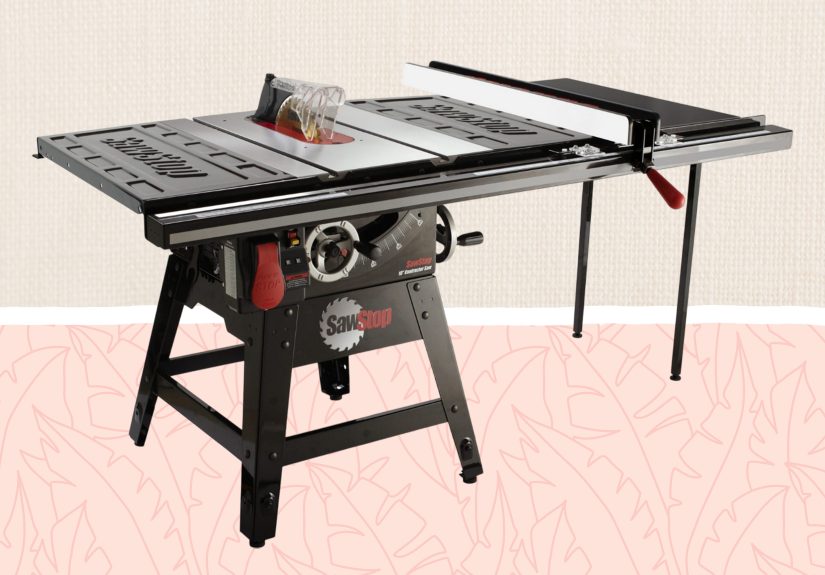
5) Best for Safety: SawStop Contractor Saw
If you want a saw that treats safety like the main character (as it should), look hard at the SawStop Contractor Saw. The headline feature is its flesh-sensing safety system, designed to detect contact and stop the blade extremely quickly. It’s the kind of investment that makes sense when multiple people use the saw, when you teach kids/teens, or when you just prefer your fingers exactly as currently configured.
- Why it stands out: Safety tech that’s designed to dramatically reduce blade-contact injury severity, plus a contractor-saw form factor that suits a serious home shop.
- Best for: Safety-first woodworkers, families, shared workshops, schools, and anyone who values risk reduction as much as cut quality.
- Keep in mind: When the brake activates, you typically replace the brake cartridge and often the bladethink of it as an emergency airbag for your saw.
Example project fit: Building built-ins with repeated rip cuts and long sessions at the saw? Safety systems and a stable platform can be especially valuable when fatigue sets in.
6) Best Mini (Crafts): MXBAOHENG Mini Table Saw
Not everyone needs to rip hardwood planks. Sometimes you need to cut tiny piecesfor models, crafts, small trim, or hobby materials where a full-size table saw would be like using a bulldozer to plant herbs. A mini table saw like the MXBAOHENG category can fill that niche when used appropriately.
- Why it stands out: Compact footprint for small-detail work in crafting and hobby contexts.
- Best for: Model makers, DIY crafters, and small-material cutting (think: thin wood pieces, hobby plastics) with careful technique.
- Keep in mind: Mini saws are not substitutes for full-size table saws. Use the right tool for the material, and prioritize eye protection and stable workholding.
7) Best Hybrid: Grizzly G0771Z Hybrid Table Saw
Hybrid saws exist for woodworkers who want more stability and dust collection than a portable saw can offer, but don’t want (or can’t accommodate) the full commitment of a massive cabinet saw. The Grizzly G0771Z leans into that mission with a cabinet-style base, serious dust collection potential, and a shop-friendly footprint.
- Why it stands out: Hybrid build with shop-oriented features like a cabinet-style stand and a 4-inch dust port, plus quick-change guarding/riving-knife design.
- Best for: Garage shops, small workshops, and DIYers who build furniture and want a more stable cutting platform.
- Keep in mind: Heavier saw = better stability, but plan your shop layout first. You don’t want to “store” it in the doorway permanently.
8) Best Cabinet: Powermatic PM1000 (30" Rip)
The Powermatic PM1000 is for woodworkers who want the confidence of a cabinet sawstable cuts, smoother adjustments, and better dust controlwithout necessarily stepping into the largest industrial footprint. It’s the kind of saw you buy when woodworking stops being “a hobby” and starts being “the reason you now own eight clamps and still need three more.”
- Why it stands out: Cabinet-saw construction, a respected fence system, and the kind of stability that helps cuts feel more controlled and repeatable.
- Best for: Serious DIYers, furniture builders, and anyone tired of fighting vibration and setup drift.
- Keep in mind: This is an investment-level tool. Make sure the saw matches your space, electrical setup, and long-term goals.
Safety & Setup: The “Boring” Part That Saves Your Hands
Table saw safety isn’t about fearit’s about habits. A few practices consistently show up in professional safety guidance and shop training:
- Stand slightly to the side of the blade path to reduce kickback risk.
- Use the rip fence correctly and keep stock guided parallel to it.
- Use a push stick or push block when your hands would otherwise get too close to the blade.
- Use a riving knife/splitter and guard when the cut allows it.
- Dress for the job: avoid loose clothing, tie back long hair, and protect your eyes/ears/lungs.
If you’re new to table saws, consider doing a “dry run” with the saw unplugged: practice your hand positions, the board path, and where the offcut will go. It sounds silly until it prevents a very real “why is this board suddenly trying to become a helicopter?” moment.
FAQ: Common Questions People Ask Before They Click “Add to Cart”
Do I need a 10-inch blade table saw?
For most DIY and woodworking tasks, a 10-inch table saw is the standard sweet spot: widespread blade availability, strong cutting depth, and compatibility with many common accessories. Cordless models often use smaller blades to balance power and portability.
What rip capacity should I get?
If you cut full sheets of plywood often, you’ll appreciate higher rip capacity. For occasional projects, a mid-range rip capacity can still work if you add infeed/outfeed support and break down sheets with a track saw or circular saw first.
Is a flesh-sensing brake worth it?
For many people, yesespecially in shared shops, learning environments, or households where multiple skill levels are involved. It’s a premium feature, but it’s designed for injury severity reduction when something goes wrong.
Extra: of Real-World Experiences (The Stuff You Only Learn After Living With a Table Saw)
Experience #1: Your first “perfect cut” will make you irrationally happy. You’ll start with something simplemaybe ripping a board for shelvingand when the edge comes off smooth and straight, you’ll look at it like you just invented carpentry. This is normal. Embrace it. Take a photo. Text it to someone who doesn’t care but will politely respond with “Nice!”
Experience #2: The fence is your relationship test. A good fence makes you feel calm. You set it, lock it, and trust it. A bad fence makes you measure three times, nudge it, measure again, whisper threats, and still wonder if your shelf will be shaped like a banana. This is why so many experienced woodworkers talk about fences the way car people talk about engines.
Experience #3: Sheet goods humble everyone. Cutting a 4×8 sheet of plywood on a table saw is not just “a cut.” It’s choreography. You need support infeed and outfeed, a clear path, and a plan for the offcut. Without that, the plywood becomes a floppy sail determined to steer the cut wherever the wind of chaos blows. Many DIYers discover a workflow that’s easier: rough-break sheets down with a circular saw or track saw first, then use the table saw for precise final cuts.
Experience #4: Dust is sneaky, and it will move in like it pays rent. The first few cuts seem finethen you notice a fine layer on everything. The next day it’s on your tool handles. The next week it’s in your soul. Connecting a shop vac or dust collector and wearing a decent mask on long sessions feels like “extra,” until you experience the difference and realize your lungs would like to keep their security deposit.
Experience #5: Kickback is fastso you build habits, not reflexes. People often describe kickback like it’s a dramatic movie scene. It’s not. It’s a blink. That’s why safe positioning matters (standing slightly off to the side), why riving knives and guards are important, and why push sticks are not optional accessoriesthey’re part of the operating system.
Experience #6: Dado stacks and specialty cuts make you feel advanced… and then immediately cautious. As your confidence grows, you’ll want joinerydados, rabbets, half-laps. This is where reading your saw’s manual and using the right accessories matters. Many woodworkers remember the first time they did a clean dado like it was a graduation ceremony. The key is to stay methodical: test cuts, correct blade height, and safe workholding.
Experience #7: Portable saws teach you patience; cabinet saws teach you gratitude. Portables are incredibly capable, but you’ll notice vibration, noise, and the need to set up supports. When someone eventually upgrades to a heavier contractor, hybrid, or cabinet saw, the first reaction is usually: “Oh. So this is what stability feels like.” The second reaction is: “Why didn’t I do this sooner?” (The third is checking the bank account and whispering, “That’s why.”)
Experience #8: The best table saw is the one that matches your life. If you move tools every weekend and work in a driveway, you’ll love a jobsite saw with a smart stand. If you build furniture and want repeatable precision, heavier saws shine. If you’re safety-first or teach others, a brake-equipped saw may be the most reassuring choice you’ll ever make. The right saw is the one that fits your projects, your space, and the way you actually worknot the fantasy version of you who has a spotless shop and unlimited time.
Final Thoughts
The best table saw isn’t just “the most powerful” or “the most popular.” It’s the one that gives you consistent accuracy, stable support, and safe control for the kinds of projects you really do. Pick the category that matches your workflow (portable vs. shop-based), prioritize a trustworthy fence and safety features, and you’ll end up with a tool that earns its floor space.