Table of Contents >> Show >> Hide
- Why Music Makes Slope Easier to Teach
- What “Slope Through Music” Actually Means
- Simple Ways to Teach Slope Through Music
- A Sample Mini-Lesson for Middle School Math
- How to Keep the Lesson Rigorous
- Common Mistakes Teachers Can Avoid
- Best Tools for Teaching Slope Through Music
- Why This Strategy Supports More Learners
- Conclusion
- Classroom Experiences: What Teaching Slope Through Music Looks and Feels Like
- SEO Tags
Teaching slope can feel a little like trying to explain why pineapple on pizza is “controversial.” Some students instantly get it, some strongly disagree, and a few stare at you like you’ve personally invented confusion. On paper, slope seems simple: rise over run. In real classrooms, though, students often mix up direction, steepness, sign, and rate of change. That is exactly why music can be such a powerful teaching tool.
Music gives slope a sound, a feeling, and a rhythm. Instead of treating a graph like a silent mountain range on a worksheet, teachers can help students hear what a line is doing. A pitch that rises steadily feels like positive slope. A pitch that drops feels like negative slope. A quick jump sounds steeper than a slow glide. Suddenly, slope is not just a number trapped in a formula. It becomes movement with a personality.
This approach works especially well because slope is not only a procedure. It is an idea. Students need to connect graphs, tables, equations, words, and real-world meaning. Music helps bridge those forms naturally. A note can rise. A beat can stay constant. A melody can drop fast or drift gently. That makes “rate of change” feel less like textbook wallpaper and more like something students can actually notice.
Why Music Makes Slope Easier to Teach
At its core, slope describes how one quantity changes compared with another. In a graph, that usually means how much the line goes up or down as it moves to the right. In music, students already understand similar patterns. They can hear a sound getting higher, lower, faster, slower, louder, softer, or more dramatic. That familiarity matters.
When teachers use music in math, they add another route into the content. Some students learn best by seeing. Others need to hear, move, speak, sketch, or compare patterns out loud. A lesson on slope becomes stronger when students can listen to a changing tone, describe it in everyday language, draw a matching line, and then write an equation for it. That sequence is much more memorable than tossing m = (y2 – y1)/(x2 – x1) onto the board and hoping for the best.
There is also a motivation bonus here. Music changes the mood of the room. A concept that felt stiff and intimidating suddenly becomes playful. And when students are engaged, they are more willing to try, revise, argue, and explain. Math stops feeling like a silent test and starts acting more like an experiment.
What “Slope Through Music” Actually Means
Teaching slope through music does not mean turning algebra class into a talent show where everyone leaves with a tambourine and no understanding of linear relationships. It means using sound and musical structure to make slope visible, audible, and discussable.
Positive and Negative Slope
If a pitch rises from low to high, students can connect that sound to a line that rises from left to right. That is positive slope. If a pitch drops from high to low, that matches negative slope. Students often understand this much faster with sound than with vocabulary alone.
Steepness
A fast change in pitch can represent a steeper slope. A gentle change can represent a slope closer to zero. This helps students stop treating every upward line as basically the same. Up is not enough. How fast it goes up matters.
Zero Slope
A steady note with no pitch change is a beautiful way to model zero slope. The line is flat. The sound is flat. The concept is flat in the best possible way.
Rate of Change
Music is built on patterns over time, which makes it a natural partner for rate of change. Students can compare how much the sound changes during equal time intervals. That is a perfect doorway into interpreting slope as a constant rate.
Initial Value
Once students begin hearing slope, teachers can extend the lesson to slope-intercept form. The starting pitch can help students think about the initial value, or where the line begins when x = 0. In other words, music can support not only the slope, but the whole “why does this graph start there?” conversation.
Simple Ways to Teach Slope Through Music
1. Start With Everyday Language First
Before using terms like positive slope, negative slope, or rate of change, ask students what they hear. Is the sound rising, falling, staying level, or changing quickly? This step matters. It gives students a chance to build meaning before the formal vocabulary arrives in its usual algebra tuxedo.
Try prompts like:
- “What is the sound doing?”
- “Does it rise quickly or slowly?”
- “Would the graph go up, down, or stay flat?”
- “Would the line be steep or gentle?”
2. Use a Slide Whistle, Keyboard, or Digital Tone Generator
A slide whistle is a wonderfully low-tech way to teach slope. Push the pitch up at a steady speed for positive slope. Pull it down for negative slope. Hold it steady for zero slope. If you want a more polished classroom setup, a keyboard app, digital piano, or graphing tool with audio can do the same job.
The point is not musical perfection. Nobody needs a Grammy to teach linear functions. The point is consistency. Students should hear the change and match it to the graph.
3. Pair Sound With Sketching
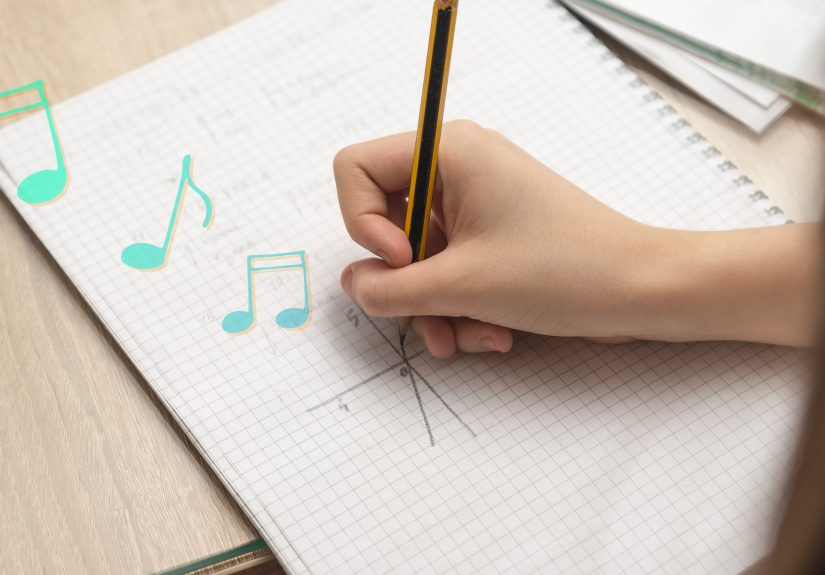
Play a sound without showing a graph. Ask students to sketch the line they think matches what they hear. Then reveal the graph and let them compare. This is where the magic happens. Students begin forming mental links among sound, shape, and symbolic meaning.
You can increase the challenge over time:
- Round 1: Positive, negative, and zero slope
- Round 2: Gentle versus steep slopes
- Round 3: Different slopes with different starting values
- Round 4: Students create sounds for classmates to graph
4. Turn Rise Over Run Into Rhythm
Rhythm is a great way to model ratio and repeated change. For example, if a line rises 2 units for every 1 unit to the right, students can clap two strong beats, pause, then step once. If the slope is 1/2, they can clap once and take two small steps. It sounds a little goofy at first, but good teaching is sometimes gloriously goofy.
This physical rhythm gives students a body-based memory for slope. Instead of memorizing a fraction in isolation, they feel the relationship.
5. Connect Tables, Graphs, and Equations
Music-based lessons should not stop with sound. After students hear and sketch the slope, move them into a table of values, then an equation, then a real-world interpretation. If the pitch rises by 2 each second, build a table. Then graph it. Then write the rule. Then ask what that constant increase means.
That sequence helps students see slope across multiple representations, which is exactly where real understanding grows.
A Sample Mini-Lesson for Middle School Math
Warm-Up: “Draw What You Hear”
Play three short sounds: one rising, one falling, and one steady. Students draw the matching lines on mini whiteboards. Keep it quick and playful.
Discussion: Put Feelings Into Math Words
Ask students to describe each sound in ordinary language. Then introduce formal terms: positive slope, negative slope, and zero slope. Connect student language to math language rather than replacing it.
Explore: Compare Steepness
Play two rising sounds: one slow and one fast. Ask which line would be steeper and why. Then graph both lines and compare their slopes numerically.
Extend: Add Initial Value
Show two lines with the same slope but different starting points. In sound terms, the “shape” of the rise is the same, but the starting note changes. This is a great way to move into slope-intercept form without students feeling ambushed by new notation.
Practice: Table to Sound to Equation
Give students a small table of values. Ask them to describe what the sound would do if the values were turned into pitch over time. Then they graph the line and write the equation.
Exit Ticket
Ask students to explain, in one or two sentences, how a steep positive slope would sound compared with a gentle negative slope. If they can explain it clearly, they probably understand it clearly.
How to Keep the Lesson Rigorous
Whenever teachers use creative strategies, someone eventually raises an eyebrow and wonders whether students are really learning math or just having a nice time. Fair question. The solution is simple: keep the creativity tied to precise mathematical thinking.
Ask students to justify their answers. Require them to connect sound to graphs, graphs to tables, and tables to equations. Use units when interpreting slope in context. Make them compare slopes, explain why one is steeper, and identify what the initial value represents. In other words, let music open the door, but make sure math still owns the house.
A strong music-based slope lesson should help students do all of the following:
- Recognize whether a slope is positive, negative, zero, or undefined
- Interpret slope as a rate of change
- Compare steepness meaningfully
- Move among verbal, auditory, graphical, tabular, and symbolic forms
- Explain slope and initial value in context
Common Mistakes Teachers Can Avoid
Using Music as a Cute Extra Instead of the Main Representation
If sound is just a five-second gimmick before a worksheet, students may enjoy it but not learn much from it. Build the lesson so music is part of the reasoning, not a warm-up decoration.
Moving to Formal Vocabulary Too Fast
Students need room to notice patterns in plain language first. Let them say “the sound climbs fast” before demanding “the graph has a large positive slope.” Both matter, but one helps build the other.
Ignoring Context
Slope is more than rise over run on an empty graph. Ask what the slope means in a situation. If a note rises by 2 steps every second, what is changing, and how fast? That question turns procedure into understanding.
Skipping Student Talk
This strategy shines when students compare, debate, and revise. Let them explain what they heard. Let them disagree. Let them test a sketch against the sound and fix it. That is not classroom noise. That is learning noise.
Best Tools for Teaching Slope Through Music
You do not need a fancy music lab. A good slope lesson can happen with simple tools:
- A slide whistle or kazoo for low-tech pitch changes
- A keyboard or piano app for more precise notes
- Graphing technology with audio features for direct graph-to-sound connections
- Mini whiteboards for instant sketching
- Headphones for focused listening stations
- QR codes or short audio clips for independent practice
The best tool is the one that helps students notice patterns clearly. The second-best tool is the one you can actually set up before first period without needing emotional support.
Why This Strategy Supports More Learners
Teaching slope through music can make math more accessible because it offers students more than one entry point. A student who freezes when looking at a graph may quickly understand a rising tone. Another student may need to move, clap, tap, or speak before the equation clicks. Music also creates room for collaborative learning, low-stakes prediction, and joyful practice.
That matters for all learners, but it is especially helpful in mixed-ability classrooms where students bring different strengths, language backgrounds, and confidence levels. When a concept is presented visually, verbally, aurally, and physically, more students can participate in meaningful ways.
Conclusion
Teaching slope through music is not about making math less serious. It is about making math more understandable. Slope is a relationship, and music is full of relationships: high and low, fast and slow, tension and release, repetition and variation. When teachers connect those worlds, students can hear what a graph is doing before they are expected to calculate it.
That is powerful. It helps students move from confusion to pattern, from pattern to language, and from language to formal math. More importantly, it gives them a reason to care. A line is no longer a mysterious diagonal slash on a coordinate plane. It becomes something alive, something you can hear, draw, describe, and explain.
And honestly, when a class starts talking about slope like it is a melody instead of a punishment, you know you are onto something good.
Classroom Experiences: What Teaching Slope Through Music Looks and Feels Like
In real classrooms, teaching slope through music often begins with hesitation. Students are used to math being presented in neat boxes with exact answers, so when a teacher says, “Listen to this sound and draw the graph,” the room usually goes quiet for one second. Then come the nervous laughs. Then someone says, “Wait, are we in music class now?” That moment is actually a gift. It breaks the routine, lowers the pressure, and signals that this lesson will ask students to think in a different way.
One of the most memorable experiences teachers describe is the way struggling students suddenly join the conversation. A student who may not volunteer during a traditional lesson will often say, “That one definitely goes down,” or “This one sounds steeper.” They may not begin with formal vocabulary, but they are noticing the mathematics. That is the breakthrough. They are no longer locked out of the concept just because the textbook wording felt abstract.
There is also a strong social element to these lessons. When students work in pairs, one can describe a sound while the other sketches the graph. They compare results, laugh at the dramatic wrong answers, and then refine their thinking. Instead of hiding mistakes, they talk through them. A line that was drawn too steep becomes a chance to ask, “What part of the sound made you think it changed that fast?” That kind of discussion is gold in a math classroom.
Teachers also notice that music gives students a memory anchor. Days later, when they ask about negative slope, students often remember the “falling whistle” or the “sad trombone graph.” It may sound silly, but silly is not the enemy of learning. Forgettable is. If students can connect an idea to a sound, a joke, or a classroom moment, they are much more likely to retrieve it later.
Another common experience is that the lesson reveals misconceptions quickly. Some students confuse “higher sound” with “higher starting point” rather than with change over time. Others hear a fast rise and focus only on direction, not steepness. But this is useful, because misconceptions become visible right away. Instead of discovering confusion on a quiz three days later, teachers can address it in the moment.
Perhaps the best part is the classroom energy. Students sit up more. They argue more productively. They ask better questions. Even the teacher tends to loosen up. Math can feel deeply human in these moments, less like a stack of rules and more like a system for noticing patterns in the world. By the end of the lesson, students are not just solving for slope. They are experiencing it. And that experience often stays with them longer than any formula copied into a notebook.