Table of Contents >> Show >> Hide
- A Tiny Doorway Into a Much Larger Imagination
- Who Is Furze Chan?
- Inside the Studio: A Kingdom of Miniatures
- The Language of Paper, Stitch, and Soft Color
- Color Pencil as a Serious Art Form
- Books, Memory, and the Art of Returning
- Why Furze Chan’s Work Matters Now
- What Creatives Can Learn from a Studio Visit with Furze Chan
- Conclusion: The Big Meaning of Small Wonders
- Additional Experiences: Living with Small Wonders in Everyday Creative Life
- SEO Tags
Editorial Note: This article is written as a web-ready studio profile based on publicly available information about Furze Chan, her creative practice, exhibitions, paper-based work, illustration portfolio, and design background.
A Tiny Doorway Into a Much Larger Imagination
Some artists announce themselves with thunder. Furze Chan seems to prefer a quieter entrance: a paper puppet, a miniature book, a soft pencil line, a tiny vase waiting politely for one equally tiny flower. The result is not small in feeling. It is small in scale, yes, but large in atmosphere, like opening a matchbox and discovering a theater inside.
“Small Wonders: Studio Visit with Furze Chan” is more than a charming title. It describes the central magic of Chan’s work: her ability to turn modest materials into objects that feel intimate, poetic, and strangely alive. Based in Hong Kong, Chan is known as an illustrator, graphic designer, book designer, and co-founder of 1984 Publishing. Her creative world moves between paper goods, color-pencil drawings, editorial illustration, independent publishing, and objects that seem to have wandered out of a daydream with excellent manners.
In an age when design often screams for attention, Chan’s work whispersand somehow gets the room to lean closer. Her practice reminds us that wonder does not always arrive wearing glitter and shouting “Look at me!” Sometimes it shows up as a carefully framed drawing of light, a soft-colored object, a delicate illustration for a magazine, or a paper animal that looks like it knows something you forgot in childhood.
Who Is Furze Chan?
Furze Chan was born in Hong Kong and continues to live and work there. She studied Visual Communication Design at the School of Design at Hong Kong Polytechnic University, then built a practice that crosses graphic design, illustration, publishing, and art objects. Her client list has included international names such as JR Central Japan Railways, Medium, The New York Times, Vice Media, and M le magazine du Monde, while her local creative circles include Obscura Magazine, K11 MUSEA, and other cultural projects.
What makes Chan’s profile especially interesting is not simply the résuméthough it is a solid onebut the way her work refuses to sit neatly in one drawer. She is not only an illustrator. Not only a designer. Not only a publisher. Not only an artist of small things. She is the rare maker who treats paper, image, memory, food, travel, books, and natural light as members of the same extended family. The family reunion, thankfully, is tasteful.
From Paper Products to Color Pencil Worlds
In 2009, Chan launched her own paper product brand, With Her Animal Poetry, creating festive cards and paper puppets featuring her drawings. That early paper-based work helped build the foundation for her later interest in color pencils, delicate textures, and hand-finished details. By 2016, she had shifted more directly toward illustration, using color pencils as a primary medium and gradually developing the quiet, soft-toned style now associated with her name.
Color pencil can be mistaken for a humble toolsomething from a school desk, a stationery aisle, or the bottom of a drawer where one lonely blue pencil goes to retire. But in Chan’s hands, it becomes a serious instrument for atmosphere. It does not bully the viewer. It layers, fades, glows, and waits.
Inside the Studio: A Kingdom of Miniatures
A memorable studio visit is never just about furniture placement. It is about clues. What does the artist keep nearby? What gets pinned to the wall? What sits within arm’s reach? What is arranged with care, and what is allowed to be deliciously imperfect?
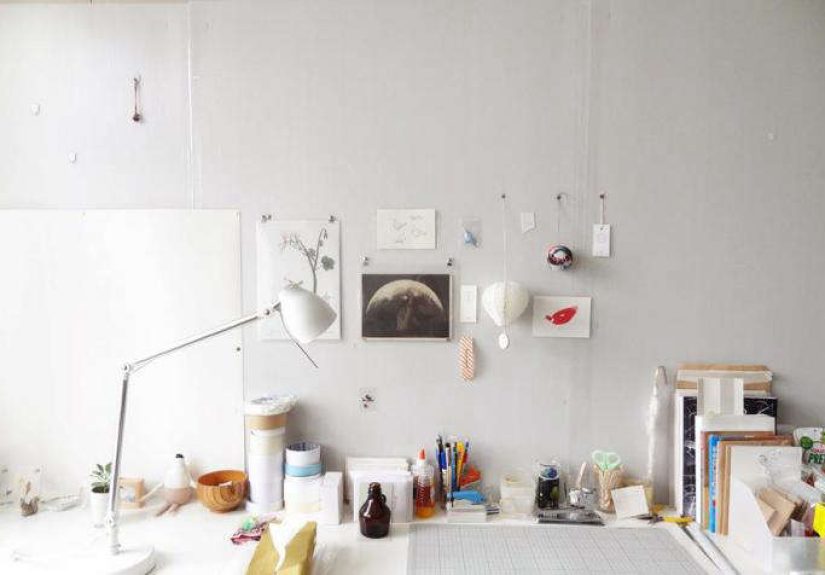
Chan’s studio has been described as sunlit, minimal, and personala place where small treasures, inspiration boards, paper objects, textiles, and miniature works create a private creative ecosystem. The phrase “kingdom of miniatures” feels especially fitting. Her studio does not sound like a warehouse of grand statements. It sounds like a quiet room where small things are given royal treatment.
This matters because scale affects attention. A huge painting can command your body from across a room. A tiny book asks for your hand. A miniature vase asks you to bend closer. A paper puppet asks you to imagine movement. Chan’s small works invite a slower kind of looking, the kind that makes time feel less like a deadline and more like a cup of tea that has not yet gone cold.
The Beauty of Personal Objects
Artists’ studios often reveal how creative thinking happens before it becomes “finished” work. A wall above a desk can become a rotating inspiration board. A scarf collection can turn into a color study. A shelf of objects can behave like a private museum. In Chan’s universe, the ordinary does not remain ordinary for long. It is observed, softened, rearranged, and allowed to become poetic.
This is one reason her work appeals to readers who love interiors, independent art, book design, stationery, craft, illustration, and slow living. Her practice connects those worlds without forcing them into a marketing category. It says, gently: your desk can be a landscape; your tiny collections can matter; your smallest rituals may be secretly enormous.
The Language of Paper, Stitch, and Soft Color
Chan’s early work with paper puppets, cards, small books, and paper goods shows a deep respect for tactility. Paper is not just a surface for her. It is a material with personality. It bends, folds, absorbs, shadows, and remembers pressure. Add stitch, soft toys, printed matter, or hand-colored detail, and the result is a world that feels handmade without becoming precious in the stiff, “please don’t breathe near it” sense.
Her approach fits into a broader modern appreciation for craft and independent publishing. In a world of screens, handmade and small-batch objects have gained renewed emotional value. They offer proof of touch. They carry the reassuring evidence that someone chose the paper, trimmed the edge, considered the margin, and made the thing exist in real space. This is design with fingerprintsmetaphorical ones, at least, because actual fingerprints on art paper are still a minor tragedy.
Why Small Objects Feel So Personal
Small-scale art has a special psychological pull. A tiny object feels discoverable. It creates the sensation of being let in on a secret. Unlike monumental design, which can feel public and declarative, miniature work often feels private and conversational. It tells the viewer, “Come closer. I will not shout.”
Chan’s work benefits from that closeness. Her miniature art books, paper creations, and soft visual worlds feel like invitations into a gentler rhythm. They do not deny the noise of modern life; they simply offer a pocket-sized shelter from it.
Color Pencil as a Serious Art Form
Chan’s later work, especially her color-pencil drawings, reveals a deeper exploration of patience, light, and stillness. Her 2024 solo exhibition “Light Colour Pencil Drawings” presented a series of works focused on light and shadow as expressions of time. The drawings used natural references such as forests and blossoming fields, but they were not simply pretty landscapes. They were studies of fleeting statesmoments when light falls, changes, trembles, and then disappears.
The exhibition notes describe Chan working under natural daylight and layering soft strokes gradually. Some works reportedly took up to two and a half years to complete. That fact alone could make anyone with an overflowing inbox feel personally attacked. But it also explains the calm intensity of the work. The drawings are not rushed impressions. They are accumulations of looking.
Drawing Light, Drawing Time
Light is a tricky subject because it is both everywhere and impossible to hold. You can see what light touches, but light itself keeps moving. Chan’s drawings attempt to catch that movement by turning it into a still image. A dapple across leaves, a pale glow in a forest, a soft floral fieldthese subjects become less about scenery and more about duration.
In this sense, her studio practice feels almost meditative. She does not appear to chase spectacle. She studies intervals. Her drawings suggest that attention is not passive. Attention is labor. Attention is craft. Attention is also, occasionally, eye strain.
Books, Memory, and the Art of Returning
Chan’s work with 1984 Publishing adds another dimension to her creative identity. As a co-founder, she participates in the world of independent publishing, where books are not merely containers for content but crafted objects with texture, pacing, weight, and silence. In the design of books such as Tang Ho Lun’s “36,” Chan has spoken about needing time to digest a project before understanding how it should take form. That patience is visible across her practice.
Her own publication “Return” has been discussed as a food-and-travel journal connected to memory, Japan, and the emotional power of ordinary meals. Food, in that context, is not just food. It is a time machine disguised as lunch. A cup of coffee, a bowl of eel rice, or a simple dish can bring back a place, a weather pattern, a mood, or the person you were before you knew you had changed.
The Studio as a Memory Machine
This is where Chan’s small wonders become especially powerful. Her work often seems to collect moments that might otherwise vanish: a taste, a beam of light, a small animal shape, a mood inside a room, the softness of a familiar object. Her studio becomes a memory machine, not by storing everything, but by selecting carefully.
That selectiveness is part of her design intelligence. Good design is not simply adding more. Often, it is deciding what can disappear. A quiet margin, a pale palette, a small format, or a nearly empty composition can give the viewer space to feel something. Chan seems to understand that emptiness is not a lack. Sometimes it is where the work breathes.
Why Furze Chan’s Work Matters Now
Chan’s work feels timely because it resists speed without becoming nostalgic. She uses traditional and tactile methods, but her clients and platforms place her firmly in contemporary visual culture. Her illustrations can appear in major publications, brand projects, animation, exhibitions, and independent books. This balance between handcraft and professional design makes her practice especially relevant for today’s creative landscape.
For designers, Chan offers a lesson in restraint. For illustrators, she demonstrates how a recognizable voice can develop through material discipline and emotional consistency. For collectors and art lovers, she shows that small works can carry big presence. For anyone who has ever kept a tiny object on a desk for reasons they cannot fully explain, she provides elegant validation.
The Quiet Power of a Distinct Visual Voice
A strong visual voice does not always require aggressive branding. Chan’s voice is built through softness, smallness, careful composition, and a recurring sensitivity to memory and atmosphere. Whether she is creating paper goods, editorial illustration, book design, or color-pencil drawings, there is a recognizable tenderness in the work.
This tenderness is not weakness. It is discipline. It takes confidence to make quiet work in a loud visual culture. It takes even more confidence to trust tiny things.
What Creatives Can Learn from a Studio Visit with Furze Chan
A studio visit with Furze Chan offers several practical lessons for artists, designers, writers, and makers. First, scale is not the same as impact. A miniature object can change a room if it is made with clarity and care. Second, materials matter. Paper, pencil, thread, frames, and margins are not neutral; they shape the emotional experience of the work.
Third, slowness can be a creative advantage. Chan’s process shows the value of allowing ideas to settle. This is not procrastination wearing a fancy scarfthough procrastination would absolutely try that. It is incubation. Some projects need time before they reveal their best form.
Build a Studio That Helps You Notice
Chan’s studio suggests that a creative workspace does not need to be huge or dramatic. It needs to support attention. A small inspiration board, a shelf of meaningful objects, natural light, organized tools, and enough emptiness to think can be more useful than a glamorous room designed mainly to impress visitors.
The real studio is not just a place where work gets made. It is a place where noticing becomes a habit. Chan’s practice reminds us that the best ideas may begin as minor observations: the way light falls on fabric, the memory attached to a meal, the shape of a tiny vessel, the emotional temperature of a soft color.
Conclusion: The Big Meaning of Small Wonders
“Small Wonders: Studio Visit with Furze Chan” is ultimately a story about attention. Chan’s work proves that smallness can be expansive, quietness can be memorable, and handmade detail can still feel fresh in a digital-first world. Her paper puppets, miniature books, color-pencil drawings, editorial illustrations, and independent publishing projects all share a devotion to the overlooked moment.
In her hands, a studio is not merely a workplace. It is a cabinet of curiosities, a thinking room, a paper garden, and a soft laboratory for memory. Her art asks viewers to slow downnot forever, not dramatically, just long enough to notice what was already glowing in the corner.
And perhaps that is the most useful lesson. Wonder does not always need more space. Sometimes it needs a smaller frame, a sharper pencil, and someone patient enough to see the light before it moves.
Additional Experiences: Living with Small Wonders in Everyday Creative Life
Spending time with the idea of Furze Chan’s work changes the way you look at ordinary spaces. After studying her small-scale objects and soft visual language, even a messy desk begins to feel like a possible studio rather than a crime scene involving receipts. A postcard leaning against a mug becomes a tiny exhibition. A pencil shaving becomes evidence of effort. A square of afternoon light on the floor becomes, briefly, the most important artwork in the room.
One experience related to this topic is the act of creating a personal “small wonders” corner at home. It does not require expensive supplies or a perfectly designed studio. Start with a tray, a shelf, or a small section of a desk. Place a few objects there: a favorite card, a tiny notebook, a dried leaf, a smooth stone, a fabric scrap, a matchbox, a pencil, a photo, or a miniature vase. The goal is not decoration in the glossy-magazine sense. The goal is attention. Each object should remind you to pause and look more carefully.
This exercise reveals why Chan’s world feels so compelling. Small objects become powerful when they are chosen, arranged, and revisited. They gather meaning through repetition. The same way Chan’s drawings of light can hold time still, a small object on your desk can hold a mood still. It becomes a marker of a day, a season, a trip, a friendship, or a private thought that would otherwise dissolve into the general soup of life.
Another useful experience is trying to draw one modest subject repeatedly. Choose something extremely ordinary: a cup, a plant stem, a folded napkin, a spoon, a window shadow. Draw it once quickly, then again slowly, then again in softer tones. By the third attempt, the subject stops being “just a cup” and starts becoming a world of curves, reflections, edges, and personality. This is the kind of looking that Chan’s work encourages. It turns observation into intimacy.
Independent publishing offers a similar lesson. Making a small zine, folded booklet, or handmade card can help writers and designers understand the relationship between content and object. Paper weight, page order, margins, binding, and cover design all affect how a reader feels. A poem printed on thin office paper feels different from the same poem printed on thick textured stock. A tiny book asks the reader to handle it differently. The format becomes part of the message.
For bloggers, designers, artists, and content creators, Chan’s practice offers a refreshing reminder: not everything needs to be scaled up. The internet trains us to chase moremore reach, more posts, more pixels, more noise, more everything until even our coffee needs a content strategy. But creative value can also come from narrowing the frame. A focused article, a thoughtful illustration, a tiny handmade product, or a carefully edited photo essay can create deeper attention than a flood of rushed output.
The experience of “small wonders” is also emotional. It is about giving dignity to small joys. A good meal remembered years later. A beam of sunlight on a wall. A paper animal that makes you smile for reasons that are not entirely adult. These details may appear minor, but they are often the texture of a meaningful life. Furze Chan’s work helps us see that the small is not the opposite of the important. Sometimes, it is where importance hides best.
In that sense, a studio visit with Furze Chan is not only about visiting her creative space. It becomes an invitation to visit your own attention. What have you been walking past? What tiny thing on your desk deserves a second look? What memory is waiting inside an object you almost threw away? The answers may be small, but as Chan’s work beautifully suggests, small is plenty.