Table of Contents >> Show >> Hide
- Why physical therapy matters after a stroke
- When physical therapy starts and what the rehab timeline looks like
- What physical therapy targets after stroke
- Core techniques used in stroke physical therapy
- Task-specific training (aka: practice the thing you want to do)
- Gait training (walking practice with a purpose)
- Balance and fall-prevention training
- Strength training (yes, it’s allowedencouraged, even)
- Aerobic conditioning (because your heart helps your brain)
- Spasticity, stiffness, and tone management
- Assistive devices, braces, and orthotics (tools, not “defeats”)
- Technology-assisted rehab (when available)
- What a physical therapy plan might look like (by phase)
- How progress is measured (so you’re not guessing)
- Tips to get more out of stroke physical therapy
- Safety notes: when to pause and get medical help
- Conclusion: recovery is training, not a countdown
- Experiences From Stroke Physical Therapy (What People Commonly Report)
A stroke can flip life’s “autopilot” switch right off. One day you’re walking to the kitchen without thinking about it; the next,
your leg feels like it’s arguing with your brain in a different language. Physical therapy (PT) is one of the main ways people
retrain movement after strokebuilding strength, balance, coordination, and confidence step by step (sometimes literally).
This article explains what post-stroke physical therapy does, why it works, which techniques are commonly used, and what progress
often looks like over time. It’s educational, not medical adviceyour rehab team should tailor everything to the person, the stroke,
and the moment.
Why physical therapy matters after a stroke
1) It helps the brain re-learn (hello, neuroplasticity)
After stroke, the brain can reorganize and form new pathwaysespecially when training is specific, repetitive, and meaningful.
PT takes advantage of this by practicing real-world tasks: standing up, walking, climbing steps, turning, reaching, balancing.
Think of it like rebuilding detours around a road closure: the route may change, but the destination (function) can still improve.
2) It reduces “secondary problems” that slow recovery
Weakness and limited movement can lead to stiffness, loss of endurance, deconditioning, poor posture, pain, and a higher fall risk.
PT targets these issues early with safe mobility, stretching, strength training, and balance workbecause recovery isn’t just about
the brain. It’s also about muscles, joints, lungs, heart, and confidence.
3) It builds independenceone practical skill at a time
PT often focuses on the mechanics of daily life: transferring from bed to chair, walking with (and eventually without) a device,
navigating a curb, getting off the toilet safely, or managing stairs. Those “small” wins add up to a much bigger outcome:
participating in your own life again.
When physical therapy starts and what the rehab timeline looks like
Many people begin rehabilitation while still in the hospital, often within the first couple of days, depending on medical stability.
Early therapy commonly includes gentle mobility, sitting balance, and safe transfers. The key word is “safe.” Starting early can be
helpful, but extremely intense out-of-bed activity too soon isn’t always betteryour team will adjust timing and dose based on how
your body and brain are responding.
From there, rehab typically continues in one (or more) settings:
- Acute care (hospital): early mobility, preventing complications, basic function.
- Inpatient rehabilitation facility (IRF): higher-intensity therapy, multiple disciplines, structured days.
- Skilled nursing facility (SNF): therapy plus nursing care when more support is needed.
- Home health PT: therapy in the home when travel is difficult or safety is a concern.
- Outpatient PT: clinic-based therapy for higher-level walking, balance, endurance, community mobility.
Recovery isn’t a straight line. Many people improve quickly early on, then hit plateaus, then improve againespecially when the plan
changes or intensity increases. That’s normal. Rehab is part science, part coaching, and part stubborn optimism.
What physical therapy targets after stroke
A PT evaluation usually looks at how you move now, what’s limiting you, and what matters most to you. Common areas include:
- Walking (gait): speed, symmetry, endurance, safety, and adaptability (turning, obstacles, uneven ground).
- Balance: sitting and standing balance, reactions to losing balance, fall prevention strategies.
- Strength and motor control: especially hip, knee, ankle control; trunk/core stability; and coordination.
- Transfers and functional mobility: bed mobility, sit-to-stand, chair transfers, car transfers.
- Range of motion and flexibility: preventing contractures and stiffness.
- Spasticity management: dealing with tight, overactive muscles that affect movement.
- Endurance and conditioning: because fatigue can be a major barrier to function.
PT is often paired with occupational therapy (OT) and speech therapy. OT typically emphasizes arms/hands and daily activities,
while PT emphasizes mobility and walkingthough there’s overlap, and good rehab teams coordinate goals rather than “owning” body parts.
Core techniques used in stroke physical therapy
Task-specific training (aka: practice the thing you want to do)
Task-specific training is the backbone of modern rehab. If your goal is to walk safely to the mailbox, therapy won’t only be
leg lifts on a table. Expect lots of stepping practice, sit-to-stand reps, weight shifting, turning, and real-life movement patterns.
Repetition mattersbut so does relevance.
Examples:
- Repeated sit-to-stand from different chair heights (because life is not one perfect chair).
- Stepping onto a low step, then a higher step, then stepping sideways.
- Walking while scanning left/right (to mimic grocery aisles or crossing a street).
Gait training (walking practice with a purpose)
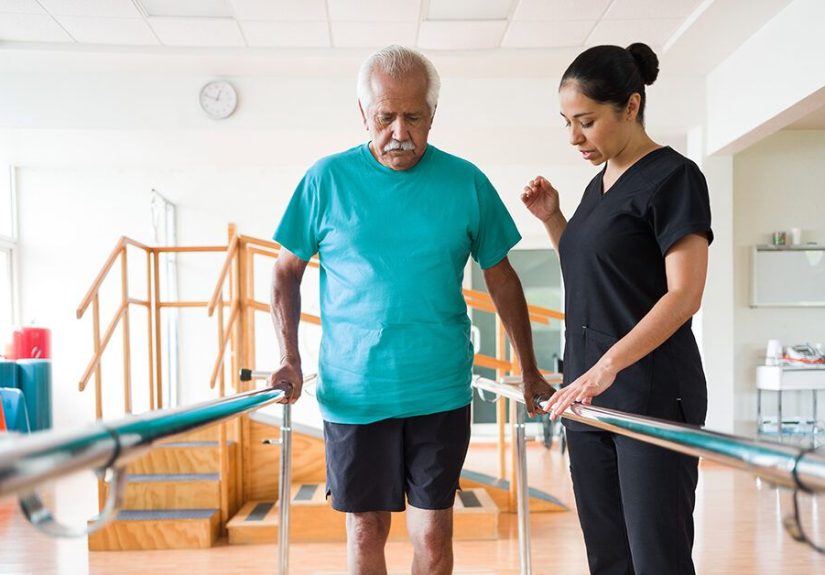
Gait training can include overground walking practice, treadmill training (sometimes with body-weight support), cueing strategies
(visual cues on the floor, metronome rhythm), and coaching to improve step length, toe clearance, and weight shift.
In many programs, therapists aim to increase the amount of stepping practicebecause you get better at walking by walking. Some
clinics also incorporate higher-intensity walking (when appropriate) to improve speed and endurance, especially later in recovery.
Common focus points in gait training:
- Toe clearance: reducing tripping risk (often a big deal with “foot drop”).
- Weight shifting: safely loading the affected leg.
- Hip stability and knee control: improving confidence and reducing compensations.
- Endurance: gradually increasing distance and time on feet.
Balance and fall-prevention training
Balance after stroke is about more than “standing still.” It’s reacting to real-life surprises: a turn, a dog toy, a slippery sock
(the sworn enemy of rehab progress). PT often includes static and dynamic balance work, stepping reactions, and strategies to safely
recover from a loss of balance.
Examples:
- Weight shifting and reaching in standing.
- Turning practice, figure-8 walking, and stepping over low obstacles.
- Dual-task balance (walking while carrying a cup, answering a question, or scanning for objects).
Strength training (yes, it’s allowedencouraged, even)
Post-stroke weakness is common, and strengthening can support walking, transfers, and stamina. Strength training is often paired
with motor-control practice so the nervous system learns to use that strength efficiently.
Therapists may use bodyweight exercises, resistance bands, weights, or machinesstarting with safe mechanics and progressing
gradually. Strengthening commonly targets the legs and trunk, but can also include shoulder stability and posture support.
Aerobic conditioning (because your heart helps your brain)
Many stroke survivors experience reduced cardiovascular fitness. Carefully dosed aerobic exerciselike walking intervals, cycling,
or aquatic therapycan improve endurance and help people tolerate more activity. Your team may monitor heart rate, blood pressure,
perceived exertion, and symptoms to keep training safe.
Spasticity, stiffness, and tone management
Spasticity can make muscles feel tight, jumpy, or resistant to movement. PT approaches often include stretching, positioning,
range-of-motion routines, weight-bearing strategies, and functional movement practice. Sometimes spasticity management also involves
bracing, medications, or injectionsthose decisions live with the medical team, but PT helps translate them into better movement.
Assistive devices, braces, and orthotics (tools, not “defeats”)
Canes, walkers, and ankle-foot orthoses (AFOs) are common in stroke rehab. The right device can improve safety and efficiency while
you build strength and control. A good therapist treats devices like training wheels: sometimes you need them for confidence and
distance, and sometimes you gradually reduce reliance as ability improves.
For foot drop, options may include an AFO or functional electrical stimulation (FES) devices that help activate muscles during
walking. The best choice depends on gait pattern, skin tolerance, cognitive factors, and goals.
Technology-assisted rehab (when available)
Some clinics use tools like body-weight-supported treadmills, robotic gait training devices, biofeedback, or virtual reality-based
practice. These can increase the amount of practice or improve engagement. They’re not magic, but they can be useful “practice
multipliers” when paired with skilled coaching and goal-based training.
What a physical therapy plan might look like (by phase)
In the hospital: “Safe movement first”
Early sessions often focus on sitting balance, standing tolerance, transfers, and short bouts of walking (if safe). You might work
on:
- Rolling and moving in bed
- Getting to the edge of the bed and sitting upright
- Standing with support
- Short walks with a walker and close supervision
Inpatient rehab or early home/outpatient: “Volume + quality”
As you stabilize, PT typically increases practice time and complexity. Sessions may include circuit-style training: walking,
stepping, strengthening, balance work, and functional tasks in the same visit.
Example session (simplified):
- Warm-up: seated marching, ankle pumps, gentle trunk rotations
- Strength/control: sit-to-stand reps, mini-squats, step-ups
- Gait: treadmill intervals or overground walking with cueing
- Balance: reaching, turns, obstacle navigation
- Cool-down: stretching and breathing, review of home program
Later outpatient: “Real-world walking and higher-level goals”
Later-stage therapy often looks more like life: community mobility, uneven terrain, endurance training, speed changes, and dual-task
walking. If returning to work, travel, caregiving, or sports is a goal, therapy can become more specificbuilding capacity and
confidence for those demands.
How progress is measured (so you’re not guessing)
Good rehab uses both “how you feel” and “what we can measure.” Therapists may track:
- Walking speed and distance
- Timed Up and Go (TUG) or similar mobility tests
- Balance tests (various standardized tools)
- Transfer independence (how much help you need)
- Endurance and perceived exertion
Measurements do two helpful things: they show improvement that’s hard to notice day-to-day, and they flag when it’s time to adjust
the plan (more challenge, different technique, new goals, or more recovery support).
Tips to get more out of stroke physical therapy
- Bring your goals, not just your symptoms. “I want to walk my daughter down the aisle” is a rehab compass.
-
Ask for a home program you can actually do. Consistency beats perfection. Five minutes daily can matter more than
one heroic hour once a week. - Track reps and wins. Recovery loves receipts. Write down how many sit-to-stands you did or how far you walked.
- Respect fatigue. It’s common after stroke. Your therapist can help you pace activity and build stamina safely.
-
Practice safely, not bravely. Use the right supervision and device. Falls are a fast way to add complications to
a complicated situation. -
Tell your therapist what’s hard at home. The “real” rehab obstacles are often: a narrow hallway, a tall bathtub
edge, or stairs that feel like Mount Everest.
Safety notes: when to pause and get medical help
Exercise and activity should be tailored and monitored, especially early on. Stop activity and seek medical guidance if you have
chest pain, severe shortness of breath, fainting, new or worsening neurological symptoms (like sudden weakness or speech changes),
or severe headache. Your rehab team can also teach warning signs specific to your health history.
Conclusion: recovery is training, not a countdown
Physical therapy after stroke is about rebuilding movement through specific practice, smart progression, and steady repetition.
The best programs target walking, balance, strength, endurance, and real-world functionwhile keeping safety and personal goals at
the center. Recovery can be slow, surprising, frustrating, and deeply rewarding, sometimes all in the same week. Keep showing up,
keep practicing, and let your rehab plan evolve as you do.
Experiences From Stroke Physical Therapy (What People Commonly Report)
The internet loves “overnight transformations.” Stroke rehab does not. What many survivors and caregivers describe instead is a
series of small, oddly specific victoriesoften celebrated like championship wins. The first time someone sits unsupported at the
edge of the bed can feel as triumphant as running a 5K. Not because sitting is glamorous, but because it’s a milestone: balance is
returning, the nervous system is reconnecting, and independence is inching closer.
A common early experience is the “brain-body mismatch.” A person may know exactly what they want to dolift the foot, straighten the
knee, shift weightbut the movement comes out delayed, shaky, or not at all. Therapists often coach patients through this phase
with simple cues and tons of repetition. Many people report that the hardest part isn’t pain; it’s effort. Concentrating on a step
that used to be automatic can be exhausting. That’s why therapy sessions may look short at first, then gradually expand as stamina
improves.
Another frequently reported reality is the emotional roller coaster of plateaus. Week-to-week gains might slow after the initial
burst of recovery. People often describe a moment of panic: “Is this as good as it gets?” Skilled therapists usually respond by
changing the challengeadding more stepping practice, increasing walking intensity when appropriate, switching to more functional
tasks, or building strength that supports better mechanics. Many survivors say that a plan adjustment (not just “try harder”) is
what helped progress restart.
Families and caregivers often talk about the delicate balance between helping and overhelping. It’s natural to want to do everything
for someone you love, especially when time is tight. But in rehab, doing everything for the person can accidentally reduce
the person’s practice opportunities. Many caregivers describe a learning curve: stepping back safely, letting the survivor attempt
the transfer, and cheering on efforteven when it’s slower than everyone would like. This is where training from PT is gold:
caregivers learn safe guarding techniques and how to support without taking over.
People also often report that the most successful “home exercise programs” are the ones that don’t feel like homework. Instead of
a long list of exercises, they build practice into daily routines: sit-to-stands before meals, a short walking loop after brushing
teeth, step practice while waiting for coffee. Survivors frequently say that consistencytiny sessions done oftenhelped more than
occasional marathon workouts. Rehab becomes less like a project and more like a lifestyle: “This is what I do now to get my life
back.”
Finally, many stroke survivors describe a shift in how they define success. Early on, success might be “walk without the walker.”
Later, it becomes “walk safely and confidently to the park,” “keep up with my grandkids,” or “have enough energy to enjoy the day.”
PT doesn’t just train muscles. It trains problem-solving, resilience, and the ability to adapt goals without giving them up.