Table of Contents >> Show >> Hide
- Why I Wanted Robinhood IPO Shares in the First Place
- How Robinhood IPO Access Changed the Mood
- Robinhood’s Own IPO Made the Whole Thing Bigger and Stranger
- Then the Market Opened, and the Vibes Got Complicated
- What Surprised Me Most About the Robinhood IPO Experience
- What I Learned About Getting IPO Shares on Robinhood
- Would I Try IPO Access Again?
- Who Should Consider IPO Shares on Robinhood
- Extended Reflection: What Getting Robinhood IPO Shares Really Felt Like
This is a first-person-style feature article based on how Robinhood IPO Access worked during Robinhood’s 2021 IPO and the public details released at the time.
Getting Robinhood IPO shares on Robinhood felt a little like watching a velvet rope get unclipped in real time. Normally, IPOs have a way of making regular investors feel like they arrived late to a party that started three hours ago, ran out of snacks, and somehow still charged a cover fee. Institutions get the early access, favored clients get the whispers, and everyday people usually meet the stock only after it starts trading in public and all the easy bragging rights may already be gone.
That was the big appeal of Robinhood IPO Access. The idea sounded simple and dangerously attractive: request shares before the stock started trading, get them at the IPO price if allocated, and finally experience the kind of access that used to live behind mahogany conference room doors. When Robinhood decided to make its own IPO available through its own app, the whole thing felt almost too on-brand. Of course Robinhood would try to turn the public offering into a retail-investor event. Of course it would let users try to buy the stock of the app they were already using to buy everything else.
And of course the experience would be equal parts fascinating, empowering, awkward, and slightly nerve-rattling.
Why I Wanted Robinhood IPO Shares in the First Place
The attraction was not just the company itself. It was the experiment. Robinhood had spent years marketing itself as the app that made investing feel less intimidating, less expensive, and less wrapped in old-money etiquette. So when it offered users the chance to request shares in its own public debut, it felt like the logical next act in the “democratizing finance” storyline.
There was also the basic math of human curiosity. IPOs tend to attract attention because they carry the possibility of a first-day jump. In many offerings, retail investors do not get access until trading begins, which means they can end up paying more than the IPO price if the stock pops out of the gate. Robinhood’s pitch was that users could request shares at the IPO price before public trading started. That sounds small until you realize how unusual that experience has historically been for ordinary investors.
So my interest was part investing, part research, part “let’s see whether this app can actually pull this off without turning it into a digital scavenger hunt.” I was not expecting magic. I was expecting friction, fine print, and at least one moment where I stared at the screen and wondered whether I had clicked the right button. Reader, I got all three.
How Robinhood IPO Access Changed the Mood
What stood out first was how casual the whole process felt on the surface. That was classic Robinhood. The interface did not scream “historic public market event involving underwriting banks, securities rules, and capital formation.” It felt closer to, “Hey, would you like in?” That ease was part of the product’s charm, but it was also what made the experience weirdly educational. The app lowered the emotional barrier to participation, yet the actual mechanics still reminded me that IPOs are not lottery tickets wrapped in confetti.
Requesting Shares Was Easy. Knowing What That Meant Was Harder.
Robinhood’s IPO process let users submit a request, essentially a conditional offer to buy shares if they were allocated. That did not mean shares were guaranteed. It did not mean the number you requested would be the number you received. And it definitely did not mean the stock would stage some glorious moon mission the second it started trading.
That was the first real lesson: access is not the same thing as certainty.
On paper, the flow was straightforward. You review the deal, decide how many shares you want, and submit the request in the app. The app then lets you wait for allocation, which is where the experience shifts from “cool, I’m in” to “cool, I’m in some kind of orderly suspense.” Robinhood’s materials made clear that users could receive all, some, or none of the shares they asked for. It also noted that asking for more shares did not necessarily improve your odds. So right away, the process felt more like standing in a very polite digital line than slamming a buy button and calling yourself a market wizard.
The Waiting Period Was Quietly the Most Emotional Part
People think the excitement starts when the stock begins trading. Honestly, that is only half true. The weirdest emotional stretch comes earlier, when you have already decided you want the shares but do not yet know whether you are getting them. It is a limbo stage. You have enough access to feel involved, but not enough information to feel settled.
I found myself doing the usual retail-investor brain gymnastics: How many shares should I request? If I get fewer than I want, is that disappointing or responsible? If I get all of them, am I excited or suddenly more aware of risk? It is amazing how quickly a simple share request turns into a mini personality test.
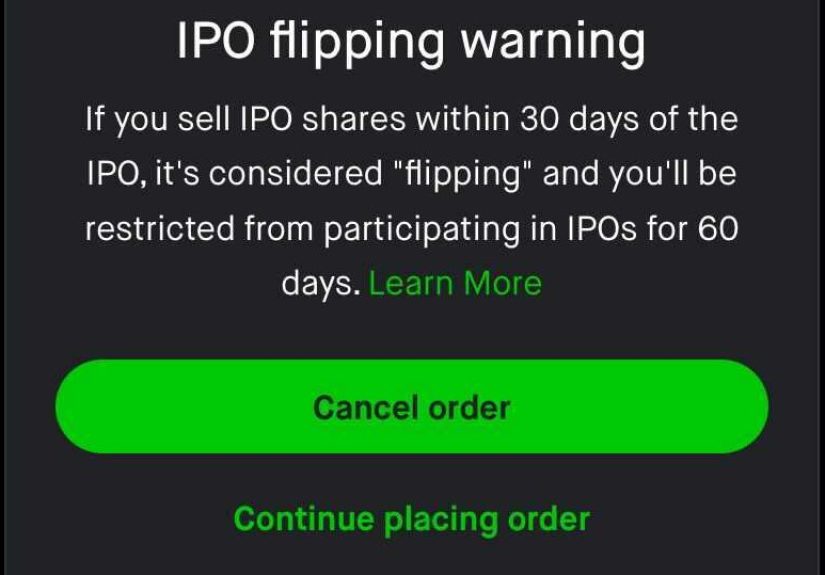
Robinhood also had rules around “flipping” IPO shares. If users sold IPO shares within 30 days, the platform warned that they could be restricted from participating in IPO Access for 60 days. That policy added another wrinkle. Even before getting allocated anything, you were being nudged to think like someone with a plan, not just someone chasing a fast trade and a screenshot.
Robinhood’s Own IPO Made the Whole Thing Bigger and Stranger
Robinhood did not just bring users into an IPO. It brought users into its own IPO, which made everything feel more self-referential in the most 2021 way imaginable. The app that had become a symbol of the retail-investing boom was now asking those same retail investors to participate in its debut as a public company. If Wall Street had a sense of irony, it probably needed a nap.
Robinhood reserved an unusually large portion of its IPO shares for retail investors using the app. That detail mattered. It was not a token gesture or a ceremonial “look, a few crumbs for the crowd.” It was a meaningful attempt to pull retail investors into a process that often excludes them. That was exciting. It was also risky. Robinhood itself warned in its filings that such a large retail allocation could contribute to volatility in the stock.
In other words: “Come on in, the water’s fine, but there may be sharks, waves, and an emotional support whistle.”
Pricing Day Felt Like the Point of No Return
When Robinhood priced its IPO at $38 per share, the moment became real. Up to then, the experience still had some hypothetical softness around the edges. Once the price was set, everything sharpened. If you had requested shares and got allocated, you were no longer observing a financial event from the sidelines. You were in it.
That is an important distinction, because getting Robinhood IPO shares on Robinhood did not feel like ordinary stock buying. It felt more ceremonial. Regular trading is often reactive. An IPO allocation feels premeditated. You are making a decision before the market starts arguing with itself in public.
That part appealed to me. It felt deliberate. It felt like participating in price discovery rather than arriving after the crowd had already pushed the stock around. Even if the outcome turned out messy, the process itself felt meaningful.
Then the Market Opened, and the Vibes Got Complicated
If I had imagined the debut as a clean little triumph for retail investors, the market was kind enough to correct me quickly. Robinhood’s stock did not roar out of the gate like a blockbuster IPO. It had a rough first day, eventually closing below the IPO price. That alone was a useful reminder that IPO shares on Robinhood were not some secret cheat code. Access to the IPO price does not cancel risk. It just changes your entry point.
And honestly, that was probably the healthiest possible lesson.
For years, a lot of retail investors had watched IPOs from the outside and assumed the real advantage was simply getting in before the first trade. Robinhood’s debut complicated that story. Sometimes getting in early is great. Sometimes getting in early just means you are first in line to learn humility. Markets are generous like that.
What I remember most from that part of the experience was the sudden contrast between product design and market reality. The app made the process feel approachable. The market made the outcome feel adult. That gap between the ease of the interface and the unpredictability of the stock was where the real education happened.
It Was Also a Crash Course in What “Volatility” Actually Feels Like
Volatility is one of those financial words that sounds abstract until it is attached to your own position. Then it becomes very personal, very quickly. Robinhood had warned that its high retail allocation could make the stock more volatile, and that warning did not feel theoretical for long. The stock’s debut and the days after it showed exactly how sentiment, hype, skepticism, and social buzz can collide.
That emotional roller coaster changed how I thought about IPO investing. Before the experience, “volatility” sounded like a line from a prospectus. Afterward, it felt like watching your expectations get rewritten in real time. One day the stock looked sluggish. Soon after, it swung dramatically higher. The lesson was not that Robinhood was uniquely chaotic. The lesson was that the market does not care whether your narrative is elegant. It cares whether buyers and sellers show up in force.
What Surprised Me Most About the Robinhood IPO Experience
The biggest surprise was not the price action. It was how normal the process felt. Not easy in the sense of “risk-free,” but normal in the sense of “this should have been available to more retail investors years ago.” Robinhood stripped away some of the intimidation factor without stripping away the reality that IPO investing can be uncertain, partial, and emotionally messy.
The second surprise was how quickly enthusiasm turns into analysis once real money is involved. Before allocation, the mood is mostly curiosity. After allocation, the questions sharpen: Do I actually believe in this company? Am I investing or just participating in a cultural moment? Would I still want these shares if nobody on the internet were talking about them? Those are excellent questions, and IPO Access has a way of forcing them earlier than usual.
The third surprise was that the most valuable part of the experience may not have been the trade itself. It may have been the perspective. I got to see how IPO demand, retail access, pricing, allocation, and opening-day performance fit together in a way that ordinary post-IPO buying does not teach nearly as well.
What I Learned About Getting IPO Shares on Robinhood
1. Access Is Powerful, but Discipline Matters More
Robinhood made access easier, but easy access can tempt people to confuse availability with opportunity. Just because you can request shares does not mean you should request them without understanding the business, the valuation, and the risks.
2. A Cleaner Entry Price Does Not Guarantee a Better Outcome
Buying at the IPO price sounds like an automatic advantage, and sometimes it is. But if the stock trades down after the debut, that early access can feel less like a golden ticket and more like front-row seats to your own impatience.
3. Partial Allocations Are Part of the Game
One underrated part of the Robinhood experience is learning that allocation is not all-or-nothing. You may request one number and receive another. That is normal. It is not personal. The app is not ghosting you. That is just how demand and supply sort themselves out.
4. Interface Simplicity Does Not Reduce Market Complexity
Robinhood deserves credit for making the process feel accessible. But the market on the other side of that simple interface remains gloriously complicated. Great product design can make participation easier. It cannot make uncertainty disappear.
Would I Try IPO Access Again?
Yes, but differently.
I would still appreciate the chance to buy into an IPO at the offering price. I would still value the sense of participating in a process that traditionally leaves retail investors outside the door. But I would go in with fewer fantasies and more rules. I would care less about the hype and more about the business. I would treat the allocation as a research-backed investment decision, not as a collectible experience.
That is probably the mature takeaway from my experience getting Robinhood IPO shares on Robinhood. The product did what it said it would do: it gave retail investors real access. The market then did what markets do: it reminded everyone that access is only the beginning.
Who Should Consider IPO Shares on Robinhood
Robinhood IPO Access makes the most sense for investors who genuinely want exposure to a specific company and who understand that IPOs can be volatile, oversubscribed, and emotionally noisy. It is especially appealing to people who have historically been locked out of traditional IPO channels and want a more level playing field.
It makes less sense for anyone who is chasing a guaranteed opening-day pop, treating the request like a game, or assuming the app’s simplicity means the trade itself is simple. It is not. IPO investing is still IPO investing. The nice interface just means you can learn that lesson with better typography.
Extended Reflection: What Getting Robinhood IPO Shares Really Felt Like
What sticks with me most is the odd mix of empowerment and vulnerability. On one hand, the experience felt historic in a small, personal way. I was not just reading about a public offering after the fact. I was participating in it through the same app I used for everyday investing. That felt new. It felt modern. It felt like one of those moments where finance stops looking like an exclusive club and starts looking like something regular people can actually touch.
On the other hand, touching it is exactly what makes it nerve-racking. Once you are allocated shares, the story stops being theoretical. The headlines, the pricing chatter, the skepticism, the optimism, the social media noise, the analyst takes, the memes, the whole circus suddenly has a seat at your kitchen table. You are no longer discussing whether retail investors should have IPO access. You are sitting there with actual shares, actual exposure, and actual feelings about every tick in the price.
There was also something weirdly poetic about buying Robinhood through Robinhood. It felt like a feedback loop built by the internet. The app that became famous for making markets feel more accessible was now asking its own users to help define its opening chapter as a public company. That gave the experience a sense of narrative that most investments do not have. Usually, buying a stock is just buying a stock. This felt more like participating in a case study while it was happening.
I also noticed how fast emotions changed. Before the allocation, I felt curious. After the allocation, I felt responsible. When trading started, I felt alert. When the stock struggled, I felt humbled. And when the volatility kicked in later, I felt that familiar mix of fascination and exhaustion that only markets can produce. It was a reminder that investing is never just numbers. It is expectations, timing, behavior, and self-control in a trench coat pretending to be rational.
If I had to sum up the experience in one sentence, it would be this: getting Robinhood IPO shares on Robinhood made me feel like retail investing had grown up a little, but it also reminded me that markets are still very good at embarrassing anyone who shows up overconfident. I came away appreciating the access, respecting the risk, and understanding that the real value of the experience was not just whether the trade worked on day one. It was that I got to see, firsthand and in real time, how modern IPO access can empower ordinary investors without protecting them from ordinary market consequences.