Table of Contents >> Show >> Hide
- Why Protein Purification Matters So Much
- The MIT Breakthrough: Nanoparticles That Help Proteins Crystallize
- How the Nanoparticle Method Works
- Why Traditional Protein Purification Is So Costly
- The Bigger Goal: Cheaper Drugs and Better Access
- What Makes This Method Different?
- What Still Needs to Happen Before This Reaches Industry?
- Specific Examples of Where This Could Matter
- Analysis: Why This Innovation Is More Than a Lab Trick
- Experience: What This Breakthrough Feels Like From a Real-World Manufacturing Perspective
- Conclusion
- SEO Tags
Protein drugs have changed modern medicine, but making them is still expensive. MIT engineers are exploring a smarter, faster purification method that could help bring biologic medicines closer to more patients worldwide.
Why Protein Purification Matters So Much
Some medicines are simple chemical compounds. Others are closer to microscopic works of art. Protein drugs, including insulin, monoclonal antibodies, enzymes, hormones, and some vaccine components, belong to the second group. They are large, delicate, highly specific molecules that can do things traditional small-molecule drugs often cannot. They can block inflammatory signals, replace missing proteins, target cancer cells, or help prevent infectious diseases.
There is just one tiny problem: making them can be wildly expensive. And by “tiny problem,” we mean the kind of problem that can make a manufacturing budget sweat through its lab coat.
Unlike many conventional drugs, biologic medicines are usually produced inside living cells such as yeast, bacteria, or mammalian cell cultures. These cells are grown in bioreactors, where they act like microscopic factories. After the cells produce the target protein, manufacturers must separate that valuable protein from everything else in the mixture: cells, cell debris, host-cell proteins, DNA fragments, media components, salts, and other process-related impurities.
That separation step is known as downstream processing or protein purification. It is essential because a biologic drug must be pure, consistent, safe, and effective. But purification can also account for a large share of protein drug manufacturing costs, especially when companies rely on expensive chromatography materials and complex multi-step workflows.
The MIT Breakthrough: Nanoparticles That Help Proteins Crystallize
MIT engineers have developed a promising alternative approach that uses specialized nanoparticles to rapidly crystallize proteins. Instead of relying only on traditional chromatography, the method encourages proteins to form crystals that can potentially be separated more easily from the surrounding liquid.
The research, led by MIT mechanical engineering professor Kripa Varanasi with graduate student Caroline McCue and Henri-Louis Girard, focuses on bioconjugate-functionalized nanoparticles. In plain English, these are tiny particles coated with chemical groups that help proteins gather, align, and form crystals more quickly. It is a little like giving proteins a dance floor, a playlist, and very clear instructions: “Line up neatly, please.”
Protein crystallization is not new. Scientists have used it for decades to study protein structures. The challenge is that crystallization can be slow, unpredictable, and difficult at the low protein concentrations often found in manufacturing streams. MIT’s approach tackles that bottleneck by using nanoscale surfaces as templates. These surfaces locally concentrate proteins and guide them into the correct orientation, helping crystal formation begin sooner.
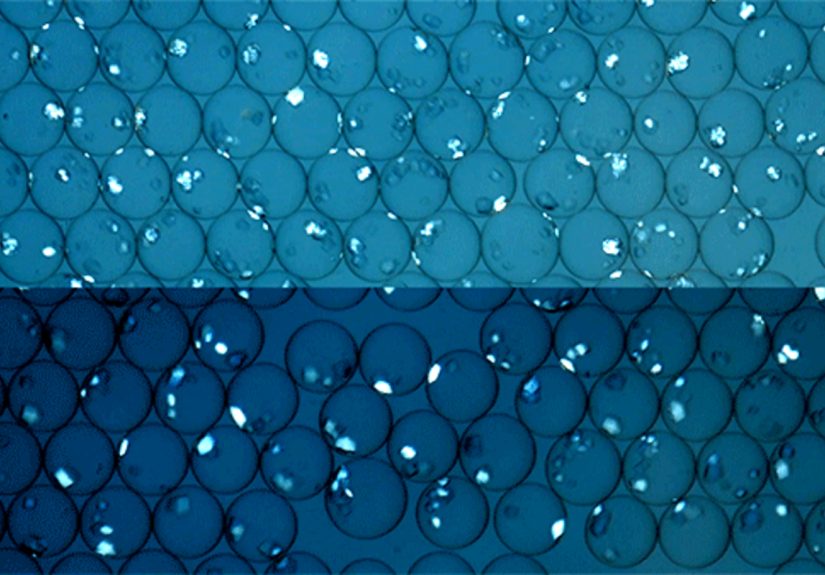
In the MIT study, the team demonstrated the concept using lysozyme, a well-studied antimicrobial enzyme, and insulin, one of the most important protein drugs in the world. The researchers found that coated nanoparticles reduced the induction time for crystal formation by up to sevenfold and increased the nucleation rate by up to threefold compared with control conditions.
How the Nanoparticle Method Works
1. Proteins Are Produced in a Bioreactor
The manufacturing journey begins with living cells engineered to produce a desired protein. In a typical recombinant protein process, scientists develop the genetic instructions, create a stable cell system, grow production cultures, harvest the protein-containing fluid, and then purify the target molecule. The purification stage comes after harvest and before formulation into the final drug product.
2. Functionalized Nanoparticles Are Added
MIT’s method introduces gold nanoparticles coated with bioconjugates such as maleimide and NHS chemistry. These molecules are already familiar in biotechnology because they can help attach proteins to other materials. In this case, they help proteins bind to the nanoparticle surface.
3. Proteins Gather and Align
Once the protein solution meets the coated nanoparticles, protein molecules begin accumulating at the surface. The coating helps orient them in a way that favors organized crystal growth. Without that guidance, proteins may drift around the solution like guests at a party who cannot find the snack table.
4. Crystals Form Faster
When enough protein molecules align properly, crystals begin to form. These crystals could eventually be separated from the remaining liquid, potentially offering a lower-cost purification route for some biologic products. MIT also used machine learning to analyze thousands of crystal images, allowing the team to quantify changes in induction time and nucleation rate more efficiently than manual counting would allow.
Why Traditional Protein Purification Is So Costly
Today, many monoclonal antibody purification processes rely heavily on chromatography, especially protein A chromatography. Protein A is valuable because it binds strongly and selectively to antibodies, making it extremely useful for capturing the target product from a complex mixture. However, protein A resins are costly, and the equipment, buffers, cleaning procedures, validation work, and repeated processing steps add more expense.
Chromatography is powerful, reliable, and deeply established in the biopharmaceutical industry. No serious manufacturer will abandon it overnight because a shiny new nanoparticle walked into the room. Regulatory expectations, product quality requirements, and process validation are strict for good reasons. Patients need medicines that behave the same way every time.
Still, the industry has long searched for ways to reduce downstream processing costs. Improvements in upstream production have helped cells make more protein, but that success can create a new challenge: larger quantities of protein-containing fluid must be purified. In other words, when the cell factory becomes more productive, the purification department gets the “Congratulations, you now have more work” email.
That is why alternative purification strategies, including crystallization, precipitation, membrane technologies, continuous chromatography, and smarter process modeling, attract serious attention. MIT’s nanoparticle-templated crystallization method fits into this larger effort to make biologics manufacturing faster, simpler, and more affordable.
The Bigger Goal: Cheaper Drugs and Better Access
The promise of cost-effective protein purification is not just a manufacturing story. It is a patient-access story.
Protein drugs can be life-changing. Insulin helps people with diabetes manage blood sugar. Monoclonal antibodies can treat autoimmune disorders, cancers, migraines, viral infections, and other conditions. Enzyme replacement therapies can help people with rare diseases. Vaccine-related proteins can support prevention strategies against infectious diseases.
But biologics are often expensive, and manufacturing complexity is one reason. Pricing also depends on research and development costs, patents, market dynamics, distribution systems, insurance coverage, regulation, and business decisions. A cheaper purification step does not automatically mean a cheaper prescription at the pharmacy counter. The healthcare system is not a vending machine where lower resin costs instantly drop the snack price.
However, reducing manufacturing cost still matters. It can make biosimilar production more attractive, support smaller or regional manufacturing facilities, improve supply resilience, and help global health organizations stretch limited budgets. For developing countries, lower-cost production methods could be especially important for biologics that are difficult to distribute widely because of price and infrastructure barriers.
MIT’s work is partly connected to global health goals, including efforts to make biologic drugs such as preventive antibodies more accessible in lower-resource settings. If a manufacturing process can be simplified and scaled safely, it may help bring advanced medicines to places where they are currently too costly or logistically difficult to supply.
What Makes This Method Different?
It Targets a Major Manufacturing Bottleneck
Many drug-development headlines focus on discovering new molecules. That is exciting, but manufacturing innovation can be just as important. A brilliant medicine that cannot be made affordably or consistently is like a gourmet meal locked behind a glass wall. You can admire it, but it does not feed anyone.
MIT’s work focuses on downstream processing, a practical bottleneck that affects real-world production. By improving the speed and reliability of protein crystallization, the method could eventually reduce the time, materials, and equipment required for purification.
It Uses Nanotechnology in a Practical Way
Nanotechnology sometimes sounds like science fiction wearing safety goggles. Here, the idea is refreshingly concrete: use extremely small engineered surfaces to help proteins organize themselves. The nanoparticles are not magic dust. They are carefully functionalized templates designed to influence molecular behavior.
It Combines Materials Science With Machine Learning
The MIT team also used machine learning to analyze crystal formation across many images. This matters because protein crystallization is stochastic, meaning it has a built-in element of randomness. To understand whether a method truly improves nucleation, researchers need large datasets. Machine learning can help detect crystal formation faster and more consistently than manual image review.
What Still Needs to Happen Before This Reaches Industry?
MIT’s purification concept is promising, but it is not yet a plug-and-play replacement for industrial chromatography. Several major questions must be answered before this type of technology can move from lab-scale experiments to commercial biologics manufacturing.
Scaling Up
A method that works in microfluidic droplets or small experimental systems must be adapted for large bioreactors and industrial process streams. Scaling crystallization is not simply a matter of using a bigger beaker. Mixing, temperature, concentration, particle recovery, crystal size, impurity removal, and process control all become more complex at larger volumes.
Testing More Proteins
The MIT team demonstrated the method with lysozyme and insulin. The next challenge is proving that it can work with more complex and commercially important proteins, including monoclonal antibodies, vaccines, and other therapeutic proteins. Each protein has its own shape, charge, stability profile, and crystallization behavior. Proteins are divas; they do not all follow the same backstage routine.
Meeting Regulatory Standards
Biologic manufacturing is tightly regulated because the process can affect the final product. Any new purification method must show that it consistently removes impurities, preserves protein activity, avoids harmful contaminants, and produces a drug substance that meets quality specifications.
Economic Validation
The method must also prove that it saves money in practice. A lower-cost purification technology must account for nanoparticle production, recovery, reuse or removal, process monitoring, validation, waste handling, and integration into existing facilities. The most exciting lab idea still has to survive the spreadsheet.
Specific Examples of Where This Could Matter
Insulin Manufacturing
Insulin is one of the best-known protein drugs and remains essential for millions of people with diabetes. MIT’s demonstration with insulin is important because it shows the concept may apply to a real therapeutic protein, not only to a convenient laboratory model.
Monoclonal Antibodies
Monoclonal antibodies are among the most commercially important biologics. They are used in oncology, autoimmune disease, infectious disease prevention, neurology, and more. If nanoparticle-assisted crystallization can help purify antibodies at scale, the impact could be significant.
Vaccines and Global Health Biologics
Some vaccine components and preventive antibody products require advanced protein manufacturing. Lower-cost purification could support global health programs, especially when the target population is large and price sensitivity is high.
Small-Batch and Regional Manufacturing
Not every medicine needs to be made in massive centralized facilities. More efficient purification could support flexible, smaller-scale production models, including regional manufacturing for outbreak response, rare-disease therapies, or local supply security.
Analysis: Why This Innovation Is More Than a Lab Trick
The most interesting part of the MIT work is not merely that nanoparticles speed up crystallization. It is that the research reframes purification as a design problem at the molecular interface. Instead of waiting for proteins to crystallize under ideal conditions, the method engineers a surface that encourages the desired behavior.
This approach reflects a broader shift in biomanufacturing. The industry is moving from trial-and-error process development toward more predictive, data-rich, and modular systems. Machine learning can help interpret complex experiments. Nanomaterials can create new control points. Continuous processing can reduce downtime. Better cell engineering can improve yield. Each advance chips away at cost and uncertainty.
Of course, no single technology will solve drug affordability by itself. Cheaper purification cannot fix every pricing, insurance, supply-chain, or patent problem. But it can remove one technical barrier from a very complicated equation. In medicine, removing barriers matters. Sometimes the path to better access is not one giant leap but a series of stubborn, clever, well-validated steps.
Experience: What This Breakthrough Feels Like From a Real-World Manufacturing Perspective
Anyone who has spent time around bioprocessing quickly learns that purification is where optimism meets plumbing. Upstream scientists may celebrate a high-producing cell line, but downstream teams know that every extra gram of protein must be captured, cleaned, concentrated, tested, and documented. The protein may be precious, but the broth around it is messy. It contains useful product floating in a soup of biological leftovers, and the job is to recover the good stuff without damaging it.
That is why MIT’s nanoparticle crystallization method feels so compelling. It speaks directly to a daily manufacturing frustration: how do you separate a delicate protein efficiently without building an expensive obstacle course of columns, buffers, and hold tanks? In a typical facility, chromatography is dependable but demanding. Columns must be packed, qualified, cleaned, monitored, and sometimes replaced. Resin lifetime matters. Buffer preparation matters. Flow rates matter. One small process deviation can trigger a long investigation that ruins everyone’s afternoon coffee.
A crystallization-based purification method offers a different mental model. Instead of forcing the protein through a resin bed and hoping the right molecules bind while the wrong ones wash away, the process encourages the target protein to organize itself into a separable solid phase. That sounds elegant, almost suspiciously elegant, like the protein agreed to clean its own room. But the beauty of MIT’s approach is that it does not rely on wishful thinking. The nanoparticles provide a designed surface that helps nucleation happen faster and at lower concentrations.
In practical terms, this could be valuable for early process development. Teams often test many purification conditions before finding a robust workflow. If nanoparticle templates can expand the range of successful crystallization conditions, developers may spend less time wandering through experimental dead ends. That matters because time is money, and in biologics, time is also freezer space, technician hours, analytical testing, and batch records thick enough to qualify as light exercise.
There is also a morale angle that rarely appears in technical papers. Manufacturing teams love processes that are simpler, cleaner, and easier to explain. A process with fewer high-cost consumables and fewer bottlenecks is not just cheaper; it is less stressful. It gives facilities more flexibility and reduces the number of things that can go wrong at 2 a.m. during a critical run.
Still, experienced biomanufacturing professionals would be appropriately cautious. They would ask hard questions: Can the nanoparticles be fully removed? Can the method handle real harvest fluid, not just clean model systems? What happens with product variants, aggregates, or host-cell impurities? How consistent is crystal size? Can the crystals be washed and redissolved without losing potency? Does the process scale without creating new headaches?
Those questions are not pessimism. They are the immune system of good manufacturing. Promising technology becomes valuable only when it survives practical scrutiny. MIT’s work is exciting because it opens a credible path, not because it declares victory too early. If future studies show that this approach works with complex biologics at industrial scale, it could become one of those quiet manufacturing innovations that patients never see but benefit from every time a medicine becomes easier to produce.
Conclusion
MIT engineers have introduced a cost-effective protein purification concept that could help reshape biologic drug manufacturing. By using bioconjugate-functionalized nanoparticles to accelerate protein crystallization, the team has addressed one of the most stubborn challenges in downstream processing: making purification faster, less expensive, and more practical at lower protein concentrations.
The method is still in development, and it must be scaled, validated, and tested with more therapeutic proteins before it can influence commercial drug production. But its potential is clear. If manufacturers can reduce purification costs while maintaining strict quality and safety standards, protein drugs such as insulin, monoclonal antibodies, vaccines, and other biologics could become easier to produce and, ideally, more accessible.
Cheaper drugs will require more than one clever purification method. Pricing systems, regulation, competition, infrastructure, and public health priorities all matter. Still, MIT’s work is a meaningful step toward a future where advanced biologic medicines are not limited by manufacturing complexity. Sometimes the road to affordable medicine begins with something incredibly small: a nanoparticle giving proteins just the right place to start forming crystals.