Table of Contents >> Show >> Hide
- Meet the Commodore 64: 1 MHz of Pure Nostalgia
- So… What Does “LLM on a C64” Actually Mean?
- How Does It Compare to “Real” LLMs?
- Why Retro-AI Experiments Matter
- Other Ways AI Is Sneaking Onto the C64
- Engineering Around Brutal Constraints
- What You Can Actually Do With a C64 LLM
- From Breadbox to Big Picture: Why This Hack Resonates
- Experiencing “LLM on a C64” Firsthand
- Conclusion: A Tiny Model With a Big Story
If you ever spent the 1980s waiting for a game tape to load on a flickering TV,
the idea of a large language model on a Commodore 64 sounds like
pure science fiction. The C64 has just 64KB of RAM, a roughly 1 MHz 8-bit CPU, and
a BASIC prompt that cheerfully dares you to break something. And yet, here we are:
a modern LLM-style model has been coaxed into running on this vintage
hardware, in a project that Hackaday gleefully described as
“LLM Ported To The C64, Kinda.”
It’s not ChatGPT in a breadbox. It’s not even a full-blown conversational AI.
But it is a very real demonstration that clever engineering, tiny models,
and a lot of patience can push 1982 silicon into the age of generative AI.
Let’s unpack what this project actually does, how it works, and why it matters
for both retro-computing fans and the future of small AI models.
Meet the Commodore 64: 1 MHz of Pure Nostalgia
Before we drop an LLM into it, it helps to remember what the
Commodore 64 actually is. Launched in 1982, the C64 became the
best-selling home computer of all time, powered by a MOS 6510 CPU running at
about 1 MHz with a grand total of 64KB of RAM. That’s kilobytes, not megabytes
or gigabytes.
The machine’s charm came from its dedicated graphics and sound chips: the VIC-II
handled sprites and smooth scrolling, while the SID chip delivered legendary
3-voice synth music that still has a cult following today. For kids of the era,
this beige “breadbox” wasn’t just a computer; it was a game console, a music
machine, and a first encounter with coding via the built-in BASIC interpreter.
What the C64 didn’t have was anything like today’s AI workloads in mind.
Modern LLMs can easily require gigabytes of VRAM, vectorized math units, and
serious cooling. In that context, trying to run an LLM on a C64 feels a bit like
trying to tow a trailer with a bicycle. You can do it, but only if you
get very creative with the trailer.
So… What Does “LLM on a C64” Actually Mean?
The Hackaday-featured project that kicked off all the excitement is
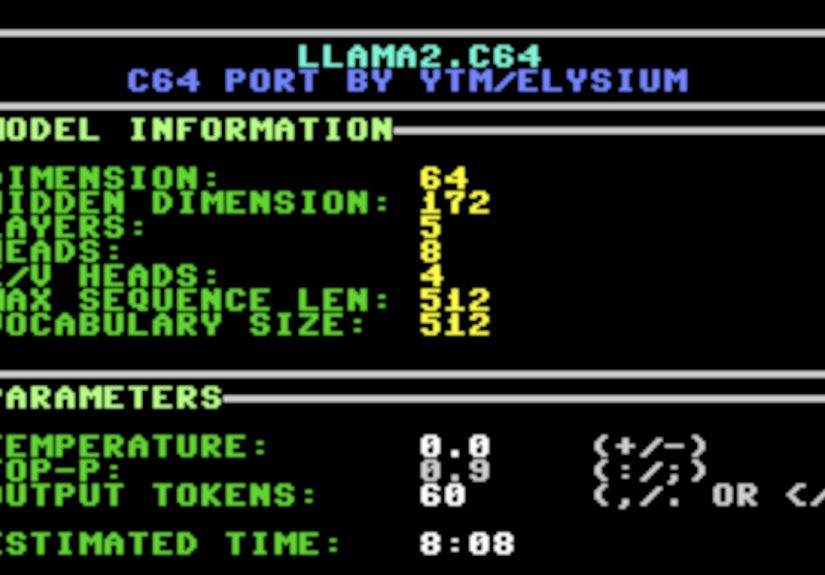
Llama2.c64, a port of a tiny LLaMA-style model to the Commodore 64.
Instead of trying to cram a multi-billion-parameter chat model into 64KB of RAM
(spoiler: you can’t), the author selected a much smaller
“TinyStories”-type model with around 260K parameters and then
leaned on expanded memory hardware to make it all work.
That “kinda” in the Hackaday headline is doing some polite heavy lifting.
This isn’t a full, general-purpose large language model that you can interrogate
about quantum physics or your tax return. Think of it more as a super-compact,
story-focused network that can generate simple, child-like narratives when
prompted with a short text seed.
Under the Hood: Llama2.c64 and the REU
To pull this off, the project relies on a C64 paired with at least a
2MB RAM Expansion Unit (REU). That expansion isn’t optional;
it acts as external storage for the model weights and intermediate data that
would otherwise never fit in 64KB.
The core of the project is a C port of a minimal LLaMA-style inference engine,
tuned and compiled for the 6510 CPU. The REU is used as a kind of slow, external
memory pool: the C64 pulls chunks of parameters from the REU as it computes,
shuffling tensors around one careful step at a time. This is not high-performance
GPU computing; this is “I will fetch a few bytes, crunch on them, and then go
get a few more” computing.
The result is an offline text generator for the C64 that behaves
like a very small language model. You give it a beginning of a story, and it
continues in simple, sometimes repetitive, but surprisingly coherent English,
much like a young child telling a story out loud. Because the model is so tiny,
its vocabulary and world knowledge are extremely limited, but that’s part of the
charm: it feels like your old 8-bit machine has learned a party trick.
How Does It Compare to “Real” LLMs?
If you’re used to interacting with large models on modern hardware, the
C64 version will feel… slow. Each token can take seconds to appear, and
the generated text is short and simple. There’s no fancy chat interface,
no streaming from a cloud API, and no ability to casually switch tasks
or answer arbitrary questions about the world.
But that’s precisely why the project is interesting. It highlights the
core of what a language model is: a giant probability machine that
picks the next token in a sequence based on the previous ones. Strip away
the huge context windows, embeddings, and sophisticated tooling, and you
still have the same basic idea running on hardware that predates the web,
cell phones, and even most people reading this article.
More importantly, this project isn’t about building a useful
assistant on the C64. It’s about pushing boundaries, understanding the
constraints, and appreciating how far optimization, quantization, and
clever memory management can go when you really want to run AI on
ultra-low-resource devices.
Why Retro-AI Experiments Matter
At first glance, “LLM on a C64” sounds like a novelty hack
a fun weekend project for retro nerds. But there’s a deeper story here:
these experiments are a kind of living laboratory for
understanding AI efficiency.
Real-world deployments already need models that can fit into
small microcontrollers, edge devices, and embedded systems. Tiny models
power smart keyboards, on-device assistants, and IoT sensors that need
to be fast, cheap, and battery-friendly. When you make something work
on a 1 MHz 8-bit CPU, you’re exploring the extreme edge of that design
space.
Projects like Llama2.c64 also reinforce a valuable lesson: not every
use case needs a giant model. A toy story generator, a simple code helper,
or a pattern recognizer can sometimes do its job with a tiny network and
some clever engineering. Retro hardware just makes those trade-offs
impossible to ignore.
Other Ways AI Is Sneaking Onto the C64
Llama2.c64 isn’t the only attempt to blend AI and the Commodore 64.
Some modern setups use the C64 more as a front end while most of the heavy lifting
happens on a contemporary machine. For example, hobbyist projects have connected
the C64 to external servers or tools like LM Studio, effectively turning the
breadbox into a vintage terminal for modern large language models.
In those configurations, the C64 sends prompts over a serial or network link and
receives AI-generated text back. It’s not “running” the model locally, but it does
recreate the experience of chatting with a modern AI through a retro interface.
You still get the chunky fonts, the blue background, and the whirr of drives
while the magic happens somewhere else in the chain.
You can see similar spirit in other extreme AI builds, like a
multi-million-parameter model constructed entirely inside
Minecraft using redstone circuits. That project also sacrifices speed and
practicality in favor of a mind-blowing demonstration of what’s possible
when you take AI out of its usual comfort zone and drop it into a constrained,
playful environment.
Engineering Around Brutal Constraints
Running a tiny LLM-style model on the C64 requires a whole set of tricks
that feel alien to most modern developers:
-
Extreme quantization: Weights and activations must be
hashed down to very compact formats so they fit into limited memory and can
be processed efficiently by an 8-bit CPU. -
Careful memory banking: With the REU acting as a slow
external memory pool, code must explicitly swap banks, fetch data, and
avoid unnecessary copies or temporary buffers. -
Sequential, not parallel: There are no SIMD instructions,
no GPU, and no threading. Everything happens one instruction at a time, so
the code is tuned to minimize multiplications and memory accesses. -
Simplified architecture: The model architecture itself is
pared downfewer layers, tiny hidden sizes, and a limited vocabulary to keep
parameter counts manageable.
That kind of painstaking optimization is reminiscent of classic demoscene work:
squeezing every cycle out of the hardware to do something everyone assumed was
impossible. The fact that the “impossible” trick is now a tiny language model
instead of a sprite tunnel or a chiptune only makes it more fascinating.
What You Can Actually Do With a C64 LLM
Let’s set expectations: you’re not going to run a productivity workflow,
summarize PDFs, or generate marketing copy on your Commodore 64. The model is
too small, the hardware is too slow, and the interface is too basic for that.
What you can do is:
-
Prompt the model with the beginning of a fairy tale and watch it spin out
a short, simple continuation. -
Experiment with different prompts to see how a tiny network “thinks” about
the next word in a sequence. -
Use it as a teaching tool to explain what language models are and how they
differ from traditional rule-based programs or Markov chains. -
Show off at meetups: “Yes, that’s a real Commodore 64 generating text from
a neural network. No, I’m not kidding.”
In other words, it’s a playground. A wonderfully nerdy one, but a playground
nonetheless. And for many enthusiasts, that’s more than enough reason to build it.
From Breadbox to Big Picture: Why This Hack Resonates
The LLM-on-C64 story resonates for a few reasons:
-
Nostalgia meets futurism: It welds childhood hardware to
cutting-edge AI, compressing forty-plus years of computing history into a
single demo. -
Proof of possibility: It shows that language models can be
shrunk, pruned, and optimized far beyond what most people assume is practical. -
Educational value: It’s an ideal way to teach both AI and
low-level computing, because you can literally see how far you have to bend
the system to make it work. -
Inspiration for tiny AI: It nudges developers toward designs
that prioritize efficiency and simplicityqualities that are crucial for
sustainable, scalable AI deployment.
In an era when most discussion around LLMs focuses on ever-larger models,
cloud scaling, and GPU shortages, this kind of project is a welcome reminder
that there is also joyand serious technical valuein going small.
Experiencing “LLM on a C64” Firsthand
So what does it feel like to actually use something like Llama2.c64?
Imagine this: you power on your Commodore 64, the familiar blue screen appears,
and instead of typing in a BASIC game from a magazine, you load up a program
that claims it can make the computer “write stories.”
You type a short prompt: ONCE UPON A TIME THERE WAS A LITTLE ROBOT.
The drive chatters, the CPU churns, and you wait. A few seconds later, the C64
prints the next word. Then another. Then another. One line at a time, your
vintage machine starts telling a story about a little robot who wants to learn,
gets scared, makes friends, and walks into the sunset. The vocabulary is simple,
the grammar occasionally odd, but the overall flow is recognizable. It’s like
watching a three-year-old improvise a bedtime story through a 40-column screen.
The pace is slow enough that you become acutely aware of every token. On a
modern laptop, language model tokens appear fast enough that you barely think
about the underlying math. On the C64, each word feels earned. You can almost
hear the matrix multiplications as the drive light flickers and the
REU quietly shuffles data in the background.
That deliberate slowness changes your relationship to the model. Instead of
hammering out 20 prompts in a minute, you craft one good prompt and then sit
with it. You experiment with tiny variations: “a brave robot” versus “a shy
robot,” or “in space” versus “in a small town.” You start to notice how much
influence the opening phrase has on the overall narrative when the model and
context window are this small. It becomes less like chatting with an assistant
and more like tuning an old analog synthyou’re nudging a fragile system to
behave just the way you want.
You also bump into the model’s limitations quickly. Ask it anything too abstract,
and it veers into nonsense or loops. Try to push for long stories, and it may
drift, repeating phrases or degenerating into word salad. Instead of being
frustrated, though, many hobbyists find that boundary itself fascinating.
You’re literally exploring the edge of what a microscopic language model can
do when it’s trapped inside 1980s constraints.
The most surprising part might be the emotional response. When a modern
cloud-hosted LLM makes a mistake, you might shrug. When your C64 stumbles
through a story, you almost feel proud of it. It’s like watching a
toddler take its first steps or a classic car finally start after a long
restoration. Rationally, you know the “intelligence” is just math on bits,
but subjectively, it feels like your old computer has learned a brand-new
trick decades after it left the factory.
For many retro fans, that’s the real payoff. Not the practicality, not the
benchmarks, but the experience of bridging eras: connecting a machine built
for BASIC and floppy disks to the age of neural networks and generative text.
You end up with a deeper appreciation for both sidesthe raw, minimal hardware
of the C64 and the sophisticated algorithms that now run atop it, one CPU
cycle at a time.
Conclusion: A Tiny Model With a Big Story
“LLM Ported To The C64, Kinda” is not about turning your Commodore 64 into
a modern AI assistant. It’s about curiosity, constraint, and craft. By cramming
a tiny LLaMA-style model into a 1 MHz, 8-bit machine with a memory expansion,
the project manages to do something that is technically unnecessary but
intellectually delightful.
In the process, it reminds us that:
- Language models don’t have to be huge to be interesting.
- Extreme constraints can lead to elegant, educational designs.
- There’s still room in modern AI for play, experimentation, and nostalgia.
Whether you’re a retro-computing fan, an AI researcher, or just someone who likes
seeing ridiculous ideas actually work, this hack is a perfect intersection of
past and future. The C64 may never have been designed for neural networks, but
with the right model, a clever port, and a generous REU, it can still tell
stories in ways that would have blown 1982’s mind.