Table of Contents >> Show >> Hide
- A Century of Speed, Skill, and Silver-Armed History
- Picture One: Montreal 2007 The Rookie Becomes a Winner
- Picture Two: Indianapolis 2007 The Teammate Battle Goes Global
- Picture Three: Silverstone 2008 Rain, Roar, and a Masterclass
- Picture Four: Interlagos 2008 The Champion in the Last Corner
- Picture Five: Hungary 2009 Winning Through a Rough Season
- Picture Six: Canada 2010 Hamilton the Street-Fighter
- Picture Seven: Austin 2012 A Win Before a Major Leap
- Picture Eight: Hungary 2013 The First Mercedes Win
- Picture Nine: 2014 The Turbo-Hybrid Era Begins
- Picture Ten: 2015 A Champion Finds Cruise Control
- Picture Eleven: 2016 Rivalry at Boiling Point
- Picture Twelve: 2017 and 2018 The Vettel-Ferrari Fight
- Picture Thirteen: 2019 The Machine Keeps Winning
- Picture Fourteen: 2020 Records Fall in a Strange World
- Picture Fifteen: 2021 The Road to 100
- Why Lewis Hamilton’s First 100 Wins Matter
- The Best “Picture Captions” From Hamilton’s First 100 Wins
- Experiences and Reflections: What Hamilton’s First 100 Wins Feel Like as a Formula 1 Story
- Conclusion: A Gallery That Redefined Formula 1 Greatness
Editorial note: This feature is written as a picture-led storytelling article, using vivid scene descriptions and caption-style moments rather than reproducing copyrighted race photos.
A Century of Speed, Skill, and Silver-Armed History
Lewis Hamilton’s first 100 Formula 1 wins are not just numbers on a statistics sheet. They are snapshots: a rookie grinning in Montreal, a young champion skating through rain at Silverstone, a Mercedes driver turning Sundays into silverware, and finally a veteran in Sochi making history while the sky threw one last dramatic plot twist over the track.
When Hamilton won the 2021 Russian Grand Prix, he became the first Formula 1 driver to reach 100 career Grand Prix victories. That sentence sounds simple, almost polite. In reality, it is a mountain wearing racing gloves. Formula 1 has been around since 1950, and for decades the idea of 100 wins felt like something from a motorsport fairy tale. Then Hamilton arrived, pressed the accelerator, and apparently forgot to stop collecting trophies.
This visual journey through Lewis Hamilton’s first 100 F1 wins follows the most important images behind the milestone: the cars, circuits, rivalries, weather chaos, team calls, tire gambles, emotional radio messages, and podium celebrations that built one of the greatest careers in sporting history.
Picture One: Montreal 2007 The Rookie Becomes a Winner
Canadian Grand Prix, Win No. 1
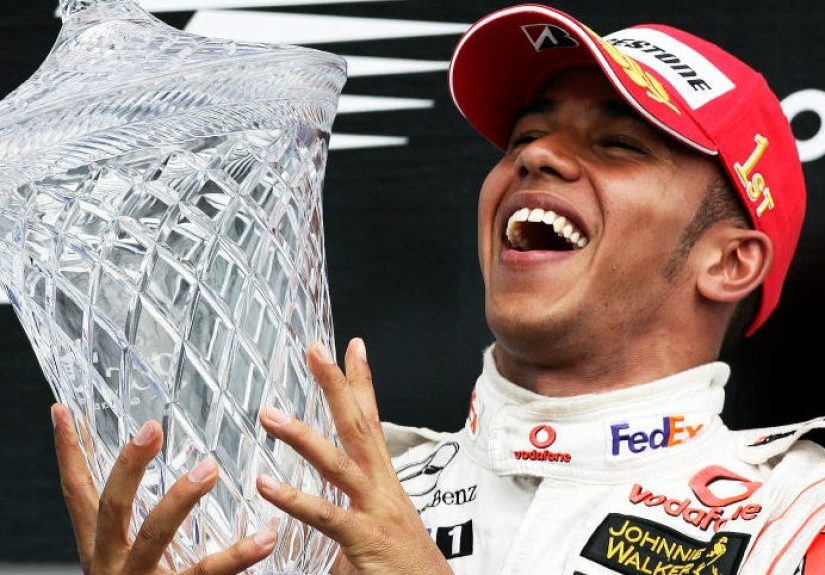
If Hamilton’s first victory were a photograph, it would show a 22-year-old McLaren driver standing on top of the world and trying very hard not to look like he had just shaken Formula 1 by the shoulders. The 2007 Canadian Grand Prix at Circuit Gilles Villeneuve was only his sixth F1 start, yet Hamilton drove with the confidence of someone who had misplaced the memo about rookie nerves.
Starting from pole, he controlled a messy race filled with safety cars and interruptions. Around him, chaos kept knocking on the door, but Hamilton stayed calm, clean, and fast. The win announced him as more than a promising young driver. It made him a problem for everyone else on the grid.
That first image matters because it captures the beginning of a pattern. Hamilton did not win by luck or by simply having a strong car. He won by managing pressure, reading the race, and staying sharp when others blinked. In hindsight, Montreal 2007 looks less like a surprise and more like a trailer for the next decade and a half.
Picture Two: Indianapolis 2007 The Teammate Battle Goes Global
United States Grand Prix, Win No. 2
Hamilton’s second victory came one race later at the 2007 United States Grand Prix. The defining image is not just Hamilton crossing the line. It is Hamilton holding off Fernando Alonso, the reigning double world champion and his McLaren teammate. That was not supposed to happen so quickly. New drivers were expected to learn, smile politely, and wait their turn. Hamilton brought his own timetable.
The win gave fans an early look at one of Hamilton’s signature qualities: he could fight elite drivers wheel-to-wheel without treating the moment like a museum exhibit. He belonged in the fight. He knew it. Soon, everyone else did too.
Picture Three: Silverstone 2008 Rain, Roar, and a Masterclass
British Grand Prix, Win No. 5
Some wins look good in photographs. Hamilton’s 2008 British Grand Prix win looks like cinema. Heavy rain soaked Silverstone, cars tiptoed across standing water, and the home crowd watched Hamilton produce one of the finest wet-weather drives modern Formula 1 has seen.
The picture here is Hamilton’s McLaren slicing through spray while the rest of the field appears to be negotiating with gravity. He won by more than a minute, which in Formula 1 terms is not a victory margin so much as a polite demolition notice. The race became a defining part of the Hamilton legend: fast in the dry, magical in the wet, and somehow more comfortable when the conditions looked completely unreasonable.
That Silverstone performance also added emotional weight to his career. Winning at home in Britain would become one of Hamilton’s specialties, but the first home win had a particular electricity. It was the day the crowd saw a future world champion drive like he had borrowed the weather from a superhero movie.
Picture Four: Interlagos 2008 The Champion in the Last Corner
Brazilian Grand Prix, Title-Defining Moment
The 2008 Brazilian Grand Prix was not one of Hamilton’s 100 race wins, but no picture journey can ignore it. His first world championship was sealed in one of the most dramatic finishes in sports history. On the final lap, at the final corner, Hamilton gained the position he needed to become world champion by a single point.
The image is unforgettable: rain falling, Ferrari fans celebrating too early, McLaren tension exploding into relief, and Hamilton becoming the youngest world champion at that time. It proved something important about his wins that followed. Hamilton’s career was never just about raw pace. It was about surviving pressure that could turn a steering wheel into a stress test.
Picture Five: Hungary 2009 Winning Through a Rough Season
Hungarian Grand Prix, Win No. 10
Not every Hamilton victory came from a dominant season. The 2009 Hungarian Grand Prix showed his ability to find gold in a difficult year. McLaren had started the season off the pace, but upgrades slowly brought the car back toward competitiveness. At the Hungaroring, Hamilton took advantage.
The photo in your mind: a silver-and-red McLaren that had looked ordinary earlier in the year suddenly looking alive again. Hamilton’s win was a reminder that great drivers do not vanish when the car is imperfect. They wait, push, develop, and pounce when opportunity arrives. In a career full of dominant Sundays, Hungary 2009 remains valuable because it shows resilience.
Picture Six: Canada 2010 Hamilton the Street-Fighter
Canadian Grand Prix, Win No. 12
Hamilton and Montreal have always had a special relationship. The Circuit Gilles Villeneuve rewards commitment, late braking, and a willingness to flirt with walls like they owe you money. Hamilton’s 2010 Canadian Grand Prix win captured his aggressive but calculated racing style.
This was Hamilton in his McLaren prime: sharp elbows, fearless overtaking, and enough confidence to make every braking zone feel like a personal invitation. The image is not of domination but of attack. In the early part of his career, Hamilton built his reputation as one of the grid’s most exciting racers because he could make a Grand Prix feel unstable in the best possible way.
Picture Seven: Austin 2012 A Win Before a Major Leap
United States Grand Prix, Win No. 21
The 2012 United States Grand Prix at the new Circuit of the Americas gave Hamilton one of his most stylish McLaren victories. He chased down Sebastian Vettel and passed him to win, delivering a thrilling race for American fans as Formula 1 returned to the U.S. with fresh energy.
The image is Hamilton’s McLaren closing on the Red Bull, the Texas track rising and falling beneath them, and a driver preparing for a career-changing decision. At the end of 2012, Hamilton left McLaren for Mercedes. At the time, some critics treated the move like a risky career detour. Looking back, it was more like switching from a bicycle to a rocket factory before everyone else noticed the rocket factory had been built.
Picture Eight: Hungary 2013 The First Mercedes Win
Hungarian Grand Prix, Win No. 22
Hamilton’s first win for Mercedes came at the 2013 Hungarian Grand Prix. That victory is one of the most important images in the whole collection because it marks the bridge between two careers: Hamilton the McLaren prodigy and Hamilton the Mercedes record-breaker.
Mercedes was not yet the unstoppable force it would become in the turbo-hybrid era. The car had speed, but tire management was a concern. Hamilton made it work, controlling the race and proving that his move to Mercedes had immediate promise. The picture is Hamilton on the podium in Mercedes colors, smiling as if he knew something the rest of Formula 1 was about to learn the hard way.
Picture Nine: 2014 The Turbo-Hybrid Era Begins
From Malaysia to Abu Dhabi
The 2014 season changed everything. Formula 1 introduced turbo-hybrid power units, and Mercedes nailed the new regulations. Hamilton turned that opportunity into a championship campaign filled with decisive wins, including Malaysia, Bahrain, China, Spain, Britain, Italy, Singapore, Japan, Russia, the United States, and Abu Dhabi.
The visual theme of 2014 is silver dominance under bright lights. Hamilton’s duel with teammate Nico Rosberg gave the season tension, but Hamilton’s race craft and late-season momentum carried him to his second world title. The Abu Dhabi finale, with double points adding unnecessary spice to the championship stew, ended with Hamilton victorious and champion again.
This was the season when Hamilton’s win total stopped looking impressive and started looking historic. The Mercedes partnership gave him the machinery, but Hamilton supplied the relentless execution.
Picture Ten: 2015 A Champion Finds Cruise Control
Third World Championship Season
Hamilton’s 2015 campaign was smooth, confident, and ruthless. Wins in Australia, China, Bahrain, Canada, Britain, Belgium, Italy, Japan, Russia, and the United States helped him secure his third world championship.
The most iconic image from 2015 may be Austin, where Hamilton clinched the title after a dramatic race and a tense battle involving Rosberg. By then, Hamilton had become a complete driver: fast over one lap, consistent over a race distance, politically sharper within the team, and emotionally connected to a growing global fanbase.
For SEO-friendly history lovers searching for “Lewis Hamilton first 100 Formula 1 wins,” 2015 is a key chapter. It is where the accumulation becomes undeniable. Hamilton was no longer chasing greatness. He was living inside it.
Picture Eleven: 2016 Rivalry at Boiling Point
Winning While Losing the War
Hamilton won 10 races in 2016, more than any other driver that season, yet lost the championship to Nico Rosberg. That fact alone tells you how strange and intense the year was. Reliability issues, slow starts, and intra-team pressure shaped the campaign.
The mental picture is Hamilton standing on the top step again and again, while the championship math refused to behave. Wins in Monaco, Canada, Britain, Hungary, Germany, the United States, Mexico, Brazil, and Abu Dhabi showed his pace remained extraordinary. His wet-weather win in Brazil was especially brilliant, another reminder that rain often turns Hamilton from great to almost unfair.
Even without the title, 2016 added depth to the first 100 wins. It showed that victories are not always enough in Formula 1. Timing, reliability, and tiny margins can rewrite an entire season.
Picture Twelve: 2017 and 2018 The Vettel-Ferrari Fight
Hamilton Becomes the Modern Benchmark
The 2017 and 2018 seasons gave Hamilton a fresh rival: Sebastian Vettel in a resurgent Ferrari. These were not simple Mercedes parades. Ferrari often had the pace to challenge, and Vettel led parts of both campaigns. Hamilton responded with some of the most mature racing of his career.
In 2017, his wins in places like Canada, Britain, Belgium, Italy, Singapore, Japan, and the United States helped him secure a fourth championship. In 2018, he won in Azerbaijan, Spain, France, Germany, Hungary, Italy, Singapore, Russia, Japan, and Brazil. The Germany and Italy victories were especially symbolic because Hamilton won on days when Ferrari expected to shine.
The picture here is Hamilton standing on rival territory, turning red celebrations into silver silence. These seasons showed his ability to combine patience with punishment. If Ferrari made a mistake, Hamilton rarely needed a second invitation.
Picture Thirteen: 2019 The Machine Keeps Winning
Sixth World Championship
By 2019, Hamilton’s winning had become so frequent that the extraordinary risked feeling normal. That is one of the hazards of greatness: people start treating magic like a calendar appointment.
Hamilton won 11 races in 2019, including Bahrain, China, Spain, Monaco, Canada, France, Britain, Hungary, Russia, Mexico, and Abu Dhabi. His Monaco victory, following the death of Niki Lauda, carried deep emotion for Mercedes. His British Grand Prix win extended his love affair with Silverstone. His Hungary performance showed his strategic intelligence, as Mercedes used tire strategy to chase down Max Verstappen late in the race.
The image is Hamilton in full command: measured, fast, experienced, and surrounded by a Mercedes operation that understood how to turn small advantages into big Sundays.
Picture Fourteen: 2020 Records Fall in a Strange World
From Win No. 85 to Win No. 95
The 2020 Formula 1 season unfolded under unusual global circumstances, with revised calendars, empty or limited grandstands, and strict protocols. Hamilton still turned it into one of his finest campaigns.
At the Eifel Grand Prix, he matched Michael Schumacher’s record of 91 wins. At the Portuguese Grand Prix, he broke it with victory No. 92. That image belongs in any gallery of Hamilton’s first 100 wins: a driver crossing into territory no one had reached before, making the impossible look tidy.
Then came Turkey 2020, where Hamilton delivered another wet-weather masterpiece to clinch his seventh world championship, tying Schumacher’s title record. The track was slippery, the conditions were unpredictable, and the race demanded patience. Hamilton managed his tires beautifully and won by a huge margin. The picture is a black Mercedes gliding through chaos while everyone else tries to solve the puzzle in real time.
Picture Fifteen: 2021 The Road to 100
Wins No. 96 to No. 100
The 2021 season brought Hamilton into a fierce championship fight with Max Verstappen. Red Bull was strong, Verstappen was relentless, and Mercedes no longer enjoyed the same cushion it had in earlier years. That made Hamilton’s wins feel different. They were harder, sharper, and more contested.
Hamilton won in Bahrain, Portugal, Spain, Britain, and Russia before reaching his 100th victory. Bahrain was a tactical defensive drive against Verstappen. Portugal showed Hamilton’s clean race pace. Spain highlighted strategy and tire management. Britain was dramatic and controversial after the first-lap collision with Verstappen, followed by Hamilton chasing down Charles Leclerc for victory.
Then came Russia. Sochi began dry and ended wet, which is Formula 1’s way of saying, “Please enjoy this stress buffet.” Lando Norris looked set for his first win, but late rain changed everything. Hamilton and Mercedes chose intermediate tires at the right moment. Norris stayed out too long, lost grip, and Hamilton swept through to win.
The 100th victory image is layered with emotion: Hamilton crossing the line, Mercedes celebrating, Norris heartbroken, Verstappen recovering from the back to second, and history clicking into place. It was not Hamilton’s cleanest or most dominant win, but it was fitting. A century in Formula 1 should not arrive gift-wrapped. It should come with pressure, risk, timing, rain, and a reminder that even legends still need to make the right call at the right second.
Why Lewis Hamilton’s First 100 Wins Matter
Hamilton’s first 100 Formula 1 wins matter because they stretch across eras. He won in V8 McLarens, early hybrid Mercedes cars, dominant championship machines, and pressure-heavy seasons against elite rivals. He won in Canada, Britain, Hungary, Italy, Germany, Japan, Brazil, the United States, Russia, Turkey, and many more. He won from pole, from strategy, in the rain, under safety cars, against teammates, against champions, and sometimes against the mood of the entire paddock.
His first 100 wins also changed what Formula 1 records could look like. For years, Schumacher’s 91 wins stood as the sport’s towering benchmark. Hamilton did not merely reach it; he moved beyond it and then became the first driver to enter triple digits. That reshaped the statistical imagination of F1.
But the story is bigger than numbers. Hamilton’s career brought new audiences to Formula 1. As the sport’s first Black driver, he also became a cultural figure beyond racing. His success, activism, fashion presence, and global celebrity made him one of the most recognizable athletes in the world. Whether fans loved him, doubted him, debated him, or argued about him online with the energy of people defending family recipes, Hamilton became impossible to ignore.
The Best “Picture Captions” From Hamilton’s First 100 Wins
1. Montreal 2007: The Smile of a Rookie Who Knows
A young Hamilton on the podium, McLaren cap in place, realizing his first F1 win has arrived earlier than almost anyone expected.
2. Silverstone 2008: Spray, Speed, and Silence
The British crowd watches Hamilton dominate the rain so completely that the race feels like a personal driving lesson for the entire grid.
3. Hungary 2013: Mercedes Belief Begins
Hamilton celebrates his first Mercedes victory, a moment that now looks like the opening scene of a record-breaking partnership.
4. Abu Dhabi 2014: Champion Again
Hamilton stands under the lights as a two-time world champion, confirming that his move to Mercedes was not a gamble but a masterstroke.
5. Portugal 2020: Record Breaker
Win No. 92 places Hamilton alone at the top of the all-time victory list, passing Schumacher and entering new territory.
6. Turkey 2020: Seven Titles in the Wet
A drenched Istanbul Park becomes the stage for Hamilton’s seventh championship and one of the finest tire-management drives of his career.
7. Russia 2021: The Century
Hamilton wins No. 100 after late rain transforms the race, proving that history sometimes arrives wearing intermediate tires.
Experiences and Reflections: What Hamilton’s First 100 Wins Feel Like as a Formula 1 Story
Watching Lewis Hamilton’s first 100 wins as a long-form Formula 1 story feels like flipping through a photo album where the background keeps changing but the central character keeps finding the top step. At first, the images feel fresh and surprising. The rookie in 2007 looks almost too young to be carrying that much expectation. Every podium grin has the brightness of discovery. Then, as the seasons unfold, the tone changes. The wins become heavier. They carry championship consequences, rivalry tension, and the weight of records that once seemed unreachable.
For many fans, the most memorable experience is not simply seeing Hamilton win. It is seeing how different each win can feel. A dominant victory is satisfying in one way, like watching an expert chef make a perfect omelet without breaking eye contact. A wet-weather victory is different. It feels fragile, dramatic, and slightly unreasonable. Hamilton’s best rain drives have a special electricity because the car seems to move with more confidence than the conditions should allow.
Another experience tied to Hamilton’s first 100 wins is the sound of strategy. Formula 1 is visual, but Hamilton’s career is also full of radio moments: calm instructions, tense tire discussions, emotional thanks, and occasional frustration. His victories often show how modern F1 is a team sport disguised as a solo performance. The driver is the face in the photograph, but behind that image are engineers, mechanics, strategists, tire specialists, simulator crews, and pit-wall decisions that can make or break a race in seconds.
Hamilton’s first 100 wins also teach patience. Fans sometimes remember the highlight pass or the champagne spray, but many wins were built slowly. He protected tires, managed gaps, waited for pit windows, and trusted strategy even when it looked uncomfortable. The casual viewer sees speed; the experienced fan sees timing. That is why the Russian Grand Prix in 2021 is such a fitting 100th victory. It was not just about pace. It was about reading changing weather, listening to the team, and making a call before the opportunity disappeared.
There is also a human side to the journey. Hamilton has been celebrated, criticized, doubted, praised, booed, adored, and analyzed from every possible angle. Through it all, the wins kept arriving. That consistency is easy to underestimate because television turns elite performance into weekly entertainment. But winning even one Formula 1 race requires rare talent, engineering excellence, and a weekend where hundreds of details align. Winning 100 requires a career of astonishing durability.
For younger fans discovering Hamilton through highlight reels, the first 100 wins can feel like legend. For long-time fans, they feel like chapters from Sundays they actually lived through: the rainy afternoons, early alarms, late-night races, controversial moments, and group chats exploding after a safety car. That is the real beauty of “Lewis Hamilton’s First 100 Formula 1 Wins in Pictures.” It is not only Hamilton’s history. It is also a shared memory bank for a generation of Formula 1 viewers.
In the end, Hamilton’s century of victories is best understood not as one giant statistic, but as a gallery. Some pictures are polished. Some are soaked. Some are controversial. Some are joyful. Some are painful for rivals. Together, they show a driver who turned talent into discipline, opportunity into dominance, and race wins into a record that changed Formula 1 forever.
Conclusion: A Gallery That Redefined Formula 1 Greatness
Lewis Hamilton’s first 100 Formula 1 wins form one of the most remarkable collections in sports history. From Montreal 2007 to Sochi 2021, the journey covers rookie brilliance, championship drama, Mercedes dominance, wet-weather genius, tactical intelligence, and record-breaking ambition.
The phrase “Lewis Hamilton’s first 100 Formula 1 wins in pictures” suggests a simple visual tribute, but the deeper story is about evolution. Hamilton grew from a fearless newcomer into a complete racing driver who could win in almost every possible way. His first 100 victories are not just proof of speed. They are proof of adaptability, resilience, and sustained excellence across changing cars, rules, rivals, and eras.
Formula 1 records are made to be chased, but Hamilton’s century changed the scale of the chase. It gave the sport a new summit and gave fans a gallery of moments that will be replayed for decades. And somewhere in that gallery, between the spray of Silverstone and the rain of Sochi, sits the clearest picture of all: Lewis Hamilton did not simply collect wins. He changed what winning in Formula 1 could mean.