Table of Contents >> Show >> Hide
- What Makes Jupiter’s Moon Io So Wild?
- Why Io Has So Many Volcanoes
- A Surface Painted by Sulfur, Frost, and Fire
- The Volcanoes Are Not Just Active. They Are Absurd.
- Io’s Thin Atmosphere Is Barely Hanging On
- Why Scientists Love This Nightmare Moon
- How Io Compares to Earth’s Volcanoes
- What Future Exploration Could Reveal
- The Experience of Thinking About Io: 500 Extra Words of Pure Planetary Awe
- Conclusion
Some moons inspire poetry. Io inspires emergency evacuation plans. Jupiter’s moon Io is the kind of place that makes Earth’s volcanoes look like they are politely clearing their throats. It is the most volcanically active world in the solar system, a battered, blistering moon where lava lakes simmer, sulfur compounds paint the landscape in yellows, reds, blacks, and ghostly whites, and the ground is constantly rewritten by eruptions. If the solar system were a neighborhood, Io would be the house with flames in the windows, weird smoke in the yard, and a sign that says, “Do not knock unless you are a spacecraft built by NASA.”
Yet Io is not just cosmic nightmare fuel. It is also one of the most scientifically valuable places in our planetary backyard. By studying this volcanic moon, scientists learn how tidal heating works, how planetary interiors move heat, how surfaces get resurfaced, and how entire worlds can remain geologically furious for billions of years. Thanks to missions like Voyager, Galileo, New Horizons, and especially Juno, we now know that Io is not just a dramatic world. It is a full-blown geological opera, and every act involves fire.
What Makes Jupiter’s Moon Io So Wild?
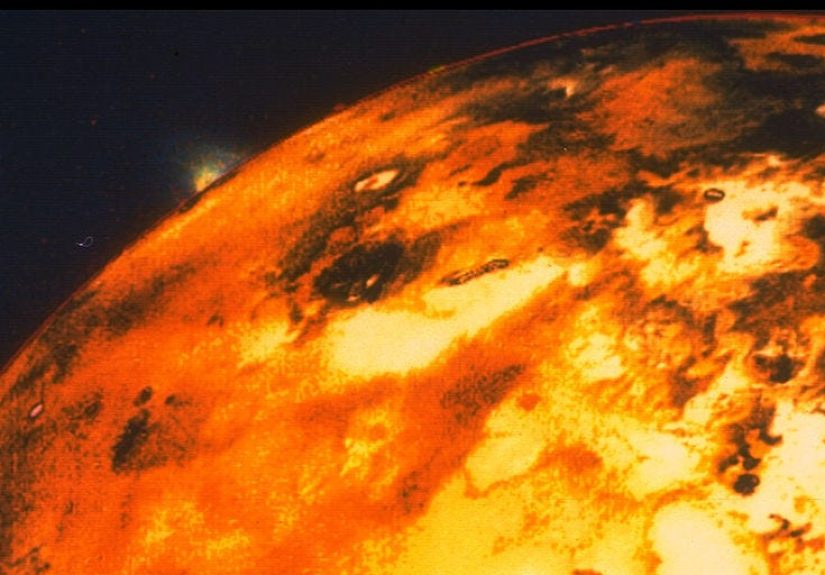
Io is the innermost of the four large Galilean moons of Jupiter, and it was first observed in 1610. It is only a little larger than Earth’s moon, but the similarities mostly stop there. Earth’s moon is quiet, gray, and ancient-looking. Io looks like someone spilled mustard, rust, charcoal, and molten metal across a pizza stone and then launched the whole thing into Jupiter’s orbit.
The biggest reason Io looks so outrageous is simple: it is geologically hyperactive. While many moons preserve impact craters like old scars, Io barely keeps any. Its surface is constantly renewed by lava flows, volcanic deposits, and sulfur-rich frost. In plain English, Io keeps repainting itself before the dents can stick around.
This resurfacing creates a landscape filled with broad plains, lava flow fields, towering mountains, and giant volcanic depressions called paterae. One of the most famous is Loki Patera, a massive lava lake that has long fascinated scientists because of its size, heat, and changing brightness. Another star of the show is Pele, surrounded by dramatic reddish deposits that make Io look like it lost a paintball fight with a fire god.
Why Io Has So Many Volcanoes
Tidal Heating: The Ultimate Cosmic Stress Ball
Io’s volcanic madness is powered by tidal heating. This is the main keyword to remember if you want to sound smart at dinner or terrify your astronomy club in a very informed way. Io orbits incredibly close to Jupiter, and Jupiter’s gravity squeezes the moon hard. But Jupiter is not acting alone. Europa and Ganymede also tug on Io in a repeating orbital rhythm, keeping Io’s orbit slightly stretched instead of letting it settle into a neat circle.
That tiny orbital oddity has enormous consequences. As Io moves closer to and farther from Jupiter during its orbit, the moon is flexed over and over again. Its interior is bent, squeezed, relaxed, and bent again, much like a paper clip that heats up when you keep twisting it. Only in Io’s case, the “paper clip” is an entire moon, and the heat generated is enough to melt rock beneath the surface and feed nonstop volcanism.
That is why Io has hundreds of volcanoes, active lava fields, and widespread evidence of molten material beneath the crust. Recent findings from NASA’s Juno mission have added an especially interesting twist: Io may not have a shallow global magma ocean after all. Instead, it appears to move heat in a more complex way, with magma, lava fields, and subsurface warmth distributed across the moon like a planet-sized radiator system. So yes, Io is still infernal, but it may be infernal with more plumbing complexity than scientists once thought.
A Surface Painted by Sulfur, Frost, and Fire
One of the strangest things about Io is how colorful it is. This is not a soft, tasteful pastel world. It is loud. Its surface includes yellows, oranges, reds, browns, blacks, and white-gray patches. Much of that palette comes from sulfur and sulfur dioxide, which are released by volcanic activity and then settle back onto the surface.
Some active plumes on Io eject material that later falls like exotic frost or “snow,” except this is not the charming kind that inspires cocoa and holiday music. On Io, sulfur dioxide can condense in the near-vacuum and settle around vents, producing bright white deposits. Other sulfur-rich materials create red and yellow stains that spread around volcanic centers like the moon is leaking chemistry experiments.
And then there is the lava. Io’s eruptions are not just decorative. Some observed lava temperatures have likely exceeded the hottest basaltic eruptions on Earth today. Scientists studying infrared data from spacecraft have found evidence that some vents on Io erupt silicate lavas at extremely high temperatures, making the moon one of the best places in the solar system to study heat-driven geological processes in overachiever mode.
The Volcanoes Are Not Just Active. They Are Absurd.
Lava Lakes, Giant Plumes, and Constant Change
Calling Io “volcanic” almost undersells it. This is a moon where volcanic plumes can rise dozens of miles high, where lava lakes glow in infrared observations, and where surface features can visibly change between spacecraft flybys. The moon’s volcanoes do not merely erupt; they perform.
NASA’s Juno mission has delivered some of the most exciting modern updates about Io. During close flybys in late 2023 and early 2024, Juno captured detailed views of the surface and its poles, offering fresh data about lava flows, hot spots, and plume activity. Then came an even bigger headline in early 2025: Juno detected a gigantic volcanic hot spot in Io’s southern hemisphere, larger than Lake Superior and releasing extraordinary amounts of energy. That kind of discovery would be dramatic anywhere. On Io, it somehow feels on-brand.
These observations matter because Io is not static even on human timescales. Changes can happen across months, weeks, or possibly faster. A plume appears. A hot region brightens. A flow spreads. A familiar pattern on the surface gets rewritten. Watching Io is a bit like checking in on a very unstable kiln that happens to orbit Jupiter every 1.769 Earth days.
Io’s Thin Atmosphere Is Barely Hanging On
Despite all the volcanic violence, Io has only a very thin atmosphere. It is composed mostly of sulfur dioxide, with trace components mixed in. Volcanoes help supply this atmosphere, but sunlight also plays a starring role in keeping it around. When sulfur dioxide frost on the surface warms up, it sublimates into gas and helps maintain the atmospheric shroud.
Here is where Io gets even weirder. Its atmosphere can partially collapse when the moon passes into Jupiter’s shadow. In darkness, temperatures drop, sulfur dioxide freezes out onto the surface, and the atmosphere thins dramatically. When Io returns to sunlight, the frost turns back into gas and the atmosphere re-inflates. Most worlds have weather. Io has a daily atmospheric vanishing act.
This matters beyond trivia value. Material escaping from Io helps feed the environment around Jupiter, contributing charged particles to the giant planet’s magnetosphere. In other words, Io is not just a chaotic moon minding its own business. It is actively influencing the broader Jovian system.
Why Scientists Love This Nightmare Moon
Io Is a Laboratory for Planetary Science
As hostile as Io is, researchers adore it for good reason. It is one of the best natural laboratories for understanding how worlds evolve under extreme internal heating. On Earth, geology is shaped by plate tectonics, radioactive decay, water, atmosphere, and erosion. On Io, the rules are stripped down and intensified. The moon shows what happens when internal flexing becomes the main engine of surface change.
That makes Io valuable not only for understanding Jupiter’s system, but also for thinking about Europa, Enceladus, distant rocky exoplanets, and other bodies where tidal forces may generate heat beneath the surface. Even when Io seems like the least relaxing destination imaginable, it is teaching scientists some of the biggest lessons in planetary evolution.
Io also helps researchers rethink old assumptions. For years, some models suggested a shallow global magma ocean might be lurking beneath the surface. Juno’s gravity and thermal results have complicated that picture, suggesting a more nuanced interior structure. Meanwhile, new mapping efforts of volcanic heat emissions across the moon are revealing just how globally distributed and persistent the activity really is.
How Io Compares to Earth’s Volcanoes
Earth has famous volcanoes, of course. We have shield volcanoes, stratovolcanoes, calderas, and enough ash-cloud footage to keep documentary channels busy forever. But Earth’s volcanism operates in a world with oceans, weather, atmospheric pressure, and a crust that plays by very different mechanical rules.
Io is the opposite of subtle. There is no thick atmosphere to soften the spectacle. There is no rain to wash ash into muddy valleys. There is no forest to hide the scars. The eruptions interact with vacuum, sulfur compounds, and constant gravitational torture from Jupiter. Even the mountains on Io appear to form through unusual geologic processes unlike the ones that build most mountains on Earth.
So while comparisons to Hawaii, Iceland, or Yellowstone can be useful, Io is not simply “Earth with more volcanoes.” It is a fundamentally different volcanic world. That is why calling it a volcano-ridden hellscape is not just fun SEO language. It is surprisingly close to the scientific vibe.
What Future Exploration Could Reveal
Io remains one of the most compelling targets for future planetary exploration. Scientists want to know exactly how heat is transported from the interior to the surface, how different classes of volcanoes behave, how plume chemistry changes over time, and how Io’s eruptions interact with Jupiter’s magnetic environment.
The proposed Io Volcano Observer mission reflects that excitement. A dedicated mission to Io could answer long-standing questions about tidal heating, magma transport, atmospheric chemistry, and surface change. It could also improve our understanding of how volcanic worlds work beyond Earth, which is the kind of thing that starts as planetary science and ends up influencing how we think about rocky worlds across the galaxy.
In short, Io still has plenty of secrets. And because it keeps changing, every new spacecraft visit is not just a photo opportunity. It is a chance to catch an active world in the middle of rewriting itself.
The Experience of Thinking About Io: 500 Extra Words of Pure Planetary Awe
There is something special about learning about Io that goes beyond memorizing facts. You do not just read about it and nod politely like you would for a perfectly respectable moon covered in ice. Io sticks in your imagination. It barges in, throws molten sulfur on the mental carpet, and refuses to leave. The experience of thinking about Jupiter’s moon Io is half science lesson, half cosmic fever dream.
Imagine seeing it for the first time through the eyes of a spacecraft. Jupiter fills the background like a giant striped storm machine, and in front of it hangs this smaller world that looks bruised, scorched, stained, and alive. Not alive in the biological sense, obviously. More alive in the way a furnace is alive when you open the door and immediately regret all your life choices. Io has that energy.
For astronomy fans, Io offers the rare thrill of a world that feels active right now. Many places in the solar system are beautiful because they preserve the past. Io is beautiful because it seems incapable of calming down. A lava flow here, a plume there, a hot spot glowing in infrared, a fresh stain blooming around a vent. It gives you the feeling that the solar system is not a museum. It is a workshop, and one table in the back is still throwing sparks.
There is also a strange emotional contrast built into Io. From far away, it is just one moon among many, circling a giant planet in the dark. But once you understand what is happening on its surface, that calm celestial picture falls apart. This tiny object is being kneaded by gravity so intensely that rock melts beneath its crust. Its atmosphere freezes and reforms. Its volcanoes can fling material high above the surface. It is both elegant and violent, graceful in orbit and savage in geology.
That combination is what makes Io memorable. It reminds us that nature does not care about our categories of pretty, scary, calm, or chaotic. Sometimes it builds a moon that is all four at once. A photographer sees color. A geologist sees heat flow. A planetary scientist sees a natural experiment in tidal energy. A writer sees a place that sounds like it was designed by a heavy metal album cover artist with a chemistry degree.
Even from Earth, the idea of Io can change the way you look at the night sky. Jupiter stops being just a bright object overhead and starts feeling like the center of a whole working system, with moons that are icy, oceanic, cratered, or, in Io’s case, outrageously volcanic. That is part of the joy of astronomy: learning that the dots in the sky are not abstract. They are real places with weather, chemistry, history, and in some cases, world-class lava drama.
So the experience tied to Io is not only scientific curiosity. It is perspective. Io makes Earth feel both lucky and tame. It makes volcanoes feel bigger, gravity feel stranger, and the solar system feel less like empty space and more like a neighborhood full of wildly different worlds. Some are calm. Some may hide oceans. And one, apparently, woke up and chose fire.
Conclusion
Io earns its reputation honestly. It is the most volcanically active world in the solar system, a moon shaped by relentless tidal heating, resurfaced by lava, painted by sulfur, and still surprising scientists after decades of observation. It is hostile, unstable, and scientifically priceless. The more researchers study it, the clearer one thing becomes: Io is not just a side character in Jupiter’s story. It is one of the most extreme and revealing worlds we have ever seen.
If you want a neat symbol for how weird and wonderful planetary science can be, Io is perfect. It is a moon that looks like an apocalypse and behaves like a laboratory. That is a spectacular combination, even if you absolutely would not want to vacation there.